How to Start a Pedicab Business in 2026: A Complete Step-by-Step Guide
There are very few businesses you can launch for under $45,000, be fully operational within two months, and generate $30,000–$35,000 in annual revenue per vehicle from day one. The electric pedicab business is one of them — and in 2026, it's one of the most overlooked opportunities in urban transportation.
Pedicabs are no longer a novelty act. They're a legitimate commercial transportation business, generating income from three separate revenue streams simultaneously: passenger rides, advertising wraps, and event contracts. The operators who figured this out early are scaling fast. EZ Pedicabs in Kansas City started with 2 cabs in March 2024 and now runs 8 cabs with 20+ drivers — that's 100%+ year-over-year growth — and they recently won a $35,000 prize from AltCap recognizing their impact as a small business.
This guide walks you through every step to start your own pedicab business from scratch. No prior experience required.
---
Step 1: Research Your Local Market
Before you spend a dollar, you need to understand the market you're entering. Not every city supports a commercial pedicab operation equally, and your revenue potential depends heavily on where you operate.
The best pedicab markets share a few characteristics:
- A dense, walkable entertainment district. Think downtown areas with bars, restaurants, music venues, and hotels within a few blocks of each other. People need to be moving short distances in a place where rideshare pickup is inconvenient or slow.
- A tourism economy. Cities with strong visitor traffic — whether from conventions, sports, nightlife, or landmarks — provide steady customer flow, especially on weekends. Tours are one of your highest-margin products.
- Regular events. Concerts, sporting events, festivals, conferences, and parades are where pedicab operators earn their biggest single-day revenues. A city with 50+ major events per year is a significantly better market than one with 10.
- Favorable local regulations. Some cities actively support pedicab operators; others have dense permit requirements or operating restrictions. Research this before committing.
Talk to locals, hotel concierges, and entertainment venue staff. Find out where foot traffic concentrates at night, which events draw the biggest crowds, and whether any pedicab businesses are already operating. Competition isn't necessarily a bad sign — it often validates the market — but you should understand the landscape.
---
Step 2: Choose Your City and Territory
Once you've validated a market, lock in your operating territory. Xion's Fleet Operator Program covers 59+ US markets, and territory guidance is included when you order a fleet package. This matters: knowing which blocks, which entertainment strips, and which event venues fall within your zone keeps your cabs earning instead of repositioning.
When evaluating your specific territory within a city, look for:
- A core "home base" district — typically a 6–10 block area where rides originate most frequently
- Proximity to hotel corridors (hotel-to-restaurant, hotel-to-venue runs are consistent earners)
- Access to stadiums, arenas, and amphitheaters for event work
- Permit-friendly streets where pedicabs are allowed to operate after dark
If you're early in this process and still deciding between cities, consider markets that combine strong nightlife with tourism: cities like Nashville, Austin, New Orleans, Kansas City, Denver, and Scottsdale tend to perform well for pedicab operators. Your specific launch city should be somewhere you can be present to manage the early days of the operation.
---
Step 3: Understand Your Revenue Streams
One of the most powerful things about the pedicab business model is that you're not dependent on a single revenue source. A single commercial electric pedicab can earn money three ways at once:
Passenger Rides and Tours
The most visible revenue stream. Standard pricing runs approximately $15 per passenger per 15-minute ride for point-to-point transportation. Tours — especially historic, food, or nightlife tours — command $50–$80 per person.
Tours are worth building into your model early. A two-person pedicab running a 90-minute food tour at $65 per person generates $130 in a single run, often with tips on top. Run two tours per evening on a weekend, and that single cab earns $260 before advertising income is factored in.
Advertising Wraps
This is the revenue stream most new operators underestimate. Your pedicabs are moving billboards operating in the densest, highest-foot-traffic areas of your city. Local businesses — bars, restaurants, real estate agents, banks, law firms, and event promoters — will pay to put their brand on your vehicles.
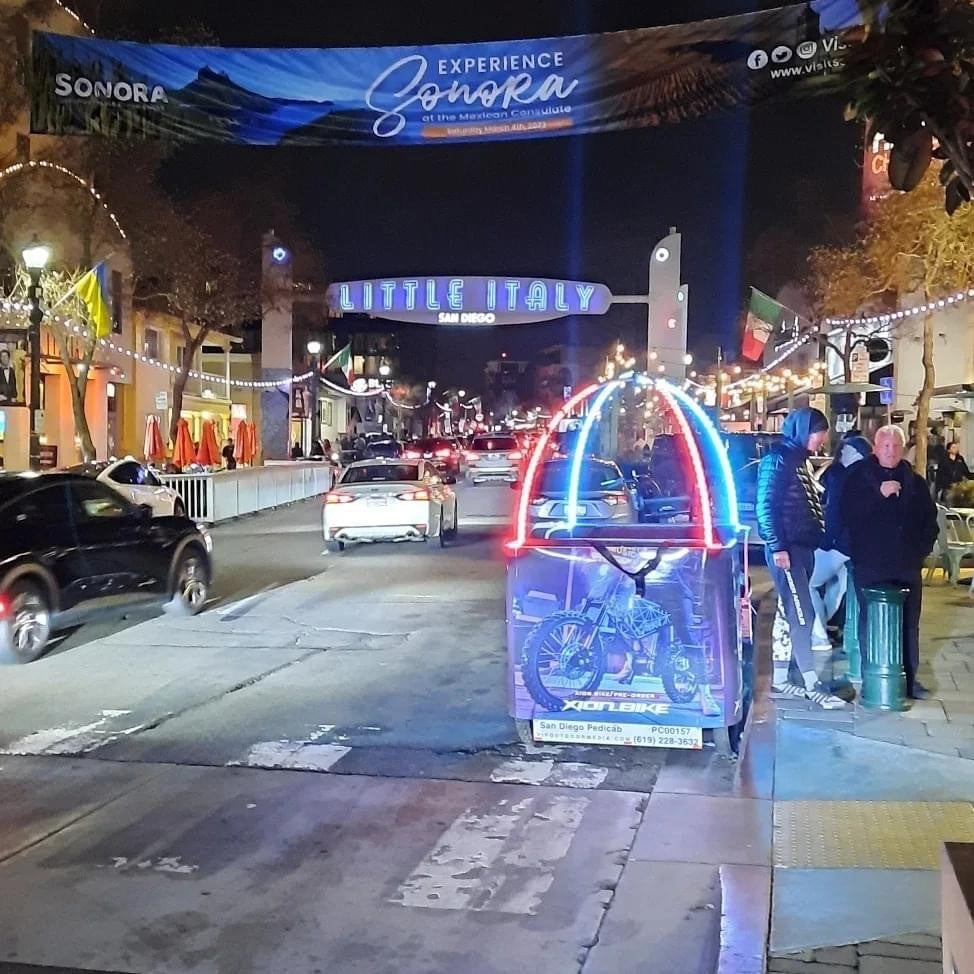
Advertising wrap contracts run $500–$3,000 per vehicle per month, depending on market size and the advertiser's budget. Even a modest $750/month contract on a single cab generates $9,000 per year in recurring revenue with no additional labor cost. Xion's San Diego affiliate, VIP Pedicab, has operated 130+ pedicabs for over 20 years and now earns 60% of total revenue from advertising alone.
Event Contracts
Events are where pedicab businesses earn their highest single-day revenues. Sporting events, music festivals, conventions, marathons, parades, and corporate events all need ground-level transportation for large numbers of people moving short distances quickly.
Event contracts range from $1,500 to $25,000+ per event, depending on duration, vehicle count, and scope of service. A three-cab fleet running a major music festival for two days at $4,000 per event is a $12,000 weekend.
Build relationships with local event promoters, venue operators, and city event coordinators early. These contracts often renew annually and become the backbone of your operation's income.
---
Step 4: Secure Financing
The total investment to launch a 3-cab starter fleet is $40,500 for the vehicles, plus shipping and insurance. Individual pedicabs are priced at $13,500 (3-seat) to $15,000 (6-seat) depending on configuration.
The good news: 100% equipment financing is available through Xion with $0 down. You can launch a commercial pedicab operation without a large upfront capital outlay, which makes this accessible to entrepreneurs who don't have $80,000 in liquid capital sitting around.
When evaluating financing options:
- Equipment financing is typically structured against the vehicles themselves, so your personal assets aren't on the hook
- SBA microloans (up to $50,000) are worth exploring for first-time small business owners
- Local small business development centers (SBDCs) often know about regional grants and incentives for sustainable transportation businesses — EZ Pedicabs' $35,000 AltCap prize is a good reminder that capital is available for operators who pursue it
- CDFI lenders in your area may offer favorable rates for transportation startups
With $30,000–$35,000 in annual revenue per cab, a 3-cab fleet generating $90,000–$105,000/year, most operators see full payback in under 12 months even on a financed fleet.
---
Step 5: Order Your Vehicles
Xion Motors is the only US-based manufacturer of commercial electric pedicabs, building every vehicle in San Diego, CA. This matters for a few reasons:
- Domestic manufacturing means shorter lead times and faster parts availability
- US-built vehicles meet domestic safety and commercial standards without import complications
- Warranty support and service are handled domestically
Fleet packages include more than just the vehicles. When you order through Xion's Fleet Operator Program, you get:
- The vehicles (3-cab starter configuration: $40,500)
- Shipping to your city
- Custom branding (your logo, color scheme, or advertiser wraps)
- Integration with the Chariot app for dispatch and ride management
- Rate templates based on your market
- Driver onboarding support
- Insurance provider shortlist
- Territory guidance for your city
From order to operating, plan on 1–2 months. That timeline includes manufacturing, shipping, local permits, insurance setup, and initial driver recruitment.
---
Step 6: Get Permits and Insurance
Permitting requirements vary significantly by city, so this step requires local research. Common requirements for pedicab operators include:
- Business license (required in essentially every jurisdiction)
- Pedicab operator permit (some cities require this separately from a standard business license)
- Vehicle registration (varies — some states classify pedicabs as bicycles, others as motor vehicles)
- Driver permits (some cities require individual drivers to obtain pedicab operator licenses)
- Event permits (most large events require proof of liability insurance and a city-issued event permit)
Start this process early. Some city permitting offices move slowly, and you don't want permits to be the bottleneck when your vehicles arrive.
For insurance, expect to need:
- Commercial general liability ($1M–$2M per occurrence is typical)
- Commercial auto coverage (if your vehicles are classified as motor vehicles)
- Umbrella/excess liability for event work
Xion provides an insurance provider shortlist as part of the fleet package — these are carriers familiar with commercial pedicab operations, which matters because standard auto insurers often don't know how to underwrite this vehicle type.
Budget approximately $3,000–$6,000 per year for a small fleet insurance package, though rates vary by city, vehicle count, and coverage limits.
---
Step 7: Hire and Train Drivers
Your drivers are the face of your business. They interact with every passenger, represent your brand to potential advertisers, and determine whether your reviews are five stars or two stars. Hiring well here is one of the highest-leverage decisions you'll make early on.
What to look for in pedicab drivers:- Physical fitness and comfort operating a pedal-assist e-bike in traffic
- Strong people skills — this is a hospitality job as much as a transportation job
- Reliability, especially for event work where showing up late has real consequences
- Local knowledge (for tour operations, this is essential)
Pedicab driving tends to attract a specific type of person: college students, fitness-oriented workers, people who prefer flexible hours, and those with backgrounds in hospitality, tourism, or entertainment. Cast a wide net on local job boards, and word of mouth spreads quickly once you have a reputation as a good operator to work for.
Driver compensation models vary. The most common structures are:- Revenue share (driver keeps 40–60% of ride revenue, operator keeps the rest)
- Hourly pay plus tips (common for event contracts where the driver isn't directly selling rides)
- Flat daily/nightly rate (common in tourist markets with predictable nightly volumes)
Chariot app integration (included in your fleet package) handles dispatch, tracking, and ride logging — which makes managing multiple drivers across multiple cabs significantly easier.
---
Step 8: Launch Operations
You've got your vehicles, your permits, your drivers, and your territory. Now you launch — but launch smart.
In the first 30 days:- Start with soft operations on your highest-traffic nights (Friday and Saturday evenings in the entertainment district)
- Build relationships with bar managers, restaurant hosts, and hotel concierges who can refer customers
- Begin outreach to local businesses about advertising wraps — even one contract in month one changes your economics materially
- Document everything for your first 30–60 days so you have real numbers for your second and third cab
---
Frequently Asked Questions
Do I need experience in transportation or pedicabs to start?
No. Xion's Fleet Operator Program is designed for entrepreneurs with no prior pedicab experience. Vehicle training, driver onboarding support, rate templates, and territory guidance are all included.
How long does it take to start making money?
From order to operating is typically 1–2 months. Revenue begins immediately once you're licensed, insured, and running. Most operators are generating consistent weekly revenue within the first 30 days of operation.
Can I start with just one pedicab?
Individual pedicabs are available starting at $13,500. However, a 3-cab starter fleet ($40,500) provides meaningfully better economics — you can cover more territory, pursue event contracts that require multiple vehicles, and your per-cab revenue targets are more achievable with operational redundancy.
What's the annual revenue potential?
Fleet operators average $30,000–$35,000 per pedicab per year across all three revenue streams. A 3-cab fleet can generate $90,000–$105,000 annually.
Is 100% financing really available?
Yes. Xion offers 100% equipment financing with $0 down through its Fleet Operator Program. The vehicles themselves serve as collateral.
What cities are available?
Xion's program currently covers 59+ US markets. Contact the fleet team to confirm availability and territory details for your target market.
---
Ready to Launch Your Pedicab Business?
The window to enter most markets as an early operator is still open — but it won't stay open forever. The pedicab business has a real first-mover advantage: the operator who builds relationships with local venues, event promoters, and advertisers first tends to dominate the territory.
Xion's Fleet Operator Program gives you everything you need to go from zero to operating in under two months: commercial electric pedicabs built in San Diego, app-based dispatch, custom branding, territory guidance, and financing options that let you start with $0 down.