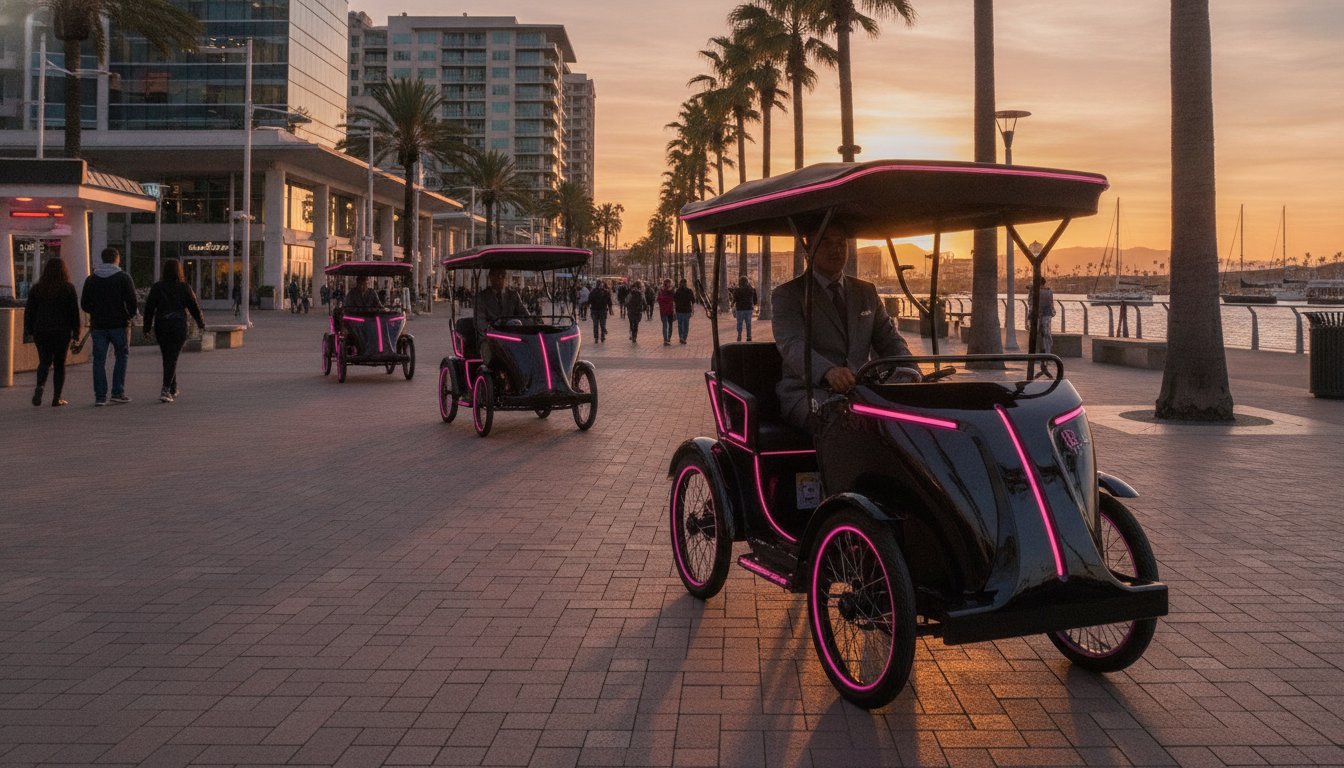
If you're buying a pedicab for commercial use, you're not buying a bicycle. You're buying a vehicle that will run 6–12 hours a day, 300+ days a year, carry multiple passengers, and need to be serviced quickly when something breaks. The brand you choose determines whether that math works in your favor.
Here's what separates the best pedicab brands from the rest — and how the major players stack up.
What to Look for in a Commercial Pedicab
1. Electric vs. Pedal-Only
In 2025, electric-assist pedicabs have become the standard for serious commercial operators. Pedal-only cabs are fine for light-use or tourism settings but create driver burnout in high-volume markets. An electric-assist system means your driver can work longer shifts, take hillier routes, and carry heavier passenger loads without fatigue destroying your utilization rate.
Look for: Class 2 e-bike classification (throttle + pedal assist), battery range of 40+ miles per charge, and a swappable or quick-charge battery system for multi-shift operations.
2. Passenger Capacity
3-seat vs. 6-seat is a core business model decision. Three-seaters are more maneuverable, lower cost, and easier to permit in some cities. Six-seaters carry more passengers per ride, increase per-ride revenue, and are better suited for group tours and airport/hotel transfer contracts. Many operators start with 3-seaters and expand to 6-seaters as they scale.
3. Parts Availability and Service Support
This is where many import brands fail commercial operators. A $9,000 pedicab that sits inoperative for 6 weeks waiting on a proprietary part from overseas costs you far more than you saved on the purchase price. Buy from a manufacturer with:
- U.S.-based parts stock
- Documented service manuals
- Compatible with standard e-bike components for field repairs
- A U.S. support contact
4. Advertising Panel Design
If advertising revenue is part of your model (and it should be), the cab's body panel design matters. Look for flat, wide panels that accept full vinyl wraps cleanly, integrated LED lighting for nighttime wrap visibility, and a design that projects a professional brand image to potential sponsors.
5. Warranty and Lifespan
Commercial pedicabs should have a minimum 1-year frame warranty and 6-month drivetrain warranty. More important than the stated warranty is the manufacturer's track record — ask for references from existing operators running 2+ year-old units.
The Major Pedicab Manufacturers
Xion Motors (USA)
Xion is the leading U.S.-based electric pedicab manufacturer, the only major brand designing and assembling commercial pedicabs domestically. The Xion 3-seater and 6-seater are Class 2 electric-assist, built specifically for high-utilization commercial operations in tourism, entertainment, and fleet contexts. U.S.-based parts and service support. Starting at $13,500 for the 3-seater. Fleet pricing available at 3+ units. Best for: commercial operators who need reliability, service support, and advertising-ready design.
Main Street Pedicabs (USA)
A small-batch U.S. builder known for custom and specialty builds. Strong craftsmanship but limited production scale, longer lead times, and higher per-unit costs than Xion. Better suited for custom branding projects than fleet operations.
Stallion (Import)
A common import brand found on many pedicab rental platforms. Lower acquisition cost but pedal-only (no electric assist), limited U.S. parts availability, and frame quality that struggles in high-volume commercial use. Acceptable for low-frequency rental or event use.
Generic Chinese Imports
Numerous unbranded or rebadged electric pedicabs are available through Alibaba and wholesale importers at $6,000–$10,000. The cost is appealing, but commercial operators consistently report: proprietary parts with no U.S. stock, poor quality control across units, no service documentation, and frames that don't hold up to 300+ operating days per year. The total cost of ownership over 3 years often exceeds a domestic brand.
The Total Cost of Ownership Question
The best pedicab brand for your operation is the one that costs the least to own over 3–5 years, not the one with the lowest sticker price. Run the math:
- Purchase price
- Expected downtime per year (days out of service)
- Parts and maintenance cost
- Revenue lost per down day
A $13,500 Xion unit that runs reliably for 5 years outperforms a $9,000 import that requires 3 parts-sourcing delays per year by a wide margin when you account for lost fare and advertising revenue during downtime.
Our Recommendation
For U.S.-based commercial pedicab operations, Xion Motors is the clear choice. It's the only manufacturer combining electric-assist performance, U.S. parts availability, advertising-ready design, and fleet pricing in a single product line.
For operators on a very tight budget starting with a single cab in a low-volume seasonal market, a used Xion or a reputable domestic used unit can make sense — avoid offshore imports for anything you plan to run commercially.
View Xion pedicab models and pricing | Browse used pedicabs for sale | Fleet pricing (3+ units)
Frequently Asked Questions
How much should a commercial pedicab cost?
A commercial electric pedicab runs $13,500 for a 3-seat and $15,000 for a 6-seat when purchased direct from the manufacturer. Certified pre-owned units run $7,000 to $10,000. Fleet buyers get 10% off at 3 or more units and 15% off at 10 or more.
What warranty should a commercial pedicab carry?
Look for coverage written for commercial multi-driver use, not recreational use. Xion provides a 2-year frame warranty, 1-year motor and battery warranties, and lifetime phone and email support, with parts stocked in the USA.
Should I buy an electric or pedal-only pedicab?
Electric, for any commercial operation. A 750W direct-drive transaxle handles hills and full passenger loads that end shifts early on pedal-only cabs, which means longer shifts, heavier fares, and far lower driver turnover.
What specifications matter most for commercial use?
Payload capacity, since Xion pedicabs carry 1,500 lb, plus a 72V 58Ah battery for a full shift, hydraulic disc brakes, and domestic parts availability. Vehicles built for 300 or more operating days a year outlast consumer-grade frames by years.