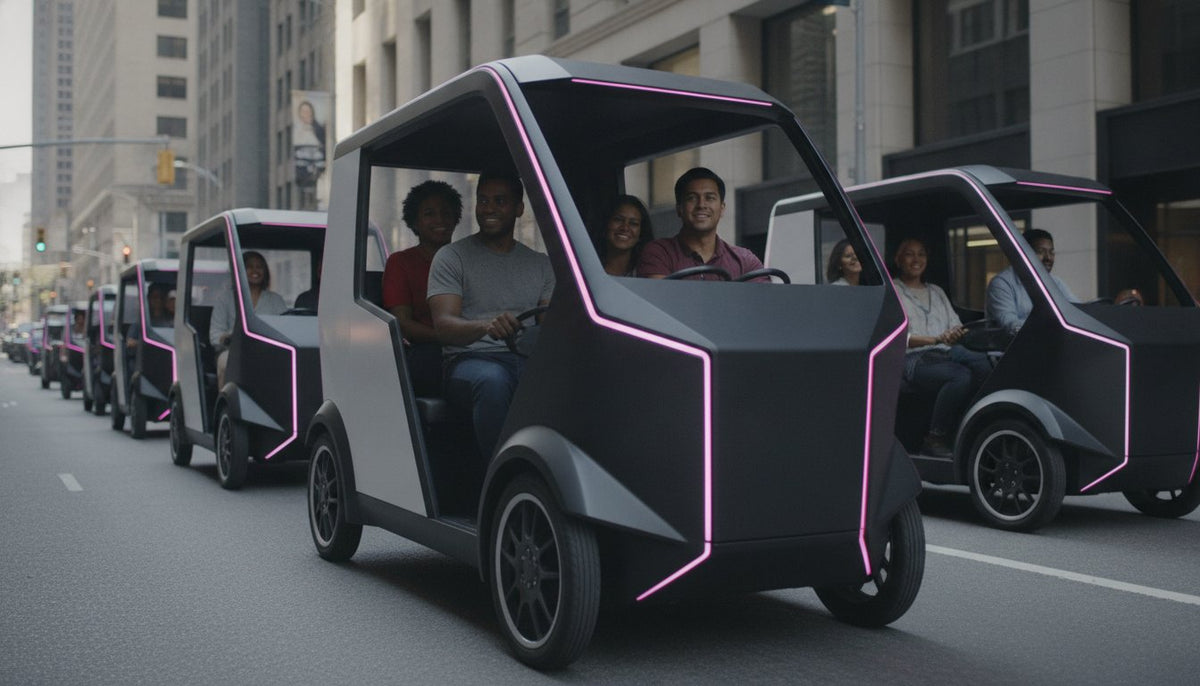
The most expensive vehicle in your fleet isn't the one with the highest invoice. It's the unit that breaks down during a peak festival weekend. For many entrepreneurs entering the transit market, the build vs buy commercial pedicab debate starts as a way to save capital, but it often ends in a graveyard of custom-welded frames and incompatible parts. You want a business that scales, not a hobby that requires constant repairs. We've spent over 20 years in the trenches of fleet operations; we know that industrial-grade durability is the only metric that matters for your bottom line.
You're likely weighing the upfront savings of a DIY project against the long-term reliability of a factory-engineered chassis. It's a critical decision that impacts your insurance rates, safety compliance, and annual revenue potential. This guide provides a definitive breakdown of the ROI between professional builds and home-grown units. We'll explore the engineering requirements for high-torque drive systems found in models like the CyberX and VorteX, the reality of parts support, and how to choose between 3-seat and 6-seat configurations to dominate your local market. By the end, you'll have a clear strategy to deploy a fleet that works as hard as you do.
Key Takeaways
- Master the engineering requirements for passenger transport. Specialized high-torque drive systems are mandatory for heavy-duty 3-seat and 6-seat configurations.
- Analyze the 12-month financial impact of your build vs buy commercial pedicab strategy. Don't let the "parts scavenger" problem compromise your operational uptime.
- Secure your business against liability and financial drain. Industrial-grade manufacturing offers structural integrity that DIY steel welds cannot match.
- Streamline your national expansion. Street-legal, professionally built units simplify rider training and standardize your maintenance protocols.
- Leverage 20 years of fleet experience. The CyberX and VorteX platforms are engineered to deliver immediate ROI for serious operators.
The Build vs. Buy Dilemma: Evaluating Commercial Pedicab Viability
The appeal of building your own commercial pedicab is real. You control the design, you cut the acquisition cost, and there's a certain entrepreneurial satisfaction in launching a business on a chassis you welded yourself. Tracing back through cycle rickshaw history, human-powered and assisted passenger vehicles have always attracted resourceful operators willing to improvise. But improvisation and commercial viability are two different things entirely.
The core question in any build vs buy commercial pedicab analysis isn't whether you can build a rideable trike. It's whether that trike can survive 12-hour shifts, six days a week, in a high-revenue environment. That's where the gap between ambition and engineering reality becomes brutally clear.
Defining "commercial grade" matters here. A consumer e-bike conversion or a garage-built frame may look functional on a test run around the block. Bolt on a passenger bench, add some battery capacity, and it moves. The problem surfaces the moment you introduce real operational loads: multiple passengers, sustained inclines, repeated hard stops, and the thermal stress of continuous motor cycling. At that point, you're not testing a vehicle. You're exposing every engineering compromise you made to save money.
The Limitations of Consumer-Grade Components
Standard e-bike braking systems aren't rated for the stopping demands of a loaded passenger trike. When your vehicle is carrying a combined passenger load exceeding 1,000 lbs, brake fade isn't a theoretical concern; it's a liability event waiting to happen. Lightweight aluminum frames compound the problem. They're engineered for single-rider efficiency, not the lateral stress and torque loads generated by high-capacity passenger transport. The failure mode isn't gradual. It's a cracked weld mid-shift, a seized brake caliper on a downhill approach, or a drivetrain that shreds itself because it was never designed for this application. "Cheap" components don't save money. They convert your upfront savings into emergency repair costs, lost revenue days, and insurance exposure.
The Strategic Advantage of Professional Manufacturing
Speed to revenue is the decisive argument. A professionally manufactured unit like the CyberX or VorteX arrives engineered, tested, and ready to operate. You're not sourcing parts or troubleshooting frame geometry. You're training your first rider and booking your first fares.
For operators planning a scalable fleet rather than a side hustle, consistency is equally critical. Standardized platforms mean standardized maintenance protocols, interchangeable replacement parts, and a uniform rider experience across every unit in your operation. That's not a luxury. That's the operational foundation every serious build vs buy commercial pedicab decision should be measured against.
Engineering for Revenue: Structural Integrity and Power
Revenue in the transit industry is a direct product of mechanical uptime. If your vehicle isn't moving, you aren't earning. When navigating the build vs buy commercial pedicab decision, you must look past the aesthetics and focus on the physics of passenger transport. Moving a 1,000-pound payload through urban congestion requires more than just a motor; it requires an integrated power system designed for high-cycle durability.
The engineering requirements for a 3-seat CyberX or a 6-seat VorteX differ fundamentally from standard e-bike builds. While hub motors are common in the consumer world, they often lack the heat dissipation and low-end torque necessary for commercial starts on inclines. High-performance mid-drive systems, coupled with sophisticated Battery Management Systems (BMS), ensure that your fleet can operate for a full 8 to 12-hour shift without voltage sag or thermal shutdown. These systems monitor cell health in real-time, preventing the common failures that plague unmanaged DIY battery packs.
High-Torque Performance Standards
Torque is the primary metric for urban success. Top speed is irrelevant in a crowded downtown core, but the ability to accelerate a 6-passenger load safely into the flow of traffic is mandatory. Industrial-grade gearing plays a vital role here. By utilizing specialized gear ratios, professional manufacturers reduce the stress on the motor and drivetrain, effectively doubling the operational lifespan of these critical components compared to hobbyist conversions. This engineering precision is why professional operators prioritize purpose-built drive systems when weighing the build vs buy commercial pedicab options.
Structural Durability and Passenger Safety
A commercial chassis must endure thousands of miles of pothole-ridden urban terrain. Industrial-grade manufacturing utilizes precision jigs and stress-testing protocols that home-welded steel frames simply cannot replicate. Professional engineering also reduces mechanical vibration, which is a silent killer of electrical connections and rider comfort. By using precision-aligned chassis components, models like the CyberX minimize the wear and tear that typically destroys consumer-grade conversions within their first season.
Safety features must be integrated, not bolted on as an afterthought. Adhering to equipment guidelines like the Federal Motor Vehicle Safety Standard No. 500 ensures your vehicles are equipped with the necessary lighting, signaling, and restraints to operate legally as low-speed vehicles. When you invest in the engineering behind electric pedicabs, you're buying the confidence that your vehicle will remain structurally sound and legally compliant through years of heavy-duty use.
The Hidden Costs of DIY: Total Cost of Ownership and Liability
Entrepreneurs often mistake the initial purchase price for the total cost of doing business. In the build vs buy commercial pedicab calculation, the DIY path hides its true expense behind a veil of "sweat equity" and non-standardized components. We call this the "Parts Scavenger" trap. When a custom-built unit breaks, you don't simply order a replacement from a catalog; you hunt for it across multiple vendors or fabricate it from scratch. This kills your uptime. A professional operator knows that a vehicle sitting in the shop is a liability, not an asset.
Resale value provides another reality check. A branded, industrial-grade vehicle like the CyberX maintains a high market value because the next buyer trusts the engineering and parts availability. An unbranded custom build has almost zero liquidity. You aren't just buying a vehicle; you're investing in a liquid business asset that can be sold or traded as your fleet scales.
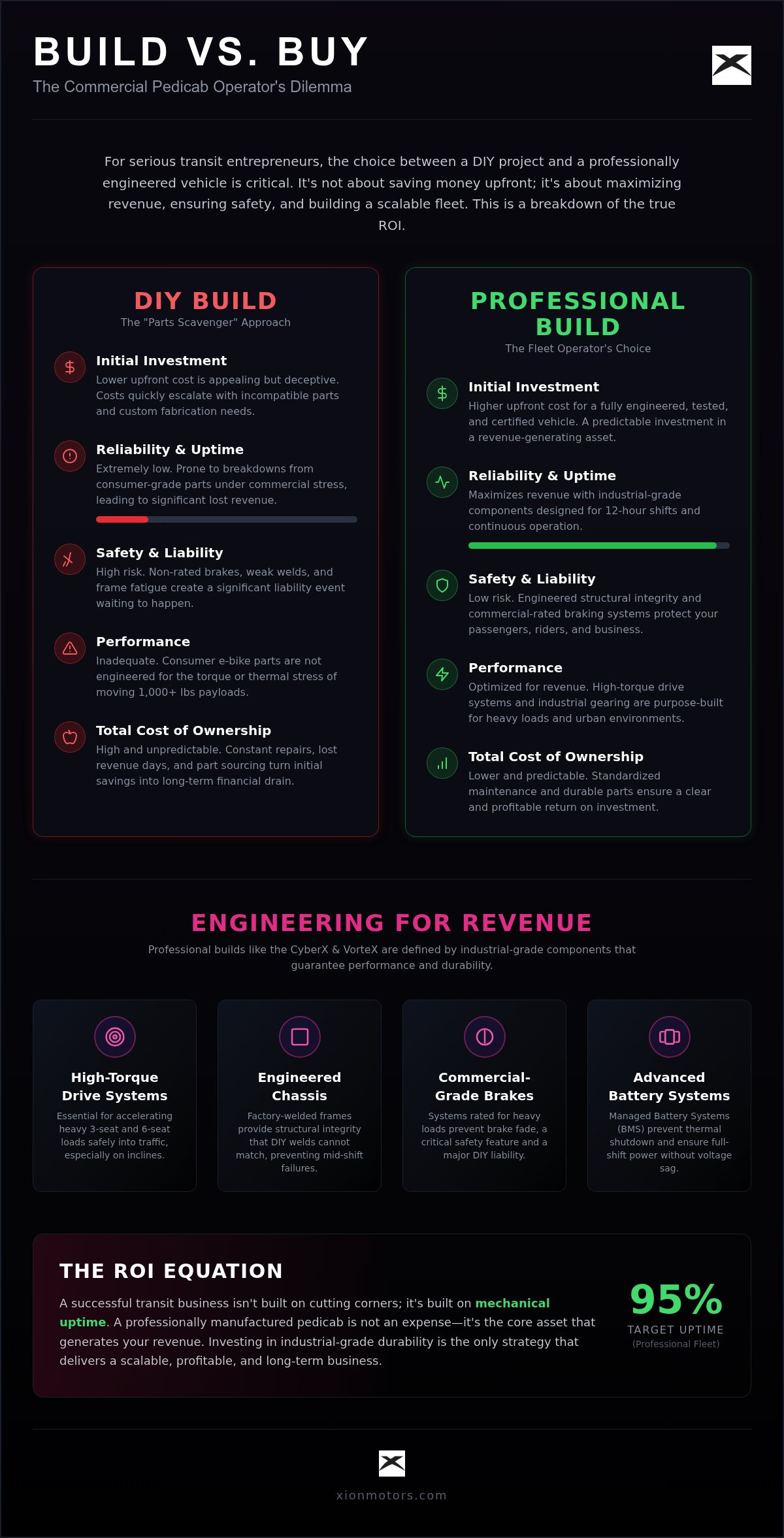
TCO: Professional vs. DIY Build
Deploying a professional fleet is about speed to market. A factory-built unit arrives ready for the street, allowing you to begin generating revenue immediately. DIY builds often drag on for months as you troubleshoot wiring harnesses and frame geometry. Industrial-grade components also offer significantly longer maintenance intervals. While consumer-grade chains and bearings might require weekly attention under heavy loads, the specialized hardware found in professional units is built for the grind. You'll spend less on replacement parts and more time capturing fares. When you account for the lost revenue during build time and the increased frequency of repairs, the "cheap" DIY trike often becomes the most expensive vehicle in the fleet within its first year.
Liability and Commercial Compliance
Insurance providers are increasingly skeptical of "home-built" vehicles in high-traffic tourism districts. They want to see standardized manufacturing and rigorous testing protocols. Adhering to the SAE International Low-Speed Vehicle Standards is the best way to prove that your equipment meets professional safety benchmarks. Using UL-certified battery systems and professionally welded chassis significantly lowers your risk profile. If an accident occurs, having a vehicle from an established manufacturer provides a layer of legal protection that a garage-built trike cannot offer. Standardized safety features like integrated signaling and passenger restraints aren't just about compliance; they're about protecting your brand and your passengers. Don't let a DIY engineering shortcut turn into a business-ending legal settlement.
Compliance and Scalability: Preparing for National Operations
Scaling a transit business requires more than just adding vehicles; it demands a repeatable operational model. If you're still weighing the build vs buy commercial pedicab options, consider how your choice impacts national expansion. Local municipalities often enforce strict equipment requirements. Showing up with a factory-built, street-legal unit like the CyberX immediately establishes your professional credibility with city regulators. It signals that you aren't just a hobbyist, but a serious operator with industrial-grade equipment.
Standardization is the bedrock of any successful fleet. When every vehicle in your operation shares the same chassis, drive system, and electrical architecture, your business becomes significantly more resilient. You aren't troubleshooting unique quirks for every individual bike; you're following a proven maintenance playbook that keeps your riders on the street and your revenue flowing.
5 Steps to Scale a Pedicab Fleet
- Step 1: Market Feasibility. Conduct a study of passenger volume and tourism cycles in your target district to ensure consistent demand.
- Step 2: Platform Selection. Select a standardized vehicle platform like the CyberX to ensure uniform performance and rider safety.
- Step 3: Maintenance. Establish a preventative maintenance schedule based on operational hours to prevent mid-shift failures.
- Step 4: Insurance. Secure commercial liability coverage by presenting your fleet as professionally manufactured and safety-compliant.
- Step 5: Scale. Grow your operation through Pedicab Fleet Packages that offer consistent branding and easier rider training.
Standardization for Operational Continuity
Identity is everything in a competitive urban market. When your fleet shares a unified aesthetic, your brand becomes a recognizable landmark for tourists and commuters alike. Beyond the external branding, standardization is about back-end efficiency. Having identical vehicles simplifies your parts inventory; you only need to stock one type of brake pad, tire, or motor controller. You don't want a "franken-fleet" of various DIY builds that require a master engineer to maintain. You want a cohesive unit that any trained mechanic can service quickly. For a deeper dive into these logistics, see our guide on the Operational Dynamics of Pedicab Fleet Management.
Modern operations also leverage fleet management software to track battery health and rider performance. This data only provides value if you have a reliable source for components when issues arise. Building a relationship with a veteran manufacturer ensures you have national shipping and parts support. Xion Motors provides the industrial-grade continuity needed to move from a single-operator setup to a dominant regional force. If you're ready to move past the DIY stage, explore our professional fleet packages to start your expansion today.
Xion Motors: Industrial-Grade Solutions for Professional Operators
Every weld in a Xion Motors vehicle represents 20 years of operational history. We've spent decades in the trenches, managing fleets and identifying the exact moment a consumer-grade component fails under pressure. This history is why our build vs buy commercial pedicab analysis always favors professional engineering. You aren't just buying a frame; you're acquiring a legacy of high-performance reliability designed to dominate the urban market. We've already solved the engineering problems that DIY builders are only beginning to encounter.
Our lineup is built for high-torque performance and maximum uptime. The CyberX serves as the industry gold standard for 3-seat configurations, delivering the precision power needed for rapid urban transit. For operators targeting high-volume routes, the VorteX provides maximum capacity engineering in a robust 6-seat layout. These aren't hobbyist trikes; they're industrial-grade revenue assets built to withstand the harshest street-level conditions. When you weigh the build vs buy commercial pedicab options, the choice between a garage project and a proven profit center becomes clear.
Operational continuity is our priority. We offer national shipping and maintain a comprehensive inventory of vehicle parts for all 50 states. This ensures that your fleet remains on the street, not in the shop waiting for custom fabrication. When you choose to buy rather than build, you're securing a logistical partner dedicated to your long-term ROI and fleet scalability.
Why Industry Veterans Choose Xion
Seasoned operators don't gamble on unproven frames. They choose Xion because our engineering prioritizes uptime above all else. We've refined our specialized drive systems to handle the extreme torque requirements of passenger transport, ensuring that your motor and drivetrain outlast the competition. Our rugged authority in the market is built on real-world results, not theoretical specs. Explore the technical depth of our flagship model in our report on CyberX: The Industrial-Grade Engineering Standard.
Ready to Launch Your Fleet?
Starting a transit business is an ambitious move. Scaling it into a dominant force requires a decisive strategy and the right equipment. Xion Motors supports new operators by providing the standardized platforms and fleet packages necessary for rapid deployment. Whether you need a custom VorteX trike for a specific tourism route or a full fleet of electric pedicabs, we have the tools to fuel your growth. Don't let the hesitation of a DIY build slow your momentum. View our fleet packages and start your business today.
Dominate Your Market with Industrial-Grade Performance
The transition from a single operator to a dominant fleet owner requires a shift in mindset. You've seen how engineering integrity and structural durability dictate your long-term ROI. While a DIY project might satisfy a creative itch, it cannot compete with the uptime and safety standards of a factory-built machine. The build vs buy commercial pedicab decision is the definitive fork in the road between a hobbyist experiment and a scalable transit enterprise.
Successful businesses are built on reliability. By choosing a standardized platform, you bypass the "Parts Scavenger" trap and secure a logistical partner dedicated to your growth. We bring 20 years of fleet experience to every industrial-grade CyberX chassis we manufacture, backed by national shipping and parts support to keep your revenue flowing. Don't let engineering compromises limit your ambition. It's time to deploy a fleet that reflects the professional standards of your business.
Invest in Professional Grade: Explore Xion Motors Pedicabs
Frequently Asked Questions
Is it cheaper to build my own electric pedicab?
Initial material costs for a DIY project might appear lower, but the long-term total cost of ownership is often much higher due to engineering failures and operational downtime. DIY builds lack the specialized high-torque drive systems found in professional units. When you factor in the cost of custom fabrication for repairs and lost revenue during the lengthy build phase, buying a factory-engineered chassis is the more cost-effective choice for serious businesses.
Can I get insurance for a home-built commercial pedicab?
Securing commercial general liability insurance for home-built units is significantly more difficult than for professionally manufactured vehicles. Most providers require equipment to meet standardized safety benchmarks like those established by SAE International. A professionally built chassis provides a documented safety record that underwriters trust. This makes it easier to obtain the $1 million liability limits typically required by city municipalities for professional transit operations.
What is the lifespan of a professional electric pedicab?
A professionally manufactured industrial-grade chassis is engineered to last for several years of heavy daily use. While consumer-grade e-bike conversions often fail within a single season, units like the CyberX utilize reinforced frames and specialized drivetrains designed for high-cycle durability. Regular maintenance and the immediate availability of genuine replacement parts ensure that your investment remains a revenue-generating asset long after a home-grown DIY build would have been retired.
How much weight can a commercial 6-seat pedicab like the VorteX carry?
Commercial 6-seat models like the VorteX are specifically engineered to handle payloads exceeding 1,000 lbs. This capacity requires a reinforced industrial-grade chassis and a high-torque motor system capable of managing significant weight on urban inclines. Professional engineering ensures that the braking systems and frame geometry remain stable under full passenger loads, providing a level of safety and performance that home-welded frames simply cannot replicate in a build vs buy commercial pedicab comparison.
Do I need a special license to operate an electric pedicab fleet?
Licensing requirements are highly localized and vary by city. Most major municipalities require a business license and individual operator permits for each driver. Some cities also mandate that the vehicles themselves be registered and inspected for safety compliance. While there are no federal construction standards, your fleet must typically meet low-speed vehicle equipment requirements, such as integrated lighting and signaling, to operate legally in professional commercial districts.
Where can I find replacement parts for a commercial pedicab?
Professional operators rely on manufacturers that provide dedicated parts support and national shipping. Xion Motors maintains a comprehensive inventory of specialized components to ensure operational continuity for our fleet owners. This is a major advantage in the build vs buy commercial pedicab debate; DIY builders often struggle to source compatible high-torque motors or custom bearings when a vehicle breaks down mid-season, leading to extended periods of lost revenue.
How long does it take to charge a commercial pedicab battery?
Charging times depend on the battery capacity and the charger output, but most professional units reach a full charge within 4 to 6 hours. High-capacity lithium-ion packs, such as the 72V 58Ah systems used in industrial models, are designed for rapid turnaround between shifts. Many fleet managers utilize swappable battery systems or overnight charging protocols to ensure that every vehicle is ready for a full 8 to 12-hour operational window.
What is the ROI on a professional electric pedicab?
A single commercial electric pedicab can generate between $30,000 and $35,000 in annual gross revenue. Most professional operators see a full return on investment in under 12 months. This rapid payback period is driven by high passenger turnover and secondary revenue streams like on-vehicle advertising. By prioritizing uptime and industrial-grade durability, you maximize the number of paid hours each vehicle spends on the street, significantly outperforming the inconsistent earnings of DIY builds.