The era of simple federal rebates for clean fleets ended on September 30, 2025, but the most resilient operators are already pivoting to new financial strategies. You likely feel the pressure of the "One Big Beautiful Bill Act" as it phased out the traditional 45W purchase incentives for new vehicle acquisitions. It's a complex shift that leaves many business owners questioning the viability of their expansion plans. However, the opportunity to leverage commercial electric vehicle tax credits hasn't vanished; it's simply moved from the point of sale to your long-term operational balance sheet.
This guide provides the clarity you need to maximize your fleet's ROI in this new regulatory environment. You'll discover how to utilize the $10,000 federal auto loan interest deduction and secure the 30% refueling property credit before it expires in June 2026. We've built this roadmap to help you turn industrial-grade equipment like the CyberX and VorteX into tax-optimized powerhouses. We'll examine current eligibility rules, outline specific steps for IRS compliance, and show you how to maintain a competitive edge through strategic fleet management.
Key Takeaways
- Decode the 2025 legislative shifts to understand how the current tax landscape impacts your fleet expansion strategy in 2026.
- Identify the specific weight and battery capacity thresholds required to qualify industrial-grade pedicabs for maximum federal incentives.
- Learn to calculate "incremental cost" and use the 15% vs. 30% rule to optimize your return on investment for new vehicle acquisitions.
- Establish rigorous documentation standards for VIN and battery specifications to secure your commercial electric vehicle tax credits during IRS filing.
- Discover why industrial-grade engineering is the critical factor in building a durable, tax-advantaged fleet that stands up to heavy commercial use.
Navigating the 2026 Commercial EV Tax Credit Landscape
The regulatory landscape for commercial electric vehicle tax credits underwent a massive tectonic shift following the One Big Beautiful Bill Act of 2025. This legislation effectively sunsetted the primary purchase credits that many operators relied on for aggressive fleet expansion. If you didn't acquire your vehicles or sign a binding contract by September 30, 2025, the rules of the game have changed. You can't rely on outdated 2024 strategies to fuel your growth. Scaling a high-performance fleet in 2026 requires a deeper understanding of the remaining federal levers and a focus on long-term operational deductions.
Commercial credits differ fundamentally from consumer rebates. They lack the restrictive MSRP caps and personal income limits that often stifle private buyers. Instead, they focus on the utility and the "incremental cost" of industrial-grade equipment. As a Master Practitioner in this industry, we know that tax strategy is as critical as engineering. You don't just buy a vehicle; you invest in a financial asset. Successful operators prioritize the total cost of ownership by stacking every available federal and local incentive.
Understanding Section 45W and the IRC
To qualify as a 'Qualified Commercial Clean Vehicle,' a platform must be manufactured by a vetted entity and intended for use on public roads or as specialized mobile machinery. This includes industrial-grade trikes and pedicabs that meet specific battery standards. Section 45W is a federal tax credit designed to incentivize the transition to clean energy fleets by providing a financial offset for vehicles acquired before the 2025 sunset, serving as a legacy benefit for early-adopting 2026 operators. You can find broader context in this Overview of EV Incentives to understand how these federal moves fit into the wider industrial shift toward electrification.
Current Status of the Inflation Reduction Act (IRA) Incentives
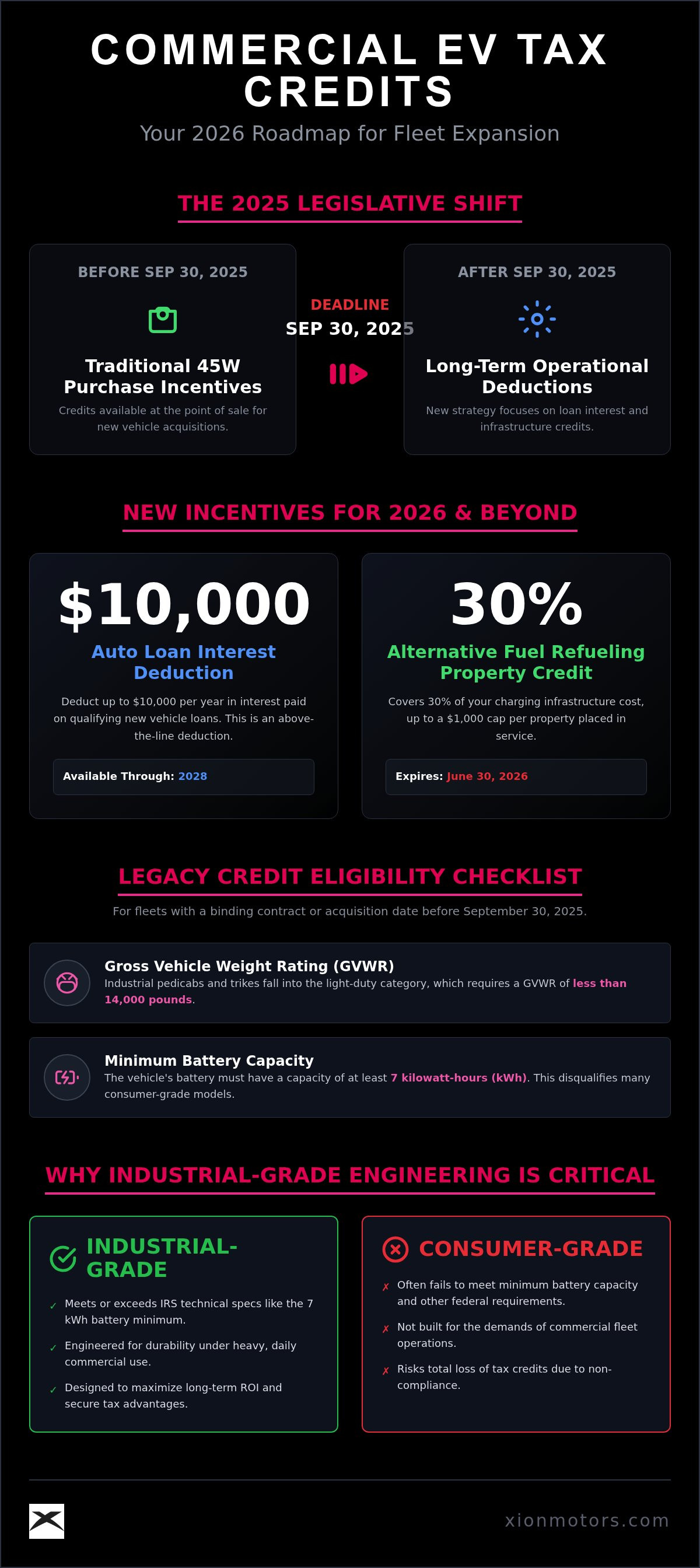
The 2025 legislative changes were decisive. For vehicles acquired after September 30, 2025, the traditional Section 45W purchase credit is no longer available. However, operators deploying fleets in 2026 still have powerful tools at their disposal. A new federal tax deduction for auto loan interest is available through 2028. This allows you to deduct up to $10,000 per year in interest paid on qualifying new vehicle loans. It's an above-the-line deduction that provides immediate relief to your bottom line.
Infrastructure also remains a priority for the IRS. The Section 30C Alternative Fuel Vehicle Refueling Property Credit is available for property placed in service before June 30, 2026. It covers 30% of the cost of your charging setup, capped at $1,000. These incentives reward the serious business owner who builds a complete ecosystem rather than just chasing a one-time rebate. By focusing on loan interest and charging infrastructure, you can still drive significant ROI even in a post-sunset environment.
Eligibility Criteria for Electric Pedicabs and Commercial Trikes
Not every micro-mobility vehicle on the market is built to satisfy federal auditors. To secure commercial electric vehicle tax credits for the 2026 tax year, your equipment must have met the strict acquisition deadline of September 30, 2025. This isn't a loophole; it's a hard legislative boundary. If you secured your vehicles or signed a binding contract before that date, your fleet must still adhere to specific technical and operational standards to remain eligible. The IRS classifies vehicles primarily by weight and energy storage capacity, focusing on platforms that provide genuine industrial utility.
The 14,000-pound Gross Vehicle Weight Rating (GVWR) is the primary dividing line in federal tax logic. While heavy-duty trucks sit on one side, industrial-grade pedicabs and trikes occupy the light-duty category. You can't just slap a motor on a standard bicycle and expect a tax break. The vehicle must be a "qualified clean vehicle" manufactured by a recognized entity that has entered into a formal agreement with the IRS. As a Master Practitioner in this field, we've seen operators lose out because they prioritized low upfront costs over verified technical compliance.
Technical Specifications for Credit Qualification
Battery capacity is the non-negotiable metric for federal eligibility. For vehicles with a GVWR of less than 14,000 pounds, the battery must have a capacity of at least 7 kilowatt-hours (kWh). Many consumer-grade trikes fall short of this mark, leaving owners empty-handed at tax time. However, the CyberX is engineered with high-capacity drive systems specifically designed to meet these industrial efficiency standards. Beyond the battery, the vehicle must be propelled to a significant extent by an electric motor that draws electricity from a rechargeable battery. You should review the Official IRS Section 45W Credit Rules to confirm how these specs apply to your specific fleet configuration and ensure your hardware meets the mark.
The Business Use Test
Eligibility extends beyond the hardware; it's about how you deploy the asset. Your pedicabs must be "depreciable property" used predominantly for business purposes in tourism or entertainment districts. This means personal use is strictly off-limits if you intend to claim the full benefit. If you're leasing your fleet, the tax credit typically stays with the owner, but this can often be negotiated into more favorable lease terms for the operator. The IRS also requires that the original use of the vehicle commences with the taxpayer. You can't claim this credit for used equipment or units that have been previously titled.
Rigorous record-keeping is your best defense against an audit. You'll need to prove that each vehicle is utilized for revenue-generating activities. Keep detailed logs of mileage and service hours for every unit in your Pedicab Fleet Packages to ensure your investment remains fully tax-advantaged. Authentic commercial use is defined by consistent, professional operation that contributes to the local economy.
Calculating the Real-World Impact: Credits vs. Fleet ROI
Tax strategy is a high-stakes game of precision where the right calculations transform a line-item expense into a competitive advantage. For operators who secured their equipment before the 2025 sunset, commercial electric vehicle tax credits act as a powerful capital injection that accelerates fleet expansion. You aren't just looking for a discount; you're looking for the shortest possible payback period. By leveraging federal incentives, you can effectively lower the barrier to entry for high-capacity equipment, allowing you to deploy more units and capture a larger share of your local tourism market.
The financial viability of a modern fleet depends on your ability to stack initial credits with long-term operational savings. While the upfront cost of industrial-grade machinery is higher than consumer-grade alternatives, the federal government's formula for "incremental cost" is designed to bridge that gap. This ensures that the premium you pay for durability and performance is partially offset by the IRS, rewarding the "Master Practitioner" who invests in professional-grade tools rather than disposable hardware.
The Incremental Cost Formula
The IRS determines your credit amount by comparing the purchase price of your clean vehicle to a "comparable" internal combustion engine (ICE) vehicle. In the pedicab sector, this often means comparing an electric trike to a gas-powered utility vehicle or rickshaw. The credit is generally the lesser of 15% of the vehicle's basis (30% for vehicles not powered by gas or diesel) or the incremental cost. To determine your maximum credit amount, calculate 30% of the vehicle's total basis, provided the unit is powered exclusively by a clean energy drive system and does not exceed the applicable federal cap. You can find deeper technical guidance on these benchmarks through the Department of Energy's Clean Vehicle Tax Credits for Fleets resource.
Long-Term ROI and Operational Savings
A tax credit is a one-time event, but its impact on your bottom line is permanent. When you use these incentives to fund a 6 seat electric pedicab expansion, you're increasing your revenue per trip while the government covers a portion of the hardware. This allows you to scale from a single unit to a full fleet package much faster than if you were relying solely on organic cash flow. It's a strategic move that positions you as a market leader in high-traffic entertainment districts.
To maximize this ROI, you must integrate your tax strategy with a rigorous electric pedicab maintenance guide. Every dollar saved on fuel and mechanical upkeep acts as a multiplier to your initial tax credit. Industrial-grade engineering ensures that your vehicles stay on the street longer, generating revenue while consumer-grade trikes are in the shop. By combining federal incentives with the durability of a vetted platform, you create a self-sustaining cycle of growth and profitability.
Step-by-Step Guide to Claiming the Section 45W Credit
Securing commercial electric vehicle tax credits requires more than just a receipt. It demands a systematic approach to documentation and a deep understanding of IRS filing protocols. If you successfully met the September 30, 2025, acquisition deadline, your focus now shifts to ironclad record-keeping to defend your claim. For operators entering the market in 2026, the process pivots toward maximizing the new 10,000 dollar annual loan interest deduction and the Section 30C refueling property credit. Moving from the "what" to the "how" is where the Master Practitioner separates themselves from the amateur operator.
Execution is everything in commercial transportation. You must treat your tax filings with the same precision you apply to your drive system maintenance. A single missing VIN or an unverified battery specification can disqualify a unit, turning a tax-advantaged asset into a full-cost liability. Professional-grade results require professional-grade preparation. We've spent decades in the trenches of fleet operations, and we know that the IRS rewards the diligent. Consult with a tax professional specialized in industrial equipment to ensure your 2026 filings are bulletproof.
Pre-Purchase Due Diligence
Before you commit capital to new units, you must verify their eligibility with the manufacturer. Request a formal certification that the vehicle meets the kilowatt-hour (kWh) minimums and that the manufacturer is a "qualified" entity in the eyes of the IRS. You must also confirm the vehicle is being sold as "new." Original use must commence with your business to trigger the credit. Aligning these technical audits with your broader milestones for starting a pedicab company ensures you build your fleet on a foundation of financial viability. Don't take a salesperson's word for it. Demand the engineering data that proves the vehicle's "Qualified Clean Vehicle" status.
Filing and Documentation
When tax season arrives, you will primarily interact with IRS Form 8954. This is the gateway to the Clean Commercial Vehicle Credit. You'll need to provide the specific Vehicle Identification Number (VIN) for each unit and the exact date it was placed in service. For the 2026 tax year, you should also document the interest paid on your vehicle loans to claim the new federal deduction. Storing proof of purchase, delivery dates, and battery capacity specs in a centralized digital vault is essential for audit protection. Many states offer additional incentives that can be stacked with federal benefits. Coordinating these layers of support can significantly reduce your effective cost per unit. Precision in your paperwork is the final step in securing your industrial-grade future.
Build your legacy with Pedicab Fleet Packages designed for maximum performance and tax-advantaged scaling.
Scaling Your Fleet with Xion Motors: Industrial-Grade Performance
Building a tax-optimized fleet requires more than just understanding the IRS code; it requires a manufacturer that builds to those specific standards. Xion Motors serves as the definitive partner for operators looking to maximize commercial electric vehicle tax credits through high-performance hardware. We don't just sell vehicles. We provide industrial-grade assets designed to withstand heavy-duty operations in the most demanding tourism districts. With over 20 years of experience in the trenches of pedicab fleet operations, we've refined our engineering to ensure every unit is a profit center. Our USA-based manufacturing process prioritizes the durability required to justify the "incremental cost" benchmarks set by federal regulators.
Choosing the right platform is a decision that dictates your long-term financial viability. The custom electric trikes for business we produce are engineered to meet the federal battery capacity and weight thresholds discussed earlier in this guide. This isn't accidental. It's the result of a Master Practitioner approach to manufacturing. We understand that your success depends on sustained street-level performance, not just a one-time tax break. When you invest in a Xion Motors fleet, you're investing in a legacy of reliability and market leadership.
Engineering for Commercial Success
Our drive systems are built for heavy-duty passenger loads and high-traffic urban environments. The CyberX and VorteX models represent the pinnacle of professional-grade performance, featuring high-torque motors that maintain efficiency under pressure. We support our national network of operators with a comprehensive inventory of vehicle parts and direct technical expertise. If a unit is down, you're losing revenue. Our model ensures you have the components and the engineering support to keep your fleet in constant motion. We don't outsource our support; we provide the same rugged authority that goes into our vehicle builds.
Ready to Scale Your Operations?
Scaling a business in 2026 demands speed and precision. Xion Motors offers national shipping across all 50 states, ensuring that your equipment arrives ready for service regardless of your location. Our direct-to-operator sales model eliminates the middleman, allowing you to invest more of your capital directly into your hardware. We offer custom configurations tailored for resort transportation, event logistics, and high-volume entertainment districts. This flexibility allows you to adapt to local market opportunities while maintaining a standardized, tax-advantaged fleet.
Market dominance isn't given; it's engineered. By combining the federal incentives we've outlined with the most durable trikes on the market, you position your business to outlast and out-earn the competition. It's time to stop reacting to tax changes and start leveraging them. Contact Xion Motors to discuss your fleet package and tax eligibility and take command of your local market today.
Command Your Fleet’s Financial Future
The shifting regulatory environment of 2026 doesn't have to be a barrier to your growth. While the 2025 sunset changed the primary incentive landscape, savvy operators are pivoting toward loan interest deductions and refueling property credits to sustain their momentum. Success in this industry requires a relentless focus on hardware that meets strict federal battery and weight standards. You can't scale a professional business on consumer-grade equipment that fails to qualify for commercial electric vehicle tax credits or collapses under heavy passenger loads. Precision pays dividends.
Xion Motors delivers the precision engineering you need to maximize your fleet's ROI. We back our vehicles with 20+ years of industrial-grade engineering experience and offer direct-to-operator fleet pricing that keeps your capital working harder. With national shipping to all 50 states, we ensure your expansion is seamless and professionally supported. It's time to stop navigating the complexity alone and start building a legacy of performance. Execution is everything.
Explore Xion Motors Fleet Packages and Maximize Your ROI
Your path to market leadership starts with the right tools and a bulletproof tax strategy.
Frequently Asked Questions
Are electric pedicabs eligible for the Section 45W Commercial Clean Vehicle Credit in 2026?
Yes, provided you met the acquisition deadline of September 30, 2025. If you secured a binding contract before that date, your industrial-grade pedicabs remain eligible for commercial electric vehicle tax credits when placed in service during 2026. For new acquisitions without a prior contract, the primary credit has sunsetted. These operators should instead focus on the 10,000 dollar annual federal interest deduction and state-level incentives to optimize their fleet ROI.
How much is the maximum tax credit for a commercial electric vehicle?
For vehicles with a Gross Vehicle Weight Rating under 14,000 pounds, the maximum credit is 7,500 dollars. This applies to most light-duty commercial trikes and pedicabs. If a vehicle exceeds that 14,000-pound threshold, the credit amount can reach up to 40,000 dollars. The actual benefit is calculated as the lesser of 15% to 30% of the vehicle's basis or the incremental cost compared to an internal combustion engine alternative.
Can I claim the tax credit if I lease my pedicab fleet instead of buying?
The tax credit generally belongs to the owner of the vehicle, which is the leasing company in a standard lease agreement. Many lessors choose to pass a portion of these savings to the operator through reduced monthly payments. It's a strategic negotiation point for fleet managers. If you intend to claim commercial electric vehicle tax credits directly on your corporate return, you must hold the title and meet all IRS business-use requirements.
What battery capacity is required for a vehicle to qualify for the EV tax credit?
To qualify as a clean commercial vehicle, units with a GVWR of less than 14,000 pounds must be equipped with a battery capacity of at least 7 kilowatt-hours (kWh). This is a critical engineering benchmark. Many consumer-grade trikes fail this test, but industrial-grade models like the CyberX are designed to meet these rigorous federal standards. Always verify the kilowatt-hour rating with the manufacturer before finalizing your fleet acquisition strategy to ensure compliance.
Do I need to buy an American-made vehicle to get the commercial tax credit?
Section 45W for commercial vehicles is more flexible regarding assembly locations than consumer-level credits. However, the manufacturer must be a "qualified manufacturer" that has entered into a formal agreement with the IRS. Choosing a domestic partner like Xion Motors ensures your equipment meets the high-performance standards required for industrial use while simplifying the verification process. Domestic manufacturing also streamlines national shipping and provides reliable access to replacement parts for long-term fleet maintenance.
What is 'incremental cost' and how does it affect my credit amount?
Incremental cost is the price difference between a clean vehicle and a comparable internal combustion engine vehicle. The IRS uses this figure to cap your credit amount. For light-duty vehicles, the credit is the lesser of 30% of the vehicle's basis or the calculated incremental cost. This rule rewards operators who invest in high-performance, industrial-grade platforms, as the engineering complexity of these units often justifies the maximum available federal credit.
Can I stack federal EV tax credits with state-level incentives?
Yes, stacking federal and state incentives is a cornerstone of a high-performance financial strategy. While federal credits provide a broad foundation, many states offer additional rebates, vouchers, or grants for commercial electrification. Combining these benefits can significantly lower your effective cost per unit. You should coordinate with a specialized tax professional to ensure you're capturing every available dollar across both federal and local jurisdictions to maximize your fleet's total return on investment.
What IRS forms do I need to file to claim the clean commercial vehicle credit?
You must file IRS Form 8954, titled "Clean Commercial Vehicle Credit," with your annual tax return to claim this incentive. This form requires specific data for each unit, including the Vehicle Identification Number (VIN) and the exact date the vehicle was placed in service. For the 2026 tax year, you should also document loan interest payments to claim the 10,000 dollar federal deduction. Rigorous record-keeping is essential to defend your claim during an audit.