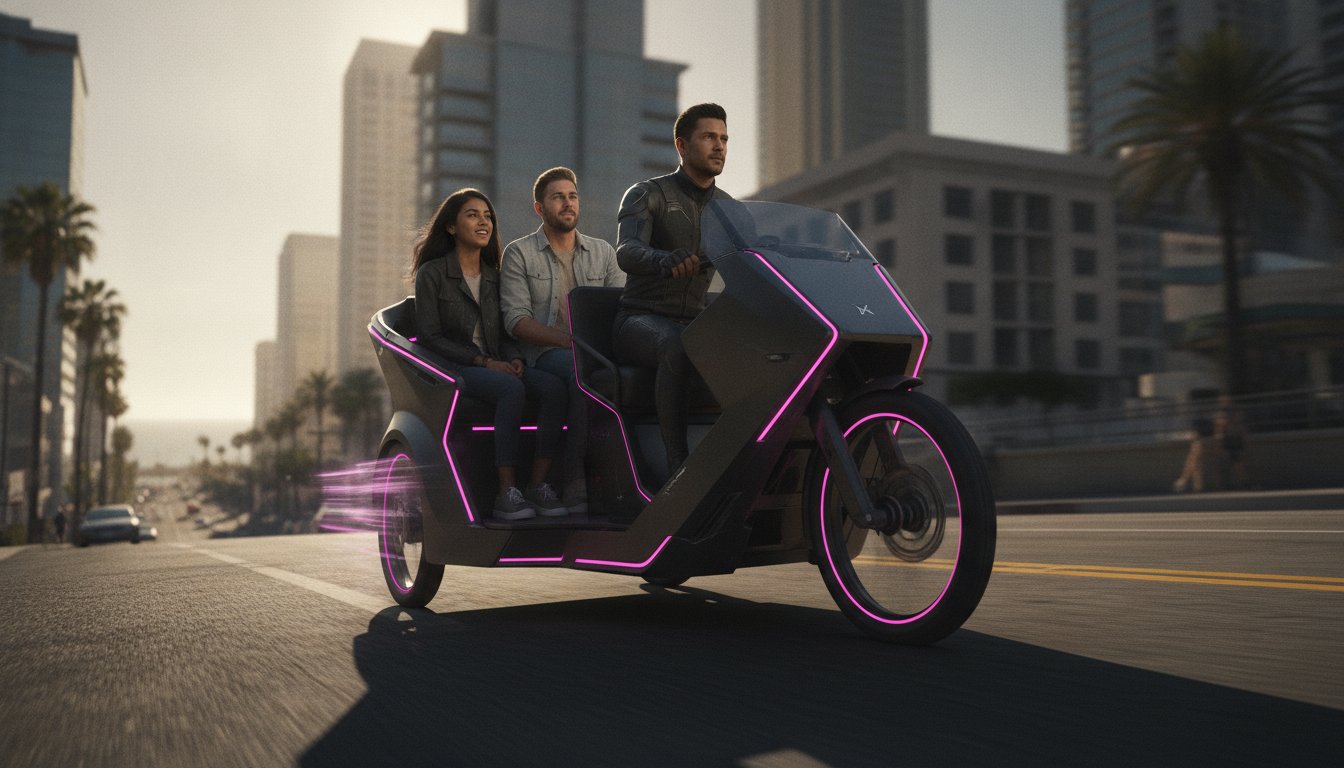
The seasonal pedicab hustle is dead. The future of urban mobility belongs to high-performance, electric-assist fleets that operate as legitimate transit infrastructure. If you're serious about starting a pedicab company in 2026, you've likely realized that the old model of buying a bike and finding a corner doesn't work in a market defined by $2,000,000 insurance requirements and strict municipal oversight. You need a strategy that balances the high initial cost of commercial-grade equipment with the massive revenue potential of a professionalized fleet.
Xion Motors understands the friction points because we've built the vehicles that solve them. This blueprint delivers a comprehensive roadmap to launching and scaling a high-ROI operation in today's increasingly regulated environment. You'll gain clarity on navigating the evolving state and local licensing standards and proposed transportation regulations across the nation. We'll also dive into validated revenue models, from $500 daily advertising wraps to high-margin tour packages, ensuring your investment is backed by industrial-strength reliability and proven financial viability.
Key Takeaways
- Identify high-traffic zones within entertainment districts and transit hubs to establish your fleet as an essential micro-mobility solution.
- Learn why starting a pedicab company demands industrial-grade engineering, focusing on the chassis durability found in CyberX and VorteX standards.
- Secure your operation by navigating the specific classifications and permit requirements necessary for professional commercial vehicle registration.
- Implement a "Three-Pillar" revenue strategy to drive profitability through a sophisticated combination of passenger fares, brand advertising, and contract services.
- Optimize your growth trajectory by transitioning from individual units to a multi-vehicle fleet using professional packages designed for standardized maintenance.
Analyzing Market Viability and Capital Requirements
Success in the micro-mobility sector requires more than just enthusiasm; it demands a clinical analysis of urban infrastructure. Starting a pedicab company in the 2026 climate is a high-stakes play for market share in the "last-mile" transit gap. You aren't just buying bikes. You're deploying a fleet of industrial-grade electric vehicles designed to outperform traditional gas-powered shuttles through lower overhead and superior maneuverability. While the Cycle rickshaw overview highlights the vehicle's humble origins, modern electric fleets are high-performance assets that function as legitimate transit solutions.
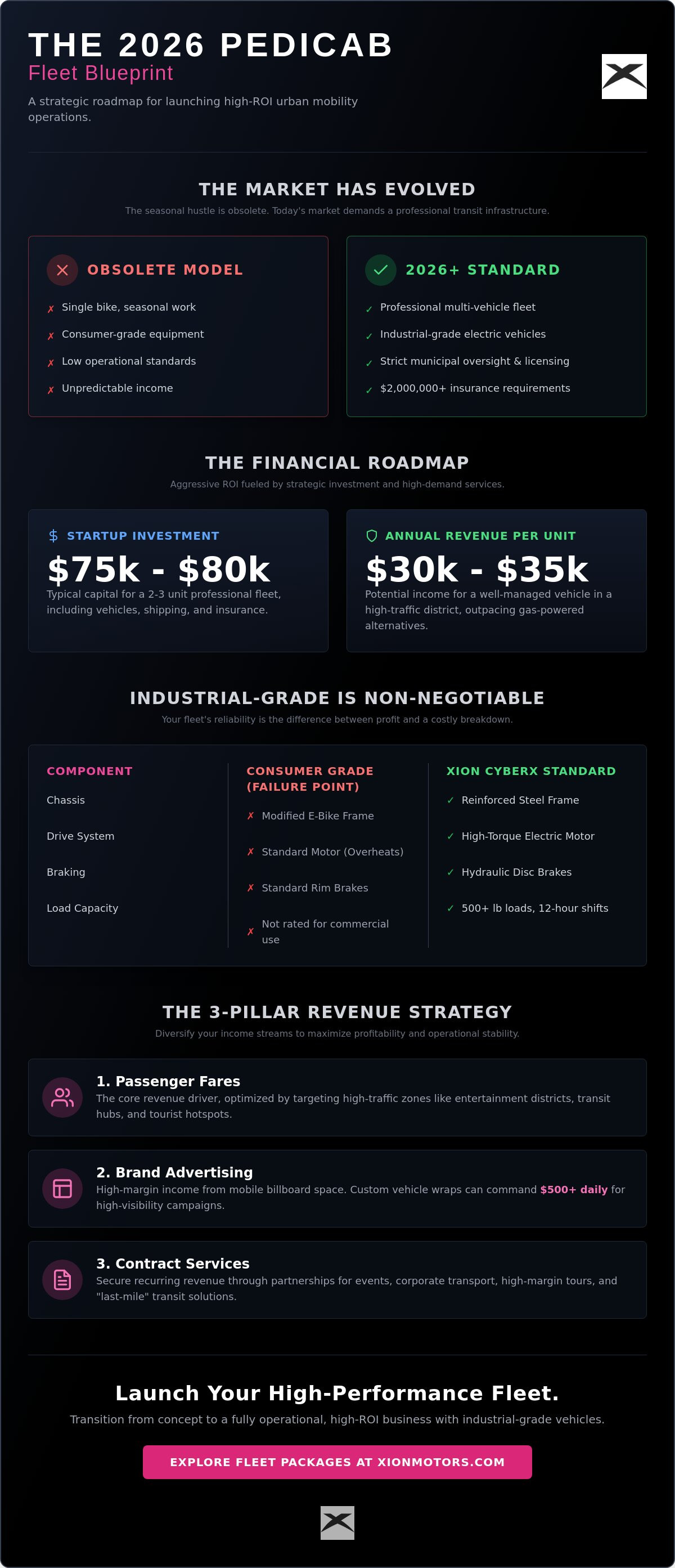
Profitability depends on your ability to identify high-traffic zones where traditional transit fails. Entertainment districts, major tourism hubs, and transit deserts are your primary targets. In these environments, the convenience of a pedicab often beats rideshare wait times and fixed-route buses. Industry data suggests a startup investment for a professional 3-unit fleet starts at $40,500 for the heavy-duty vehicles, with shipping, storage, and the robust insurance policies now required by major municipalities budgeted on top. The ROI is aggressive; a well-managed unit can generate between $30,000 and $35,000 in annual revenue, significantly outpacing the high fuel and maintenance costs of internal combustion alternatives.
Identifying Your Primary Service District
Evaluate foot traffic density with a focus on connectivity gaps. You're looking for areas where the distance is too long to walk comfortably but too short or congested for a car. Topography is the silent killer of amateur operations. If your district includes significant inclines, high-torque electric motors are non-negotiable. Don't settle for consumer-grade components that burn out under commercial loads. Analyze the competition by timing rideshare pickups during peak hours. If a customer has to wait 15 minutes for a car to move three blocks, your pedicab fleet has already won the fare.
Budgeting for Professional Launch
Factor in vehicle acquisition tiers based on your specific market needs. High-capacity 6-seat models are essential for group tours, while agile 3-seat units excel in dense urban corridors. Beyond the hardware, allocate funds for professional branding and custom wraps. These aren't just aesthetic choices; they're revenue drivers that allow you to command higher rates for advertising contracts. Always maintain a contingency fund for spare parts and specialized maintenance tools. A grounded vehicle earns zero revenue, so having a "ready-to-deploy" inventory of tires, brake pads, and battery modules is a hallmark of a master practitioner in the pedicab industry.
Selecting Industrial-Grade Equipment: CyberX vs. VorteX Standards
Don't fall for the trap of thinking a modified e-bike will survive a commercial shift. Starting a pedicab company requires hardware that can withstand 500-pound loads for twelve hours a day. While hobbyists might discuss DIY kits on forums, professional operators know that structural failure is a business-killer. You need reinforced steel frames and industrial-grade chassis that won't buckle under the stress of constant stopping and starting. Precision engineering is the difference between a profitable shift and a costly tow. Every component must be rated for heavy-duty use, from the reinforced spokes to the industrial seat posts. We build for the street, not the showroom.
High-torque drive systems are the heartbeat of a reliable fleet. They provide the necessary power to move heavy passenger loads through hilly terrain without overheating the motor or draining the battery prematurely. Uptime is the only metric that matters in this industry. If your motor burns out on a Friday night, you've lost your highest-earning window. Safety is equally critical. You can't rely on standard bicycle rim brakes when carrying three or six adults. Hydraulic disc brakes are a mandatory commercial requirement for any vehicle. These standards align with the rigorous equipment checks found in Pedicab Company Permit Application Standards, ensuring your fleet remains road-legal and fully compliant with municipal safety codes.
The CyberX Engineering Standard
The CyberX model sets the benchmark for 3-seat urban navigation. It's built for agility in dense corridors where larger vehicles can't maneuver. The CyberX engineering focuses on structural integrity while prioritizing rider ergonomics. This reduces operator fatigue during long shifts, which is essential for driver retention and consistent service quality. Most importantly, it utilizes battery swap technology. This allows your vehicles to run 24/7 without being tethered to a charger, effectively doubling your earning potential per unit. It's a rugged, efficient tool for the serious entrepreneur who values performance over gimmicks.
The VorteX High-Capacity Framework
For high-capacity needs, the 6-seat VorteX models are the definitive choice. Group tours and event transport demand a different level of suspension engineering. You aren't just moving people; you're managing complex weight distribution and center-of-gravity challenges. The Custom VorteX Trike configurations allow you to tailor the vehicle to your specific business model. Whether you're running a wedding shuttle or a city-wide tour service, the suspension must be tuned for passenger comfort and vehicle stability. This is industrial machinery designed for scale. If you're ready to upgrade your hardware, you should explore our industrial-grade electric pedicabs today.
Navigating the Regulatory and Insurance Landscape
Starting a pedicab company in 2026 requires more than a standard business license; it demands a strategic alignment with evolving municipal transit codes. The days of operating under vague "bicycle" classifications are ending. Modern cities now categorize electric fleets as commercial micro-mobility vehicles, subjecting them to rigorous oversight. In London, for example, new regulations effective October 30, 2026, mandate that drivers undergo enhanced DBS checks and meet specific medical standards. Ignoring these shifts is a recipe for operational failure. You must position your business as a professional transit partner rather than a seasonal novelty.
Permitting is the primary gatekeeper for market entry. You'll typically navigate a three-tier system: a general business license, specific vehicle registrations, and individual operator permits. These requirements vary significantly by jurisdiction, but the trend is toward stricter enforcement. New York City has recently proposed moving oversight to the Taxi and Limousine Commission, which would standardize rates and require meters. Understanding Austin's Pedicab Economy provides a baseline for how high-demand events drive regulatory evolution. Mastery of these local laws ensures your fleet remains on the street during peak revenue windows.
Securing Commercial Pedicab Insurance
Risk management is where the Master Practitioner separates themselves from the amateur. You don't just buy insurance; you engineer a liability shield. In major markets like New York, you're looking at a combined single limit of $2,000,000 for the entire business or specific per-vehicle coverage of $100,000 for individual injury. These aren't suggestions. They're mandatory requirements for municipal contracts. Industrial-grade safety features, such as our hydraulic disc brakes and reinforced frames, aren't just for protection; they're fiscal tools. Demonstrating a fleet built on these standards can often help you negotiate more favorable premiums by reducing the insurer's perceived risk profile.
Municipal Compliance and Permitting
Approach city councils with a focus on "last-mile" connectivity and eco-friendly transit. Position your fleet as a solution to urban congestion. To gain "Street Legal" status, your vehicles must pass regular safety inspections, covering everything from lighting systems to braking distance. In London, vehicle licensing costs approximately £114, with applications opening as early as March 2026. Secure your place in designated pedicab stands by proving your operational legitimacy. When you respect "Right of Way" laws and municipal boundaries, you move from being a traffic nuisance to a vital component of the modern urban landscape. Professionalism is your strongest currency when negotiating with city planners.
Maximizing Revenue: Beyond the Standard Passenger Fare
Passenger fares are the baseline, but they shouldn't be your only income stream. When you're starting a pedicab company, you must view your fleet as a multi-functional commercial asset. We utilize a "Three-Pillar" revenue model that balances street hails with high-margin advertising and exclusive service contracts. This diversification protects your cash flow from seasonal dips and shifts in foot traffic. By treating each vehicle as a mobile billboard and a premium shuttle service, you transform a simple transport business into a high-performance marketing and logistics engine.
Digital payment integration is no longer optional. Modern passengers rarely carry cash, and forcing them to find an ATM is a lost sale. Implementing digital payment systems increases transaction speed and consistently results in higher tip percentages. Data from active operators suggests that digital-first fleets see a significant lift in total driver compensation compared to cash-only units. It's a small technical upgrade that delivers immediate operational results. Speed and convenience are the hallmarks of a professional operation.
The Advertising Wrap Opportunity
A pedicab is a high-visibility mobile billboard that penetrates areas where static signage is banned or ignored. You can generate between $500 and $3,000 per month per vehicle through advertising wraps alone. This passive income often covers your monthly financing and insurance costs before you even pick up your first passenger. Pedicabs offer a significantly lower cost per thousand impressions than traditional outdoor media because they operate at eye level in the most congested pedestrian zones. For high-impact branding, focus on high-contrast designs that remain legible while the vehicle is in motion. Your fleet should be as much a marketing agency as it is a transit provider.
Event and Corporate Partnerships
Scaling Operations with Professional Fleet Packages
Standardization is the bedrock of a professional fleet. Investing in electric pedicab fleet packages ensures that every vehicle in your inventory shares the same technical DNA. This uniformity simplifies everything from operator training to long-term logistics. When every unit uses the same motor, battery system, and chassis components, your maintenance complexity drops significantly. You aren't just buying trikes; you're building a predictable, high-performance transit network. Consistency in your equipment translates to consistency in your brand's reliability.
Standardized Maintenance Protocols
Maintenance isn't a reaction to failure; it's a proactive defense against downtime. Establish a rigorous daily checklist for motor, brake, and tire inspections. A master practitioner knows that a five-minute check in the morning prevents a five-hour repair in the evening. Always use authentic vehicle parts to maintain the structural integrity of your fleet. Cheap substitutions lead to mechanical failure and increased liability. Building a direct relationship with the manufacturer for technical support ensures your team has the expert knowledge required to keep industrial-grade machines in peak condition. Uptime is your most valuable currency.
Strategic Growth and Expansion
Adding your next vehicle shouldn't be a guess. Watch your "utilization rate" closely. When your current fleet is consistently booked at 85% capacity during peak windows, it's the definitive trigger to expand. Diversify your offerings by mixing agile 3-seat CyberX models with high-capacity 6-seat VorteX units. This allows you to capture both the solo commuter market and the large tour groups simultaneously. Scaling is about precision, not just volume. If you're ready to take the next step in your professional journey, contact Xion Motors for a custom fleet consultation and let's build your industrial blueprint for 2026.
Build Your Industrial Legacy
Starting a pedicab company in 2026 isn't about chasing a trend; it's about deploying a sophisticated transit solution. You've seen the blueprint. Success requires the clinical selection of industrial-grade hardware and a proactive approach to municipal regulations. By prioritizing durability and a diversified revenue model, you move beyond the seasonal hustle and into a position of market leadership. The transition from a single unit to a professional fleet is a calculated move that demands the right partner.
We've spent over 20 years in the trenches of fleet operations, perfecting the tools you need to scale. Our USA-manufactured vehicles aren't just bikes; they're high-performance assets with a proven ROI of over $30,000 annually per unit. Don't settle for consumer-grade compromises when you can lead the market with rugged authority. Launch your high-performance fleet with Xion Motors today and secure your place in the future of urban mobility. The street is waiting for a professional standard. It's time to build yours.
Frequently Asked Questions
Do I need a special driver’s license to operate an electric pedicab?
You generally need a valid driver's license, though specific requirements are tightening in major global markets. Starting October 30, 2026, London operators must have a full driving license or valid theory test certificate alongside an enhanced DBS check. Always verify with your local transit authority, as many cities are moving toward standardized commercial operator permits to ensure fleet safety and accountability.
How much can a pedicab business realistically earn in its first year?
A professionally managed unit can realistically generate between $30,000 and $35,000 in annual revenue. This figure includes a sophisticated mix of passenger fares, guided tours, and high-margin advertising wraps. When starting a pedicab company, your first-year earnings depend heavily on your presence in high-traffic entertainment districts and your ability to secure lucrative corporate event contracts.
What is the average battery life for a commercial electric pedicab?
High-performance commercial batteries typically provide 40 to 60 miles of range per charge, depending on passenger load and local topography. We utilize battery swap technology to eliminate charging downtime entirely. This allows your fleet to remain operational 24/7, effectively doubling your daily earning potential compared to units with fixed, non-removable battery systems.
Are electric pedicabs street legal in all US states?
Electric pedicabs are legal in most major US cities, but they're governed by municipal codes rather than a single federal law. Cities like Portland and New York have established clear permit frameworks for commercial operation. You must ensure your vehicles meet specific safety standards, such as having hydraulic disc brakes and integrated lighting, to qualify for local registration and "Street Legal" status.
How do I find insurance for a new pedicab company?
You should seek out specialized commercial liability brokers who understand micro-mobility and transit risks. In markets like New York City, you'll need a policy that names the city as an insured party with a combined single limit of $2,000,000. Industrial-grade equipment with documented safety features often helps in securing these high-limit policies by reducing the insurer's perceived risk profile.
What is the difference between a 3-seat and 6-seat pedicab for business?
The 3-seat CyberX is designed for nimble navigation in dense urban corridors where speed and maneuverability are paramount for quick street hails. The 6-seat VorteX models are built for high-capacity group tours and event shuttles. Choosing the right mix for your fleet depends on whether your primary revenue comes from rapid transit or pre-booked group experiences.
Can I operate a pedicab company in the winter or during rain?
Yes, industrial-grade electric pedicabs are engineered for year-round operation in diverse weather conditions. Reinforced steel frames and sealed electrical components protect the vehicle's core systems from rain and road salt. While ridership may dip in extreme cold, many professional operators maintain revenue through winter by offering heated blankets or clear weather enclosures for their passengers.
How long does it take to get a return on investment for a new fleet?
Many operators see a full return on investment within 12 to 18 months when utilizing a multi-pillar revenue model. By combining passenger fares with monthly advertising contracts that pay between $500 and $3,000 per vehicle, you create a stable financial foundation. Our professional fleet packages are specifically designed to accelerate this timeline through standardized maintenance and maximum vehicle uptime.
Thinking about starting or scaling a pedicab operation?
See what a pedicab costs ($13,500–$15,000 direct from the manufacturer), explore fleet pricing on 3+ units, or start with $0-down equipment financing. Xion operators earn $30,000–$35,000 per cab per year across 59+ US markets.