Treating a commercial fleet like a standard e-bike is the fastest way to compromise your bottom line. While a weekend rider might get away with casual care, your business depends on vehicles that haul heavy passenger loads through dense urban traffic for ten hours a day. You understand that every minute a trike sits in the shop during a peak event season is a direct hit to your profitability. This electric pedicab maintenance guide is designed to bridge the gap between hobbyist care and professional fleet management.
We'll provide a master-level blueprint for sustaining industrial-grade performance across your entire operation. You'll learn how to implement rigorous structural inspections that ensure passenger safety and how to optimize battery cycles for maximum longevity. By the end of this guide, you'll have the tools to extend the lifespan of your motors and protect your capital investment. It's time to move past reactive repairs and start building a legacy of reliability and street-level excellence.
Key Takeaways
- Shift from a hobbyist mindset to a rigorous industrial framework to manage the extreme duty cycles of professional passenger transport.
- Identify critical stress points in CyberX and VorteX frames to prevent structural fatigue and ensure uncompromising passenger safety.
- Follow this electric pedicab maintenance guide to implement daily pre-flight rituals and weekly tactical services that eliminate unexpected downtime.
- Master advanced thermal management and battery charging protocols to maximize the lifespan of your high-torque motors and power systems.
- Leverage fleet standardization and authentic vehicle parts to simplify your maintenance logistics and accelerate long-term ROI.
Beyond the E-Bike: Why Commercial Pedicab Maintenance is a Business Imperative
Your fleet is an engine of revenue, not a collection of bicycles. Treating it like a hobbyist's weekend ride is a recipe for financial failure. True commercial maintenance is a disciplined framework designed for one thing: operational continuity. This electric pedicab maintenance guide establishes the protocols necessary to keep your assets on the street where they belong. We don't just fix things when they break; we manage systems to ensure they never fail in the first place.
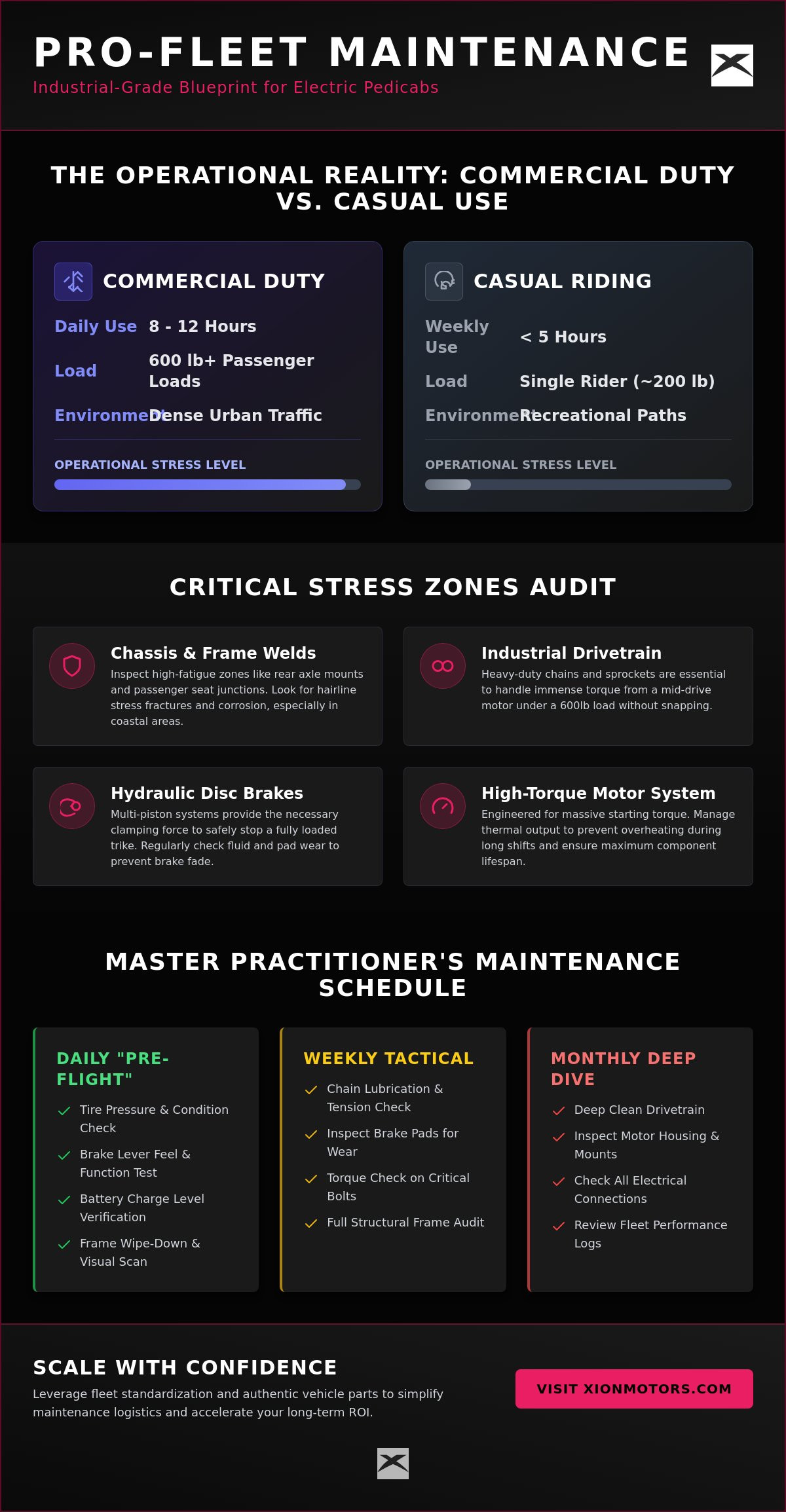
Industrial vehicles operate under a grueling "duty cycle" that would destroy a standard consumer e-bike. While a commuter bike might see five hours of use per week, a commercial Cycle rickshaw often runs 8 to 12 hours daily under massive passenger loads. This constant stress demands a Master Practitioner mindset. You must prioritize proactive inspection over reactive repair. It's about protecting your ROI. A meticulously maintained CyberX or VorteX unit retains a significantly higher resale value and ensures your investment doesn't evaporate into scrap metal through neglect.
The High Stakes of Commercial Fleet Uptime
Downtime is the silent killer of fleet profitability. A dead vehicle sitting in the garage during a major city festival or a sold-out stadium event is a catastrophe. It isn't just a missed fare; it's hundreds of dollars in lost revenue and advertising impressions every single hour. Beyond the balance sheet, structural integrity is your primary defense against liability. For tourism operators, a mechanical failure with passengers on board is an unacceptable risk. Well-maintained equipment also boosts driver morale. Professionals want to pilot machines that feel tight, responsive, and powerful. When the gear is solid, the tips follow.
Commercial vs. Casual: Understanding the Engineering Gap
The physics of a 50lb commuter e-bike and a 600lb, 6-seat commercial pedicab are worlds apart. Starting a full passenger load on an incline requires massive torque that would melt a standard hub motor. Industrial-grade trikes like the VorteX utilize reinforced chassis and a high-torque 750W direct-drive transaxle specifically engineered for these stresses. Standard bike shop parts often fail under the shear forces of a heavy trike. You need components that can handle the weight and the heat. Understanding this engineering gap is the first step toward professional-grade fleet management. If you use consumer-grade solutions for industrial-grade problems, you'll pay for it in constant repairs and lost uptime.
The Anatomy of Industrial Durability: Key Stress Points in CyberX and VorteX Models
A commercial trike is only as strong as its weakest weld. While casual e-bikes prioritize weight savings, industrial models like the CyberX and VorteX are engineered for survival. They utilize 4130 chromoly steel or reinforced aluminum frames to withstand the constant torsion of high-capacity passenger transport. This electric pedicab maintenance guide identifies the critical zones where engineering meets the pavement. You aren't just looking for dirt; you're auditing the structural integrity of a revenue-generating asset.
The drivetrain and braking systems represent the most significant mechanical burdens in your fleet. A high-torque 750W direct-drive transaxle generates immense force, driving the rear axle through a differential. This requires heavy-duty, industrial-grade drivetrain components that can handle the sudden engagement of the motor under a 600lb load without failing. Stopping that momentum is equally demanding. Multi-piston hydraulic disc brakes provide the necessary clamping force to ensure safety on steep inclines. Consistent Electric vehicle maintenance protocols for your motor and braking fluid are essential to prevent system fade during long shifts. If you notice a drop in performance, sourcing authentic Vehicle Parts is the only way to maintain factory-spec reliability.
Chassis and Frame Structural Audits
High-load areas require a surgical eye during your inspections. Pay close attention to the rear axle mounts and passenger seat junctions. These zones experience the highest fatigue during daily operations. Look for hairline stress fractures in the finish that may indicate underlying metal fatigue. In coastal cities, corrosion is your primary enemy. Wipe down frames daily to prevent salt air from compromising the 4130 chromoly. Verify that every passenger safety railing is torqued to spec. A loose mount is a liability you can't afford.
Heavy-Duty Wheel and Tire Management
Commercial wheels settle differently than consumer gear. The sheer weight of a 6-seat configuration means spokes require specialized tensioning to prevent dishing under load. Check your spoke resonance weekly to ensure the wheel remains true. Tire pressure is a strategic variable. A 3-seater may run comfortably at lower pressures, but a 6-seat VorteX requires maximum PSI to prevent sidewall deformation during tight turns. Monitor tread wear patterns closely. Uneven wear on one side of a tire usually points to an alignment issue or a bent axle that needs immediate correction.
The Master Practitioner’s Maintenance Schedule: Daily, Weekly, and Monthly Protocols
Consistency is the hallmark of a professional operation. While amateur operators react to breakdowns, the Master Practitioner follows a rigid schedule to preempt them. This electric pedicab maintenance guide outlines the essential protocols required to maintain your fleet's industrial-grade performance. By standardizing these rituals, you eliminate the guesswork that leads to costly downtime and ensure your assets remain on the street during peak revenue windows.
Success in the pedicab industry is built on repetition. When your vehicles are covering dozens of miles daily under heavy loads, small issues escalate quickly. A disciplined maintenance schedule acts as your first line of defense. It transforms maintenance from an occasional chore into a foundational business process. For those managing multiple units, aligning your internal processes with U.S. Department of Energy fleet guidelines provides a professional framework for safety and efficiency. Establish these protocols as non-negotiable standards for every member of your team.
The Daily Pre-Ride Safety Checklist
Every driver must perform a 5-minute pre-flight ritual before their shift begins. It's a simple process that prevents major liabilities. Start with the brake bite test. Pull the levers firmly to ensure immediate, crisp engagement under simulated load. Next, verify all lighting and visibility systems. Turn signals, brake lights, and ground effects must be fully functional to navigate dense urban traffic safely. Finally, inspect the battery security. Check that mount points are tight and connectors are free of debris. Clean connectors prevent arcing and power loss during high-torque maneuvers on inclines.
Weekly and Monthly Fleet Service Protocols
Weekly tactical service focuses on the drivetrain and fasteners. Urban grit is an abrasive that destroys gears. You must degrease the chain and cogs weekly to remove road grime before applying fresh, high-quality lubricant. Use a torque wrench to verify the integrity of critical bolts on axles, cranks, and steering stems. Hand-tightening isn't enough for industrial vehicles; precision is required to prevent component failure.
Monthly deep-audits shift the focus to the hydraulic systems and structural diagnostics. Inspect the passenger-braking circuit for any signs of fluid weeping or hose abrasion. Quarterly, perform a comprehensive performance tune. This includes battery cell balancing to ensure maximum range and motor firmware checks to keep your systems running at peak efficiency. These deep-dives protect the long-term health of your CyberX or VorteX fleet and guarantee the ROI you expect from high-performance equipment.
Advanced Troubleshooting: Managing High-Torque Motors and Battery Systems
Amateur operators view the motor and battery as a "black box" that works until it doesn't. A Master Practitioner understands that these components are the lifeblood of the fleet. Managing heat and electrical continuity is what separates a profitable season from one plagued by technical failure. This level of technical oversight is a core pillar of any professional electric pedicab maintenance guide. You must move beyond visual inspections to monitor the invisible forces of thermal load and voltage stability.
Thermal management is the primary challenge during back-to-back tours in high-traffic urban environments. When your motor hauls a full passenger load up an incline in 90-degree weather, it generates massive internal heat. Identifying the early signs of thermal throttling allows you to adjust routes or rotation schedules before a permanent shutdown occurs. Use your onboard diagnostic systems to monitor sensor data for early error codes. Early detection of a faulty Hall sensor or a frayed phase wire prevents a minor glitch from becoming a total system failure on the street.
Maximizing Battery Life for All-Day Operations
Battery ROI is won or lost in how you manage charge cycles. The 20-80% rule is your standard operating procedure. Avoid discharging your high-capacity lithium-ion packs below 20% whenever possible, as deep discharges accelerate chemical degradation. Full 100% charges are necessary for cell balancing, but leaving a pack at 100% in a hot garage is a mistake. For seasonal operators, off-season storage is the danger zone. You must maintain a storage charge of approximately 50% and check voltage monthly to prevent "bricking" the pack. If a battery begins to show "lazy cells" through inconsistent voltage sag, decommission it immediately to protect the rest of your fleet's electrical integrity.
Motor Performance and Drive System Care
Listen for the "tell." A healthy high-torque motor has a consistent, low-frequency hum. If you hear a high-pitched whine or feel a rhythmic vibration, you're likely dealing with motor bearing wear. Catching this early allows for a simple bearing replacement instead of a total motor swap. Smooth power delivery is also vital for passenger comfort. If the torque sensor feels jerky or unresponsive, recalibrate the system to ensure the assist engages predictably. Finally, weatherproofing is a non-negotiable task. Apply dielectric grease to industrial-grade connectors to prevent corrosion from rain or road salt. If your fleet needs specialized components to survive these conditions, source your Vehicle Parts directly from engineering experts who understand industrial duty cycles.
Scaling with Confidence: How Xion Motors Supports Long-Term Fleet Excellence
Scaling a fleet is a rigorous test of your operational infrastructure. If your maintenance protocols are fragmented, growth will only amplify your inefficiencies. Xion Motors serves as a strategic partner in this expansion, providing the engineering depth and standardized components required for high-level success. This electric pedicab maintenance guide concludes by focusing on the systems that allow you to manage ten vehicles as easily as one. True fleet excellence is achieved when maintenance becomes a predictable, scalable process rather than a series of emergency repairs.
Uniformity is the secret to rapid scaling. When your entire fleet consists of standardized CyberX or VorteX units, your maintenance cycle becomes predictable. Your technicians don't need to learn five different wiring diagrams or stock ten different tire sizes. They develop a specialized muscle memory for the specific torque specs and sensor layouts of Xion engineering. This standardization reduces human error and slashes the time each vehicle spends on the lift. It allows you to move with the speed of a modern industrial operation.
Authentic Parts and Commercial Continuity
Using "off-the-shelf" bicycle components on an industrial trike is a professional liability. Standard bike parts are designed for 180lb riders, not 600lb commercial loads. Xion's Vehicle Parts are purpose-built for the extreme stresses of urban transit. To maintain a 24-hour turnaround, keep an on-site inventory of essential spares like multi-piston brake pads, heavy-duty chains, and high-PSI tires. Leverage our national shipping to replenish your stock quickly. When you use authentic parts, you're investing in the safety of your passengers and the long-term viability of your business.
Building a Culture of Maintenance
Technology alone won't sustain your ROI; your team must embrace a culture of mechanical accountability. Link vehicle condition to operator incentives. When drivers know that a clean, well-maintained trike leads to performance bonuses, they become your first line of defense against neglect. Transition from paper checklists to digital logging software to track the health of every unit in real-time. This data-driven approach allows you to identify trends across the fleet and address potential failures before they occur.
Maintenance is the ultimate competitive advantage in the urban transit market. While competitors struggle with broken chains and dead batteries, your fleet remains visible and profitable. Xion's modular design also ensures future-proofing. You can upgrade motors or battery packs as technology evolves without the need to replace your 4130 chromoly chassis. This path allows you to grow with confidence, backed by the reliability of a traditional craftsman and the vision of a bold innovator.
Master Your Fleet Operations for Long-Term Profitability
Transitioning from reactive repairs to a disciplined framework is the only way to protect your ROI. This electric pedicab maintenance guide provides the blueprint to transform your fleet into a high-performance urban transit system. You now have the protocols to audit chassis integrity, manage high-torque thermal loads, and standardize service schedules across your entire operation. Consistency in these rituals ensures your vehicles remain on the street during the most lucrative event seasons.
Success in this industry belongs to those who prioritize uptime. Xion Motors brings over 20 years of fleet operation experience to your shop, providing the industrial-grade CyberX and VorteX engineering your business demands. We support your growth with national shipping to all 50 states, ensuring you never lose a day of revenue to logistics delays. Secure your fleet’s future with authentic Xion Motors parts and support. Your commitment to excellence starts in the garage and ends on the street. Build your legacy on the foundation of mechanical integrity and watch your business thrive.
Frequently Asked Questions
How often should I service my electric pedicab motor?
Service your motor every 500 miles or quarterly to ensure industrial-grade performance. High-torque commercial duty cycles generate significant heat and vibration that can loosen mounting bolts or fatigue phase wires. A disciplined inspection schedule prevents these minor issues from escalating into catastrophic motor failure during a peak event.
What are the most common points of failure in a 6-seat pedicab?
Structural stress fractures and drivetrain fatigue are the primary failure points due to the massive 600lb payload. Rear axle mounts and spoke tension often fail first if they aren't monitored with professional-grade precision. This electric pedicab maintenance guide emphasizes checking these high-load zones daily to ensure uncompromising passenger safety and operational uptime.
Can I use standard bicycle tires on a commercial electric trike?
No, standard bicycle tires lack the load rating and sidewall reinforcement required for industrial trikes. Using consumer-grade tires on a CyberX or VorteX leads to rapid blowouts and rim damage under heavy passenger loads. You must use heavy-duty, high-PSI tires specifically engineered for the shear forces and weight of multi-passenger commercial transit.
How long do the batteries last in a commercial pedicab fleet?
Commercial lithium-ion packs typically provide 2 to 4 years of reliable service depending on your charge cycle management. Following the 20-80% rule and avoiding deep discharges is essential for maximizing your battery ROI. Extreme temperatures and poor storage habits during the off-season are the primary factors that degrade high-capacity power systems prematurely.
Do I need a specialized mechanic for CyberX or VorteX maintenance?
You need a technician who understands high-voltage electrical systems and industrial-grade mechanics. While many tasks resemble standard bike repair, the torque requirements and hydraulic braking systems demand a more sophisticated approach. Xion Motors provides engineering support and standardized protocols to help your local team master this electric pedicab maintenance guide.
How do I clean my electric pedicab without damaging the electronics?
Use a low-pressure wash and a damp cloth to clean the chassis while avoiding direct spray on the motor, controller, and display. High-pressure water can bypass seals and cause short circuits or corrosion in sensitive connectors. Always dry the drivetrain and re-lubricate the chain immediately after cleaning to prevent urban grit from causing premature wear.
What spare parts should I always have in stock for my fleet?
Maintain an on-site inventory of multi-piston brake pads, heavy-duty chains, and high-PSI tires to eliminate unexpected downtime. It's also wise to stock spare spokes and a replacement torque sensor for rapid repairs. Having these high-wear Vehicle Parts ready ensures your fleet stays on the street during your most lucrative revenue windows.
Is it worth upgrading the motor on an older pedicab model?
Upgrading is a powerful way to extend the life of a high-quality 4130 chromoly steel chassis. If the frame remains structurally sound, installing a modern high-torque motor can significantly boost performance and driver efficiency. This approach allows you to modernize your fleet and improve street-level results without the capital expense of full vehicle replacement.
Thinking about starting or scaling a pedicab operation?
See what a pedicab costs ($13,500–$15,000 direct from the manufacturer), explore fleet pricing on 3+ units, or start with $0-down equipment financing. Xion operators earn $30,000–$35,000 per cab per year across 59+ US markets.