The U.S. out-of-home advertising industry generated a record-breaking $2.12 billion in revenue in the first quarter of 2026. While most operators struggle with low per-ride income, the most profitable fleets have shifted their focus from simple transportation to high-impact mobile media. You've likely felt the frustration of losing a major sponsor because your equipment looked amateur or your wraps started peeling in harsh street conditions. Effective branding a pedicab fleet requires more than just a sticker; it demands an industrial-grade approach to both design and durability. We've spent decades in the trenches perfecting the hardware and the strategy that turns a basic trike into a high-performance marketing canvas.
This guide provides the definitive blueprint for transforming your operation into a professional media powerhouse that commands $30,000 or more in annual revenue per vehicle. You'll learn how to leverage precision engineering to ensure fleet uniformity and secure the kind of multi-year contracts that provide long-term financial security. We'll examine everything from selecting the right chassis for maximum wrap longevity to the granular operational insights that satisfy the world's most demanding corporate sponsors.
Key Takeaways
- Transition from a "bike taxi" mindset to a media-first model to unlock multi-year sponsorship contracts and stable recurring revenue.
- Learn how branding a pedicab fleet starts with industrial-grade chassis engineering to provide a durable, high-performance canvas for marketing agencies.
- Pinpoint high-impact visual real estate on 3-seat and 6-seat models to command premium daily advertising rates.
- Implement a "zero-defect" maintenance rule to prevent peeling wraps from jeopardizing lucrative corporate partnerships.
- Scale your identity using uniform fleet packages that ensure consistent brand messaging across high-traffic urban markets.
Why Branding a Pedicab Fleet is the Ultimate ROI Driver in 2026
The landscape of urban mobility has undergone a radical transformation. In 2026, successful operators no longer view themselves as simple transportation providers; they are media moguls operating street-level assets. While the global use of pedicabs historically focused on moving passengers from point A to point B, the modern industry prioritizes media dominance. You aren't just selling a ride; you're selling high-frequency impressions in historic districts and entertainment hubs where traditional billboards are often prohibited. This shift from "bike taxi" to mobile billboard is the primary catalyst for explosive growth in fleet profitability.
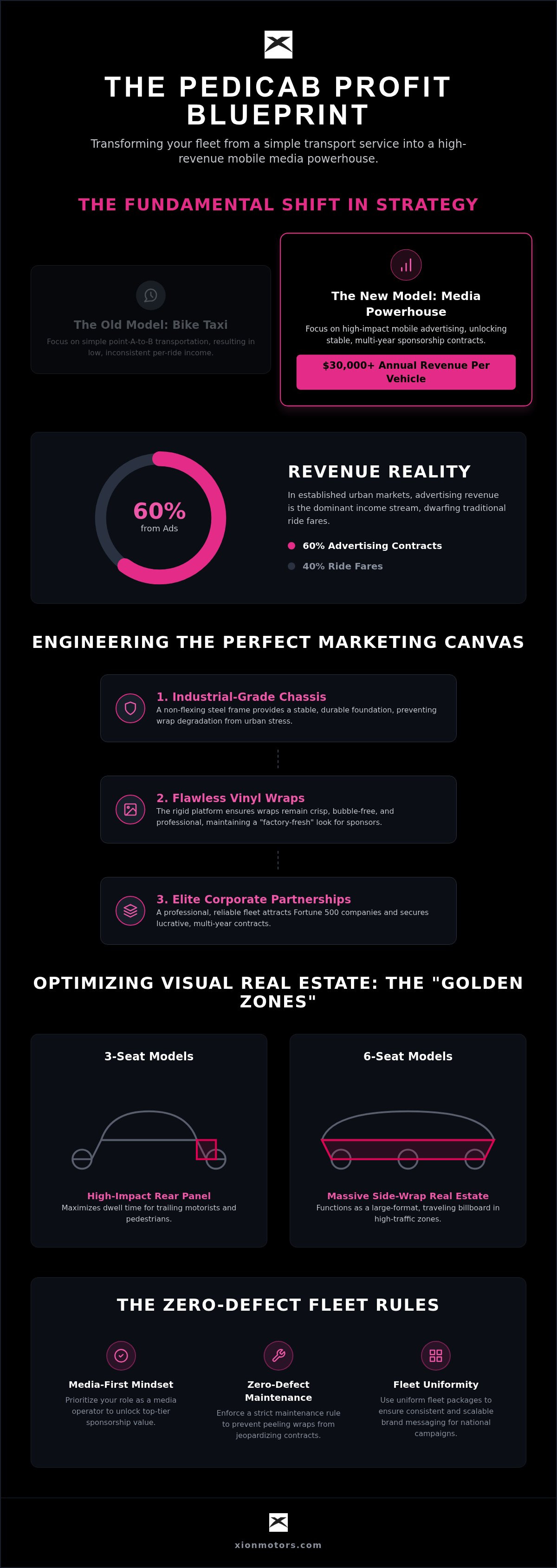
Analyzing the multi-stream revenue model reveals a stark reality: ride fares provide the floor, but advertising contracts provide the ceiling. In established urban markets, advertising revenue now accounts for as much as 60% of a fleet's total annual earnings. Corporate sponsors don't invest in DIY builds or amateur equipment that looks "cheap" on the street. They demand industrial-grade marketing canvases that reflect their brand's prestige. Using branding a pedicab fleet as a core business strategy ensures your vehicles look like professional assets rather than hobbyist projects. This professional appearance is the fundamental requirement for securing high-value contracts with Fortune 500 companies.
The Math Behind the $30k+ Annual Revenue Goal
Hitting the $30,000 revenue mark per vehicle requires a sophisticated approach to sponsorship tiers. You must move beyond small local ads and target title sponsors who want full-vehicle dominance. Revenue-per-impression for pedicabs is a metric calculated by dividing the total sponsorship cost by the estimated number of eyes on the vehicle during peak hours in high-traffic zones. When you operate a uniform fleet of CyberX or VorteX models, you increase the collective contract value because national brands can execute a cohesive campaign across your entire operation. Professional uniformity eliminates the "mismatch" look that drives away elite marketing agencies.
Attracting Elite Corporate Partnerships
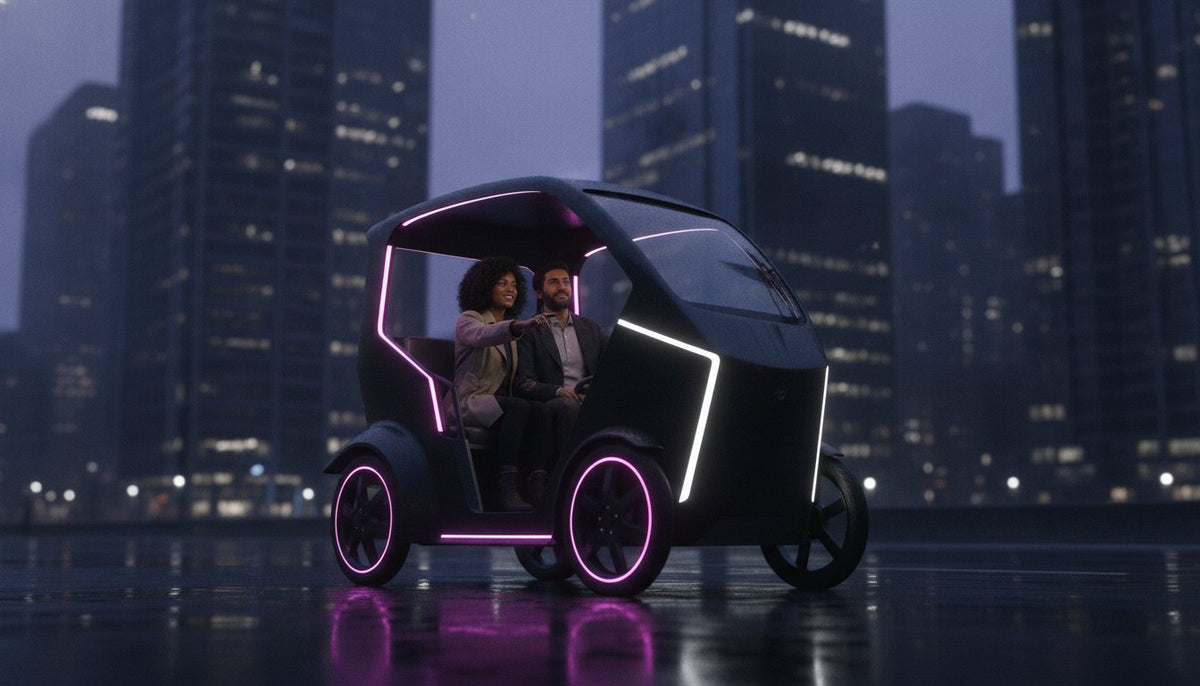
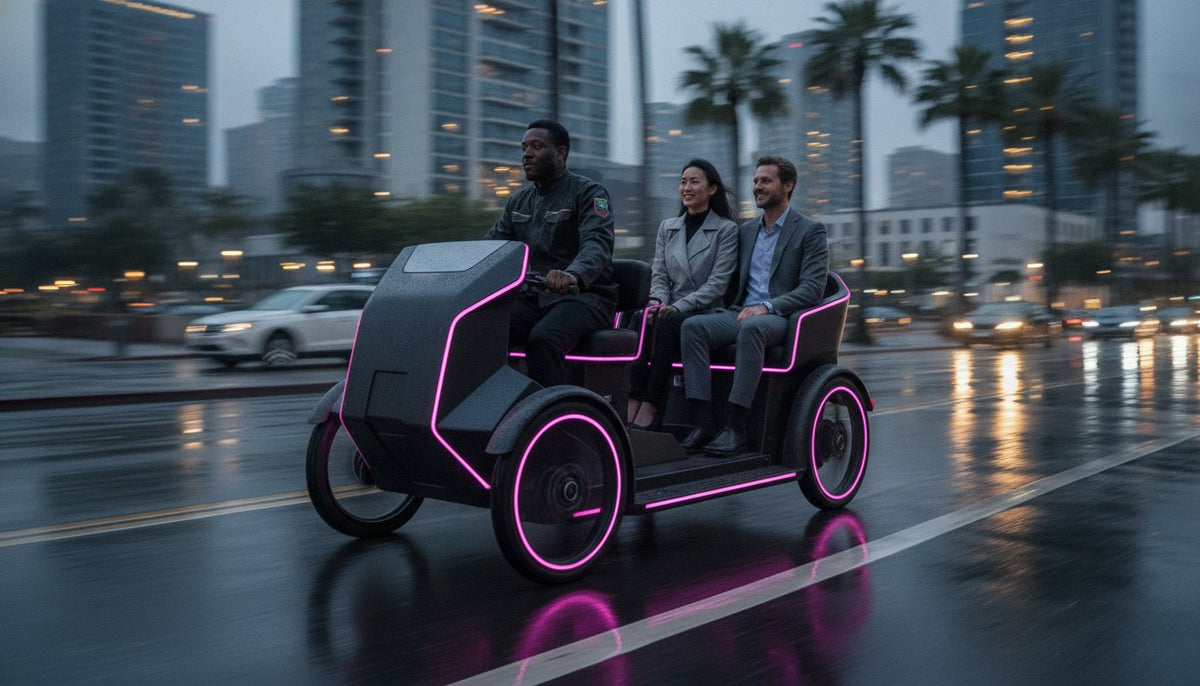
Position your fleet as a premium experiential marketing solution rather than a mere transit service. Elite sponsors prioritize brand safety above all else. They need to know their logo is attached to reliable, high-end hardware that won't break down or look dilapidated mid-campaign. High-torque drive systems and USA-based manufacturing provide the rugged authority sponsors trust. To maximize "stopping power," integrate digital components or social media-friendly elements into your physical branding. A branded pedicab fleet that looks like a futuristic piece of precision engineering naturally draws smartphones out of pockets, creating organic social media reach that extends far beyond the physical street corner.
Engineering the Perfect Marketing Canvas: Hardware Requirements
Professional branding is an engineering challenge, not just a graphic design task. When branding a pedicab fleet, the chassis serves as the literal foundation for every dollar of advertising revenue you generate. Successful branding a pedicab fleet relies on a frame that doesn't flex, ensuring your wraps stay crisp and professional for the duration of a high-stakes campaign. If a frame lacks structural rigidity, it will flex under the stress of daily urban operation, causing high-end vinyl wraps to stretch, bubble, and eventually peel. We build the CyberX and VorteX with industrial-grade steel precisely because a stable platform is the only way to maintain a "factory-fresh" look for corporate sponsors.
Visual Real Estate Optimization
Identifying the "Golden Zones" on your vehicles is critical for maximizing ROI. On 3-seat models, the rear panel offers the highest dwell time for trailing motorists, while the larger 6-seat configurations provide massive side-wrap "real estate" that functions like a traveling billboard. It's well-documented that vehicle wrapping raises brand visibility by turning every transit mile into a high-frequency marketing event. You must design for three dimensions, ensuring logos are legible from sharp street angles and elevated positions in urban canyons. For operators who refuse to compromise on visual impact, the CyberX: The Industrial-Grade Engineering Standard provides the flat, broad surfaces required for seamless, high-resolution vinyl application.
Durability Meets Aesthetics
Modern marketing standards in 2026 demand that mobile assets remain in pristine condition regardless of weather or usage intensity. Industrial-grade builds are required because standard bike components cannot withstand the additional aerodynamic drag and physical weight of heavy branding panels and polycarbonate enclosures. Our high-torque drive systems are specifically engineered to maintain performance even when the vehicle is fully loaded with passengers and custom marketing installations. If the drive system struggles under the weight of the branding, the ride quality suffers, and the brand association turns negative. We focus on the rugged authority of our builds so that your sponsors see a partner that is built to last. You can explore our electric pedicabs to see how we integrate power with professional-grade aesthetics.
Strategic Branding Models: Wraps, Panels, and Brand Ambassadors
Success in the mobile media sector requires a tiered approach to visual assets. When branding a pedicab fleet, you must offer sponsors a range of entry points that balance cost with visual dominance. Full-vehicle wraps represent the ultimate statement for title sponsors, providing a 360-degree immersive experience that traditional static signage cannot match. For short-term event activations like conventions or festivals, modular branding using interchangeable panels allows for rapid turnover. This flexibility ensures your fleet remains active and revenue-positive even between major long-term contracts.
Modern campaigns often extend beyond static graphics. Integrated technology, including weatherproof LED displays and high-fidelity audio systems, turns a standard ride into a sensory marketing event. The Out of Home Advertising Association of America recognizes mobile OOH as a primary driver of consumer engagement in dense urban environments. By leveraging the high-torque power of a professional chassis, you can support these additional electronic components without sacrificing vehicle range or performance.
Comparison of Branding Tiers
Choosing the right model depends on the sponsor's goals and your operational capacity. While full wraps command the highest daily rates, they require more significant downtime for installation. Modular panels, conversely, offer a "plug-and-play" solution for high-velocity event weekends. The following table breaks down the operational impact of these common branding strategies.
| Branding Tier | Impact Level | Installation Time |
|---|---|---|
| Full-Vehicle Wrap | Extreme | 4-6 Hours |
| Partial Wrap | High | 2-3 Hours |
| Modular Panels | Medium | 15-30 Minutes |
The Human Element: Drivers as Brand Voices
The driver is the final layer of your branding strategy. In a high-touch experiential campaign, the operator becomes a brand ambassador who can distribute samples, collect data, or deliver specific talking points to passengers. Professional uniformity is non-negotiable; a driver in a branded kit suggests a level of rugged authority that "gig economy" riders lack. If you're currently starting a pedicab company, building this human element into your initial pitch is vital. Equipping your team with deep brand knowledge transforms a simple trip into a premium interaction, justifying the higher rates that national sponsors are willing to pay for professional-grade execution.
Operational Maintenance: Protecting Your Branded Assets
In the high-stakes world of mobile media, a single flaw in your presentation can jeopardize an entire campaign. We follow the "Zero-Defect" rule. If a wrap is peeling or faded, it signals to the sponsor that their brand isn't being handled with professional-grade care. This isn't just about aesthetics; it's about contract security. Successful operators know that branding a pedicab fleet requires a rigorous maintenance schedule to prevent minor street-level damage from becoming a major liability. One visible defect can cost you a multi-year contract because elite sponsors demand perfection.
Industrial-grade cleaning protocols for high-gloss vinyl and polycarbonate surfaces are mandatory. Avoid harsh solvents that degrade adhesive or cloud the finish. Instead, use safe, pH-neutral cleaning agents that preserve the vibrancy of the graphics. We recommend keeping quick-fix kits on hand. These kits should contain matching vinyl patches and edge sealers to handle minor abrasions immediately before they escalate into full-panel failures. For a deeper dive into the mechanical side of things, consult our Electric Pedicab Maintenance Guide: Sustaining Performance.
The 2026 Branding Maintenance Checklist
- Daily visual inspections: Check specifically for edge lift on high-impact zones and monitor for UV fading, especially on darker colors.
- Safe cleaning agents: Use pH-neutral solutions that preserve the vibrancy of high-gloss vinyl without degrading the adhesive.
- Rapid replacement protocol: Ensure branded assets return to the street within 24 hours of a minor collision to fulfill impression quotas.
Long-Term Asset Preservation
The durability of the chassis is the foundation for wrap longevity. Protecting the VorteX chassis from corrosion and structural stress ensures the mounting surfaces remain flat and smooth for years, providing a consistent canvas for new sponsors. Use UV-protectant sprays to extend the life of high-resolution graphics, particularly in sun-drenched urban markets. There is a direct, measurable correlation between vehicle cleanliness and sponsor satisfaction; a spotless fleet commands the respect of elite partners. If you want to ensure your equipment reflects the quality of your service, invest in our industrial-grade electric pedicabs to build a foundation that lasts.
Scaling Your Identity with Xion Motors Fleet Packages
To dominate a metropolitan market, you need scale. National advertisers rarely buy single vehicles; they buy networks. Professional branding a pedicab fleet at scale requires a partner who understands the logistics of national deployment and high-volume asset management. We provide direct-to-operator support to ensure your growth is managed with precision. Our 20 years of fleet experience informs every package we build. Whether you're operating 5 units or 50, our fleet packages are designed to maximize your ROI by reducing initial capital expenditure while maintaining industrial-grade standards. You can explore the specifics in our Electric Pedicab Fleet Packages: 2026 Guide to Scaling ROI.
We offer aggressive tier-based pricing to facilitate rapid expansion into new territories. A 3-vehicle starter fleet qualifies for a 10% discount, while operators scaling to 10 or more vehicles can access 15% discounts. This pricing strategy allows you to deploy more "marketing real estate" per dollar spent. It's the most efficient way to secure the high-capacity volume required for major convention activations. By utilizing USA-based manufacturing, we ensure that every vehicle delivered meets the same rigorous quality benchmarks, regardless of the order size.
Standardizing Your Fleet Appearance
Mixed-fleet aesthetics are a major deterrent for elite national advertisers. If your fleet consists of mismatched frames and varying build qualities, your brand messaging becomes fragmented and looks amateur. Utilizing the VorteX and CyberX platforms ensures a cohesive, professional look across your entire operation. The 6-seat models are particularly effective for large-scale event branding. They offer massive surface areas that function as mobile billboards, providing sponsors with the high-impact visibility they crave. When every vehicle in your fleet matches, you project the rugged authority of a master practitioner. This uniformity makes your company the definitive choice for premium, high-stakes marketing campaigns.
Next Steps for Professional Operators
The 2026 season is approaching, and the demand for street-level media is at an all-time high. Consulting with our team allows you to customize trike configurations to meet the specific demands of your local urban market. We offer specialized pricing for operators who secure their fleet allocations early. Don't settle for amateur equipment that limits your revenue potential or compromises your brand safety. Our high-torque drive systems and precision-engineered frames are ready to serve as your ultimate marketing canvas. Scale your fleet with Xion Motors industrial-grade pedicabs today.
Dominate the Urban Media Landscape in 2026
The shift toward a media-first business model is no longer a futuristic prediction; it's the current reality for high-revenue operators. Success in branding a pedicab fleet depends entirely on the quality of your foundation. You can't secure premium sponsorship contracts with flimsy equipment that peels or flexes under pressure. Professional partners demand the "zero-defect" presentation that only an industrial-grade, USA-made chassis can provide.
Our team brings over 20 years of fleet operation experience to your business. We've spent decades in the trenches, perfecting the hardware and the operational strategies required to scale commercial transit fleets. By choosing precision-engineered vehicles like the CyberX and VorteX, you ensure every unit delivers a consistent, high-impact message. We offer direct-to-operator fleet pricing to help you capture the 2026 market with confidence. It's time to stop thinking like a bike taxi and start operating like a dominant media powerhouse.
Scale your operation with Xion Motors professional fleet packages and build a legacy of industrial excellence. Your market is waiting.
Frequently Asked Questions
How much revenue can a branded pedicab generate annually?
A single branded pedicab can generate between $30,000 and $35,000 in annual gross revenue through advertising contracts. In high-traffic urban markets, monthly advertising revenue per vehicle typically ranges from $2,500 to $3,000. This figure excludes passenger fares, which provide a secondary revenue stream. Successful operators prioritize these media contracts because they offer recession-proof stability compared to the variable nature of daily ride fares.
What is the best material for pedicab wraps in 2026?
The industry standard in 2026 is high-performance cast vinyl paired with a UV-protectant laminate. This material is specifically engineered to adhere to the industrial-grade surfaces of the CyberX and VorteX chassis. It resists peeling and fading even in harsh street conditions. Using premium materials ensures that branding a pedicab fleet maintains a professional appearance for the duration of multi-year sponsorship contracts and high-stakes event activations.
How do I pitch my pedicab fleet to corporate sponsors?
Pitch your fleet as a high-impact mobile media asset rather than a simple taxi service. Provide sponsors with data-driven metrics like estimated daily impressions and dwell times in historic or entertainment districts. Emphasize the "stopping power" of professional-grade vehicles and the ability of drivers to act as brand ambassadors. Highlighting your industrial-grade equipment reassures sponsors of brand safety and operational reliability throughout the entire campaign.
Do I need special insurance for branded pedicab operations?
Yes, you must secure comprehensive general liability insurance that specifically covers commercial pedicab operations. Many corporate sponsors also require you to carry advertising liability insurance to protect their brand during the campaign. Research brief data indicates that ongoing maintenance and insurance costs typically range between $2,000 and $4,000 annually per vehicle. Always verify local municipal requirements, as regulations vary significantly across different states.
How long does a professional pedicab wrap typically last?
A professional-grade vinyl wrap typically lasts between 12 and 24 months when maintained with proper cleaning protocols. Factors like UV exposure and street-level abrasions impact longevity. To maximize the lifespan of your branded assets, implement daily visual inspections and use pH-neutral cleaning agents. Protecting the underlying chassis ensures the wrap maintains its high-gloss finish without bubbling or lifting at the edges during daily operations.
Can 6-seat pedicabs generate more branding revenue than 3-seat models?
Yes, 6-seat models often command higher advertising rates due to their massive visual real estate. The larger side panels function as mobile billboards, offering significantly more surface area for complex graphics and brand messaging. These vehicles are particularly attractive for large-scale event activations where sponsors want to maximize their presence in crowded urban environments. Scaling your fleet with larger units increases the total contract value for national advertisers.
What are the most effective areas on a pedicab for brand placement?
The most effective "Golden Zones" for branding a pedicab fleet include the rear panel, side wraps, and wheel discs. The rear panel offers the highest dwell time for trailing motorists; side wraps provide massive visibility for pedestrians. Designing for three dimensions ensures that the brand remains legible from every street angle. Professional uniformity across these zones is essential for maintaining the high-end look that corporate sponsors demand.
How does electric assist impact the branding potential of a fleet?
Electric assist is a critical driver of branding ROI because it ensures consistent performance regardless of terrain or the weight of branding panels. High-torque drive systems allow vehicles to maintain a steady pace, maximizing the duration and quality of impressions. This technology also enables the integration of digital components like LED displays and audio systems. These tech-forward features significantly increase the "stopping power" and overall market value of your branded fleet.