A single industrial-grade electric pedicab can generate over $30,000 in annual revenue, but many operators watch those profits vanish because they lack a clear understanding of commercial pedicab fleet pricing. You've likely felt the frustration of underpowered motors stalling under full passenger loads or the sting of constant repairs that keep your vehicles off the street. It's an expensive lesson in why consumer-grade hardware fails in a professional environment.
This guide provides the definitive breakdown of commercial pricing and the industrial engineering standards required to dominate the 2026 market. We'll show you how to justify the premium cost of heavy-duty builds by focusing on long-term durability and maximum revenue per vehicle. You'll get a clear framework for fleet discounts on orders ranging from 3 to 10+ units and see how the right brand delivers a 300% ROI within the first year of operation. We're moving past the whimsical talk of "green" transport to focus on the rugged, high-torque reality of running a profitable, street-legal fleet.
Key Takeaways
- Identify why consumer-grade e-bikes fail in professional duty cycles and why industrial-grade propulsion is the new 2026 standard for high-traffic operations.
- Navigate commercial pedicab fleet pricing by comparing base costs for 3-seat and 6-seat models while leveraging manufacturer-direct discounts for orders of 3 to 10+ units.
- Calculate your true Total Cost of Ownership by factoring in a 20-year engineering legacy that supports annual revenues of up to $35,000 per vehicle.
- Maximize passenger capacity and revenue per operator by selecting the optimal mix of CyberX and VorteX units for your specific urban environment.
- Secure your investment with aircraft-grade chassis durability designed to withstand rigorous 12-hour shifts without the frequent downtime of lower-tier brands.
The Landscape of Commercial Pedicab Brands in 2026
The transition from manual labor to high-torque electric propulsion is a settled reality for serious operators. While the global history of pedicabs is rooted in simple manual trikes, the 2026 market demands industrial-grade machinery capable of sustained performance. Operators who try to cut corners with consumer e-bike components quickly learn an expensive lesson; a standard bicycle frame simply can't handle 1,000-pound passenger loads during a 12-hour duty cycle without catastrophic failure.
Securing commercial liability insurance is the first major hurdle for any professional fleet. Carriers now look for UL 2849 safety certifications as a prerequisite for competitive rates, which typically range from $450 to $1,000 per year for a standard policy. If your equipment doesn't meet these industrial standards, your premiums will skyrocket, or you'll be denied coverage entirely. This regulatory pressure is a primary driver of commercial pedicab fleet pricing, as the initial investment reflects the engineering required to stay legal and profitable.
Consumer vs. Commercial Grade Engineering
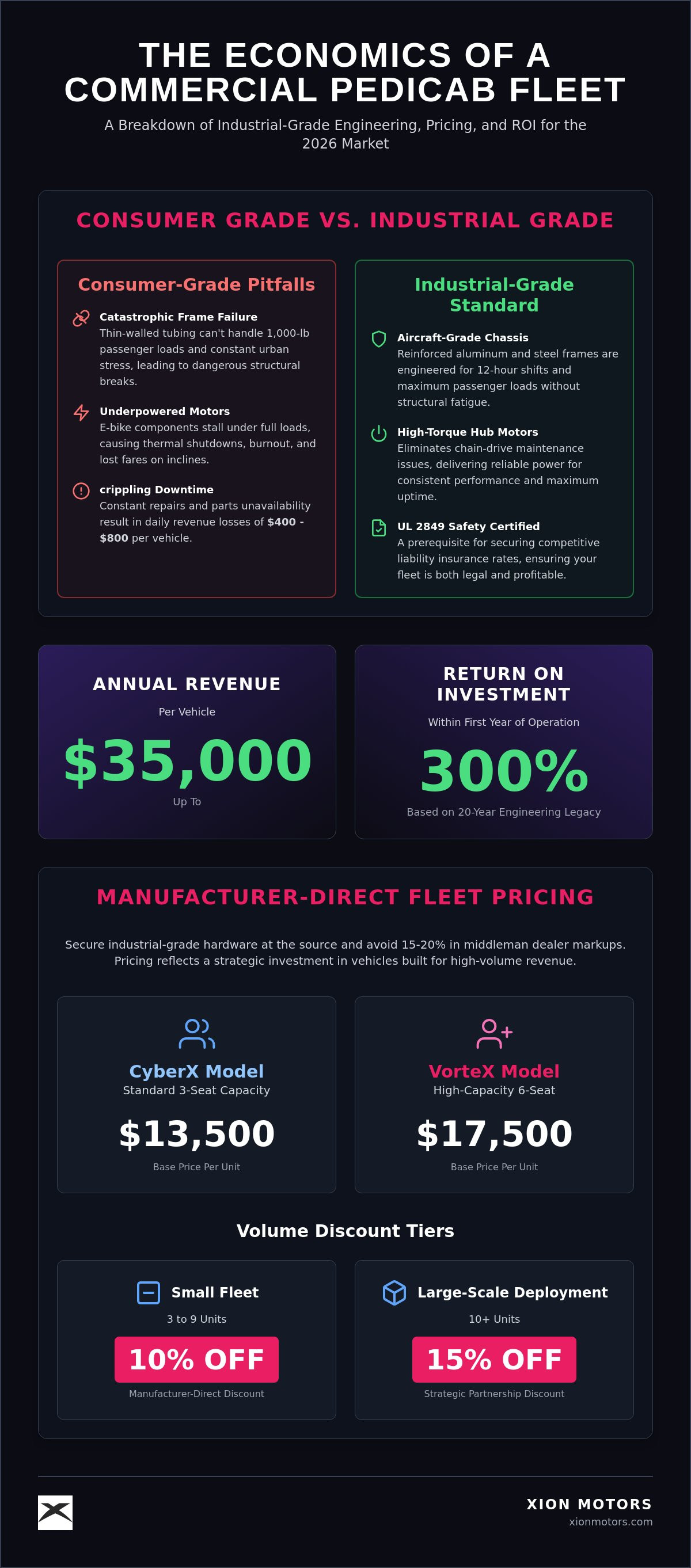
Frame thickness and axle strength are non-negotiable when you're moving six passengers. Consumer e-bikes use thin-walled tubing that eventually shears under the stress of constant stopping and starting in urban traffic. Industrial units utilize aircraft-grade aluminum and steel reinforcement to ensure the chassis remains rigid under maximum load. This structural integrity is what separates a professional tool from a hobbyist vehicle.
The hidden cost of cheap equipment is downtime. Underpowered motors in consumer-grade trikes struggle with full passenger loads, leading to frequent thermal shutdowns and component burnout. While some brands still rely on chain-drive systems, the industry is moving toward high-torque hub motors. These systems eliminate the maintenance headaches of broken chains and stripped gears, ensuring your cab stays on the street making money instead of sitting in the shop.
The 2026 Market Leaders: Who is Building for ROI?
A few elite brands currently dominate the US entertainment districts by focusing on USA-based production. This domestic focus ensures that parts availability is never an issue, which is critical when you consider that a single day of downtime can cost an operator $400 to $800 in lost revenue. Reliability isn't just a technical spec; it's a financial necessity for scaling a business.
Xion Motors stands as a master practitioner in this space, leveraging a 20-year legacy of fleet operation expertise to refine their vehicle architecture. Their CyberX and VorteX models are built from two decades of street-level data, prioritizing rugged durability over whimsical design. They understand that commercial pedicab fleet pricing must be balanced against a vehicle's ability to generate a 300% ROI within its first year. By engineering for the realities of the street, these market leaders provide the financial security fleet owners need to grow their footprint with confidence.
Commercial Pedicab Fleet Pricing and Tiers
Transparency in commercial pedicab fleet pricing is the foundation of a scalable transportation business. Most operators lose significant margin by working through middleman dealers who add 15 to 20 percent markups without providing additional engineering value. By purchasing direct from the manufacturer, you secure industrial-grade hardware at the source. Base pricing for the 2026 season starts at $13,500 for standard 3-seat models, while high-capacity 6-seat models are priced at $17,500. These figures represent a strategic investment in vehicles designed for high-volume revenue generation.
Logistics for national delivery have stabilized in 2026, though freight shipping averages should be verified at the time of order. Shipping a fleet requires precision handling to ensure vehicles arrive street-ready. It's also vital to consider local pedicab fleet licensing requirements, as some jurisdictions limit the number of units a single entity can operate. Scaling your fleet isn't just about capital; it's about navigating the regulatory landscape while maximizing your unit-level profitability.
Volume Discount Structures for Fleet Operators
Scaling from a single pilot vehicle to a regional fleet requires a tiered approach to capital expenditure. Small fleets consisting of 3 to 9 units qualify for a 10 percent discount, providing an immediate advantage to entrepreneurs entering high-traffic entertainment districts. For large-scale deployments of 10 or more units, a 15 percent strategic discount applies. This tiered model allows you to aggressively expand your footprint while lowering your average cost per seat. For specialized business applications, the Custom VorteX Trike offers a modular platform for unique branding or utility needs, with pricing tailored to specific engineering requirements.
Financing and Amortization Strategies
Smart operators don't view the sticker price in isolation. They amortize the purchase over the first 12 months of operation. While a higher upfront cost for an industrial-grade CyberX might seem daunting, it significantly reduces long-term operational expenses by minimizing unplanned maintenance. You aren't just buying a trike; you're buying uptime. For those looking to enter the market with lower initial capital, certified pre-owned cabs typically range from $7,000 to $11,000, though availability is often limited due to high demand for proven chassis. To see how these numbers fit your specific market, consider reviewing our current Pedicab Fleet Packages for a complete breakdown of equipment and support.
Industrial-Grade Engineering: CyberX vs. The Market
Engineering is survival. In the high-stakes environment of urban transit, the "Master Practitioner" approach defines our philosophy. We don't build based on theory; we build based on 20 years of street-level data gathered from operating our own fleets in the most demanding entertainment districts in the country. While competitors focus on whimsical aesthetics or interactive iPad stands, we prioritize the mechanical integrity required to keep a vehicle running 12 hours a day, seven days a week. This focus on durability is a core driver of commercial pedicab fleet pricing, as an industrial-grade chassis prevents the frame fatigue that plagues consumer-grade alternatives.
Durability starts with the skeleton. Our chassis utilize a combination of aircraft-grade aluminum and strategic steel reinforcement. This hybrid construction ensures the vehicle remains lightweight enough for efficient battery use while maintaining the rigidity necessary to support a full 6-passenger load. When you're navigating steep inclines or sudden stops in heavy traffic, you need a vehicle that doesn't flex or groan under pressure. High-torque performance isn't just a luxury; it's a safety requirement for professional operators who refuse to let a full cab stall out on a hill.
The Anatomy of the CyberX Powerhouse
The drive system is the heart of our commercial electric pedicabs. We utilize advanced Battery Management Systems (BMS) to ensure multi-shift reliability and prevent the thermal issues common in uncertified e-bike batteries. Stopping power is equally critical. While some brands cut costs with mechanical brakes, we employ heavy-duty hydraulic disc brakes designed for high-mass deceleration. This ensures consistent performance even when the vehicle is at its maximum gross weight. Maintenance-friendly design is baked into every component, reducing "time-off-street" and ensuring your fleet stays in the revenue-generating lane.
Passenger Experience and Aesthetic Authority
Curb appeal translates directly to higher tip percentages and premium booking rates. A rugged, professional-looking vehicle commands respect and attracts high-value passengers who might hesitate to board a flimsy, DIY-looking trike. Seat ergonomics and safety features are optimized for both 3-seat and 6-seat configurations, providing a secure and comfortable ride that encourages repeat business. For operators looking to integrate specific brand identities, our custom electric trikes for business offer extensive branding options. This aesthetic authority, combined with the security of industrial engineering, justifies the initial commercial pedicab fleet pricing by delivering a superior, long-term return on investment.
Calculating Total Cost of Ownership (TCO) and ROI
Successful fleet management requires looking past the initial commercial pedicab fleet pricing to understand the total cost of operation. A vehicle is only an asset when it stays on the street. While the sticker price is the largest upfront hurdle, the true value of an industrial-grade build reveals itself in the first 12 months of service. Industrial-grade electric pedicabs are designed to minimize the expensive downtime that cripples smaller, consumer-focused operations. When your equipment is engineered for the street, your electric pedicab ROI can realistically reach $30,000 to $35,000 in annual gross revenue per unit.
Operating expenses remain remarkably low for electric fleets, but they must be budgeted with precision. Electricity costs are negligible compared to gas-powered transit, yet maintenance protocols are non-negotiable. Following a rigorous electric pedicab maintenance guide ensures that high-torque motors and hydraulic braking systems remain in peak condition. Unplanned repairs are the enemy of profit. By performing scheduled inspections on drive systems and chassis integrity, you prevent the $400 to $800 daily revenue loss associated with a vehicle being out of commission.
Revenue isn't limited to passenger fares. The advertising multiplier is a critical component of the professional business model. Pedicab advertising offers a Cost Per Thousand Impressions (CPM) of $1 to $4, which is among the lowest in the out-of-home marketing industry. By utilizing vinyl wraps or digital displays, your fleet generates passive income while moving through high-traffic entertainment districts. This secondary revenue stream often covers the entire annual insurance and permitting cost for the vehicle, effectively turning your fleet into a self-sustaining marketing agency.
The First-Year Operational Budget
A professional budget must account for the regulatory and safety costs of passenger transit. Commercial general liability insurance for a $1 million policy typically costs between $450 and $1,000 per year. You must also factor in city-specific permit fees and vehicle registration, which vary significantly from NYC to Las Vegas. Additionally, set aside a contingency fund for professional wheel maintenance and replacement parts. Industrial use is punishing, and having the capital ready for wear-and-tear items ensures your fleet never misses a high-volume event.
Maximizing Your Payback Period
Most Xion operators achieve full payback on their investment in less than 12 months. This rapid recovery of capital is driven by high-volume deployments in dense entertainment and historic districts where demand for short-range transit is constant. By doubling passenger capacity without increasing labor costs, 6-seat models effectively slash the payback period and drive significantly higher margins per shift. To begin your deployment with a partner who understands the math of the street, explore our current fleet inventory and secure your 2026 territory.
Securing Your Fleet: Packages and Implementation
Strategic growth requires more than just capital; it demands a calculated mix of hardware. Most successful operators balance their inventory between the agile CyberX and the high-capacity 6 seat electric pedicab. This variety allows you to pivot between solo commuters and large tourist groups without leaving revenue on the sidewalk. By working directly with Xion Motors, you bypass the inflated dealer markups that often obscure the true commercial pedicab fleet pricing, ensuring every dollar of your investment goes directly into industrial-grade engineering.
Implementation is where your business moves from a spreadsheet to the street. While some competitors push expensive leasing models that drain your long-term equity, direct ownership through our specialized packages secures your assets and your future. Ownership is the only path to the 300 percent ROI mentioned in our previous analysis. Once your order is finalized, the focus shifts to street-ready deployment, ensuring your operators are trained on the specific high-torque systems that define our brand. If you're currently in the planning phase, follow our starting a pedicab company guide to ensure your legal and operational foundations are as rigid as our chassis.
Custom Fleet Configurations
Your market dictates your configuration. Tourism-heavy districts in cities like Charleston or San Diego demand a focus on passenger comfort and aesthetic authority, whereas urban logistics hubs might prioritize the Custom VorteX Trike for its modular utility. Integrating cargo or flatbed models into your fleet provides a multi-purpose edge, allowing you to generate revenue during off-peak passenger hours. Sustaining this continuity requires immediate access to specialized vehicle parts. We maintain a deep inventory of components specifically for our fleet partners, eliminating the weeks of downtime associated with overseas suppliers.
Ordering and National Shipping Logistics
Navigating the 50-state shipping process requires a veteran logistical partner. We manage the freight process for industrial-grade trikes to ensure they arrive calibrated and ready for immediate service. Lead times for large-scale fleet orders are managed with precision, allowing you to time your deployment with peak seasonal demand or major regional events. Finalizing your electric pedicab fleet packages involves a detailed consultation to confirm your discount tiers and shipping schedule. This methodical approach to commercial pedicab fleet pricing ensures that your expansion is both predictable and profitable from day one.
Dominating the 2026 Urban Transit Market
Success in the professional pedicab industry isn't about finding the lowest entry cost; it's about securing the highest performance per dollar. You've seen how industrial-grade engineering prevents the catastrophic failures of consumer-grade hardware and why manufacturer-direct commercial pedicab fleet pricing is the only way to protect your margins. By prioritizing high-torque propulsion and aircraft-grade chassis durability, you ensure your fleet stays on the street where the revenue is. The math of the street remains clear. With a proven ROI of over $30,000 per vehicle annually, the transition from a pilot unit to a regional powerhouse is a matter of strategic scaling. We provide the tools you need to succeed, offering direct-from-manufacturer pricing starting at $13,500 and tiered fleet discounts up to 15% for larger deployments.
Scale your transit operations with Xion Motors Fleet Packages and build a legacy of operational excellence. The market is waiting for professional operators who refuse to settle for anything less than the industrial standard. Your growth starts now.
Frequently Asked Questions
How much does a new commercial electric pedicab cost in 2026?
Industrial-grade models are priced according to their capacity and the depth of their engineering. A 3-seat CyberX starts at $13,500, while the high-capacity 6-seat VorteX is priced at $17,500. These figures reflect the cost of aircraft-grade materials and high-torque propulsion systems designed to withstand 12-hour duty cycles. Investing in professional hardware ensures your fleet avoids the expensive downtime associated with consumer-grade components that fail under commercial stress.
What are the discount tiers for purchasing a pedicab fleet?
Fleet operators benefit from structured volume incentives designed to accelerate their expansion into new markets. We offer a 10 percent discount for orders of 3 to 9 units and a 15 percent strategic discount for large-scale deployments of 10 or more vehicles. This tiered approach to commercial pedicab fleet pricing ensures that your average cost per seat decreases as your footprint grows, allowing you to scale your business with predictable capital requirements.
What is the typical ROI for a commercial pedicab operation?
Professional operators typically achieve a 300 percent return on investment within their first 12 months of operation. A single industrial-grade unit can generate between $30,000 and $35,000 in annual revenue through a combination of passenger fares and high-impact advertising wraps. This financial viability is supported by the low operating costs of electric drive systems. Because electricity is far cheaper than fuel, your margins remain high even during peak summer transit seasons.
Are electric pedicabs street legal in all 50 states?
Most electric pedicabs are classified as Class 2 e-bikes, making them legal in jurisdictions that adhere to federal e-bike standards. These vehicles must maintain a top assisted speed of 20 mph and feature a functioning throttle to remain street legal. However, local regulations vary by city; for example, California requires operators to be at least 21 years old with a valid license. Always verify local permitting rules to ensure your fleet remains compliant and avoids impoundment.
How much should I budget for commercial pedicab insurance?
You should budget between $450 and $1,000 per year for a $1 million commercial general liability insurance policy. These rates are often contingent on your fleet meeting specific safety benchmarks, such as UL 2849 certification for the electrical systems. Maintaining professional-grade insurance is a non-negotiable requirement for operating in high-traffic entertainment districts. It protects your assets while making your business more attractive to corporate sponsors seeking high-impact advertising partnerships.
What is the difference between 3-seat and 6-seat pedicab pricing?
The pricing difference reflects the increased structural reinforcement and power requirements necessary for high-capacity transit. A 3-seat model is priced at $13,500, while the 6-seat VorteX costs $17,500. While the upfront investment is higher for the larger configuration, 6-seat models generate significantly more revenue per operator by moving larger groups in a single trip. This increased efficiency often leads to a faster payback period despite the higher initial commercial pedicab fleet pricing.
How long does it take to get a return on investment for a pedicab fleet?
The payback period for an industrial-grade electric pedicab is typically less than six months in high-traffic urban environments. This rapid recovery of capital is driven by dual revenue streams: passenger transit fares and low-CPM advertising wraps. By choosing durable hardware that minimizes unplanned maintenance, you protect your daily cash flow. Operators in entertainment and historic districts often see their initial investment fully recovered well before their first full year of operation concludes.
Can I customize the branding on my fleet vehicles?
Every vehicle in your fleet can be tailored with custom vinyl wraps and digital display integrations to maximize passive income. This aesthetic authority allows you to secure high-value partnerships with local businesses and national brands looking for street-level visibility. We also offer specialized pricing for the Custom VorteX Trike, which can be engineered for specific branding or utility needs. Customization turns your transit fleet into a mobile marketing agency, significantly boosting your annual revenue.