Every minute your fleet sits in the shop during peak tourist season is a direct hit to your bottom line; it is a loss of up to $500 per day in potential advertising and fare revenue. You understand that a professional fleet is not a collection of bicycles, it is a high-performance transit operation. Managing 1,500 lb payloads and high-torque 72V systems requires more than a simple wrench and a bit of grease. It demands a rigorous, industrial-grade commercial pedicab maintenance checklist that prioritizes uptime over everything else.
We have spent two decades in the trenches perfecting the engineering and operational standards required to keep electric vehicles running at peak capacity. This blueprint will teach you how to master the protocols that eliminate unplanned downtime and maximize the ROI of your investment. We will examine the essential 2026 technical thresholds for CyberX and VorteX models, including precise battery management and hydraulic brake fluid standards, so your fleet remains the most reliable asset in your market. By shifting to a proactive, data-driven maintenance mindset, you ensure that your vehicles are always ready to dominate the street.
Key Takeaways
- Implement the "Touch-Test" morning protocol to identify hardware security risks in under ten minutes before they impact your daily revenue.
- Calibrate high-torque drive systems using the "Goldilocks" rule for chain tension to ensure maximum motor efficiency and component longevity.
- Master the industrial-grade commercial pedicab maintenance checklist to detect battery degradation and motor bearing wear months before a mechanical failure occurs.
- Secure your operations by identifying which authentic replacement parts must remain in your on-site inventory for immediate, 24-hour fleet recovery.
- Learn the non-negotiable hydraulic standards and chassis reinforcement techniques required to keep a 6-seat VorteX performing under maximum commercial load.
The Daily Pre-Flight Inspection: Your Zero-Downtime Morning Protocol
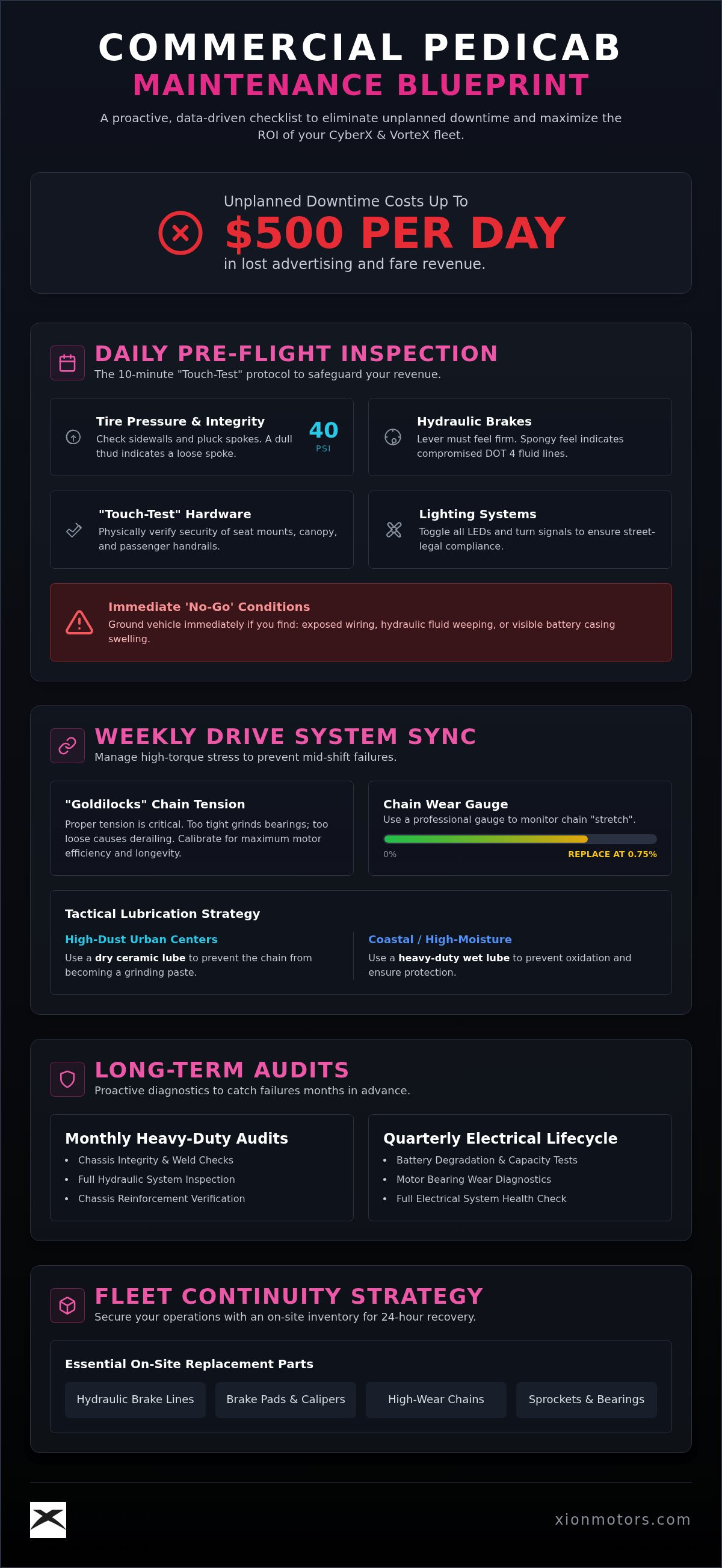
The first ten minutes of your morning dictate the profitability of your entire shift. In a high-volume transit environment, unplanned downtime is the enemy of revenue. Every veteran operator knows that a vehicle sidelined at 2 PM represents a lost opportunity that cannot be recovered. By implementing a standardized commercial pedicab maintenance checklist, you transform your morning routine from a casual glance into a professional-grade inspection protocol that protects your assets and your passengers.
We advocate for the 'Touch-Test' method. This is a physical, hands-on verification of every critical bolt and connection point. Visual inspections are deceptive. You must physically check the security of seat mountings, canopy frames, and passenger handrails. If a component moves when it should be static, the vehicle is grounded. This rugged approach to safety ensures that your fleet reflects the engineering standards of modern transportation rather than the outdated global context of cycle rickshaws that often lacked industrial oversight.
A 'No-Go' status is not a suggestion; it's a financial safeguard. Any sign of exposed wiring, hydraulic fluid weeping near the calipers, or a battery casing with visible swelling requires an immediate removal from the rotation. It's far cheaper to lose one vehicle for a morning repair than to face a liability claim or a mid-route breakdown that strands a high-paying group of six passengers. We don't guess with passenger safety; we verify with data and physical checks.
Tire Pressure and Structural Integrity Checks
Payload management is the primary stressor for industrial trikes. For the 6-seat VorteX, maintaining exactly 40 psi in both the 17 inch front and 21 inch rear tires is mandatory to support its 1,500 lb weight capacity. Low pressure increases rolling resistance and accelerates battery drain. During your walk-around, inspect the sidewalls for urban debris or pinch risks. Use your hand to pluck the spokes like a guitar string. A dull thud instead of a crisp ping indicates a loose spoke that could lead to a wheel collapse under a full commercial load.
Braking System and Lighting Verification
Hydraulic reliability is your primary safety net. Pull the brake levers to feel for immediate resistance. If the lever feels spongy or pulls all the way to the grip, air has compromised the DOT 4 fluid lines. You must never dispatch a vehicle without executing a low-speed brake test in the depot to confirm the pads are biting effectively. Finally, toggle all LED lighting and turn signals. Street-legal compliance is non-negotiable for professional fleet operators who value their standing with local transit authorities and their own commercial continuity.
Weekly Drive System Synchronization: Managing High-Torque Stress
A high-torque 750W motor delivers the power needed to move 1,500 lbs, but it also subjects your drivetrain to industrial-level stress. Standard bicycle maintenance won't cut it here. Your commercial pedicab maintenance checklist must prioritize the drive system every seven days to prevent catastrophic mid-shift failures. When a chain snaps under the torque of a fully loaded VorteX, you aren't just losing a fare; you're risking your reputation for reliability.
The "Goldilocks" rule for chain tension is your primary defense. A chain that is too tight will grind down your bearings and increase motor drag. One that is too loose will skip or derail under heavy acceleration. We use a professional wear gauge to monitor for "stretch." Once your chain reaches a 0.75% stretch threshold, it must be replaced immediately. This precision prevents the chain from "shark-finning" your sprockets, which is a far more expensive repair. Maintaining this mechanical discipline aligns with the academic analysis of pedicab safety that emphasizes the link between structural maintenance and operational security.
Lubrication requires a tactical approach based on your environment. In high-dust urban centers, a dry ceramic lube prevents the chain from becoming a grinding paste. In coastal or high-moisture areas, a heavy-duty wet lube is essential to prevent oxidation. Clean the drivetrain thoroughly before reapplying; adding fresh oil to a dirty chain only accelerates wear. If you notice persistent slippage despite proper tension, it is time to source authentic Vehicle Parts to restore your fleet's factory performance.
Mid-Drive Motor and Chainline Optimization
Vibration is a silent killer in commercial fleets. Every week, physically verify the torque on your motor mounting bolts. A loose motor can shift slightly, throwing the chainline out of alignment and causing premature wear on the primary drive chain. Inspect the sprockets for any chipped teeth or uneven wear patterns. Keeping the drivetrain degreased and free of abrasive buildup ensures that every watt of power from the XION BAC 2000 controller is translated into forward momentum rather than heat and friction.
Derailleur and Shifting Precision
Shifting under a heavy passenger load is the ultimate test for your derailleur. Fine-tune your indexing to ensure crisp, immediate gear changes. Even a slight delay in engagement can cause a chain to snap when the motor kicks in. Inspect your shift cables for fraying at the anchor points; a single broken strand is a sign of impending failure. Finally, verify your limit screw settings. This prevents the chain from overshifting into the spokes, a disaster that can ground a CyberX for days while you wait for a wheel rebuild.
Monthly Heavy-Duty Audits: Chassis Integrity and Hydraulics
Every thirty days, your fleet requires an exhaustive mechanical audit to sustain its industrial-grade performance. While daily and weekly checks manage the surface-level wear, the monthly audit is designed to preserve the structural backbone of your operation. High-utilization vehicles like the VorteX endure massive vibrations and stress from carrying 1,500 lb payloads through uneven urban terrain. Neglecting these deep-tissue inspections invites catastrophic frame failure or hydraulic collapse during your busiest season. Integrating a rigorous commercial pedicab maintenance checklist into your monthly workflow ensures that every vehicle in your fleet remains a safe, revenue-generating asset.
The chassis is the foundation of your business. Over time, the constant torque from the 750W motor and the weight of six passengers can cause even the most robust frame junctions to experience fatigue. You must physically inspect every weld point for hairline fractures or paint flaking, which often signals metal stress. Suspension tuning is equally critical; it isn't just about passenger comfort. A properly tuned suspension absorbs the road shocks that would otherwise be transferred directly to the frame and axle, extending the overall lifecycle of the vehicle. We don't just build these machines to look powerful; we build them to survive decades of street-level abuse.
Hydraulic fluid management is another non-negotiable pillar of monthly maintenance. We use DOT 4 fluid because of its high boiling point and reliability under the extreme heat generated by heavy-load braking. However, DOT 4 is hygroscopic, meaning it absorbs moisture from the air over time. This leads to a spongy lever feel and internal corrosion of the calipers. A full system flush every month is the only way to guarantee that your braking power remains absolute when descending hills with a full passenger load.
Hydraulic Brake Overhaul and Pad Replacement
Braking performance is a direct reflection of your fleet's safety standards. Measure your rear disc brake pads; if less than 1.5 mm of compound remains, replace them immediately. For the front pads, the threshold is even tighter at 1 mm. Perform a full system bleed to extract contaminated fluid and ensure a rock-solid lever response. Finally, inspect your rotors for heat-induced warping or deep scoring. A compromised rotor will chew through new pads in days, creating an unnecessary expense and a safety liability that no professional operator should tolerate.
Frame and Chassis Structural Survey
Precision alignment is the key to vehicle stability. Check the rear axle housing for any signs of bearing play or misalignment that could lead to uneven tire wear. Inspect the passenger cab mounting points; these are high-stress junctions that must remain perfectly secure to protect your riders. Apply a high-quality anti-seize compound to critical adjustment bolts during this survey. This simple step ensures future serviceability and prevents hardware from seizing due to road salt or moisture, keeping your maintenance windows short and your uptime high.
Quarterly Electrical Lifecycle Management: Battery and Motor Diagnostics
Quarterly electrical diagnostics are the invisible layer of fleet dominance. While mechanical failures are obvious to the eye, electrical degradation is a silent thief of your operational ROI. A professional commercial pedicab maintenance checklist must move beyond tires and chains into the sophisticated 72V architecture that powers your business. We engineer our systems for high-payload commercial transit; however, even the most robust 750W direct-drive transaxle motor requires quarterly internal audits to maintain its industrial-grade longevity. Neglecting these diagnostics leads to voltage sag and reduced runtime during your most profitable shifts.
The 72V 58Ah lithium battery is the heart of your CyberX. These power units typically provide 500 to 800 full charge cycles, which translates to roughly one to two years of service under heavy commercial load. Identifying "dead" cells early prevents a total system shutdown mid-route. If a battery is taking longer than the standard 5 hours to reach a full charge, or if the runtime drops below the expected 5 to 6 hours, it is a leading indicator of internal degradation. We don't guess with power; we use precision tools to verify that every cell is contributing to your fleet's performance.
Firmware updates and controller calibration are the final pillars of quarterly management. The XION BAC 2000 controller is a precision instrument that manages the high-torque demands of a 1,500 lb load. Ensuring the software is optimized for your specific terrain can improve efficiency by up to 15%. This isn't just about speed; it's about managing the thermal load on the motor and extending the lifecycle of every electrical component in the system.
Lithium-Ion Battery System Maintenance
Efficiency starts at the contact points. Every quarter, clean all battery terminals and connectors to ensure maximum current flow and prevent arcing. High-torque demand pulls significant amperage; any resistance at the connector leads to heat and potential system failure. Verify your charger's output voltage with a multimeter to prevent over-charging, which can lead to cell swelling and permanent damage. Implementing a battery rotation strategy across your fleet equalizes wear and ensures that no single unit is prematurely exhausted by high-utilization routes.
Electrical Connection and Controller Security
The controller housing must remain a dry, secure environment. Inspect the unit for any signs of moisture ingress or salt accumulation, especially if you operate in coastal areas. Secure all loose wiring looms; a snagged harness in the passenger cab is a major safety liability and a costly repair. Test the throttle response for any lag or inconsistent power delivery. If your electrical system shows signs of aging or inconsistent performance, replace components immediately with authentic Vehicle Parts to sustain your fleet's street-level excellence.
The Xion Motors Continuity Strategy: Authentic Parts and Support
Operational excellence is not a static achievement; it is a continuous commitment to the integrity of your hardware. If you have followed every technical step in this commercial pedicab maintenance checklist, you have the protocols to identify wear. However, those protocols are only effective if you have immediate access to industrial-grade components. Maintaining a fleet of high-torque electric vehicles requires a supply chain that matches the durability of the machines themselves. We have spent two decades refining this process to ensure that your business never stalls due to a missing bolt or a backordered motor.
Business continuity depends on the distinction between "bicycle parts" and "vehicle components." Standard bike shops are equipped for 200 lb recreational riders. Your operation moves 1,500 lb payloads through dense urban environments. Using consumer-grade chains, tires, or brake pads on a commercial trike is a direct threat to your safety and your revenue. We provide direct-to-operator parts support for all 50 states, ensuring that every VorteX and CyberX in the country remains built to our exacting engineering standards. This professional-grade maintenance doesn't just prevent downtime; it preserves the long-term resale value of your assets.
Authentic Replacement Parts for Commercial Continuity
Sourcing model-specific components for the CyberX is the only way to guarantee that your 72V system operates at its peak efficiency. Generic parts often lead to parasitic power loss or premature mechanical failure under the stress of high-torque acceleration. We recommend keeping a "24-Hour Recovery Kit" on-site, containing essential spares such as authentic drive chains, DOT 4-rated brake pads, and heavy-duty inner tubes. Ordering fleet-wide maintenance kits before the peak tourist season ensures you are never at the mercy of shipping delays when every hour on the street counts.
Professional Fleet Support and Engineering Expertise
You aren't just buying a vehicle; you're gaining access to twenty years of operational data and engineering insight. We have analyzed thousands of hours of fleet performance to develop our electric pedicab maintenance guide protocols. Training your mechanical team on these specific industrial standards is a critical step in scaling your business. For large-scale deployments, we offer professional consultations to help you design a shop workflow that minimizes service windows. This partnership ensures that your technicians move with the same precision and speed as our production team, keeping your fleet the dominant force in your local market.
Engineering Your Path to Market Dominance
Dominating your local market requires more than just ambition; it requires the mechanical discipline of a veteran operator. By implementing this commercial pedicab maintenance checklist, you move beyond the limitations of consumer-grade equipment and embrace a professional-grade transit model. We have proven over 20 years that uptime is the only metric that truly defines your success. You now have the blueprint to manage high-torque stress and electrical lifecycles with the precision of an industrial engineer.
Sustaining this performance depends on the quality of your supply chain. We provide direct-to-operator shipping across all 50 states to ensure you always have access to industrial-grade components built for 1,000+ lb payloads. Don't let a generic part compromise your ROI or your safety standards. It's time to lead the industry with a fleet that's as reliable as it is powerful.
Secure your fleet uptime with authentic Xion Motors replacement parts and keep your business moving forward. Your path to long-term profitability starts with the right tools and a commitment to excellence.
Frequently Asked Questions
How often should I perform a full mechanical audit on a commercial pedicab?
Perform a comprehensive mechanical audit every thirty days to ensure chassis and hydraulic integrity. This monthly deep-dive is a cornerstone of any professional commercial pedicab maintenance checklist. You should supplement this with daily pre-flight checks and weekly drive system synchronization. Maintaining this rigorous schedule prevents minor wear from escalating into a total system failure during peak revenue periods when your fleet must be at maximum capacity.
What type of hydraulic brake fluid is required for Xion Motors vehicles?
Xion Motors vehicles require DOT 4 hydraulic fluid for all braking systems. This high-performance fluid is non-negotiable because it handles the extreme heat generated when stopping 1,500 lb payloads. You must perform a full system flush every month to remove moisture contamination. Using inferior fluids or neglecting the flush schedule can lead to spongy levers and compromised stopping power on steep urban routes, creating a significant safety liability.
Can I use standard bicycle tires on a 6-seat electric pedicab?
You cannot use standard bicycle tires on industrial-grade 6-seat models like the VorteX. Consumer tires are engineered for low weights and will fail under a 1,500 lb commercial load. Our vehicles utilize specific 17 inch front and 21 inch rear industrial tires maintained at 40 psi. These heavy-duty tires provide the structural sidewall support and traction required for safe, high-torque urban transit operations across the country.
How do I know if my electric motor needs professional servicing?
Professional motor servicing is required if you detect excessive heat, grinding noises, or a noticeable lag in throttle response. These symptoms often indicate worn bearings or internal brush degradation within the 750W direct-drive transaxle motor. If the XION BAC 2000 controller reports inconsistent power delivery, ground the vehicle immediately. Early intervention prevents a complete motor seizure that could sideline your CyberX for an extended period, protecting your long-term ROI.
What is the best way to clean an electric pedicab without damaging the electronics?
Clean your vehicle using low-pressure water and a damp cloth, specifically avoiding direct spray on the controller housing, battery pack, and motor. High-pressure washers can force moisture into sealed electrical connections, causing short circuits or corrosion. Focus your cleaning efforts on the drivetrain using a dedicated degreaser to prevent abrasive paste buildup. Always dry the battery contact points thoroughly before reinserting the 72V power unit to ensure maximum current flow.
How many miles should a commercial pedicab chain last before replacement?
Chain lifespan is determined by mechanical stretch rather than a fixed mileage count. You must replace the primary drive chain once it reaches a 0.75% stretch threshold as measured by a professional wear gauge. High-torque 72V systems place immense stress on the drivetrain, especially during frequent starts with full passenger loads. Regular lubrication and tension adjustments ensure you get the maximum possible service life from your authentic commercial pedicab maintenance checklist protocols.
What are the signs of structural fatigue in a pedicab frame?
Signs of structural fatigue include hairline fractures in the metal, paint flaking at high-stress weld junctions, or persistent creaking during turns. You should pay close attention to the rear axle housing and passenger cab mounting points during your monthly audit. Any visible deformation or play in the frame indicates the vehicle is no longer safe for commercial use. Grounding the unit for immediate repair is the only way to mitigate liability and preserve your fleet.
How can I maximize the lifespan of my lithium-ion battery pack?
Maximize your 72V 58Ah lithium battery lifespan by implementing a strict rotation strategy and avoiding deep discharges below 20%. Keep the contact points clean to ensure maximum current flow and prevent arcing. Always use the manufacturer-verified charger to maintain a consistent 5-hour charging cycle. Proper thermal management and regular terminal cleaning can extend your battery's service life to the upper limit of 800 full charge cycles, ensuring years of reliable street-level operation.