Operational failure isn't just a repair bill; it's a direct tax on your bottom line that most fleet owners simply can't afford. You've likely seen the fallout of under-engineered equipment, from cracked frames and flimsy components to motors that choke on the first incline. Transitioning to heavy duty electric pedicabs is no longer about adding a battery to a bicycle. It's about deploying industrial-grade machines built for high-volume commercial rigor and relentless daily use. We know that in a competitive district, your vehicle is your most vital asset and your greatest liability if it stays in the shop.
As we move into 2026, the benchmarks for commercial success have shifted toward structural over-engineering and strict safety compliance. You'll discover the essential engineering standards required for modern operations, including UL 2849 battery certifications and the high-torque transaxle systems necessary for 6-seat passenger loads. We'll examine how precision manufacturing and professional-grade components maximize daily uptime while slashing your total cost of ownership. This guide provides the technical roadmap you need to build a dominant, profitable fleet that outlasts the competition and secures your market position.
Key Takeaways
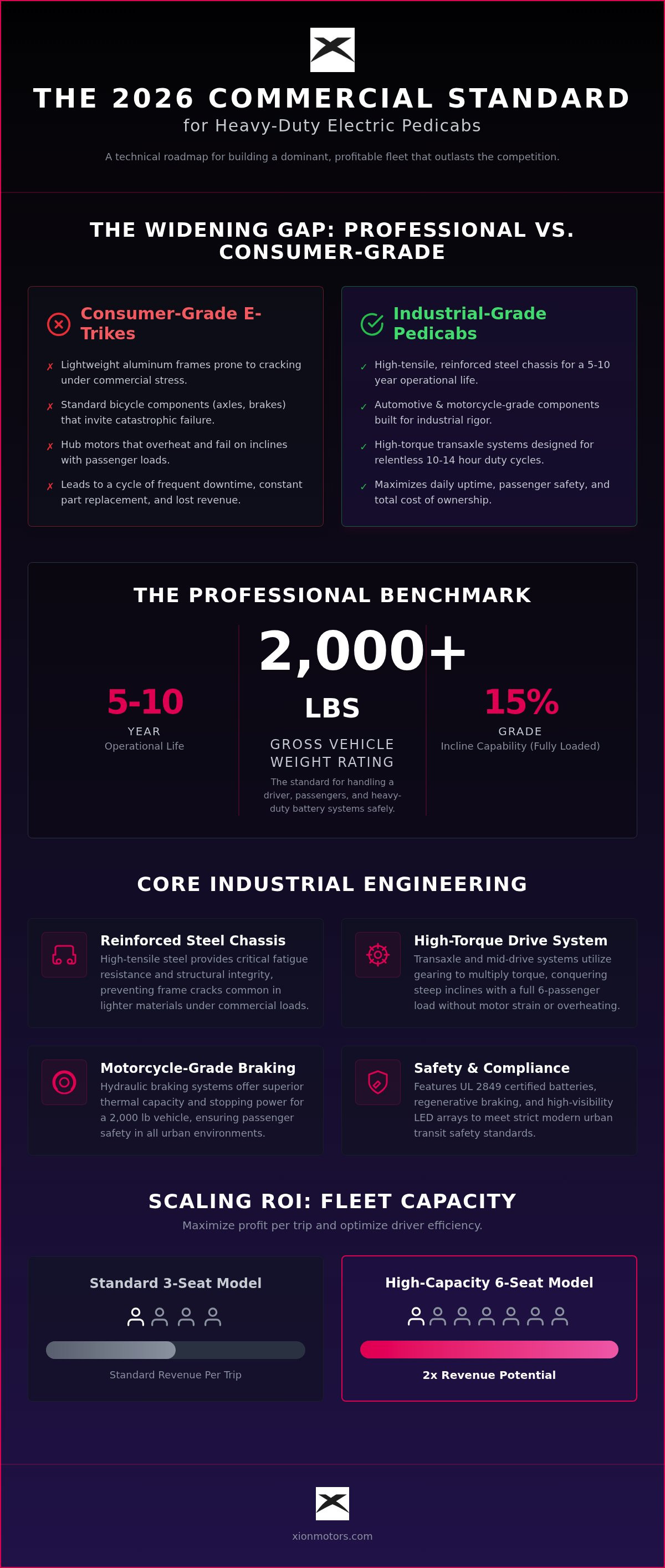
- Define the 2,000+ lbs GVWR benchmark that separates professional-grade equipment from consumer-level electric trikes.
- Understand the engineering requirements for heavy duty electric pedicabs, including reinforced steel chassis and high-torque transaxle motors built for constant commercial use.
- Analyze the revenue-scaling potential of 6-seat models to maximize your profit per trip and optimize driver efficiency.
- Implement industrial-grade maintenance protocols and part-sourcing strategies to eliminate frequent downtime and structural failures.
- Leverage direct-to-operator sales models and national shipping to streamline fleet deployment and accelerate your business growth.
Defining the Heavy Duty Electric Pedicab Category
The market is currently separating the hobbyists from the professionals. If you're running a commercial fleet, you can't afford to play with toys. A heavy duty electric pedicab isn't just a bicycle with an added motor; it's a specialized industrial vehicle designed for a Gross Vehicle Weight Rating (GVWR) of 2,000 lbs or more. This benchmark ensures the chassis can handle the combined weight of the driver, the passengers, and the heavy-duty battery systems required for all-day operation. Transitioning to heavy duty electric pedicabs requires a shift in mindset from simple bike shop maintenance to industrial fleet management.
We've spent decades in the trenches of fleet management. We know that urban transit requires a relentless duty cycle. Your equipment needs to perform for 10 to 14 hours every single day without a drop in performance. While the electric rickshaw category covers a broad spectrum of designs globally, the 2026 industrial standard demands a vehicle that functions more like a truck than a tricycle. Precision engineering is the only way to ensure your fleet stays on the road when the crowds are thick and the fares are high.
The Failure of Consumer-Grade Equipment
Consumer-grade e-trikes rely on standard bicycle components that simply aren't up to the task. When you subject a light-duty axle to 500 lb passenger loads, you're inviting a catastrophic failure. They fail. Lightweight aluminum frames are popular in the consumer world, but they lack the fatigue resistance needed for commercial service. They crack under the repetitive stress of city potholes and heavy braking. Choosing light-duty equipment creates a cycle of frequent downtime and constant part replacement that eats your profits and frustrates your operators.
Commercial Benchmarks for 2026
Industrial pedicabs are built for a 5 to 10 year operational life. This durability is anchored in reinforced steel frames and automotive-grade components. Safety features like regenerative braking and high-visibility LED arrays are now mandatory for modern urban transit. A heavy-duty standard is defined by a load-to-torque ratio that allows a fully loaded vehicle to navigate a 15% grade with zero motor strain. This level of performance ensures your operators remain confident and your passengers stay safe in every environment, regardless of the terrain or the volume of the crowd.
Industrial Engineering: Chassis, Torque, and Drive Systems
Engineering a vehicle to transport 2,000 lbs requires more than just scaling up a bike frame. It requires a fundamental shift in material science. Heavy duty electric pedicabs rely on high-tensile reinforced steel chassis to ensure structural integrity under extreme stress. The CyberX engineering standard represents this shift, moving away from the upgraded bicycle model toward a purpose-built industrial platform. This isn't just about weight; it's about the safety of your passengers and the long-term viability of your fleet.
Stopping power is non-negotiable for a vehicle of this scale. Standard bicycle calipers will melt under the heat of a 1,500-pound load descending a hill. We integrate motorcycle-grade hydraulic braking systems because they offer the thermal capacity and clamping force required for commercial safety. These systems align with broader Federal Motor Vehicle Safety Standards adapted for low-speed electric platforms, ensuring that your fleet meets the highest regulatory and operational benchmarks. If you're ready to upgrade your operational standards, our team is ready to help you deploy the right equipment.
High-Torque Drive Dynamics
Torque is the lifeblood of urban passenger transit. While hub motors are common in recreational e-bikes, they often lack the leverage needed for heavy-duty applications. Mid-drive systems win because they utilize the vehicle's gearing to multiply torque. This mechanical advantage is critical for navigating steep inclines without burning out the motor. Heat management isn't just about cooling; it's about protecting your battery's cycle life. High-wattage motors generate significant thermal energy during continuous operation, which can degrade internal components if not managed by industrial-grade controllers. Gear reduction units further protect the motor from premature wear by keeping it in its optimal RPM range, even when starting from a dead stop with a full 6-passenger load.
Chassis Durability and Suspension
Axle bowing is a silent fleet killer. Lightweight axles eventually bend under multi-passenger weight, leading to drivetrain misalignment and catastrophic failure. We use reinforced, oversized axles and industrial suspension systems to maintain vehicle geometry under load. This balance of passenger comfort and mechanical longevity is exactly what we deliver with our custom electric trikes for business. We don't just build trikes; we build revenue-generating assets that stand up to the most demanding urban environments. Precision suspension doesn't just protect the passenger; it protects the chassis from the constant vibration and impact of city streets, ensuring your investment lasts for years instead of months.
3-Seat vs. 6-Seat: Scaling Fleet Capacity for ROI
Profitability in the urban transit sector is a game of margins and labor efficiency. When you deploy heavy duty electric pedicabs, you're making a strategic choice between two distinct operational models. The standard 3-seat configuration has long been the industry baseline, but the emergence of the 6 seat electric pedicab has fundamentally changed the ROI calculation for fleet operators. One driver managing six passengers generates double the revenue of a single 3-seater with the same labor overhead. It's a simple, powerful equation that directly impacts your bottom line.
Managing these massive 6-passenger loads requires strict adherence to safety protocols and engineering standards established by organizations like SAE International. You can't simply stretch a frame and hope for the best. Our VorteX line is engineered with this precision, utilizing reinforced axles and dual-battery systems to handle the increased duty cycle. However, terrain remains a critical factor. While a 6-seater dominates flat entertainment districts, high-incline environments require the specific torque-to-weight ratios found in our mid-drive configurations. You must match the vehicle to the environment to ensure consistent performance.
The 3-Seat Workhorse
The 3-seat model remains the go-to for quick, point-to-point transit. These vehicles offer unmatched agility in high-traffic pedestrian zones where space is at a premium. They're perfect for historic districts with narrow streets and tight corners. For new operators, the 3-seat configuration provides a lower entry point for starting a single-vehicle business. It's a versatile asset that allows you to establish a presence without the higher initial investment of high-capacity units. It's the foundation of most successful fleets.
The 6-Seat Powerhouse
The 6-seat configuration is a revenue multiplier designed for the "Bachelor Party" and "Family Group" demographics. These groups are willing to pay higher ticket prices to stay together, and our 6-seat models allow you to capture that market. These vehicles compete directly with gas-powered shuttles in entertainment districts but offer a more engaging, open-air experience. Engineering requirements for a 6-passenger load are intense. We utilize dual-battery systems and reinforced axles to ensure the vehicle handles the 2,000 lb GVWR without structural fatigue. It's a powerhouse built for high-volume districts where group transit is the primary demand.
Evaluating Fleet Durability and Maintenance Protocols
Operational longevity isn't an accident; it's the result of a rigorous maintenance culture. When you're managing a fleet of heavy duty electric pedicabs, you're essentially operating a micro-transit agency. This requires a shift from reactive repairs to proactive system management. We've developed a comprehensive electric pedicab maintenance guide specifically for industrial-grade fleets. It's built on twenty years of operational experience in the most demanding urban environments. Don't wait for a component to fail in the middle of a high-volume shift when fares are at their peak.
You must resist the temptation to use generic bike shop components for your repairs. Standard bicycle parts aren't engineered for 2,000 lb GVWR loads, and they will fail under the stress of commercial service. Sourcing industrial-grade replacement parts, such as drivetrain components from Drive Systems USA, ensures that every repair restores the vehicle to its original engineering specification. Standardizing your parts across the entire fleet also slashes downtime by allowing your mechanics to perform lightning-fast swaps. If you're serious about maximizing your operational hours, you should source professional-grade vehicle parts that are built to withstand the relentless duty cycle of city transit.
Daily and Weekly Inspection Checklists
Success in this industry is measured by uptime. Your drivers should perform a brake pad wear check every 48 hours, as heavy passenger loads accelerate friction material depletion. High-load cycles also put immense stress on wheel integrity, making weekly spoke tension and wheel truing essential to prevent rim collapse. Urban environments are high-vibration zones, so you must inspect all electrical connections and motor mounts weekly to ensure they remain seated and secure. These small steps prevent the structural failures that lead to expensive downtime.
Long-Term Component Replacement
Reliability requires a scheduled overhaul of the motor and drive chain. In a commercial environment, these components are under constant load and should be replaced before they show signs of fatigue. You should plan for battery pack replacement within a 3-5 year financial model to maintain consistent range and torque for your operators. While a cheaper vehicle might save capital upfront, an industrial-grade pedicab typically pays for itself within 14 months through reduced repair costs and 98% daily uptime. This long-term perspective is what separates profitable fleet owners from those who are constantly fighting equipment failure.
The Xion Motors Advantage: National Fleet Deployment
The difference between a manufacturer and a master practitioner is twenty years of grease on the hands and thousands of hours in the driver's seat. We don't just build these vehicles; we've operated them in the most demanding markets in the country. This legacy of real-world results is baked into every weld and wire of our heavy duty electric pedicabs. When you partner with Xion Motors, you aren't just buying hardware. You're securing a professional blueprint for starting a pedicab company that is designed to dominate from day one. We've already solved the engineering hurdles so you can focus on the business of moving people and generating revenue.
Scaling a fleet requires a partner who understands the granular logistics of growth and the technical demands of a high-volume district. Our electric pedicab fleet packages are curated to maximize your initial investment while providing a clear path to long-term ROI. By selling direct-to-operator, we eliminate the unnecessary markups and communication gaps inherent in third-party dealerships. You get direct access to the engineers and practitioners who built your machines. This ensures that every technical question is answered with precision and every part you need is in stock and ready to ship, keeping your downtime to an absolute minimum.
Direct Manufacturer Support
Working directly with the manufacturer means your fleet is built to your specific district requirements rather than a generic template. We offer deep customization options for branding and specific technical configurations that aggregators simply can't match. We act as a strategic advisor for your expansion, helping you navigate the transition from a single unit to a multi-vehicle operation with confidence. Our support doesn't end when the vehicle is delivered. It begins there, as we help you manage the duty cycles of your heavy duty electric pedicabs to ensure maximum profitability.
National Shipping and Logistics
We've perfected the science of national deployment through years of refinement. Xion Motors provides crated shipping to all 50 states, ensuring your equipment arrives with its structural integrity fully intact and ready for the street. We handle the logistical heavy lifting and coordination so your vehicles arrive capable of immediate service. There's no room for hesitation in a competitive market. You need equipment that works and a partner that delivers. Scale your operations with Xion Motors industrial pedicabs today.
Dominating the 2026 Urban Transit Market
The future of urban mobility belongs to the operators who treat their equipment as industrial assets rather than recreational novelties. You've seen how a 2,000 lb GVWR and high-torque CyberX technology define the new standard for commercial success. Success in 2026 requires more than just a motor; it requires a reinforced chassis and a strategic approach to fleet scaling. By prioritizing heavy duty electric pedicabs built with precision engineering, you eliminate the structural failures that drain your revenue and frustrate your drivers.
We build every vehicle based on twenty years of operational roots in the most demanding environments. Our direct-to-operator sales model ensures that fleet owners in all 50 states receive the technical support and part availability necessary for maximum daily uptime. Don't settle for under-engineered equipment that compromises your safety and your bottom line. It's time to deploy a fleet that outlasts the competition and secures your market position for years to come.
Invest in Industrial-Grade Fleet Excellence with Xion Motors and start building your legacy today.
Frequently Asked Questions
What is the average lifespan of a heavy duty electric pedicab in a commercial fleet?
An industrial-grade chassis typically lasts between 5 and 10 years in a high-volume commercial fleet. This longevity is the direct result of reinforced steel construction and precision engineering. Consumer-grade alternatives often fail within 12 to 18 months due to structural fatigue and component failure. Maintaining a strict preventative maintenance schedule is the best way to maximize the operational life of your investment.
How much weight can a 6-seat electric pedicab safely carry?
A 6-seat electric pedicab is engineered to handle a Gross Vehicle Weight Rating (GVWR) of up to 2,000 lbs. This capacity allows for six adult passengers plus the operator without compromising the structural integrity of the frame. We achieve this through reinforced axles and high-tensile steel chassis designs. It's critical to use vehicles specifically rated for these loads to ensure passenger safety and vehicle longevity.
Do heavy duty pedicabs require a special license to operate?
Most heavy duty electric pedicabs don't require a commercial driver's license because they fall under the federal Class 2 e-bike classification. This means they utilize a 750W motor and are limited to 20 mph. While federal law is clear, you must consult your local municipal codes. Some cities require specific operator permits or vehicle registration even if a CDL isn't mandatory for the driver.
How long does a battery charge last on a commercial electric pedicab?
A standard 72V lithium battery system provides a range of 40 miles or more under typical commercial loads. For high-volume 10 to 12 hour shifts, many operators utilize dual-battery configurations or rapid-swapping protocols. This ensures the vehicle stays on the street during peak earning hours. Terrain and total passenger weight will always impact the final discharge rate during daily operations.
Are Xion Motors pedicabs shipped fully assembled?
Vehicles are shipped in specialized crates to protect the precision components and chassis alignment during transit. We ship to all 50 states using secure logistics protocols that prevent damage. While the vehicles aren't fully assembled to ensure shipping integrity, the final setup is straightforward for any mechanic. This method ensures your equipment arrives in factory-perfect condition and is ready for the street.
What is the difference between a custom VorteX trike and a standard pedicab?
The custom VorteX trike is a purpose-built industrial platform, whereas standard pedicabs are often based on modified bicycle designs. The VorteX features precision-engineered components designed for extreme duty cycles and high-capacity passenger loads. It offers superior torque and structural rigidity. This makes it a more reliable asset for businesses focused on long-term ROI and professional fleet scaling.
Can I upgrade the motor on an existing pedicab fleet?
You can upgrade existing fleets with high-torque motors and industrial-grade controllers to improve performance on inclines and heavy starts. However, you must verify that your current chassis and braking systems can handle the increased power. Upgrading to the standards of heavy duty electric pedicabs often requires reinforcing the frame to prevent torque-related structural damage and ensuring your brakes can manage the additional force.
What safety certifications should I look for in a commercial pedicab?
The UL 2849 certification is the primary safety standard you should demand for any commercial electric vehicle in 2026. This system-level certification covers the battery, motor, and charger to prevent thermal events and electrical failures. It's becoming a mandatory requirement for commercial insurance in many major cities. Prioritizing certified equipment protects your passengers and your business from significant liability risks.