Your fleet's greatest liability isn't a mechanical failure; it's a regulatory oversight that lands your equipment in an impound lot. You've likely felt the frustration of trying to reconcile federal e-bike classifications with the hyper-local, often outdated taxi ordinances of major metropolitan hubs. It's a complex landscape where a single missing safety label can halt your revenue instantly. This guide delivers the definitive roadmap to mastering bike taxi regulations USA in 2026, ensuring your operation remains both street-legal and highly profitable. We provide the clarity you need to secure insurance for multi-passenger trikes and pass municipal inspections with confidence. We will break down the 750-watt federal power limits, clarify the specific safety labeling required by 16 CFR Part 1512, and examine the unibody construction mandates now hitting major markets like Chicago. By the end of this manual, you'll understand why investing in industrial-grade, compliant hardware is the only way to secure your long-term ROI.
Key Takeaways
- Decode the three-tier regulatory landscape where federal CPSC standards define your hardware and municipal ordinances control your daily operations.
- Secure your fleet’s operational status by aligning with Class 2 throttle-assist standards, the recognized benchmark for professional pedicab efficiency.
- Navigate the complexities of bike taxi regulations USA to successfully manage capped medallion markets and pass stringent city inspections.
- Tackle the unique legal and structural requirements of high-capacity 6-seat electric pedicabs to maximize group transit revenue without legal friction.
- Leverage industrial-grade engineering to transform compliance from a hurdle into a competitive advantage for your long-term financial viability.
Understanding the Regulatory Hierarchy: Federal vs. Local Oversight
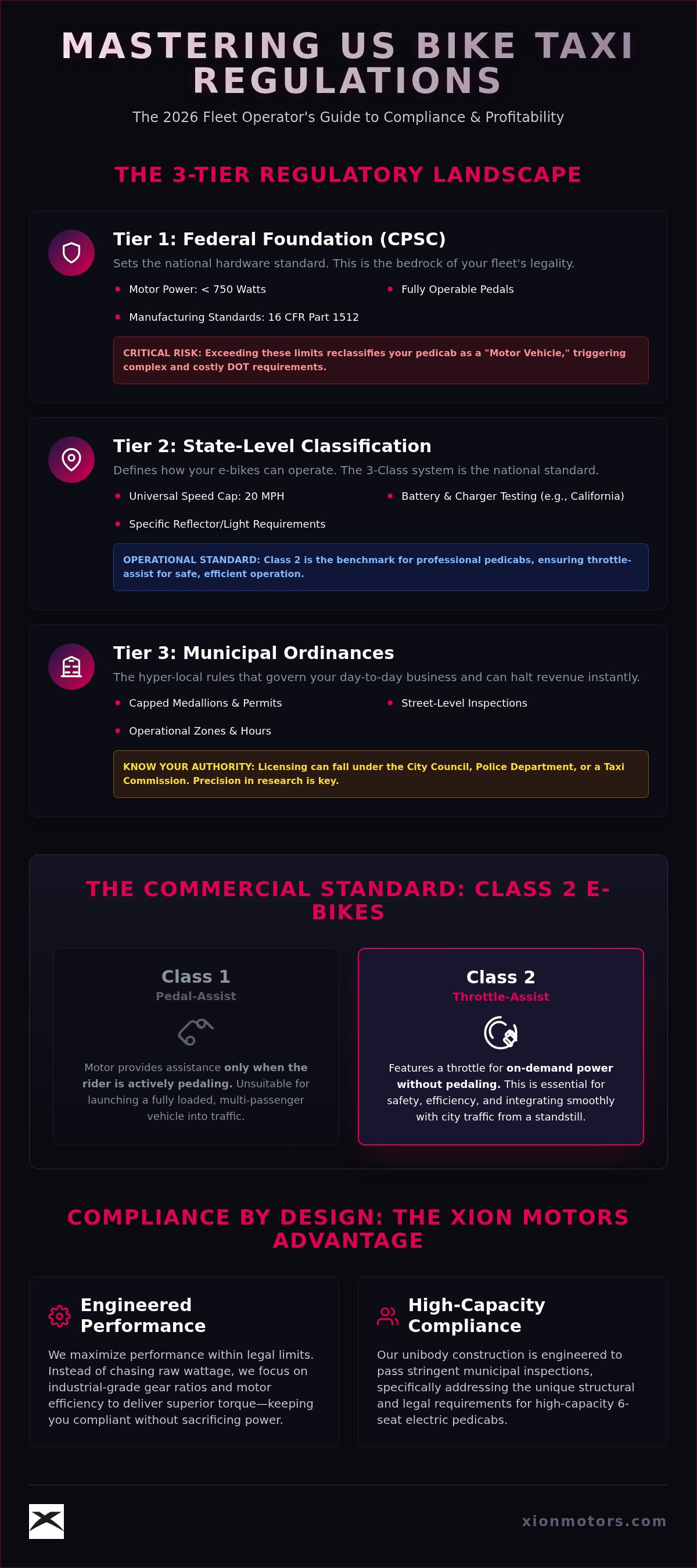
Compliance is the bedrock of any successful commercial fleet. To operate without the constant threat of equipment impoundment, you must master the three-tier regulatory system that governs bike taxi regulations USA. This hierarchy begins with federal manufacturing standards, moves through state-specific e-bike classifications, and ends with municipal operating ordinances. Each level has the power to sideline your business if your equipment or paperwork fails to meet their specific criteria. Success requires more than just a permit; it demands an industrial-grade understanding of how these laws overlap.
The Federal Foundation: CPSC and E-Bike Definitions
The Consumer Product Safety Commission (CPSC) sets the national standard for what constitutes a bicycle. Under federal law, an electric bicycle must have a motor of less than 750 watts and fully operable pedals. If your vehicle exceeds these limits, it transitions from a bicycle to a motor vehicle. This shift triggers a cascade of Department of Transportation (DOT) requirements that are often impossible for traditional pedicabs to meet. Manufacturing standards are critical here. Professional-grade frames must be engineered to comply with 16 CFR Part 1512, covering everything from braking distance to steering integrity. We build our CyberX and VorteX models to these exact federal benchmarks, ensuring your fleet starts on solid legal ground.
Navigating State-Level E-Bike Classes
States have largely adopted a three-class system to categorize electric vehicles. For the commercial operator, Class 2 is often the standard. These vehicles utilize a throttle-assist mechanism that allows for smooth acceleration even with a full load of passengers. Most states mandate a speed governor that caps motor assistance at 20 mph on level ground. While Pedicab use in the United States varies by region, the 20 mph limit is a nearly universal threshold for maintaining bicycle status. Before deploying your fleet, verify your state's stance on multi-passenger trikes. Some jurisdictions require specific rear reflectors or lights, while others, like California, have introduced stricter testing for batteries and charging systems as of 2026.
Identifying the primary authority in your specific market is your next tactical move. In some cities, the City Council dictates the number of available medallions. In others, the local Police Department or a Taxi and Limousine Commission handles the granular enforcement of street-level operations. Knowing who holds the keys to your licensing is the difference between a stalled application and a profitable launch. Precision in your initial research prevents expensive legal corrections later.
The 3-Class System and Commercial Pedicab Compliance
The 3-class system isn't just a guide for hobbyists. It's the legal framework that determines whether your fleet is a collection of bicycles or a group of unregistered motor vehicles. For operators managing bike taxi regulations USA, understanding these tiers is a matter of business survival. Federal law is clear: once you cross the threshold of 750 watts or 20 mph, you're no longer operating a bike. You're operating a motorcycle, and that brings a level of DOT oversight that can crush a small business. Precision in hardware selection is your only defense against these regulatory hurdles.
Why Class 2 is the Pedicab Standard
Class 2 compliance is the non-negotiable standard for professional transit. While Class 1 requires pedaling to engage the motor, Class 2 allows for throttle-assist. This distinction is vital when you're moving a fully loaded 6-seat vehicle from a dead stop on a crowded city street. Chauffeurs need that immediate engagement to merge safely with traffic. An academic analysis of pedicab regulation demonstrates that cities with clear throttle-assist allowances see higher safety ratings and better traffic integration. We've engineered our CyberX and VorteX models to maximize torque within these specific limits. By focusing on gear ratios and motor efficiency rather than raw wattage, our electric pedicabs deliver the performance of a heavy-duty machine while remaining strictly within the Class 2 legal envelope.
Speed Governors and Safety Cut-offs
Maintaining a strict 20 mph limit is essential for preserving your "bicycle" designation. As of 2026, federal law defines an electric bicycle as a two- or three-wheeled vehicle with fully operable pedals, an electric motor of less than 750 watts, and a maximum speed of 20 mph on a paved level surface when powered solely by the motor. Exceeding this speed in a commercial passenger environment isn't just a safety risk; it's a legal liability that can void your insurance policy instantly. You must also distinguish between peak power and continuous power in your regulatory filings. While a motor might hit higher wattages during a steep climb, the continuous rating must stay under the 750W cap to pass municipal inspections. Our industrial-grade speed governors ensure your fleet stays compliant without sacrificing the rugged durability needed for 20+ years of operation. Mastering bike taxi regulations USA requires this level of technical and legal granularity.
Municipal Licensing: Medallions, Permits, and Inspections
Federal compliance gets you through the factory door, but municipal licensing is what puts your tires on the pavement. To master bike taxi regulations USA, you must pivot from broad engineering standards to the granular ordinances of your specific city. Local governments view pedicabs through the lens of public safety and traffic flow. This results in a patchwork of rules that can vary from simple registration fees to high-stakes medallion lotteries. Understanding these entry requirements is the difference between a growing fleet and a collection of impounded hardware.
Market access is often dictated by a cap on available permits. New York City limits its registration plates to 850, while Chicago maintains a cap of 200 licenses. New Orleans operates an even tighter market with only 45 permits available. In these capped environments, your vehicle represents a limited-entry asset. You aren't just buying a trike; you're securing a position in a protected revenue stream. Navigating these lotteries requires precision and a fleet that's ready for immediate inspection.
The Safety Inspection Checklist
Inspections are becoming more rigorous as cities prioritize passenger safety. Effective April 1, 2026, Chicago requires all new pedicab license applicants to attest that their vehicles utilize unibody construction. This shift targets the structural integrity of the frame, favoring industrial-grade designs over flimsy, bolt-on alternatives. California has introduced similar rigors, mandating that e-bike batteries and charging systems meet accredited laboratory safety standards as of January 2026. Your checklist must include:
- Hydraulic Braking Systems: Mechanical cable brakes are insufficient for commercial passenger loads. Insist on hydraulic systems for consistent stopping power.
- Integrated Lighting: Turn signals, brake lights, and a red rear reflector are standard mandates in most major hubs.
- Audible Signals: A bell or horn capable of being heard from 100 feet is a baseline requirement for city operation.
Insurance and Liability Requirements
Securing a city-approved insurance policy is your final operational hurdle. Liability requirements are rising. California typically mandates a minimum of $1,000,000 in general liability insurance paired with $500,000 in umbrella coverage. Chicago requires a minimum of $300,000 per occurrence for bodily injury and property damage. Insurers prefer vehicles with proven safety engineering because they represent a lower risk profile. This reliability is a core component when Scaling Operations with Electric Pedicab Fleet Packages. When your equipment meets industrial standards, you spend less time negotiating premiums and more time generating profit.
High-Capacity Challenges: Regulating 6-Seat Electric Pedicabs
Deploying a 6-seat electric trike is a strategic play for market dominance. These vehicles offer the highest ROI per mile in the industry, yet they face a specific set of bike taxi regulations USA that 3-seat models rarely encounter. Municipal planners often view larger trikes with skepticism, focusing on pavement wear and potential traffic bottlenecks in congested entertainment districts. Success with a high-capacity fleet requires a proactive stance on engineering and urban integration. You don't just buy a 6-seater; you manage its presence on the street through superior design and operational discipline.
Weight limits are a primary concern for local DOT officials. A fully loaded 6-passenger vehicle can weigh over 2,000 pounds, pushing the limits of traditional bicycle infrastructure. This is where GVWR (Gross Vehicle Weight Rating) becomes a critical metric in your permit application. You must demonstrate that your equipment can handle these loads without compromising structural integrity or braking efficiency. ADA compliance also enters the conversation here. Providing accessible transit options isn't just a moral choice; it's increasingly a requirement for securing long-term municipal contracts in progressive urban hubs.
Width and Length Restrictions
Size dictates your route. Many cities have strict ordinances regarding the maximum width of vehicles allowed in dedicated bike lanes. If your trike exceeds these dimensions, you may be forced into the general vehicle lane, which impacts your safety profile and average speed. Turning radius is another technical hurdle. Congested districts like Austin's 6th Street or New York's Times Square demand a vehicle that can navigate tight corners without encroaching on pedestrian space. For a deeper dive into these operational nuances, consult The 2026 Guide to 6 Seat Electric Pedicab Fleet Operations. Precision in your route planning ensures your 6-seaters remain an asset rather than a liability.
Passenger Safety Standards for Large Trikes
Safety engineering for high-capacity vehicles must be uncompromising. As passenger counts rise, so does the scrutiny from insurance underwriters and city inspectors. Seatbelt mandates are becoming the norm for 6-seat configurations to mitigate liability risks during sudden stops. Reinforced chassis engineering is a structural necessity for 6-passenger loads to prevent frame fatigue and ensure long-term operational durability. We build our VorteX model with an industrial-grade roll-cage and a heavy-duty chassis designed to exceed these rigorous standards. If you want a fleet that passes inspection on the first try, you need to invest in professional-grade electric pedicabs. Durable hardware is your best defense against shifting regulatory goalposts.
Xion Motors: Engineering for Regulatory Success
Compliance is often viewed as a hurdle, but for the professional operator, it's a filter that removes low-quality competition. Navigating bike taxi regulations USA becomes a streamlined process when your hardware is engineered from the ground up to exceed municipal requirements. We don't just build trikes; we build commercial assets designed to pass the most rigorous city inspections on day one. Our 20+ years of fleet operation experience is welded into every frame, ensuring your business is positioned as a legitimate transit solution rather than a hobbyist venture.
Our documentation support is a critical component of the Xion advantage. We provide the specific manufacturer certifications and safety labels required by 16 CFR Part 1512, simplifying the path to securing commercial insurance. When you present a Xion vehicle to a city inspector, you're presenting a machine with a unibody frame designed for heavy-duty use. This professional presentation builds trust with municipal planners and police departments alike. It transforms your operations into a recognized transit partnership, securing your standing in capped markets where medallion availability is limited.
The CyberX Engineering Standard
The CyberX represents the pinnacle of professional-grade micro-mobility. It utilizes a high-torque drive system specifically calibrated for legal 750W compliance, delivering the power needed for passenger loads without triggering motor vehicle classifications. Standard features include industrial-grade hydraulic braking and integrated LED lighting systems that meet the visibility mandates of major hubs like NYC and Chicago. For a technical deep dive, read CyberX: The Industrial-Grade Electric Pedicab Engineering Standard for 2026. This isn't a modified bicycle; it's a purpose-built commercial vehicle engineered for 20+ years of operation.
Ready for Deployment
Launching your operation requires a partner who understands the logistics of national deployment. We offer direct-to-operator sales with national shipping across all 50 states, providing the necessary documentation to satisfy local DMV and police department requirements. Our 3-seat electric pedicabs and high-capacity 6-seat models are engineered for heavy-duty commercial use from the first mile. Every vehicle is backed by a comprehensive inventory of replacement parts to ensure long-term operational continuity and minimal downtime. Don't let regulatory confusion stall your growth. Build your compliant fleet with Xion Motors today and secure your place in the future of urban transit.
Dominate the Street with Regulatory Precision
Success in the modern pedicab industry requires a shift from hobbyist mentalities to professional-grade execution. You've seen how the interplay between federal e-bike classes and municipal licensing dictates your operational ceiling. By mastering bike taxi regulations USA, you transform legal hurdles into a protective moat that keeps low-quality competitors out of your market. This isn't just about street legality; it's about securing the financial viability of your entire enterprise through superior hardware and meticulous planning.
We provide the tools to cross that threshold with confidence. Our team brings 20+ years of industry expertise to every build, delivering USA-manufactured industrial frames that are engineered to pass the most stringent city inspections. We offer national shipping to all 50 states, ensuring your expansion isn't limited by geography or local supply chains. Your fleet is the face of your brand, and it should reflect the rugged authority of a market leader. Stop reacting to new ordinances and start leading the transit conversation in your city.
Invest in an Industrial-Grade, Compliant Fleet from Xion Motors. It's time to build a fleet that's as durable as your vision for the future.
Frequently Asked Questions
Are electric pedicabs street legal in all 50 states?
Electric pedicabs are legal to own across the country if they meet the federal definition of an electric bicycle. This requires a motor under 750 watts and a 20 mph speed cap. However, bike taxi regulations USA at the municipal level dictate where you can operate commercially. Cities like New York and Chicago require specific plates and permits that go beyond simple ownership rules to ensure public safety.
Do I need a driver’s license to operate a bike taxi?
Chauffeurs typically need a valid driver's license and must meet minimum age requirements. In Boston and New Orleans, you must be at least 21 or 18 years old respectively to secure an operator's permit. Many cities also require background checks and drug testing. For example, New Orleans mandates a 5-panel drug test and a $50 federal background check as part of their permitting process.
What is the maximum motor wattage allowed for a commercial pedicab?
Federal standards cap the motor at 750 watts, or one horsepower, to maintain bicycle status. Staying within this limit ensures your vehicle is classified as a bicycle rather than a motorcycle. This classification is vital for avoiding the complex registration and equipment rules managed by the DOT. Our CyberX and VorteX models are engineered to provide maximum torque for heavy loads while strictly adhering to this 750W federal cap.
How do I get a pedicab permit in my city?
You must apply through your local transportation or consumer protection agency. This process involves paying fees, such as the $250 annual vehicle license fee in Chicago or the $32 processing fee in Boston. Be mindful of market caps and lotteries. New York City held a lottery for new registration plates in June 2026 because active licenses fell below the 840 mark, showing how competitive these permits can be.
Is insurance required for a bike taxi business?
Commercial insurance is a non-negotiable requirement for legal operation in every major U.S. city. California typically demands a $1,000,000 policy, while Chicago sets the minimum at $300,000 per occurrence. Insurers often require proof that your vehicles meet specific safety standards like 16 CFR Part 1512. Operating without coverage is a fast way to get your equipment impounded and your business license permanently revoked.
Can a 6-seat electric pedicab ride in the bike lane?
Lane access depends on the vehicle's dimensions and local traffic ordinances. While many cities allow pedicabs in bike lanes, high-capacity 6-seat models may be restricted to the roadway if they block traffic flow. In Austin, pedicabs are limited to roads with speed limits of 35 mph or less. Always check your city's specific width restrictions and passenger limits before planning your routes with high-capacity vehicles like the VorteX.
What safety features are mandatory for municipal inspections?
Mandatory equipment usually includes hydraulic brakes, turn signals, and brake lights. Specific cities have unique requirements; Chicago now mandates unibody construction for all new permit applicants to ensure frame durability. California requires e-bike batteries and charging systems to be tested by accredited laboratories as of January 2026. Every Xion vehicle is manufactured in the USA with industrial-grade components designed to pass these rigorous municipal inspections.
How does Xion Motors help with regulatory compliance?
We manufacture industrial-grade vehicles that simplify the bike taxi regulations USA compliance process. Every CyberX and VorteX comes with the necessary safety labeling and technical documentation to satisfy city inspectors and insurance underwriters. We provide direct-to-operator sales and national shipping, ensuring your fleet meets the highest engineering standards from day one. Our expertise helps you navigate the complex overlap between federal laws and local city ordinances.