In the high-stakes world of urban mobility, downtime is the only expense you can't recover. You didn't build a fleet to watch it sit in the shop while passengers wait on the curb. Most operators learn the hard way that standard bicycle components simply aren't engineered for the extreme torque requirements of 3 and 6-seat commercial models. When you're constantly replacing snapped chains or failing hub motors, you aren't just buying pedicab parts; you're paying a tax on your own growth. You know that every hour a vehicle is out of service is a direct hit to your bottom line.
It's time to stop reacting to breakdowns and start engineering for endurance. This guide provides the blueprint for selecting industrial-grade components that eliminate the reliance on repurposed cycling components. We'll show you how to master the selection of drivetrain and motor systems built for the demanding market standards of 2026. You'll gain a curated list of survival parts that protect your ROI and keep your fleet operational through the busiest tourist seasons. By the end of this article, you'll have the technical confidence to build a maintenance schedule that prioritizes uptime over emergency repairs.
Key Takeaways
- Identify why standard bicycle components fail under commercial loads and how to specify parts for a 1,500 lb weight capacity.
- Learn to select high-torque pedicab parts and LiFePo4 battery systems that withstand the relentless cycles of urban stop-and-go traffic.
- Understand the engineering baseline for commercial axles and wheels, focusing on 1-inch solid steel and heavy-gauge spoke construction.
- Build a tiered survival kit of essential inventory to eliminate the most common causes of roadside delays and lost revenue.
- Discover the specialized components designed for the CyberX and VorteX models to ensure perfect compatibility and maximum fleet uptime.
Why Industrial-Grade Pedicab Parts are Non-Negotiable for Fleet Success
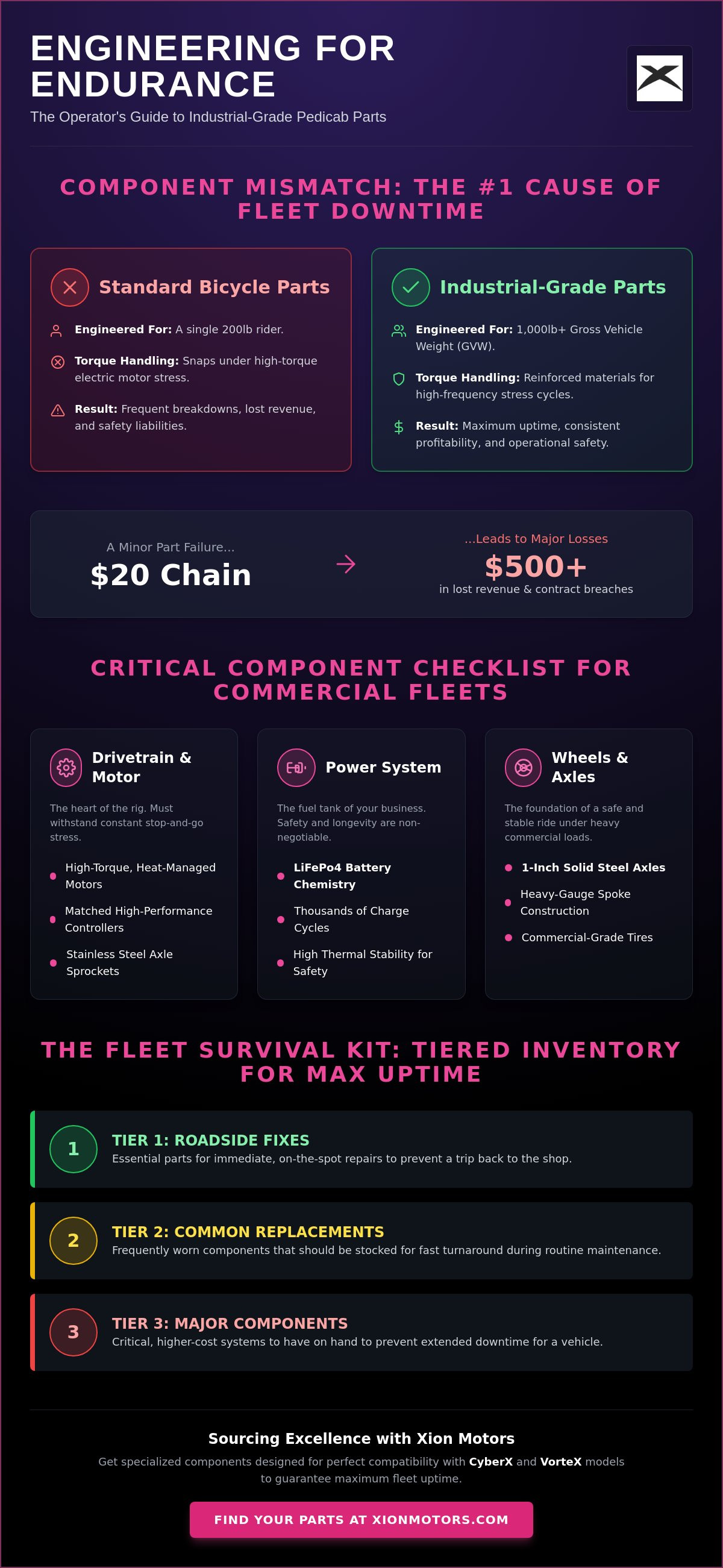
Industrial-grade is not a marketing buzzword in the professional transit sector. It's a technical specification. For a vehicle to operate safely and profitably, components must be engineered for a weight capacity of 1,500 lbs or more. This includes the weight of the chassis, the driver, and up to six passengers. Xion Motors has spent 20 years in the trenches of urban transport, refining pedicab parts that survive the brutal reality of street-level operations. We've seen the industry evolve from the traditional Cycle rickshaw into high-performance electric vehicles that demand a different level of engineering integrity. Relying on standard bicycle components is a false economy. It's a decision that saves pennies on procurement while burning thousands in lost revenue and damaged reputation.
The Difference Between Bike Parts and Pedicab Components
The torque requirements of a commercial electric motor are exponentially higher than those of a human cyclist. Standard bicycle chains and spokes are designed for a 200lb rider, not a half-ton payload moving through high-traffic intersections. When you apply full throttle to a loaded trike, standard components often snap instantly under the strain. Industrial-grade pedicab parts utilize reinforced materials and oversized dimensions to handle these frequent, high-frequency stress cycles. We prioritize heavy-duty alloys and precision-machined steel because we know that component failure in a transit environment isn't just a nuisance; it's a liability. Professional operators need parts that are built for the grind, whereas high-end consumer components from cyclecentre.com are optimized for the weekend trail ride.
Calculating the Cost of Downtime
Downtime is the silent killer of commercial ROI. A $20 chain failure seems minor until you calculate the $500 in lost shift revenue and the potential breach of a high-value event contract. If your vehicle is out of service, it's a liability rather than an asset. Investing in superior component quality is the most effective way to secure your electric pedicab fleet packages and ensure long-term profitability. High-quality parts reduce the frequency of maintenance intervals, allowing your drivers to stay on the road during peak earning windows. Uptime is the primary metric for fleet profitability.
The Heart of the Rig: Selecting Drivetrain and Motor Systems
A pedicab's drivetrain is where the battle for uptime is won or lost. You can't rely on standard hub motors designed for leisure bikes. Commercial operations require high-torque systems specifically engineered for frequent, heavy-load starts in dense urban environments. If your motor isn't built to handle the constant stop-and-go cadence of a city center, it'll burn out before the season ends. We prioritize heat management because thermal efficiency is the difference between a profitable shift and a stranded vehicle. High-performance controllers must be paired with motor systems that can dissipate heat during the peak of summer demand.
LiFePo4 battery chemistry has established itself as the commercial standard for 2026. While other lithium variants exist, LiFePo4 offers the thermal stability and longevity required for daily, high-intensity use. These batteries provide thousands of charge cycles, ensuring your energy storage remains a reliable asset rather than a recurring expense. When you're sourcing pedicab parts, the battery is the one area where you should never compromise on safety or cycle life. It's the fuel tank of your business; keep it industrial-grade.
Motor and Controller Synergy
Matching controller amperage to motor peak performance is essential for consistent hill climbing and heavy-load acceleration. If these systems are mismatched, you'll experience sluggish performance or premature component failure. We recommend using 'plug-and-play' wiring harnesses. This allows your maintenance team to perform fast field replacements, minimizing the time a vehicle spends in the shop. Look for signs of motor fatigue, such as unusual vibrations or increased operating temperatures, to catch issues before they lead to a total breakdown.
Chains, Sprockets, and Power Transfer
Standard alloy sprockets can't survive the torque of a commercial electric-assist system. You need stainless steel axle sprockets that resist wear and maintain their profile under pressure. Selecting the right chain pitch is equally critical for efficient power transfer. We've found that heavy-duty 219 chains provide the necessary tensile strength for high-capacity models. Implementing EV fleet maintenance best practices will help you track wear patterns and schedule lubrication. This is especially vital in coastal or dusty environments where debris can quickly degrade your pedicab parts. If you're looking to upgrade your current setup, exploring specialized drivetrain options can significantly improve your vehicle's reliability and long-term ROI.
Weight-Bearing Integrity: Wheels, Tires, and Axles
The foundation of a commercial vehicle is its ability to carry weight without deformation. For any operator managing multi-passenger units, 1-inch solid steel axles are the non-negotiable baseline. We've seen competitors attempt to cut weight with hollow tubes or 3/4-inch shafts; however, these components inevitably fail under the 1,500 lb payloads common in 2026. A bent axle doesn't just stop a shift; it can damage the entire drivetrain housing. High-quality pedicab parts must prioritize structural rigidity over marginal weight savings. This focus on safety is reflected in professional standards like the City of Chicago pedicab regulations, which emphasize the necessity of robust vehicle construction for public safety.
Wheel construction follows the same logic of industrial over-engineering. We utilize 48-hole hubs laced with heavy-gauge spokes to distribute load across the rim more effectively. While a 32-spoke wheel is standard for mountain bikes, it'll buckle under the lateral stress of a sharp turn with four passengers in the back. Precision is paramount here. We also specify sealed precision bearings for every hub and axle mount. These bearings reduce rolling resistance, which directly extends your electric range and minimizes the frequency of intrusive maintenance. Selecting tires that balance puncture resistance with rolling efficiency is the final step in securing your wheel system's integrity.
Reinforced Wheel Systems
The Master Practitioner knows that spoke tension is actually more critical than spoke thickness. A thick spoke with uneven tension will snap more frequently than a slightly thinner spoke that's perfectly balanced. Your rims must be wide-profile "Thicc" designs to provide a stable contact patch and handle the side-loading forces of urban navigation. This construction doesn't just prevent truing issues; it significantly improves passenger comfort by absorbing road vibrations that would otherwise rattle the chassis. It's an investment in both durability and the passenger experience.
Axle Hardware and Maintenance
Preventing component drift is a major challenge for high-mileage fleets. We use double-split axle collars to ensure that sprockets and brake rotors stay exactly where they were installed. You should inspect your pedicab parts weekly for signs of bearing wear, such as fine metallic dust or play in the axle. Xion Motors utilizes specific axle geometries for the CyberX and VorteX lines to optimize the center of gravity and reduce stress on the main bearings. This precision engineering ensures that your vehicle remains an asset on the street rather than a project in the garage.
The Fleet Survival Kit: Essential Inventory for Operators
Profitability is a game of probability. If you run a fleet long enough, components will fail. The difference between a minor delay and a lost night of revenue depends entirely on your inventory strategy. Data from high-volume operations shows that roughly five specific pedicab parts cause 80% of all roadside delays. By stocking these essentials, you transform a potential crisis into a ten-minute pit stop. Standardizing your hardware across every vehicle simplifies your toolkit and ensures your mechanics don't waste time hunting for unique wrenches or specialized fittings.
Ready-to-swap sub-assemblies are the hallmark of a master practitioner. Don't waste time truing a wheel on the sidewalk while a passenger waits. Keep pre-built wheels, complete with rotors and tires, ready in your shop. This modular approach allows you to swap a damaged unit in minutes and handle the complex repair during off-peak hours. Whether you manage 1 to 5 units or a massive 10+ unit operation, your inventory should scale to meet your daily mileage demands. Consistency across your fleet is the fastest way to reduce training time for new technicians.
The Roadside Emergency Kit
Every driver should carry a compact kit for immediate field repairs. This must include master links, spare fuses, and heavy-duty inner tubes. These small items are the most frequent points of failure in high-torque electric systems. You also need a multi-tool capable of drivetrain adjustments to keep the chain tensioned correctly. The 'Golden Hour' of pedicab repair is the first sixty minutes following a breakdown; if you can't get the vehicle back in service within this window, the shift is effectively lost. Prepare your team to act decisively so they can return to the revenue stream.
Warehouse Stocking Strategy
Your shop should function like a precision logistics hub. We recommend maintaining a 10% buffer of critical components, specifically high-torque motors and LiFePo4 batteries. This safety net protects you against supply chain fluctuations and the lead times associated with USA-manufactured custom parts. Xion Motors supports professional operators by offering bulk availability on the pedicab parts that keep fleets moving. Don't let a backordered component dictate your earning potential. Secure your operational continuity by stocking professional-grade spares before the peak season begins.
Sourcing Excellence: The Xion Motors Parts Collection
Selecting the right components is only half the battle; sourcing them from a partner who understands the industrial grind is the other. The Xion Motors parts collection represents the industry's most comprehensive inventory of professional-grade hardware. We offer more than 47 specialized components engineered to meet the exact tolerances of our CyberX and VorteX models. This isn't a catalog of generic accessories. It's a curated selection of pedicab parts designed to withstand the brutal torque and weight demands of 24/7 commercial operations. Our commitment to USA-manufactured quality means you aren't just buying a replacement; you're investing in a component that's been stress-tested in the most demanding urban environments.
Efficiency in the warehouse is just as important as performance on the street. We've developed a streamlined online portal specifically for fleet operators who need rapid replenishment without the friction of traditional procurement. You can manage your inventory levels in real-time, ensuring that your survival kits are always fully stocked before the next major event. Direct-to-operator support means you have a direct line to the engineers who designed your vehicle. We don't just ship boxes; we provide the technical infrastructure that allows your business to scale with confidence.
Standout Products for 2026
Our 2026 product lineup focuses on extreme durability and high-output performance. We've introduced high-torque motor upgrades that provide superior climbing power for fleets operating in hilly terrain or regions with high wind resistance. For the VorteX 6-seat powerhouse, our industrial-grade axle assemblies set the standard for load-bearing reliability. These aren't repurposed bike shafts. They're heavy-duty units designed for multi-year lifecycles. Our custom-engineered wheel sets utilize reinforced rim profiles and precision-matched hubs to ensure that your pedicab parts remain an asset rather than a maintenance liability.
Direct Support and Professional Expertise
Xion Motors brings 20 years of operational experience to every consultation. We've spent decades in the trenches, and we share that perfected knowledge with our partners to help them optimize their fleet configurations. If you're building a custom trike or scaling a city-wide operation, our team provides the expert advice you need to select the right drivetrain and power systems. We understand the economic advantage of superior engineering. Don't settle for components that weren't built for your specific business needs. Browse the full Xion Motors Pedicab Parts collection to secure your fleet’s future.
Engineer Your Fleet for Dominance in 2026
Success in the professional transit sector is measured by the reliability of your equipment under pressure. You now understand that industrial-grade pedicab parts are the only defense against the high-torque demands and 1,500 lb capacity of 3 and 6-seat commercial loads. By prioritizing 1-inch solid steel axles and reinforced drivetrain systems, you move from reactive repairs to proactive revenue management. A robust survival kit ensures that your vehicles stay on the street during the "Golden Hour" of peak demand, protecting your reputation and your bottom line.
Xion Motors brings over 20 years of fleet operation expertise to every component we manufacture. Our USA-manufactured parts aren't just replacements; they're precision tools engineered for the most punishing urban environments. We've perfected these systems in the trenches so you don't have to learn through failure. Secure your operational continuity and maximize your ROI with hardware that's built to last. Shop the Industrial-Grade Pedicab Parts Collection today and build a fleet that never stops earning. Your business deserves the security of professional-grade excellence.
Frequently Asked Questions
What are the most common pedicab parts that need replacement?
Drive chains, tires, brake pads, and sprockets are the most frequent replacements in any high-volume operation. These high-wear pedicab parts bear the brunt of urban friction and passenger weight every day. In electric-assist fleets, you should also monitor battery connectors and throttle cables for signs of vibration-induced fatigue. Catching these issues during a morning safety check prevents a total shift loss during your peak earning hours.
Can I use standard mountain bike parts on my electric pedicab?
You can't safely use standard mountain bike parts on a commercial electric trike. Bicycle components are designed for a 200lb rider, not the 1,500 lb weight capacity required for professional multi-passenger transport. Standard chains will snap and aluminum rims will buckle under the lateral stress of a sharp turn. Investing in industrial-grade hardware is the only way to protect your ROI and ensure passenger safety.
How do I know if a motor is powerful enough for a 6-seat pedicab?
Evaluate the motor's peak torque and heat dissipation ratings rather than just the wattage. A 6-seat pedicab demands a system that can handle frequent starts under maximum load without thermal shutdown. High-torque motors designed for urban delivery cycles provide the necessary power to navigate hills and heavy traffic safely. If your motor isn't built for these specific industrial cycles, it'll fail during your busiest summer season.
What is the difference between Type 1 and Type 2 axle bearings?
Type 1 bearings are typically standard utility grade, while Type 2 bearings are sealed precision units designed for high-load industrial environments. For commercial fleets, Type 2 is the baseline because they offer superior resistance to dust, moisture, and lateral forces. These precision bearings reduce rolling resistance, which directly improves your electric range. Swapping to higher-grade bearings is one of the fastest ways to lower your long-term maintenance frequency.
How often should I replace the drive chain on a commercial electric trike?
Commercial chains should be inspected weekly and typically require replacement every 500 to 1,000 miles depending on your terrain. The high torque from electric motors accelerates chain stretch, which can quickly ruin your axle sprockets if left unchecked. Use a precision chain wear tool to monitor elongation. Replacing a chain on a schedule is far more cost-effective than replacing a complete drivetrain after a catastrophic failure.
Are Xion Motors parts compatible with other pedicab brands?
Many of our industrial components, such as bearings and chains, follow universal standards and may fit other frames. However, our specialized pedicab parts are precision-engineered specifically for the geometry and torque requirements of CyberX and VorteX models. Using parts designed for your specific chassis ensures perfect alignment and maximum durability. If you're managing a mixed fleet, contact our engineering team to verify compatibility before starting your procurement.
What is the benefit of buying USA-manufactured pedicab parts?
USA-manufactured parts provide superior material integrity and much tighter engineering tolerances than generic imports. You aren't just buying a component; you're securing a supply chain that offers direct technical support and rapid replenishment. When a vehicle is down, waiting weeks for an overseas shipment is a recipe for lost revenue. Domestic manufacturing ensures your fleet stays operational with parts built to survive the specific rigors of American streets.
How do I build a maintenance schedule for a large pedicab fleet?
Build your schedule around daily safety checks, weekly drivetrain tuning, and monthly deep inspections of the axle and motor systems. Large fleets require a tiered inventory strategy to track the life cycles of every critical component. By documenting wear patterns, you can predict failures before they happen. This proactive approach transforms maintenance from an emergency expense into a controlled operational cost that maximizes your total fleet uptime.
Thinking about starting or scaling a pedicab operation?
See what a pedicab costs ($13,500–$15,000 direct from the manufacturer), explore fleet pricing on 3+ units, or start with $0-down equipment financing. Xion operators earn $30,000–$35,000 per cab per year across 59+ US markets.