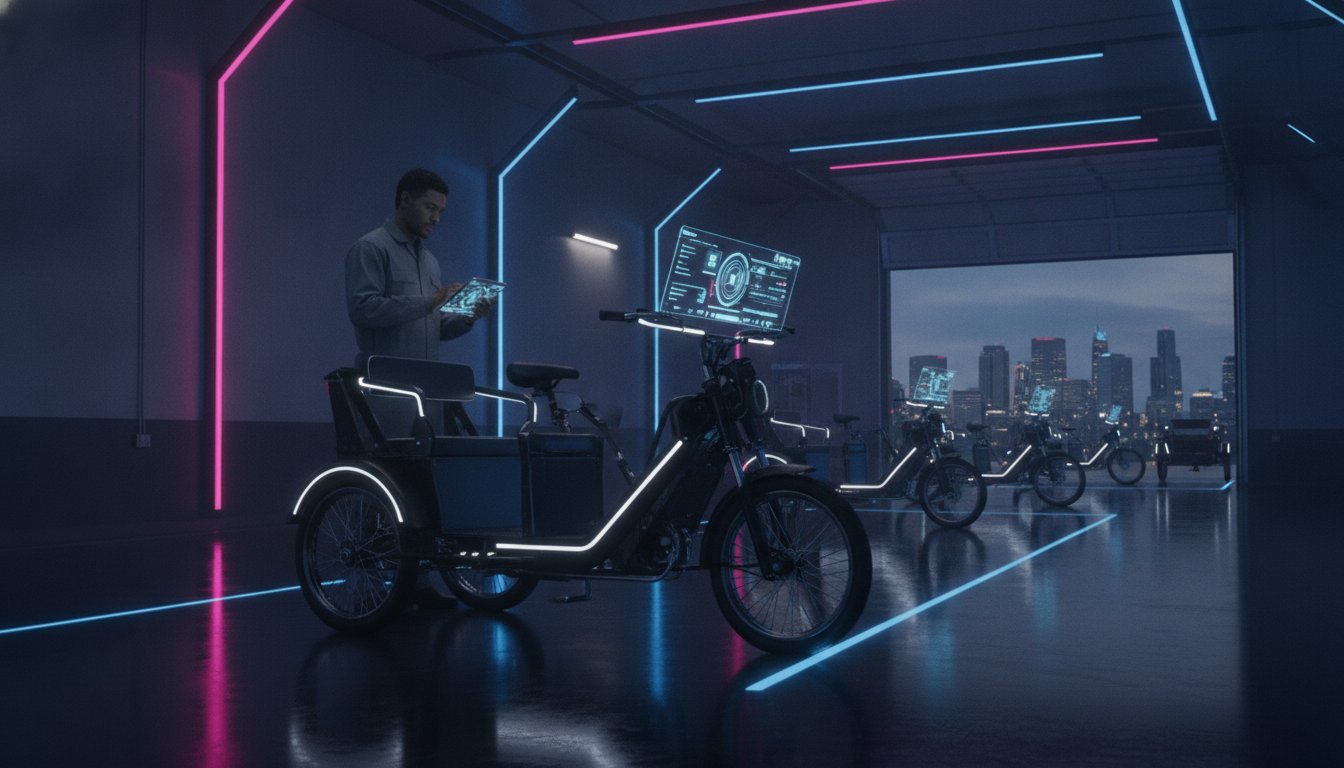
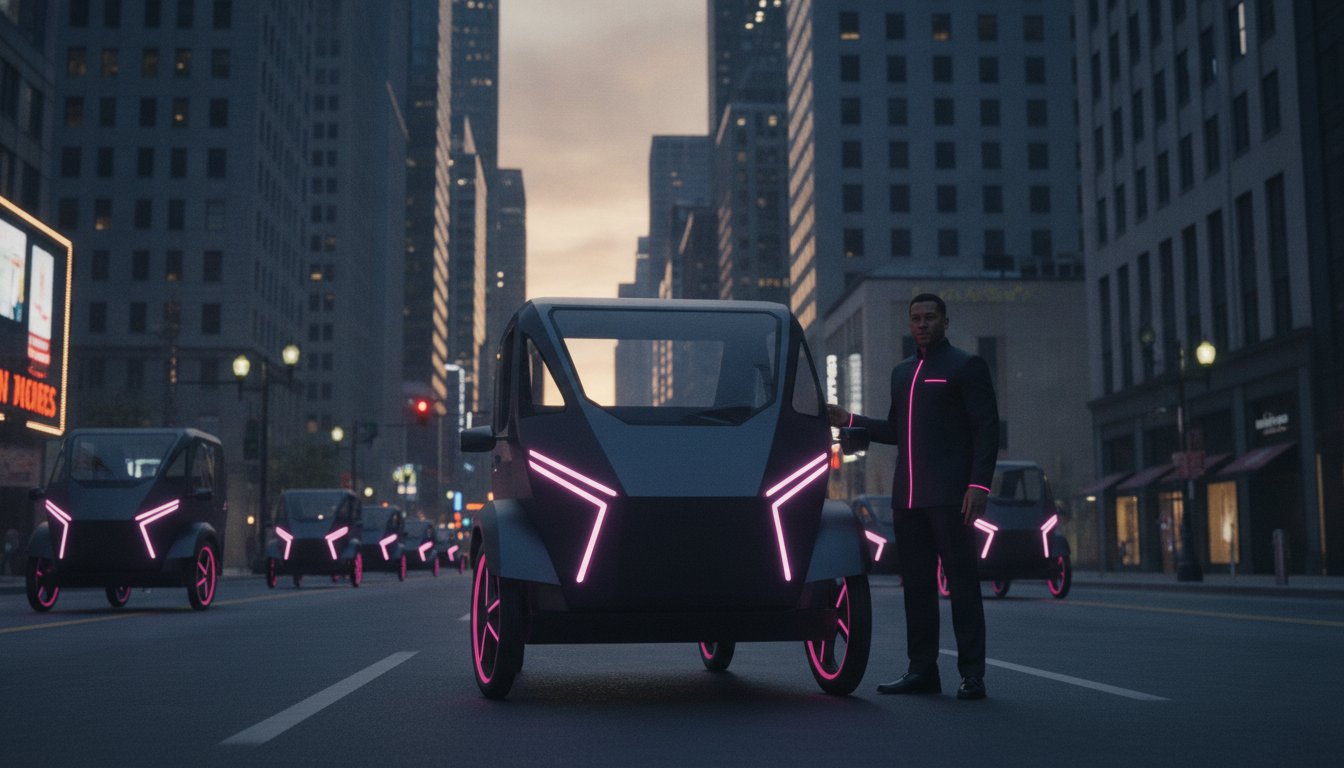
Could a single traffic mishap dismantle everything you've built? For many operators, the difference between a thriving fleet and a shuttered garage isn't the quality of their service; it's the strength of their bike taxi business insurance. You've likely felt the sting of high-risk labels and the frustration of explaining industrial-grade electric pedicabs to brokers who only understand sedans. It's a common hurdle for entrepreneurs who prioritize high-performance growth but face a wall of astronomical premiums and vague policy terms.
This 2026 guide will help you master the complexities of specialty livery insurance to safeguard your operations and secure your path to high-yield profitability. We'll provide a clear checklist of required coverages and demonstrate how better risk management leads to lower premiums. You'll learn to build a business that is attractive to investors and city regulators by proving your fleet is as safe as it is profitable. From understanding liability limits in major entertainment districts to leveraging the durability of your equipment, we're sharing the tools you need to dominate the market with confidence.
Key Takeaways
- Understand why standard e-bike policies leave your passengers exposed and how to secure specialized bike taxi business insurance for for-hire transport.
- Identify the critical differences between General Liability and Commercial Livery insurance to ensure your fleet is protected while in motion.
- Learn how industrial-grade engineering and high-torque drive systems act as risk-mitigation tools that can lower your long-term insurance premiums.
- Master the professional checklist for driver training and digital maintenance logs to make your business more attractive to underwriters and city regulators.
- Explore how high-capacity assets like the 6-seat VorteX can be leveraged as secure, insurable micro-transit solutions that drive high-yield profitability.
What is Bike Taxi Business Insurance and Why Do You Need It?
Operating a fleet of electric pedicabs is a high-performance venture that requires more than just mechanical skill. It demands a sophisticated approach to risk management. At its core, bike taxi business insurance is a specialized form of commercial livery insurance. It's engineered specifically for for-hire passenger transport on non-traditional vehicles like the CyberX or VorteX. You aren't just riding a bike; you're managing a professional transit asset that carries human cargo through dense urban environments. Standard e-bike or general business policies are insufficient here. Those policies typically contain strict exclusions for "commercial use" or "for-hire transport," leaving you personally liable the moment a passenger pays for a seat.
The legal distinction that matters most is the "Livery Gap." When you transition from recreational riding to transporting passengers for a fee, your legal risk profile shifts entirely. Actuaries view fee-based transport as a higher frequency risk because the vehicle is on the road for extended hours in high-traffic zones. Without a dedicated livery policy, a single accident could trigger a total loss of assets. Most major U.S. entertainment districts require proof of this specific coverage before they'll even process your operating permit. Insurance isn't just a safety net; it's the primary prerequisite for street-level legitimacy.
The Difference Between Livery and General Liability
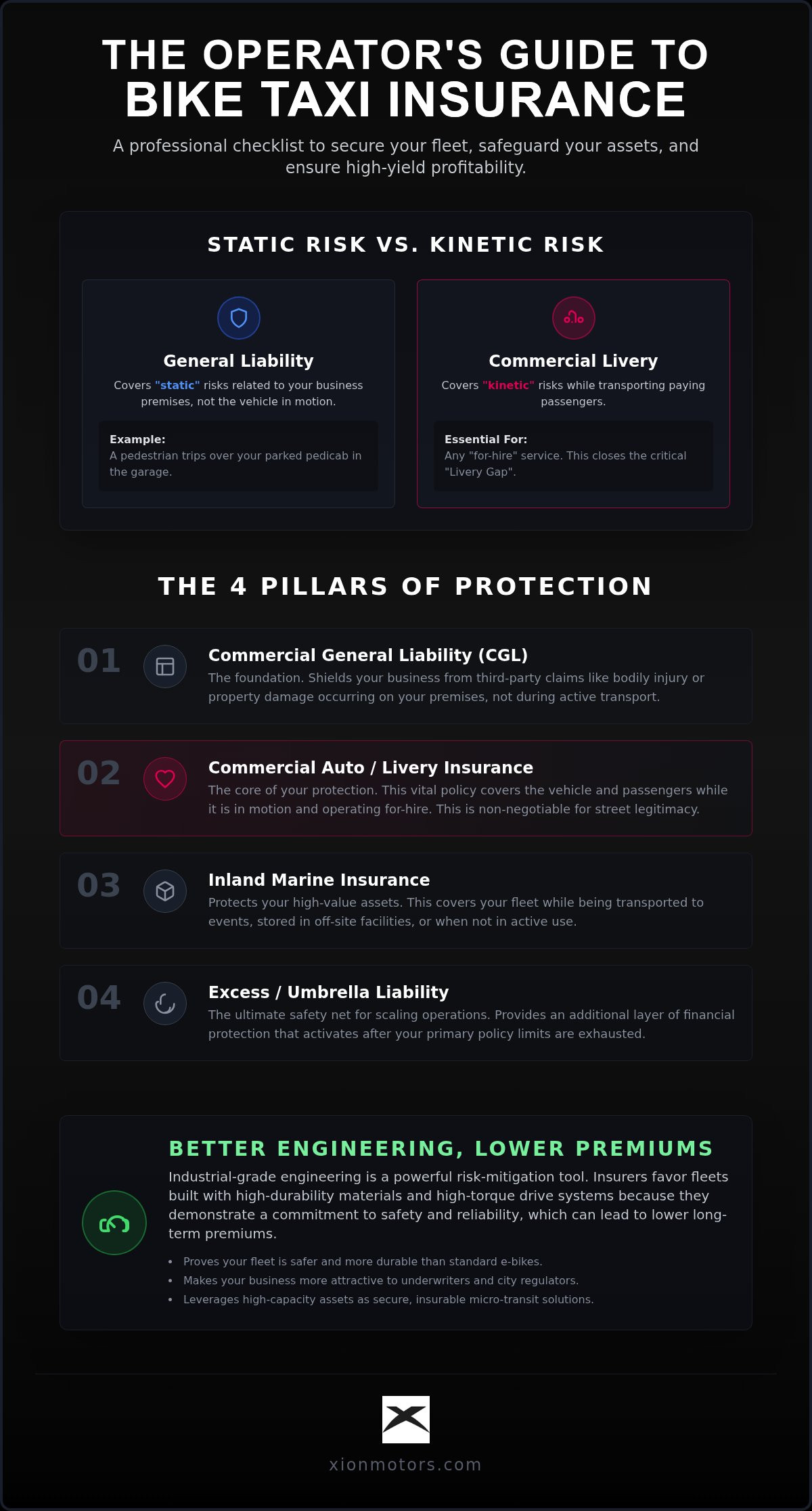
Many operators confuse General Liability (GL) with Livery coverage, but they serve two distinct functions. General Liability protects your business premises and covers incidents like a pedestrian tripping over a parked vehicle in your garage. It's about the "static" risks of your business. Commercial Livery insurance covers the "kinetic" risk. It protects the vehicle while it's in motion with passengers on board. If your business model involves guided historical or city tours, you'll also need Professional Liability. This covers claims related to the information or "advice" provided during the tour, ensuring every aspect of your service is shielded from litigation.
Legal Compliance and Street Legitimacy
City regulators demand a Certificate of Insurance (COI) that names the municipality as an additionally insured party. This document is your ticket to the street. It demonstrates to city officials and investors that your fleet is managed with professional-grade discipline. High insurance standards actually benefit established operators by acting as a barrier to entry. They filter out unprofessional competitors who lack the capital or the industrial-grade equipment to secure a policy. Ensuring your coverage specifically mentions your street legal electric pedicabs is vital for maintaining compliance and proving your fleet meets the highest safety benchmarks in the industry.
The 4 Essential Coverage Types for Pedicab Operators
Securing bike taxi business insurance isn't about checking a box for city hall. It's about building a defensive perimeter around your capital investment. A professional fleet requires four distinct pillars of coverage to remain solvent in the face of unpredictable urban variables. You need a policy that reflects the industrial reality of your equipment and the high-stakes nature of passenger transport.
Commercial General Liability (CGL) serves as the foundation of your protection. It shields your business from third-party claims involving bodily injury or property damage that occur outside the actual operation of the vehicle. Commercial Auto or Livery Insurance is the secondary, yet equally vital, pillar. This covers the vehicle specifically while it's in motion with passengers. Without this, you're operating without a safety net during your most revenue-intensive hours.
High-value assets like the CyberX require Inland Marine Insurance. This specialized coverage protects your vehicles while they're being transported to events or stored in off-site facilities. Finally, Excess or Umbrella Liability is non-negotiable for those scaling their operations. It provides an additional layer of protection that kicks in once your primary policy limits are exhausted, which is essential for covering catastrophic loss scenarios in dense metropolitan areas. If you're looking to expand, choosing industrial-grade fleet packages can help demonstrate to insurers that your business is built on a foundation of durability and professional-grade engineering.
Physical Damage and Equipment Coverage
Protecting your investment from theft, vandalism, or collision damage is a matter of business survival. When insuring vehicles that cost $17,000 or more, the distinction between Actual Cash Value and Replacement Cost is critical. Actual Cash Value only pays what the vehicle is worth at the time of the loss, accounting for depreciation. Replacement Cost coverage ensures you can actually put a new unit back on the street. Maintaining a rigorous electric pedicab maintenance guide is often a requirement for substantiating these claims to your provider, proving that the equipment was in peak operational condition before the incident occurred.
Medical Payments and Uninsured Motorist
Medical Payments coverage, often called MedPay, covers passenger medical expenses regardless of who is at fault in an accident. MedPay acts as a critical trust-builder for passengers by ensuring immediate care is available without lengthy legal battles. You must also account for the risks posed by others on the road. Uninsured and Underinsured Motorist coverage protects your drivers and your business from hit-and-run incidents or collisions caused by drivers who lack sufficient insurance. It's a proactive step that ensures your team isn't left holding the bill for someone else's negligence.
How Vehicle Engineering Impacts Your Insurance Premiums
Insurance underwriters don't just evaluate your driving record; they scrutinize the structural integrity of your fleet. In the world of bike taxi business insurance, your equipment is your primary risk-mitigation tool. Actuaries recognize that industrial-grade chassis are far less likely to suffer catastrophic structural failures than consumer-grade trikes. When you present an insurer with a vehicle built for commercial abuse, you're presenting a lower statistical probability of a mechanical failure claim. Precision engineering translates directly into lower overhead.
High-torque drive systems play a vital role in accident prevention. While cheap motors often suffer from "lurching" or unpredictable acceleration, professional-grade systems provide smooth, controlled power delivery. This precision reduces the frequency of low-speed "jerk" accidents where passengers might lose their balance during a start. Beyond the drivetrain, insurers look for integrated safety features as premium reducers. A fleet equipped with hydraulic disc brakes, integrated LED turn signals, and high-visibility lighting packages signals to the underwriter that you've prioritized safety over initial cost savings. Furthermore, UL-listed battery systems have become mandatory for modern commercial insurers to mitigate fire risks, making non-certified imports an immediate liability.
Industrial-Grade vs. Consumer-Grade Risk
The structural failure risk of cheap imports is a significant red flag for liability providers. Frames that snap under load or wheels that buckle during a turn lead to high-dollar bodily injury claims that can bankrupt an operator. Xion Motors' CyberX engineering minimizes mechanical failure claims by using heavy-duty materials and reinforced stress points designed for 24/7 commercial use. When negotiating with underwriters, don't just ask for a quote. Use your vehicle specifications to prove your lower risk profile. Showing a broker the technical specs of an industrial chassis often opens doors to preferred rates that are unavailable to operators using modified recreational bikes.
Capacity and Stability Factors
The stability profile of a purpose-built 6-seat electric pedicab is a major selling point for risk managers. Wide-track designs and low centers of gravity are inherently insurance-friendly because they resist the lateral forces that cause tipping. The VorteX's wide-track stance and low center of gravity virtually eliminate the tip-over risks associated with high-capacity urban transport. This physical stability allows you to carry more passengers with a lower risk of incident, maximizing your ROI while keeping your bike taxi business insurance premiums manageable. By investing in stable, high-capacity platforms, you demonstrate a commitment to professional-grade safety that city regulators and insurers alike respect.
Building an Insurable Business: A Professional Checklist
Securing competitive bike taxi business insurance rates requires more than just high-quality hardware. It demands operational mastery. Underwriters look for fleets that treat safety as a core business function rather than a regulatory hurdle. By implementing a rigorous driver training and certification program, you demonstrate that your operators possess the technical skill to handle high-torque electric vehicles in unpredictable urban environments. This professional discipline reduces the frequency of avoidable claims and positions your brand as a market leader in the micro-transit sector.
A truly insurable business maintains detailed digital maintenance logs for every vehicle in the fleet. These records serve as forensic proof that your CyberX or VorteX units were in peak condition at the time of any incident. Beyond maintenance, standardizing your safety equipment is a non-negotiable step. Equipping your fleet with seatbelts, providing helmets for drivers, and using high-visibility branding shows a commitment to passenger protection that insurers reward. Smart operators also integrate telematics and GPS tracking to monitor driver behavior and speed in real-time. This data allows you to correct risky habits before they result in a costly accident.
The Driver Vetting Process
Your drivers are your greatest liability or your strongest asset. Motor Vehicle Record (MVR) checks are the first thing an insurer will ask for during the underwriting process. Drivers with clean records are the only way to keep your premiums from skyrocketing. Age requirements also play a pivotal role; most insurers consider 21 or 25 to be the insurance sweet spot for commercial livery risk. Establishing these standards early is a critical part of starting a pedicab company that is built for long-term scalability and investor appeal.
Operational Documentation
Documentation is your primary defense in the event of a legal challenge. You must draft ironclad liability waivers for every passenger and special event to clearly define the limits of your responsibility. Equally important are your incident reporting protocols. Your team should know exactly what to do in the first 10 minutes after a crash, from securing witness statements to documenting the scene with photos. Maintaining clean operational records leads to Preferred status with brokers. This status translates to lower renewals and better coverage terms year after year. To ensure your business is built on a foundation of professional-grade equipment, invest in industrial-grade pedicab fleet packages that meet the highest standards of the insurance industry.
Scaling Your Fleet with Xion Motors: The Professional Choice
Xion Motors builds vehicles that define the industry standard for insurable micro-transit assets. When you approach a broker, the origin and engineering of your fleet are the first variables they evaluate. Our USA-made quality provides a level of transparency and reliability that underwriters trust. We've spent over 20 years in the trenches of pedicab fleet operations. This legacy allows us to provide direct-to-operator support that goes beyond simple manufacturing. We help you navigate the complexities of bike taxi business insurance by providing the technical documentation and safety certifications that insurers demand. You aren't just buying a trike; you're acquiring a verified business tool.
Scaling your business requires assets that can handle high-capacity demands without increasing your risk profile. By integrating custom electric trikes for business, you maximize your ROI through operational efficiency and reduced liability. Our high-torque drive systems and reinforced chassis are designed to withstand the rigors of daily commercial use, making them the preferred choice for professional operators nationwide. We ship to all 50 states, ensuring that no matter where your district is located, you have access to the highest-performing equipment on the market. Our engineering is a proactive defense against the high premiums that plague unprofessional fleets.
Securing Your Investment
The $13,500 to $17,500 price point for our units reflects a strategic investment in a lower total cost of ownership. While cheap imports might seem attractive initially, they often carry hidden costs in the form of higher premiums and frequent mechanical failure claims. Xion's industrial-grade builds minimize these long-term expenses by reducing the statistical likelihood of structural failure. We ensure that replacement parts are readily available to minimize down-time claims. If a vehicle is off the street, it isn't earning. Our supply chain stability ensures your fleet remains active and profitable throughout the peak season. Partnering with Xion is a commitment to long-term fleet viability and professional-grade performance that stands up to scrutiny.
Next Steps for Your Business
Ready to dominate your local market? The first step is selecting equipment that city regulators and insurers will approve without hesitation. Our team is available to help you build a fleet package that fits your specific market needs. We also consult with our clients on identifying industry-standard insurance partners who understand the unique needs of electric pedicab operators. This insider knowledge is the result of decades of street-level experience. Don't leave your protection to chance. Scale your operation with Xion Motors fleet packages today.
Secure Your Fleet and Dominate the Urban Transit Market
Mastering your bike taxi business insurance is the final step in transitioning from a hobbyist to a dominant fleet operator. You've seen how industrial-grade engineering, like our CyberX and VorteX chassis, acts as a primary risk-mitigation tool that underwriters respect. By combining high-performance hardware with rigorous operational documentation and driver vetting, you transform insurance from a burdensome expense into a powerful competitive advantage. This strategic approach doesn't just protect your physical assets; it builds the street-level legitimacy required to win city permits and capture investor confidence. A business built on a foundation of safety is a business built for scale.
Xion Motors provides the industrial backbone for your success. With over 20 years of operational expertise and a commitment to high-torque, industrial-grade engineering, we offer the support you need to lead the market. Our national shipping to all 50 states and dedicated parts support ensure your fleet stays active and profitable throughout the season. It's time to stop worrying about liability and start focusing on your expansion. Explore Industrial-Grade Pedicab Fleet Packages at Xion Motors and secure your path to high-yield profitability today.
Frequently Asked Questions
Is insurance mandatory for a bike taxi business in the US?
Insurance is legally mandatory in nearly every major U.S. municipality that regulates for-hire passenger transport. City regulators require a Certificate of Insurance (COI) to issue operating permits. Without it, your fleet is grounded and your personal assets are exposed to catastrophic risk. Professional bike taxi business insurance proves your commitment to public safety and operational discipline. It serves as your primary credential for entering high-traffic entertainment districts where revenue potential is highest.
How much does bike taxi insurance typically cost in 2026?
Costs for coverage are dictated by your fleet size, location, and the engineering quality of your vehicles. While industry averages fluctuate based on market conditions, underwriters offer more competitive rates to operators using industrial-grade equipment rather than modified consumer trikes. Your premium is a reflection of your risk profile. Investing in durable, high-torque systems reduces the likelihood of mechanical failure claims, which keeps your long-term operational costs manageable and your ROI high.
Can I get insurance for a 6-seat electric pedicab?
You certainly can, but you must ensure the vehicle is purpose-built for commercial loads. High-capacity assets like the 6-seat VorteX are designed with wide-track stability and reinforced chassis, which underwriters prefer over makeshift alternatives. Because these vehicles carry more passengers, insurers will scrutinize your safety features and driver training programs more closely. Providing technical specifications of your industrial-grade equipment is the best way to secure a specialized livery policy for high-capacity fleets.
Does my personal auto insurance cover my pedicab business?
No, your personal auto or homeowners policy won't provide any protection for a pedicab operation. Personal insurance specifically excludes for-hire transportation and commercial use. If an incident occurs while you're charging a fee, your personal carrier will likely deny the claim and may cancel your policy entirely. You must secure dedicated bike taxi business insurance that is engineered to cover the unique kinetic risks of professional passenger transport in urban environments.
What happens if a passenger is injured during a tour?
If a passenger is injured, your Commercial Livery or MedPay coverage becomes the primary line of defense. MedPay handles immediate medical expenses regardless of fault, which helps build trust and can prevent minor incidents from escalating into lawsuits. For more serious injuries, your liability limits protect your business from legal judgments and settlement costs. Having a clear incident reporting protocol ensures you document the scene accurately, which is vital for a successful claim process.
How do I lower my pedicab insurance premiums?
Lowering premiums requires a proactive approach to risk management. Start by using industrial-grade vehicles that underwriters trust, such as those with UL-listed batteries and hydraulic disc brakes. Implementing a digital maintenance log and a rigorous driver vetting process also signals professional discipline. Many insurers offer discounts for fleets that utilize GPS telematics to monitor driver behavior. Demonstrating a safety first culture through consistent documentation often leads to preferred status and lower renewal rates.
Do I need special insurance for electric-assist motors?
Yes, electric-assist fleets face different risk profiles than manual pedicabs. Insurers specifically look for UL-listed battery systems and high-torque motors that offer controlled power delivery. Non-certified electrical systems are often uninsurable due to fire risks and unpredictable acceleration. You must disclose the technical specifications of your drive system to your broker to ensure your policy doesn't contain exclusions for electric-assist vehicles. Using professional-grade hardware simplifies this process and keeps your fleet street-legal.
What is the minimum liability coverage required for most city permits?
Most U.S. entertainment districts and municipalities require a minimum of $1 million in Commercial General Liability, often with a $2 million aggregate limit. Some high-density cities may demand even higher limits for large-capacity vehicles. It's vital to check with your local regulatory body to verify the exact requirements for your specific district. Meeting or exceeding these minimums is essential for obtaining your COI and ensuring your business is protected against catastrophic loss scenarios.