A single hour of unplanned downtime during a peak tourism window doesn't just cost you a fare; it erodes the entire financial viability of your operation. With pedicab advertising brand recall rates hitting 85% in 2026, every minute off the road is a missed opportunity for both fare and sponsorship revenue. You've invested in industrial-grade assets like the CyberX or VorteX because you demand performance that consumer-grade bikes can't touch. However, even the most rugged 72V system will falter without a rigorous, data-driven pedicab fleet maintenance schedule designed for 1,000lb payloads. If you're treating maintenance as a reactive chore rather than a proactive engineering protocol, you're leaving thousands in potential revenue on the street.
We know that your fleet is the backbone of your business and that mechanical failures under heavy loads are unacceptable. You need your drivers to operate with total confidence and your passengers to stay safe, especially as 2026 regulations across various jurisdictions tighten requirements for vehicle integrity. This guide from Xion Motors promises to deliver a master-level blueprint for engineering zero-downtime ROI. We'll preview the specific daily, weekly, and monthly protocols required to maximize the lifespan of your high-torque motors and 72V battery systems, ensuring your fleet remains a dominant force in the market.
Key Takeaways
- Adopt a proactive industrial continuity mindset to eliminate the revenue-killing impact of unplanned downtime during peak tourism events.
- Deploy a standardized pedicab fleet maintenance schedule that prioritizes high-mileage calibrations and seasonal thermal management for 72V systems.
- Master the "Pre-Flight" inspection protocol to identify structural risks before they compromise passenger safety or driver confidence under 1,000lb payloads.
- Extend the lifecycle of your 72V lithium-ion batteries by implementing precise 80% charging thresholds and industrial-grade storage standards.
- Transition your service team from basic bicycle maintenance to advanced EV technician standards to ensure the long-term ROI of your commercial transit assets.
The Industrial Maintenance Philosophy: Why Uptime is Your Primary Metric
In the high-stakes world of commercial transit, a broken chain or a depleted battery is more than a mechanical failure; it's a direct hit to your bottom line. Transitioning from a reactive repair model to a proactive industrial continuity mindset is the first step toward market dominance. While the traditional Cycle rickshaw (pedicab) relied on simple mechanical components, modern electric fleets operate as high-torque industrial machines. You aren't just running a bike shop. You're managing a fleet of revenue-generating assets that must perform under extreme pressure.
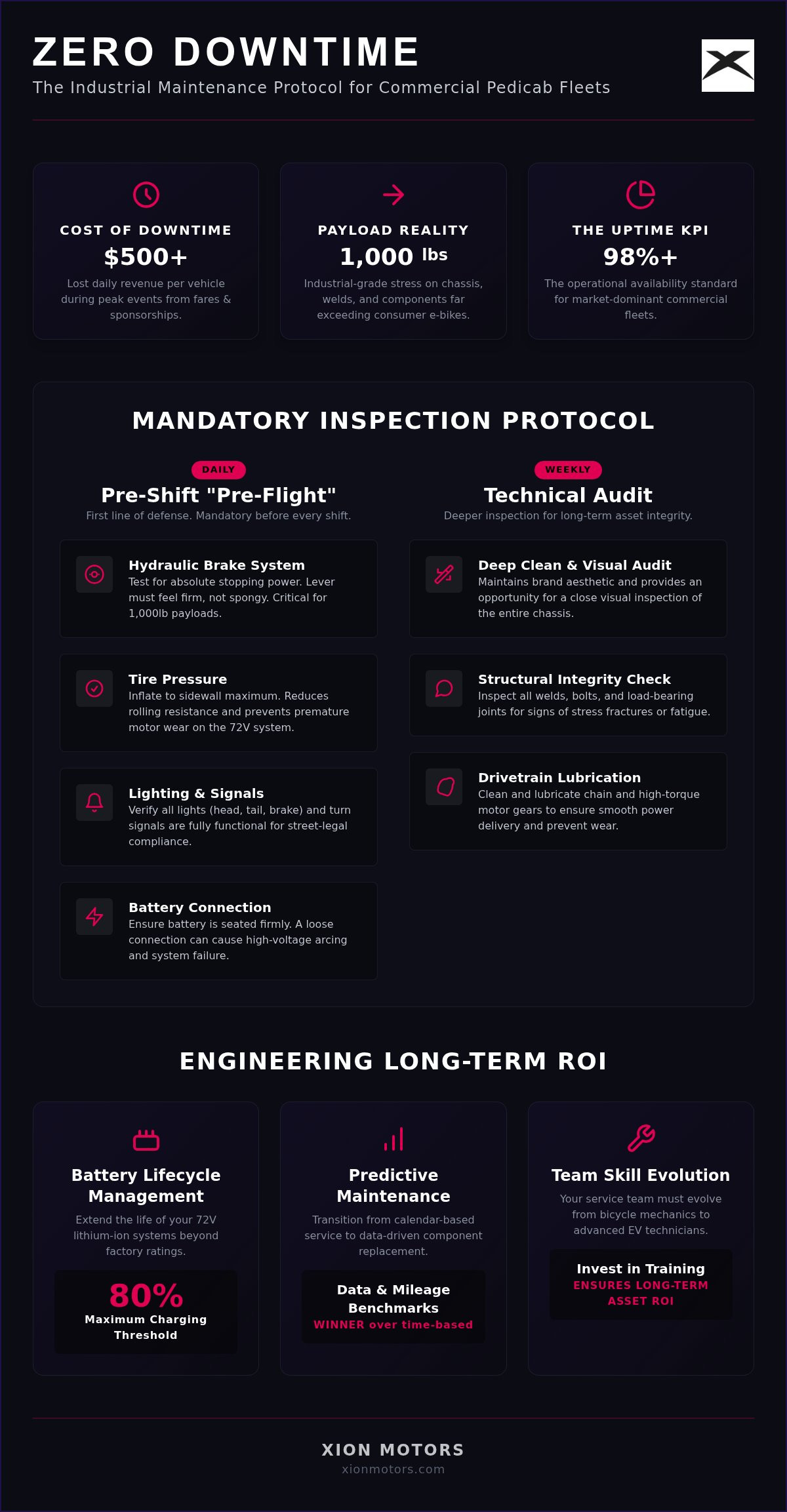
The true cost of downtime is staggering. Consider that a single industrial-grade pedicab can generate up to $35,000 in annual gross revenue. During peak events, daily advertising rates alone can reach $500 per vehicle. If a unit sits in the shop during a major convention or festival, you're losing hundreds of dollars every hour. A disciplined pedicab fleet maintenance schedule transforms these risks into predictable operational costs. It moves your team away from "fixing" and toward "precision management."
The 1,000-Pound Payload Reality
Commercial electric pedicabs face structural stresses that would shatter a standard e-bike. When you're hauling a 1,000lb payload of passengers and cargo, every weld and bolt is pushed to its limit. Standard bicycle components are not designed for this level of commercial transit demand. They fail prematurely, leading to safety risks and unplanned expenses. This reality necessitates industrial-grade chassis inspections. Engineering standards like those found in the CyberX are built to withstand these forces, but only if they are monitored with a Master Practitioner's eye. Your mechanical team must understand that they are maintaining heavy machinery, not toys.
Defining the Zero-Downtime Standard
Success in 2026 is measured by fleet availability. You should set clear KPIs for mechanical reliability, aiming for a 98% or higher uptime rate across your entire operation. Scheduled maintenance is the engine that drives this reliability, extending the lifespan of your assets to 10 years or more. While preventative maintenance follows a calendar, predictive maintenance uses data and mileage benchmarks to replace components before they show signs of distress. In the current market, predictive maintenance wins. It ensures that your pedicab fleet maintenance schedule stays ahead of the wear-and-tear curve, keeping your drivers on the street and your revenue flowing without interruption.
The Daily and Weekly Pedicab Inspection Protocol
Precision is the hallmark of a profitable operation. Your drivers aren't just operators; they are the first line of defense in your pedicab fleet maintenance schedule. Every shift must begin with a standardized Pre-Flight ritual. This isn't a suggestion. It's a mandatory protocol that protects your assets, your passengers, and your revenue stream. When you treat your fleet like industrial machinery, you eliminate the "surprises" that lead to mid-shift failures.
Daily Pre-Shift Safety Checklist
Before any unit touches the pavement, it must pass a rigorous safety audit. The hydraulic brake system is your most critical component. A 1,000lb payload requires absolute stopping power; if the lever feels spongy, the vehicle stays in the shop. Tire pressure must be optimized to the sidewall maximum to ensure the 72V system achieves its full range. Under-inflated tires increase rolling resistance and force the motor to work harder, leading to premature wear. Finally, verify all lighting and signal functions to maintain street-legal compliance and check that battery connections are seated firmly to prevent high-voltage arcing.
Weekly Technical Audits
Weekly deep-cleans serve a dual purpose: maintaining your brand's aesthetic and providing an opportunity for visual structural audits. Professional organizations like the IPMBA highlight the importance of Bicycle Fleet Management and Maintenance for high-performance fleets, and these principles apply directly to electric transit. During this weekly window, your team must perform the following:
- Drive Train Integrity: Clean and lubricate the chain to prevent mid-shift failures. Check for excessive stretch that could indicate a looming snap.
- Wheel Trueness: Audit spoke tension using a tensiometer. High-torque motors and heavy passenger loads put massive lateral stress on rims.
- Thermal Management: Wipe down the 72V motor casing. Grime and road salt act as insulation, trapping heat and degrading motor efficiency over time.
Documenting these inspections is essential for maintaining fleet liability standards. If a technician identifies "red-flag" symptoms like grinding hub bearings, frayed electrical leads, or cracked frame welds, the vehicle must be decommissioned immediately. Keeping a stock of authentic replacement parts ensures these repairs happen fast, moving the unit from the repair bay back to the street where it belongs. Never gamble with passenger safety; if a unit isn't 100% compliant, it doesn't roll.
Monthly and Seasonal Systems Calibration
A commercial pedicab isn't a weekend toy; it's an industrial asset that often covers more miles in a single month than a consumer e-bike does in a year. In 2026, a high-performance fleet requires a pedicab fleet maintenance schedule that accounts for the extreme mileage accumulated during grueling 12-hour shifts. While a hobbyist might tune their bike once a season, a professional operator performs deep-dive mechanical calibrations every 30 days. This monthly interval is where you identify the invisible wear that leads to catastrophic roadside failure.
High-Torque Mechanical Integrity
The high-torque 72V systems found in modern fleets deliver massive power, but they also exert significant stress on the vehicle's structural components. You must inspect mid-drive motor mounts for structural fatigue monthly to ensure the powertrain remains seated correctly. For the Custom VorteX Trike, verify axle bolt torque settings to exact manufacturer specifications. Loose hardware leads to vibration, which eventually causes hardware shearing or frame damage. Additionally, flush your hydraulic brake fluid and audit pad thickness. A 1,000lb payload demands maximum stopping power, and pads should be replaced once they reach 25% of their original thickness to prevent rotor scarring.
Seasonal Fleet Preparation
Your operating environment dictates your maintenance priorities. In cold-weather climates, lithium-ion batteries require specific "wake-up" protocols after winter storage to prevent cell imbalance and ensure a full 72V output. Conversely, summer operations demand rigorous cooling system audits. Ensure motor controllers stay within designated temperature specifications to avoid thermal throttling during heatwaves. For coastal or northern operations, corrosion control is non-negotiable. Apply industrial-grade protectants to the chassis and electrical contact points to shield the vehicle from road salt and humidity, which can otherwise lead to electrical gremlins or structural rot.
System longevity depends entirely on the quality of your components. Using authentic commercial trike replacement parts ensures that every repair meets the original engineering standard and maintains your warranty. Professional wheel truing and bearing replacements should happen every quarter or after any significant curb impact. By sticking to this rigorous pedicab fleet maintenance schedule, you ensure that your assets remain on the street, generating revenue for a decade or more rather than ending up in a scrap heap after two seasons.
The 72V architecture is the definitive engineering standard for modern commercial transit. While lower voltage systems struggle under load, a 72V high-performance system provides the necessary torque to move a 6 seat electric pedicab through dense urban environments without overheating. Managing this powertrain is the most technically demanding part of your pedicab fleet maintenance schedule. Because the battery is your fleet's most expensive asset, your protocols must prioritize thermal management and cycle-life preservation.Heat is the silent killer of lithium-ion cells. If you're pushing your vehicles through 12-hour shifts in high-temperature environments, your diagnostic software becomes your best friend. Use it to monitor internal cell temperatures and voltage sag. Predicting a failure before it happens saves you from the logistical nightmare of a dead unit in the middle of a busy street. Data transparency allows you to retire aging packs before they compromise your operational reliability.
Battery Charging and Storage Logistics
Maximizing ROI means keeping your batteries healthy for as long as possible. For daily operations, limit your charging to 80% of total capacity. This simple adjustment can nearly double the cycle life of your lithium-ion packs compared to constant 100% charging. However, once a week, you must allow the batteries to reach a full 100% charge and remain connected for several hours. This allows the Battery Management System (BMS) to perform cell balancing, ensuring each internal cell maintains a consistent voltage and preventing "drift" that leads to premature pack failure.
To maintain peak operational capability, implement a charge-swap-ride system. Instead of parking a vehicle to charge, swap in a fresh 72V pack and get the unit back on the street immediately. When storing packs, keep them in a climate-controlled environment at approximately 50% state of charge. This prevents the chemical degradation that occurs when batteries sit fully charged or completely depleted for extended periods.
Motor and Controller Care
The motor and controller are the brains and brawn of your operation. Your pedicab fleet maintenance schedule must include a monthly inspection of the entire wiring harness. Look for fraying, brittle insulation, or signs of heat damage near high-current connectors. Keeping motor hall sensors and connectors clean prevents erratic power delivery and "cogging" that can frustrate drivers and passengers alike. Precision in these small details prevents total system failure during peak revenue hours.
Firmware updates are equally critical. Manufacturers often release software optimizations that improve motor efficiency or refine the throttle response for better passenger comfort. Stay current with these updates to ensure your fleet operates at peak performance. If you need to refresh your inventory or replace critical powertrain components, ensure you are sourcing industrial-grade vehicle parts that are built to handle these high-voltage demands. Never compromise on the components that drive your revenue.
Scaling Maintenance: From Pilot Program to Market Dominance
Scaling from a pilot program to a dominant market presence requires more than just adding vehicles; it requires a systemic overhaul of your service logistics. When you invest in electric pedicab fleet packages, you aren't just buying hardware. You're acquiring industrial assets that demand standardized protocols. A centralized pedicab fleet maintenance schedule ensures that whether you have five units or fifty, every vehicle meets the same rigorous safety and performance benchmarks. This uniformity is what allows a fleet to maintain high revenue throughput across multiple city blocks without the chaos of localized failures.
The transition to a professional fleet also changes your human resource requirements. You don't need a traditional bike mechanic who tinkers with derailleurs and rim brakes. You need an EV technician who understands 72V architecture, controller logic, and high-torque drivetrain stress. Training your team to think like industrial engineers is the difference between a fleet that limps along and one that dominates the street. Leveraging manufacturer support for large-scale deployments ensures your technicians have the latest diagnostic protocols and service bulletins at their fingertips.
Building Your Internal Maintenance Shop
Building an internal maintenance shop is a strategic necessity for high-volume operations. You need professional-grade tools like digital torque wrenches for VorteX axle bolts and diagnostic laptops for CyberX systems. Implementing a "repair-not-replace" workflow for common issues, such as connector oxidation or cable fraying, keeps your operational costs low without compromising reliability. Always source authentic Xion Motors parts to guarantee fitment and maintain the structural integrity of your 1,000lb-capacity frames. Keeping a deep inventory of "high-velocity" parts like brake pads, chains, and hall sensors ensures that a minor issue never turns into a multi-day revenue loss.
Fleet Management Software Integration
Digital integration is the final frontier of fleet management. By using software to track maintenance history per vehicle VIN, you eliminate the guesswork associated with manual logs. Automating service alerts based on mileage or hours of operation ensures that no unit misses its 30-day calibration. Analyzing this data also allows you to optimize driver behavior. For instance, if one driver consistently triggers thermal alerts on the 72V powertrain, you can provide targeted training to reduce unnecessary wear. This data-driven pedicab fleet maintenance schedule transforms your shop from a cost center into a precision engine for long-term ROI.
Dominating the Urban Transit Market Through Operational Excellence
The difference between a struggling operation and a market leader is the commitment to technical precision. By implementing a rigorous pedicab fleet maintenance schedule, you transform your vehicles from simple bikes into high-performance industrial assets. We've explored how daily safety audits and monthly 72V system calibrations protect your most valuable investments. These protocols ensure your fleet handles 1,000lb payloads with ease while maximizing the cycle life of your battery systems.
Scaling your business requires more than just more wheels; it demands a veteran's approach to logistics and authentic component support. Xion Motors provides the foundation for this growth with 20+ years of operational expertise and a full inventory of commercial replacement parts. Our direct-to-operator pricing on CyberX and VorteX models ensures you maintain a competitive edge while delivering unmatched reliability. Secure your industrial-grade fleet with Xion Motors and start engineering your zero-downtime future today. Your path to market dominance begins with a fleet that never stops.
Frequently Asked Questions
How often should I service my electric pedicab motor?
You should perform a deep-dive motor inspection every 30 days as part of your pedicab fleet maintenance schedule. While daily visual checks for cable fraying are essential, monthly service focuses on cleaning hall sensors and verifying mounting bolt torque. High-torque 72V systems generate significant vibration that can loosen hardware over time. Neglecting this leads to erratic power delivery or total motor failure during peak revenue hours.
What is the lifespan of a 72V pedicab battery with daily use?
Industry estimates for high-performance lithium-ion packs suggest a lifespan of 2 to 4 years of daily commercial use. Your management habits dictate where you land in this range. Operators who charge to 80% capacity for daily shifts and maintain climate-controlled storage see significantly less degradation. If you constantly run the pack to 0% or store it in extreme heat, expect the lifespan to drop rapidly.
Can I use standard bicycle parts for my Xion Motors fleet?
You cannot use standard bicycle parts for a Xion Motors fleet because they aren't engineered for 1,000lb payloads. Consumer-grade chains, hubs, and spokes fail prematurely under the massive torque of a 72V system. Using non-industrial components compromises passenger safety and voids your warranty. Always source authentic vehicle parts designed for the specific structural demands of the CyberX and VorteX chassis to ensure operational continuity.
How do I check the hydraulic brakes on a 6-seat pedicab?
Check your hydraulic brakes by performing a lever pressure test before every shift and a pad thickness audit weekly. The lever should feel firm; if it pulls to the grip, you likely have air in the lines or a leak. Replace pads once the friction material reaches 25% of its original thickness. For a 6-seat unit, stopping power is non-negotiable, so use industrial-grade rotors to prevent brake fade.
What are the most common mechanical failures in commercial pedicab fleets?
The most common failures include drive chain snaps, spoke fatigue, and electrical connector oxidation. These issues usually stem from the high-torque demands of heavy passenger transit. A rigorous pedicab fleet maintenance schedule prevents these by enforcing weekly lubrication and spoke tension audits. Electrical failures are often caused by road grime ingress, making regular connector cleaning a vital part of your zero-downtime strategy.
How does payload weight affect the maintenance schedule?
Higher payload weights directly accelerate the wear on your drivetrain, braking system, and structural welds. A unit frequently hauling 1,000lb loads requires more frequent tire pressure checks and axle bolt torque verifications than a lighter model. Heavier loads also increase the thermal stress on your 72V motor and controller, necessitating more frequent cleaning of cooling fins to ensure optimal heat dissipation during long shifts.
Is it safe to pressure wash an electric pedicab?
It's not safe to pressure wash an electric pedicab because high-pressure water can bypass seals and destroy sensitive electronics. Water ingress into the motor hall sensors or controller casing causes immediate short circuits and long-term corrosion. Instead, use a damp cloth with mild industrial degreaser for the chassis. For the drivetrain, a low-pressure rinse is acceptable, provided you avoid direct spray on electrical contact points and battery housing.
How do I balance the cells in my 72V battery pack?
Balance your cells by leaving the battery connected to the charger for 4 to 6 hours after it reaches 100% charge. Perform this balancing act at least once a week. The Battery Management System (BMS) uses this extra time to bleed off excess voltage from high cells and top up lower cells. This ensures the entire 72V pack remains chemically stable, preventing the capacity loss that occurs when individual cells drift.