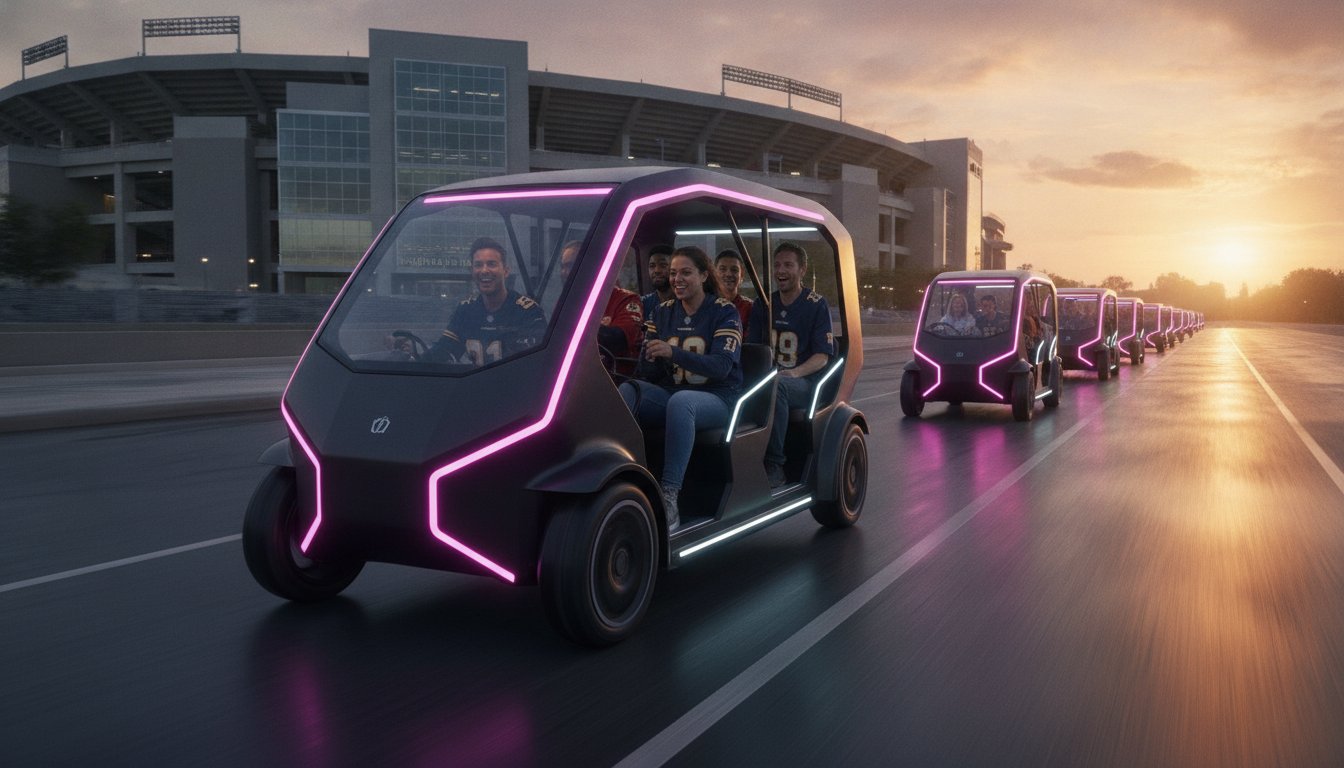
A single industrial-grade electric pedicab can generate $30,000 to $35,000 in annual gross revenue, yet the upfront cost of a professional fleet often stalls growth before the first mile. You know that scaling requires more than just standard e-bikes. You need rugged, high-performance equipment like the CyberX that can handle punishing daily shifts. Securing grants for electric pedicab fleet expansion is the definitive way to build this infrastructure without depleting your operating capital.
It's a common hurdle to feel buried by complex application language or to wonder if three-wheeled vehicles even qualify for EV incentives. This guide unlocks the specific 2026 federal and state funding pathways you need to procure Xion Motors equipment and dominate your local market. We'll examine the $6.4 billion Carbon Reduction Program, state-level voucher systems, and the precise strategy for framing your fleet as essential transit infrastructure to satisfy demanding grantors.
Key Takeaways
- Learn how 2026 national policy shifts reclassify electric pedicabs as legitimate transit vehicles, opening doors to massive infrastructure funding.
- Identify specific federal programs like the Transportation Alternatives Set-Aside and state-level voucher systems that provide capital for your next procurement.
- Master the "Grant Writing Blueprint" to frame your fleet through the lens of carbon reduction and transit equity for underserved populations.
- Discover the specific pathways to secure grants for electric pedicab fleet expansion using industrial-grade equipment designed for high-capacity commercial use.
- Understand why assets like the CyberX and Custom VorteX Trike are the ideal choices to maximize grant ROI and ensure long-term operational durability.
The 2026 Landscape for Micromobility and Pedicab Grants
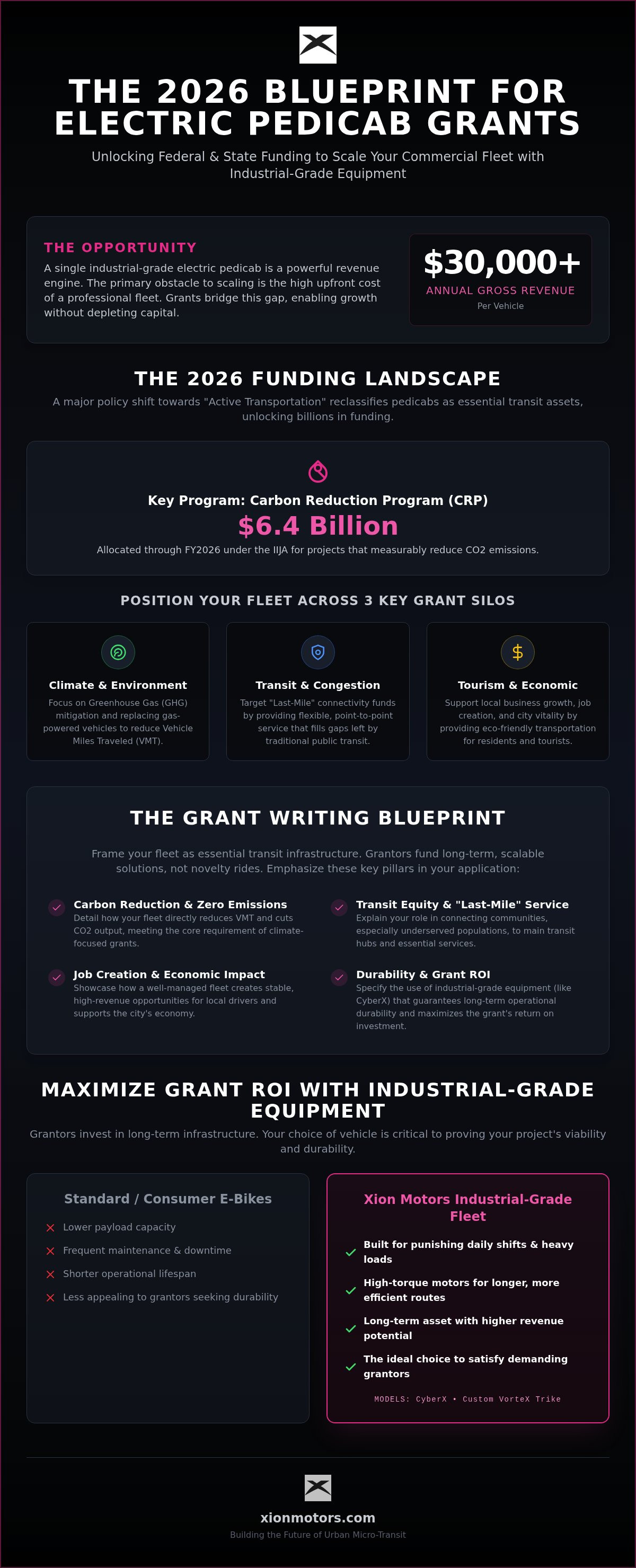
2026 marks a decisive turning point for American urban transit. Federal and state agencies have officially pivoted toward "Active Transportation" as a core pillar of national infrastructure. This isn't a temporary trend. It's a fundamental shift in how billions of dollars are allocated to reduce congestion and carbon emissions. Securing grants for electric pedicab fleet operations has become a viable strategy for entrepreneurs because grantors now recognize these vehicles as legitimate transit assets rather than novelty rides. This recognition stems from the massive $6.4 billion Carbon Reduction Program (CRP) established under the IIJA, which provides funding through FY2026 for projects that measurably cut CO2 output.
Zero-emission status is no longer optional for high-level funding; it's the baseline requirement. To successfully navigate this landscape, you must categorize your request into one of three primary silos. First, Climate and Environment grants focus on greenhouse gas (GHG) mitigation. Second, Transit and Congestion funds target "Last-Mile" connectivity. Third, Tourism and Economic Development grants support local business growth and job creation. By positioning your fleet at the intersection of these categories, you maximize your eligibility for diverse funding pools.
Why Pedicabs are the New "Micro-Transit" Standard
Modern electric pedicabs have evolved far beyond the traditional Cycle rickshaw designs of the past. They are now high-torque, industrial-grade machines capable of replacing gas-powered shuttles in dense urban cores. While a standard bus requires massive overhead and fixed routes, a pedicab fleet offers flexible, point-to-point service that fills the "Last-Mile" gap more efficiently. High-capacity trikes like the Custom VorteX Trike are specifically engineered to reduce Vehicle Miles Traveled (VMT) by taking passenger cars off the road. Grantors favor this model because it delivers a higher GHG reduction per dollar invested than almost any other transit medium.
The Economic Impact of Fleet Electrification
Transitioning from manual to electric power isn't just an upgrade; it's a complete business transformation. Electrification allows operators to run longer shifts, cover more terrain, and carry heavier loads without driver fatigue. This operational efficiency directly translates to job creation. A well-managed fleet provides stable, high-revenue opportunities for local drivers while supporting the city's economic vitality. Grants for electric pedicab fleet procurement are essential because they offset the initial capital expenditure (CAPEX) required for professional equipment. By using grant funds to purchase durable assets like the CyberX, you protect your cash flow while building a high-performance foundation that can generate $30,000 to $35,000 in annual revenue per unit.
Federal Funding Pathways: DOT, FTA, and Climate Infrastructure
Federal transit funding is no longer reserved for heavy rail and highway expansions. The Infrastructure Investment and Jobs Act (IIJA) infused billions into programs that favor light-weight, zero-emission solutions. If you're seeking grants for electric pedicab fleet procurement, the Federal Highway Administration (FHWA) and Federal Transit Administration (FTA) offer the most robust capital pools. Specifically, the Carbon Reduction Program (CRP) has allocated $6.4 billion through FY2026 to help states fund projects that measurably lower CO2 emissions. Success in this arena requires moving beyond "bike" terminology and positioning your fleet as a critical component of the regional transit network.
The reality of federal funding is that it rewards durability and scale. Grantors aren't interested in temporary fixes. They want to invest in long-term infrastructure that serves the public good. By utilizing these federal pathways, you can secure the capital necessary to deploy high-performance vehicles that outlast cheaper, consumer-grade alternatives. This approach not only secures your funding but also builds the foundation for a profitable, multi-year operation. To ensure your fleet meets these rigorous federal standards, review our industrial-grade fleet packages today.
Navigating the Transportation Alternatives Set-Aside (TASA)
TASA is the gold standard for micromobility. It specifically funds on-road and off-road facilities for pedestrians and bicycles, and electric pedicabs fit this profile perfectly as "active transportation." However, federal funds rarely flow directly to private businesses. You'll likely need to establish a public-private partnership. This involves collaborating with your local municipality or a transit-focused non-profit to apply for funds that benefit the public transit network. Your first move is connecting with your Metropolitan Planning Organization (MPO). They manage the regional project list and decide which initiatives get prioritized for federal dollars. If you can show an MPO how your fleet solves a specific transit gap, you've won half the battle.
CMAQ Funding for Entertainment and Historic Districts
The Congestion Mitigation and Air Quality Improvement (CMAQ) program is designed for zones that struggle with high traffic and poor air quality. Electric pedicabs are the definitive answer for these districts. They eliminate idling in gridlock and provide high-capacity transit without the emissions of gas-powered shuttles. When writing your application, focus on the "incremental cost" difference between a standard vehicle and an electric trike. Framing the CyberX as a high-performance, long-term infrastructure asset is key. Its industrial-grade chassis demonstrates the engineering durability grantors want to see in a taxpayer-funded investment. Proving that your fleet can replace even a small percentage of car trips in a congested core makes your application for grants for electric pedicab fleet expansion nearly impossible to ignore.
State and Regional Incentive Programs for Fleet Sales
While federal pathways focus on broad infrastructure, state and regional initiatives offer the most direct route to equipment procurement. These programs are often faster to navigate and more accessible for private operators than massive federal pools. In 2026, the shift toward localized "Voucher Incentive Programs" (VIPs) has revolutionized how businesses access grants for electric pedicab fleet expansion. Unlike traditional grants that require exhaustive reporting, these vouchers function as instant capital injections at the point of purchase. Regional Air Quality Management Districts (AQMDs) are also aggressively funding zero-emission pilot programs to meet strict 2026 climate mandates, specifically targeting high-traffic urban cores where gas-powered shuttles are being phased out.
State-level funding is currently concentrated in regions with aggressive decarbonization goals. For example, the SANDAG Flexible Fleets Pilot Grant Program in San Diego released $4.5 million in March 2026 for projects involving micromobility fleets. Similarly, the Arkansas Tri-Region E-Bike Incentive Program, which opened registration in July 2026, provides vouchers up to $1,200 for eligible residents and businesses. Programs vary by city and state, and funding windows open and close quickly, so verify current availability with each agency before building your procurement budget. These regional pockets of capital are designed to prove the viability of electric transit on a street-level basis. To win these funds, you must demonstrate that your equipment is a professional-grade asset capable of sustained commercial service.
Voucher Incentive Programs (VIPs) vs. Traditional Grants
The primary advantage of a VIP is the "point-of-sale" discount model. States like California, New York, and Connecticut lead the market with programs that reduce the net cost of the vehicle before it even leaves the factory. This model is vastly superior to the "reimbursement" grant model, which requires you to carry the full debt of the purchase while waiting months for government repayment. However, qualification for these incentives is strict. Most state agencies require vehicles to meet specific safety and engineering standards. Industrial-grade durability is a non-negotiable requirement for these programs. A fleet built on consumer-grade components won't survive the application process or the daily rigors of a commercial shift.
Leveraging Tourism and Economic Development Funds
Historic districts and resort zones often have unique funding pools separate from transit agencies. Business Improvement Districts (BIDs) frequently sponsor grants to enhance accessibility in areas where parking is restricted or non-existent. Framing a 6 seat electric pedicab as both a tourist attraction and a congestion solution is a powerful strategy for these grantors. These high-capacity vehicles provide a premium passenger experience while solving the "Last-Mile" gap that traditional buses can't bridge. By partnering with local BIDs, you can access revitalization funds that prioritize clean, quiet, and efficient transportation. This approach positions your fleet as an essential partner in local economic growth, making your request for grants for electric pedicab fleet funding a logical choice for regional planners.
The Grant Writing Blueprint: Framing Your Pedicab Fleet
Winning a grant is an exercise in strategic translation. You aren't just buying bikes; you're deploying a zero-emission transit solution. To secure grants for electric pedicab fleet expansion, your application must align perfectly with the grantor's specific KPIs. Most 2026 funding cycles prioritize carbon reduction, transit equity, and long-term asset durability. If you can't prove your fleet will be operational in five years, you won't get funded. Government agencies want to see a return on their public investment in the form of reliable, permanent infrastructure.
Follow this five-step blueprint to build a bulletproof proposal:
- Quantify Environmental Impact: Use specific data to show CO2 savings per mile compared to gas-powered alternatives.
- Define Equity Impact: Map your service area to show how you serve underserved transit zones or "transit deserts."
- Justify Equipment Grade: Explain why industrial-grade assets like the CyberX are required for commercial safety and longevity.
- Prove Lifecycle Viability: Provide a 5-year maintenance plan that demonstrates your fleet won't become e-waste after one season.
- Secure Local Support: Include letters from Business Improvement Districts (BIDs) or local transit authorities to validate your role in the ecosystem.
Technical Data Points for Your Application
Precision wins grants. When calculating your impact, focus on Vehicle Miles Traveled (VMT) reduction. For a 10-unit fleet, replacing just fifteen short car trips per unit daily can remove over 70,000 miles of passenger car traffic from city streets annually. Use high-torque motor specifications to prove your vehicles can handle the inclines and heavy payloads required for "Commercial Grade" certification. Xion Motors provides the rigorous documentation and fleet management support necessary to satisfy federal compliance audits. This level of technical detail separates professional operators from hobbyists in the eyes of a selection committee.
The "Micro-Transit" Narrative Strategy
Terminology dictates your funding bracket. Never refer to your operation as a "bike shop business" in a government filing. Use the term "last-mile transit deployment" to signal that you are a serious transportation partner. Highlight safety features that meet municipal standards, such as integrated hydraulic braking systems and high-visibility LED lighting. Federal grantors also show strong preference for domestic manufacturing. Xion Motors builds its frames in the USA, and every vehicle is engineered and assembled in San Diego — a domestic-content story that strengthens your application against operators using imported consumer goods. This narrative of rugged, domestic engineering is exactly what 2026 grantors are looking to fund.
Build your legacy on a foundation of proven engineering. Consult with our fleet experts to get the technical specs you need for your 2026 grant application.
Xion Motors: Industrial-Grade Equipment to Maximize Grant ROI
Securing grants for electric pedicab fleet expansion is only the first step. The real challenge lies in selecting equipment that survives the punishing reality of daily commercial use. Grantors want to see their investment translate into permanent, reliable infrastructure. Xion Motors provides exactly that. With over 20 years of fleet operation experience, we have perfected the art of industrial-grade engineering. We aren't just manufacturers; we are master practitioners who have spent decades in the trenches. Our vehicles are designed to be the definitive answer to the market's need for durability and performance.
The CyberX stands as the ideal grant-funded asset for 3-seat operations. Its chassis is engineered for high-cycle fatigue, ensuring it remains on the road long after consumer-grade alternatives have failed. For operators targeting high-capacity transit, the Custom VorteX Trike provides a 6-seat solution that fundamentally changes the ROI calculation. By moving six passengers with a single driver, you achieve a superior "funding per passenger seat" ratio. This metric is a powerful tool in any grant application, as it demonstrates maximum efficiency in reducing vehicle miles traveled (VMT).
Superior Engineering for Government and Fleet Standards
Government grantors prioritize safety and longevity. Our high-torque drive systems are built to handle commercial payloads across varied terrain without the risk of thermal failure. We utilize industrial-grade components, from reinforced frames to professional hydraulic braking systems, to ensure every unit meets rigorous fleet standards. This level of engineering is critical for long-term grant compliance. If your equipment stays in service, your grant remains a success. We support this lifecycle with comprehensive maintenance protocols and a robust inventory of replacement parts, ensuring your fleet remains an active part of the city's transit network for years to come.
Scale Your Fleet with Xion Motors
Scaling a business requires a partner who understands the logistics of growth. Xion Motors offers specialized fleet pricing for grant-funded orders, helping you maximize the reach of your awarded capital. We ship to all 50 states, ensuring project feasibility from dense coastal cities to historic resort towns. Our team provides the technical specifications and performance data you need to build a winning proposal. Don't settle for hobbyist equipment when you can deploy industrial-grade excellence. Contact Xion Motors for a Fleet Quote to include in your Grant Application and take the first step toward dominating your local market.
Secure Your Market Dominance in 2026
The 2026 transit landscape has shifted permanently toward zero-emission micromobility. You now have the blueprint to navigate federal TASA funds and state-level voucher programs. Remember that grantors don't just fund ideas; they fund durable, long-term infrastructure. By framing your operation as essential micro-transit and utilizing industrial-grade equipment, you position your business as a low-risk, high-impact investment for any municipality.
Securing grants for electric pedicab fleet development is the definitive strategy for scaling your operations with professional-grade assets. Xion Motors brings over 20 years of fleet operational experience to your proposal, providing the rugged engineering of the CyberX and VorteX lines that government agencies demand. We offer specialized fleet pricing for commercial operators to ensure your project remains financially viable from day one. This isn't just about moving people; it's about building a high-performance business that dominates the urban core.
Request an Industrial-Grade Fleet Quote for Your Grant Proposal and start building your legacy today. Your city is waiting for a better way to move, and you're now equipped to provide it.
Frequently Asked Questions
Are private pedicab businesses eligible for federal transit grants?
Yes, private entities are eligible provided they operate through a public-private partnership with a local government or transit agency. Most federal programs, such as those managed by the FTA, require a public sponsor to act as the primary applicant. By demonstrating how your fleet solves a specific municipal transit gap, you can secure sub-recipient status and access federal capital for equipment procurement.
How do I prove the environmental benefits of an electric pedicab fleet?
Proving environmental impact requires quantifying the reduction in Vehicle Miles Traveled (VMT) and the associated carbon offset. You must calculate the greenhouse gas emissions of a standard passenger car over your fleet's projected annual mileage and subtract the minimal energy footprint of your electric trikes. Using verified data from the Carbon Reduction Program helps validate your claims that grants for electric pedicab fleet operations deliver measurable climate results.
What is the most common grant for starting a pedicab company?
The Transportation Alternatives Set-Aside (TASA) is the most frequently utilized federal funding source for micromobility startups. This program is specifically designed to fund non-traditional transportation projects like bicycle facilities and pedestrian infrastructure. Because electric pedicabs qualify as active transportation, they are prime candidates for TASA funds when framed as a solution for last-mile connectivity in congested urban centers.
Can I use grant money to buy replacement parts for my existing fleet?
It depends on the specific grant's classification of capital versus operating expenses. Many federal and state grants are restricted to Capital Expenditures (CAPEX), which includes the initial purchase of vehicles and major components. However, some programs allow for the procurement of an initial inventory of replacement parts as part of a long-term maintenance plan to ensure the fleet's operational continuity and taxpayer ROI.
Do I need a public partner to apply for federal micromobility funding?
Yes, a public partner is almost always a requirement for federal-level funding applications. Organizations like Metropolitan Planning Organizations (MPOs) or city transit departments serve as the lead applicants for programs like CMAQ or TASA. Your role as a private operator is to provide the technical expertise and the fleet equipment, positioning your business as the operational arm of a larger municipal transit strategy.
What is the difference between a grant and a voucher incentive program?
The primary difference lies in the timing of the funds: grants are typically reimbursement-based, while vouchers provide an immediate point-of-sale discount. A grant requires you to purchase the equipment upfront and submit receipts for repayment, which can take months. Voucher Incentive Programs (VIPs) allow you to apply for grants for electric pedicab fleet equipment that reduce your out-of-pocket costs at the moment of purchase.
How much money can I typically get from a state-level e-bike grant?
State-level incentives vary significantly, but vouchers typically range from $300 to $1,250 per vehicle. For instance, the Connecticut program offers up to $1,250 for qualifying applicants, while Washington State and Arkansas provide vouchers up to $1,200. These amounts are often capped per business, so it's vital to check the specific 2026 funding levels for your region before finalizing your procurement budget.
Why is industrial-grade equipment important for grant approval?
Industrial-grade equipment is essential because grantors prioritize the Lifecycle Viability of taxpayer-funded assets. Selection committees are wary of funding consumer-grade bikes that will be scrapped within a year of heavy commercial use. By specifying high-performance vehicles like the CyberX, you prove that the grant money is being spent on durable, long-term infrastructure capable of surviving punishing daily shifts and meeting strict safety standards.