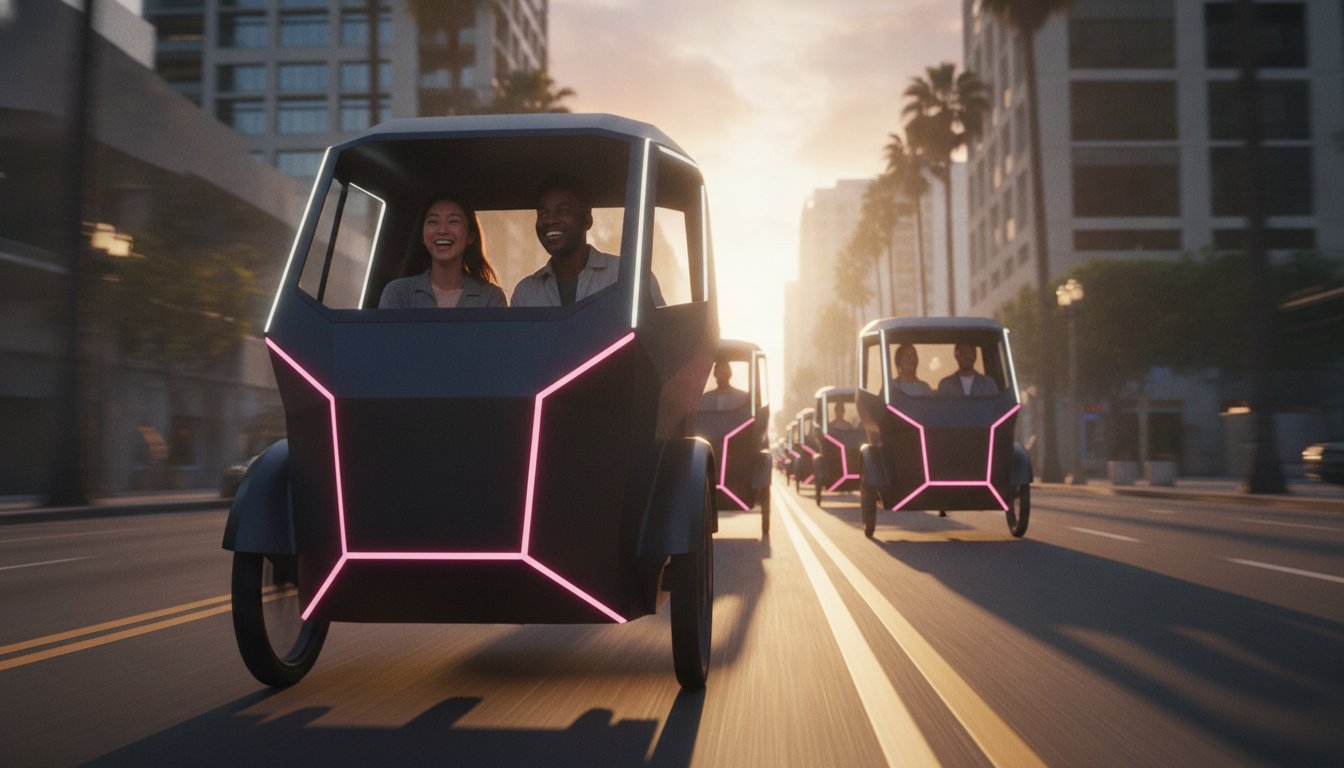
Game day at a major venue is a high-stakes logistics operation where the last mile determines your bottom line. You already understand that moving thousands of fans through congested streets requires more than just a bike with a bench. Deploying professional pedicabs for sports stadiums shouldn't feel like a gamble on hobbyist equipment that fails under pressure. You've likely dealt with the headache of vehicle breakdowns during the fourth-quarter rush or faced scrutiny from city officials over unprofessional equipment.
It's time to demand more from your fleet. This guide shows you how to solve stadium congestion and maximize game-day revenue with electric vehicles that meet the most rigorous 2026 safety standards. We'll explore the heavy-duty engineering behind the CyberX and VorteX models, including their 1,500-pound payload capacities and high-torque drive systems. You'll learn how to navigate evolving UL 2849 certifications and why professional-grade equipment is the only way to secure long-term stadium partnerships. From Nashville’s new bike lane ordinances to the $30,000–$35,000 annual revenue potential of each high-capacity unit, we're covering the essential blueprint for modern fleet dominance.
Key Takeaways
- Master the logistics of fan transport by deploying industrial-grade pedicabs for sports stadiums to bridge the critical last-mile gap between parking and the gate.
- Examine the aircraft-grade chassis integrity and high-torque engineering required to sustain 1,000-pound payloads during peak game-day hours.
- Secure your fleet's future by meeting 2026 safety standards with UL-certified electrical systems and professional-grade street-legal lighting kits.
- Maximize your game-day revenue by strategically deploying 6-seat configurations to double your passenger turnover and ROI per trip.
- Optimize your capital investment through direct-to-operator fleet pricing and veteran-led deployment strategies that cut out the middleman.
Why Electric Pedicabs are the Ultimate Last-Mile Solution for Sports Stadiums
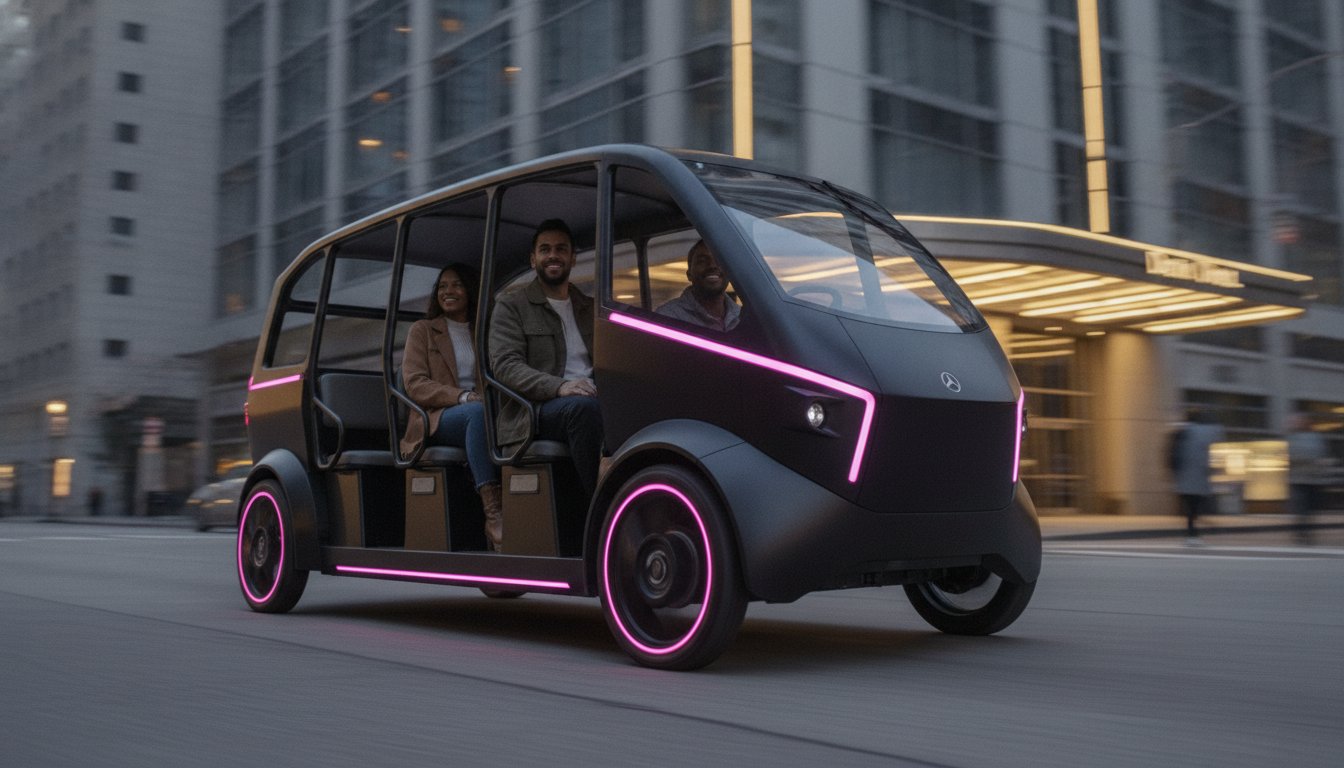
Stadium-grade pedicabs aren't just bicycles. They are precision-engineered, high-capacity transit vehicles designed to move up to six passengers with industrial efficiency. In the demanding environment of modern athletics, pedicabs for sports stadiums serve as the primary artery for fan movement between remote parking structures and the entrance gates. While the traditional Cycle rickshaw has existed for decades, the 2026 standard demands electric-assist systems capable of hauling payloads of up to 1,500 pounds without hesitation. This is heavy-duty infrastructure, not a hobbyist's toy.
Congested pedestrian zones are the death of traditional shuttle buses. Large vehicles are restricted by safety barriers and the sheer density of the crowd, often sitting idle in gridlock while fans grow frustrated. Electric pedicabs solve this by navigating narrow pathways and plazas that are off-limits to internal combustion engines. They offer a silent, zero-emission alternative that preserves the game-day atmosphere. You won't find the roar of a gas engine or the smell of exhaust here; just the smooth hum of a high-torque motor delivering fans directly to the turnstiles.
Bridging the Gap Between Parking and Gate
The fan journey begins long before the first whistle. For many, that journey involves a mile-long trek from an overflow lot, leading to pre-game fatigue that dampens the experience. High-performance pedicabs cut this travel time significantly, moving passengers at three times the average walking pace. This isn't just about speed. It's about the psychological shift from a logistical chore to a premium arrival experience. Providing a breeze-cooled, elevated view of the stadium approach creates an immediate sense of value for the attendee. It transforms a common hurdle into a highlight of the day.
The Economic Impact of High-Volume Turnaround
Profitability in stadium transit is a game of turnover. A 10-vehicle fleet utilizing 6-seat configurations can move hundreds of passengers per hour during the critical 90-minute window before kickoff. Electric assist is non-negotiable here. Without motor-driven torque, operators tire quickly, speeds drop, and your revenue per hour collapses. We've engineered our systems to maintain peak velocity even under full load, ensuring your fleet stays in constant motion. To maximize these returns, smart operators are already scaling operations with electric pedicab fleet packages to secure the necessary volume for major venue contracts.
Engineering for High-Volume Transit: CyberX and VorteX Standards
Stadium logistics are brutal on hardware. When you operate pedicabs for sports stadiums, you aren't just moving people; you're managing a 1,000-pound payload through constant stop-and-go cycles. This requires industrial-grade high-torque drive systems that don't flinch under peak load. Standard e-bike motors will burn out within a single season of stadium duty. Our engineering focuses on heat dissipation and gear durability to ensure that every start from a dead stop is smooth and powerful.
Chassis integrity is the backbone of fleet longevity. We utilize aircraft-grade materials to ensure the frame handles the stress of six passengers without flexing or fatigue. This isn't about aesthetics; it's about structural survival. Safety is equally paramount, which is why we implement industrial hydraulic braking systems. These systems provide the stopping power required for heavy-duty commercial use, aligning with the strict pedicab operating responsibilities found in major municipal codes. Reliability isn't a luxury when thousands of fans are counting on your transport. You can explore our high-performance vehicles to see how these engineering standards translate to the street.
Battery management is the silent hero of the double-header. A stadium fleet must remain operational for 10 to 12 hours straight, and our 72V 58Ah power systems deliver 5 to 6 hours of runtime under full load with a full recharge taking roughly 5 hours. With a spare pack rotation or a mid-shift charging window, your last trip of the night is as fast as your first. By prioritizing UL 2849 certification for the entire electrical system, we eliminate the fire risks and performance drops common in uncertified equipment.
CyberX: The Industrial Engineering Benchmark
The CyberX frame is built for the Master Practitioner who demands zero downtime. It features a modular design that simplifies maintenance, allowing fleet managers to swap components in minutes rather than hours. Weatherproofing is baked into the DNA of the CyberX. From sealed electrical connectors to corrosion-resistant finishes, these vehicles are built for all-season stadium operations. They thrive in the grit and pressure of a high-volume venue.
The Custom VorteX Advantage
Not every stadium environment is a flat parking lot. The Custom VorteX Trike allows for specific tailoring to your terrain. Whether you're navigating the hills of a coastal stadium or the massive sprawl of a suburban complex, we adjust the gear ratios and motor tuning to fit the landscape. This custom electric trikes for business approach ensures that high-capacity seating doesn't come at the cost of maneuverability. You get the revenue of a 6-seater with the agility of a much smaller vehicle.
Solving the Safety and Regulatory Hurdles of Stadium Transit
Municipalities often view pedicab operations as a liability rather than a logistics asset. This perception stems from the use of flimsy, under-engineered equipment that fails during peak hours or creates hazards in crowded plazas. In cities like Arlington, TX, safety concerns and operator behavior led to total program terminations. You avoid this outcome by deploying hardware that exceeds regulatory expectations. Professional pedicabs for sports stadiums must include electronic speed governors to manage pedestrian flow safely. High-quality lighting and signal kits aren't optional; they're the baseline for street-legal compliance. When your equipment looks and acts like a commercial vehicle, you change the narrative from "nuisance" to "essential transit."
Professionalizing your fleet is the fastest way to secure long-term contracts with venue management. High-performance engineering dictates driver conduct. When an operator is behind the handlebars of an industrial-grade vehicle, they're more likely to adhere to professional standards than someone on a modified beach cruiser. This shift in equipment quality mirrors the professional standards seen in high-performance sports, where athletes utilize advanced gear from brands like 2XU to maintain their competitive edge, and it directly addresses the "behavioral" complaints that often lead to regulatory pushback. You aren't just buying a vehicle; you're investing in a professional brand image that city officials can respect.
Preventing the "Arlington Problem" Through Tech
Stability is the primary engineering hurdle for high-capacity trikes. We utilize wider wheelbases and low centers of gravity to ensure our vehicles remain planted during sharp turns under full load. This prevents the tipping incidents that often trigger municipal crackdowns. Beyond the frame, integrated safety features like turn signals and multi-piston hydraulic disc brakes provide a level of control that standard bicycles can't match. This hardware doesn't just protect passengers; it attracts a higher caliber of operator. Professional drivers want to work with tools that reflect their own commitment to safety and reliability. By providing an industrial-grade last-mile solution for sports stadiums, you eliminate the amateurism that leads to friction with local law enforcement.
Navigating Local Ordinances with Superior Hardware
Compliance is a moving target. In 2026, cities are increasingly reclassifying electric trikes as legitimate transportation, but only for those who meet strict safety certifications. Our hardware meets and often exceeds DOT-style requirements for commercial trikes. This includes UL-certified electrical systems and robust lighting arrays that ensure visibility in the chaotic environment of a stadium district. Reliability is your strongest bargaining chip when negotiating with venue management. Consistent electric pedicab maintenance ensures your fleet stays in top condition, proving to city officials that your operation is a professional enterprise. When you lead with engineering excellence, regulatory hurdles become competitive advantages that keep lower-quality operators out of the market.
Maximizing Game-Day ROI: Comparing 3-Seat and 6-Seat Configurations
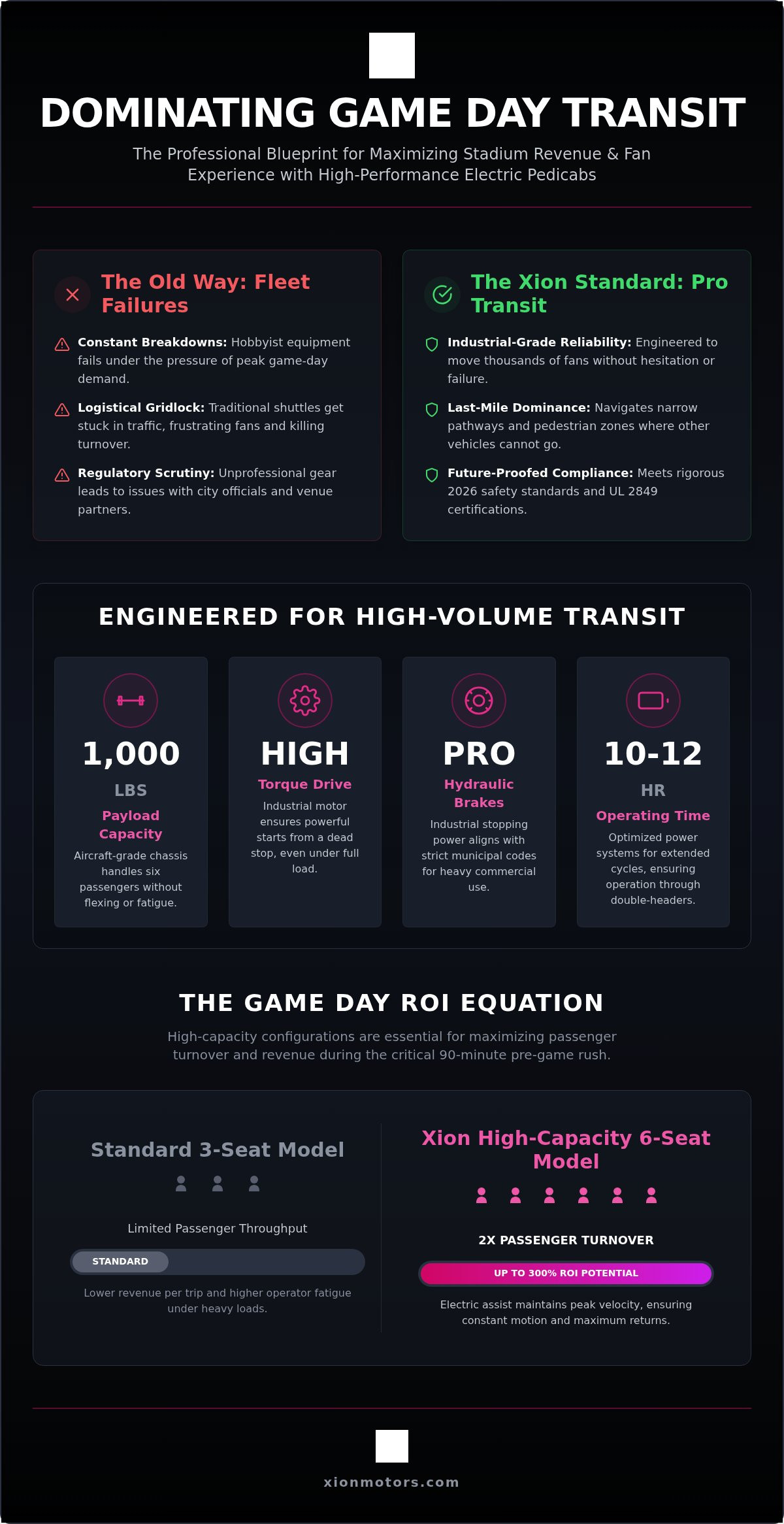
Revenue generation at a stadium is a mathematical challenge. To dominate the market, you must balance the speed of individual transfers with the raw volume of group transport. Deploying pedicabs for sports stadiums requires a strategic mix of vehicle capacities to capture every dollar on the pavement. While the 3-seat CyberX offers unmatched agility for solo fans looking to beat the crowd, the 6-seat electric pedicab acts as a force multiplier for your bottom line. Doubling your passenger capacity per trip doesn't just increase fares; it fundamentally shifts your operating margins.
Analyzing the "Tip Factor" versus the "Fare Factor" is essential for fleet owners. In a tourist-heavy downtown, individual tips might drive income, but in a stadium environment, fixed-fare volume is king. A 6-seat VorteX can clear a family of six in a single trip, generating a higher guaranteed fare than two separate 3-seat trips could ever manage in the same timeframe. When you factor in a 5-year Total Cost of Ownership (TCO), industrial-grade engineering pays for itself. High-performance components reduce the frequency of mid-season repairs, ensuring your fleet stays on the road when the stadium lights are on. You can calculate your fleet's revenue potential by choosing the right vehicle mix for your specific venue.
High-Capacity Deployment Strategies
Success depends on fleet versatility. Use 6-seaters to target family zones and group arrivals where the demand for collective transport is highest. These units are your heavy lifters. Conversely, 3-seaters should handle the "hustle" routes, weaving through tighter gaps to provide rapid service for solo attendees or pairs. Mixing your fleet ensures you never turn away a group because you lack the seats, nor do you waste a high-capacity vehicle on a single rider. This operational flexibility is the hallmark of a seasoned fleet manager.
Secondary Revenue: Advertising and Sponsorships
Your vehicles are more than transit; they are mobile billboards. Full vehicle wraps turn every trip into a high-visibility marketing event for local partners. Bars, restaurants, and sportsbooks are eager to sponsor "Courtesy Rides" that deliver fans directly to their doors. The 6-seat models increase ad-space real estate by 40%, providing a larger canvas for high-impact branding. This secondary revenue stream often covers the vehicle's operating costs before the first passenger even sits down.
Scaling Your Stadium Operations with Xion Motors
Scaling a fleet in a high-pressure environment requires more than capital; it requires the right partnership. We specialize in direct-to-operator sales because we know that every dollar saved on procurement is a dollar that can be reinvested into your growth. This model eliminates middleman markups and allows us to offer aggressive fleet pricing for large-scale stadium deployments. When you source pedicabs for sports stadiums from us, you're leveraging 20 years of operational street-knowledge. We've spent decades refining our high-torque drive systems and aircraft-grade frames to survive the specific stresses of venue logistics. Our experience ensures your equipment doesn't just look the part; it performs under the most grueling conditions.
Our commitment to your success includes a logistics network that spans the entire country. We provide national shipping to all 50 states, ensuring that your fleet arrives ready for deployment regardless of your location. Beyond the initial sale, we maintain a massive inventory of vehicle parts to guarantee your uptime. A broken trike in the middle of a playoff series is lost revenue. We ensure that never happens by providing the industrial support necessary for constant operation. You get the reliability of a traditional craftsman combined with the speed of a modern manufacturer.
Blueprint for a Professional Startup
Moving from an independent operator to a contracted stadium partner is a significant leap. You must master the starting a pedicab company process by implementing professional-grade logistics from day one. This involves more than just buying trikes; it requires a systematic approach to storage, battery charging, and preventative maintenance protocols. Our veterans help you navigate these complexities, providing the technical depth needed to win competitive contract bids. We help you present a fleet that venue managers can trust, positioning your company as the definitive solution for venue transit.
The Xion Support System
Uptime is the only metric that matters on game day. Our support system provides immediate access to authentic replacement parts, ensuring your vehicles remain in peak condition throughout the season. We also provide deep customization options, allowing you to tailor your fleet's aesthetics to match stadium-specific branding or lucrative sponsorship deals. This level of precision is why industry leaders choose us to anchor their operations. Consult with Xion Motors for your stadium fleet needs and build your operation on a foundation of industrial excellence.
Dominating the Stadium Last-Mile in 2026
Success in venue logistics requires a shift from hobbyist thinking to industrial-scale execution. You've seen how high-torque drive systems and aircraft-grade chassis integrity transform pedicabs for sports stadiums from simple bikes into high-performance transit assets. By prioritizing 6-seat configurations and meeting 2026 safety standards, you eliminate regulatory friction and maximize your game-day turnover. This isn't just about moving people; it's about building a professional brand that stadium managers trust and fans rely on every weekend.
Xion Motors provides the rugged authority and technical depth you need to scale. We back every vehicle with 20+ years of industry experience and industrial-grade engineering that has been perfected in the trenches. With national 50-state shipping and a comprehensive parts network, we ensure your fleet stays operational when the stakes are highest. Don't settle for equipment that fails under pressure. It's time to invest in the standard of the industry. Build Your Stadium Fleet with Xion Motors and capture the massive revenue potential of the modern stadium district. Your future as a market leader starts with the right hardware.
Frequently Asked Questions
Are electric pedicabs street legal for stadium district use?
Electric pedicabs are street legal in most jurisdictions when they meet specific safety certifications like UL 2849. Most cities classify these vehicles as e-bikes, allowing them to operate in bike lanes and on standard city streets. You must verify local ordinances, as cities like Nashville recently updated laws to treat them as legitimate transportation rather than entertainment. Leading with certified equipment ensures you stay ahead of these evolving municipal standards.
What is the passenger capacity of a stadium-grade electric trike?
Industrial-grade models are engineered for 3-seat or 6-seat configurations. Our stadium-grade trikes are rated for a full 1,500 lb payload capacity, ensuring you can move large groups or families without compromising structural integrity. This high-capacity design is essential for maximizing revenue during the peak hours of a game-day rush. Choosing the right seat count allows you to tailor your fleet to the specific demographics of your venue.
How long does the battery last on a typical game day?
The 72V 58Ah battery system delivers 5 to 6 hours of runtime under full load, with a full recharge taking about 5 hours. To cover a full double-header, operators rotate spare packs or schedule a mid-day charging window. Performance depends on the terrain and payload, but our high-torque systems are optimized for the frequent stop-and-go cycles of stadium traffic. Reliable power management is the backbone of your operational uptime.
Do I need a special license to operate a commercial pedicab fleet?
Licensing requirements vary by city, but most municipal codes require a commercial operator's permit rather than a standard driver's license. Many jurisdictions treat pedicabs for sports stadiums as e-bikes under the three-class system now adopted by over 40 states. You should consult your local Department of Transportation to confirm specific insurance and permitting mandates for your district. Professional equipment often simplifies this permitting process by meeting higher safety benchmarks.
How do electric pedicabs compare to golf carts for stadium transport?
Pedicabs offer superior maneuverability and access compared to larger, wider golf carts. They can navigate narrow pedestrian plazas and bike lanes where golf carts are often restricted or banned by city safety officials. Additionally, the open-air, forward-facing design of a professional trike provides a more engaging fan experience and higher visibility for vehicle-wrap advertising. You get the transit utility of a shuttle with the agility of a bicycle.
What maintenance is required for high-volume stadium fleets?
High-volume operations demand daily inspections of hydraulic braking systems and tire pressure to ensure safety. You should perform weekly checks on chain tension and electrical connections to prevent mid-game breakdowns. Using industrial-grade components reduces the frequency of major repairs, but a consistent maintenance schedule is the only way to ensure total uptime during a busy season. We provide the technical support and parts needed to keep your fleet in the trenches.
Can Xion Motors ship pedicab fleets to any state in the US?
We offer national shipping to all 50 states directly from San Diego, where every vehicle is engineered and assembled with frames made in the USA. Every unit is shipped with the necessary technical documentation to assist with local registration and compliance. This logistical support ensures that your pedicabs for sports stadiums arrive ready for deployment, allowing you to focus on securing venue contracts and hiring operators. We handle the logistics so you can focus on the business of transport.