Saving five thousand dollars on a custom-welded frame today usually results in fifty thousand dollars of lost revenue and liability by next season. Most operators start with the assumption that they can out-engineer a factory to save on upfront capital. The build vs buy commercial pedicab debate is rarely about the initial check you write; it is about the cost of the vehicle sitting in a repair shop while your competitors are out on the street.
You are likely here because you want to maximize daily revenue and ensure passenger safety without the constant headache of mechanical failure. This guide will show you exactly why industrial-grade engineering is the only viable path for serious fleet operators in 2026. You will learn how to calculate your true ROI, the risks of uncertified frames, and why professional-grade vehicles like the CyberX or the 6-seat VorteX are the definitive answer to modern market opportunities. It is time to stop treating your business like a hobby and start treating it like the high-performance operation it was meant to be.
Key Takeaways
- Understand the critical engineering gap between standard bicycle tubing and industrial-grade chassis designed to handle heavy 6-passenger loads.
- Navigate the build vs buy commercial pedicab decision by calculating the true cost of fabrication delays and mechanical downtime.
- Evaluate electric drive systems and battery management protocols that are essential for maintaining safety and range during high-demand shifts.
- Maximize your daily revenue potential by deploying high-capacity models like the VorteX, which are engineered for maximum passenger throughput.
- Gain a competitive edge by partnering directly with manufacturers to secure professional-grade replacement parts and veteran industry support.
The Entrepreneur’s Dilemma: Build vs Buy Commercial Pedicabs
The decision to enter the micro-transit market often begins with a spreadsheet and a welder. For many entrepreneurs, the allure of custom fabrication is strong; it promises a lower entry point and a vehicle tailored to a specific vision. However, the build vs buy commercial pedicab choice is where most startups either solidify their future or engineer their own exit. While the traditional cycle rickshaw has served as a simple mode of transport for decades, the 2026 economy demands a level of industrial precision that a DIY garage build cannot replicate.
We have spent over 20 years in the trenches of fleet operation. We've seen the structural failures and the lost revenue that come from under-engineered equipment. In this high-stakes environment, your vehicle isn't just a bike. It is a revenue-generating asset that must perform under extreme commercial loads. Positioning yourself as a leader in your local market requires equipment that matches your ambition.
The True Cost of 'Cheap' Entry
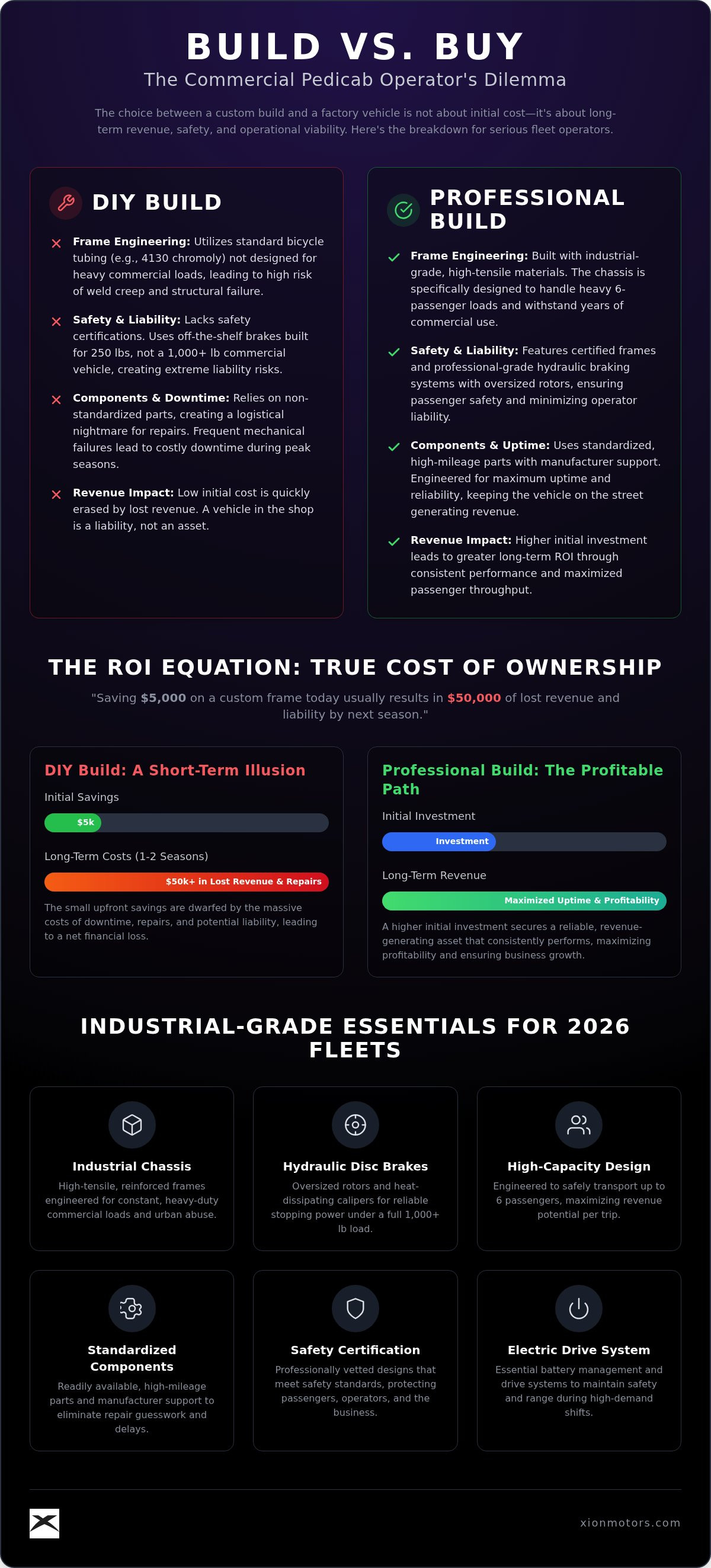
Initial savings on a DIY build usually evaporate by the time the odometer hits its first 1,000 miles. When you fabricate your own frame, you aren't just building a vehicle; you're starting an R&D department from scratch. Sourcing non-standardized components leads to a logistical nightmare when parts inevitably wear out. A single day of downtime during peak tourist season can cost hundreds in gross revenue. Reliability is the only metric that matters for fleet profitability. If the vehicle isn't on the street, it's a liability, not an investment.
Defining the Industrial Standard
There is a massive gulf between a consumer e-bike and a professional electric pedicab. Ground-up engineering is a requirement for passenger safety, especially when moving 6-passenger loads through dense urban environments. A commercial chassis must manage stress points that would snap standard bicycle tubing. Transitioning from a hobbyist mindset to a fleet operator strategy means prioritizing uptime over upfront savings. Consider these essential factors:
- Chassis Strength: Industrial frames use high-tensile materials designed for heavy-duty commercial loads rather than recreational use.
- Component Standardization: Professional builds like the CyberX use parts that are readily available and designed for high-mileage abuse.
- Safety Certification: Certified frames minimize the extreme liability risks that uncertified DIY builds often ignore.
The 2026 market is competitive and fast-paced. You need tools built by practitioners who understand the street-level reality of this business. Choosing industrial-grade engineering isn't just about buying a trike; it's about securing the financial viability of your entire operation.
Engineering for the Streets: Why DIY Frames Often Fail
The physics of micro-transit are unforgiving. When you move from a recreational bicycle to a vehicle carrying 1,000 lbs of passengers and cargo, standard engineering rules change. Most DIY builds rely on 4130 chromoly or standard aluminum bicycle tubing. While these materials work for a solo commuter, they lack the fatigue resistance required for a commercial duty cycle. The build vs buy commercial pedicab debate is often settled at the first major weld failure. If your frame isn't designed for high-stress oscillation, it isn't a transit vehicle; it's a liability waiting for a crack to form.
Stopping power is another critical failure point for garage-built rigs. Off-the-shelf e-bike brakes are designed to stop 250 lbs, not a half-ton of momentum. Professional fleets require hydraulic systems with oversized rotors and heat-dissipating calipers to ensure consistent performance during back-to-back shifts. Sourcing these components individually is difficult and expensive. It's better to invest in a platform where every bolt and bracket has been vetted through complex engineering and safety considerations from the start.
The CyberX Engineering Advantage
The CyberX sets the benchmark for durability by utilizing reinforced alloys specifically selected for high-stress components. We don't just weld tubes together; we use precision manufacturing to ensure every joint can withstand years of urban abuse. Garage-built frames often suffer from "weld creep" and alignment issues that lead to uneven tire wear and increased rolling resistance. Our industrial-grade materials ensure that the chassis remains true even after thousands of miles of heavy-duty operation. For operators looking to scale, choosing proven electric pedicabs is the only way to guarantee long-term structural integrity.
VorteX High-Capacity Stability
Designing for a 6-seat passenger experience requires more than just a longer frame. It requires a complete rethink of vehicle geometry. The VorteX model uses a specialized suspension system that balances rider comfort with heavy-duty load bearing. If the geometry is off by even a few degrees, driver fatigue skyrockets and steering becomes unpredictable under load. We've spent decades perfecting the professional geometry that keeps our trikes stable at full capacity. This focus on precision doesn't just protect your passengers; it protects your drivers and your bottom line by keeping your fleet on the road and out of the welding shop.
- High-Torque Drive Systems: We use a 750W direct-drive transaxle (up to 3,000W peak) that powers the rear axle through a differential, engineered for constant start-stop commercial use — not the standard hub motors meant for light commuting.
- Industrial Braking: Quad-piston hydraulic systems provide the necessary bite to stop 1,000+ lbs safely in all weather conditions.
- Reinforced Chassis: Our frames are built to handle the torque of electric assist without twisting or snapping.
The ROI Equation: Build Costs vs. Professional Revenue
Calculations on a napkin rarely account for the brutal reality of the street. For the serious operator, the build vs buy commercial pedicab decision isn't about saving a few thousand dollars on the front end. It's about maximizing the revenue hours of your asset. If you spend three months in a garage fabricating a frame, you've already lost a quarter of your first-year earning potential. Professional engineering allows you to bypass the R&D phase and move straight to the revenue-generation phase. Uptime is the only metric that matters in this industry. When you consider that a single well-maintained electric pedicab can generate $30,000 to $35,000 in annual gross revenue, every hour spent in the shop is a direct hit to your bottom line.
Resale value is another factor that DIY advocates often overlook. A custom, "no-name" build has almost zero liquidity in the secondary market because buyers can't verify the engineering standards or source parts. Conversely, professional brands maintain high residual value. Your fleet is an investment, not just a collection of tools. Standardized parts and proven chassis designs ensure that your business remains scalable and your exit strategy remains viable.
Hidden Costs of the DIY Build
The liability gap is the silent killer of garage-built fleets. Insurance companies are increasingly hesitant to cover uncertified, custom-fabricated vehicles in high-traffic entertainment districts. Professional manufacturers provide the documentation and safety standards that underwriters require to manage risk. Beyond insurance, the logistical strain of sourcing commercial trike replacement parts for a one-off build can paralyze your operations. If a custom bracket snaps on a Friday night, you won't find a replacement at a local bike shop. You'll be out of commission until you can fabricate a new one, while a professional operator simply pulls a standardized part from their inventory and keeps the meter running.
Purchasing for Profitability
Professional aesthetics drive higher passenger tips and premium rates. Passengers in 2026 expect a vehicle that looks like a modern transit solution, not a high school science project. The industrial design of a factory-built trike commands authority on the street, making it easier to secure high-value advertising contracts. For those ready to dominate a local market, leveraging electric pedicab fleet packages is the fastest way to achieve immediate scale. You get a synchronized fleet with uniform performance and a single point of support. This isn't just about buying vehicles; it's about deploying a proven business system that is engineered to win.
Professional Selection Criteria: Evaluating Industrial Trikes
Selecting the right vehicle is where your strategy meets the pavement. In the build vs buy commercial pedicab analysis, the "buy" side wins because of standardized industrial specifications that a custom build simply cannot guarantee. Professional operators don't look for gadgets; they look for industrial-grade drive systems that can handle 12-hour shifts in high-heat urban environments. You need a direct-drive transaxle motor with high-torque output and sophisticated thermal management. If the motor can't dissipate heat during a steep climb with a full load, your shift ends early and your revenue stops.
Battery management is equally critical for fleet longevity. Look for systems that utilize high-density cells with integrated safety protocols to prevent overheating. Range is a factor, but charging speed and cycle life determine your long-term ROI. Beyond the powertrain, evaluate the passenger cabin ergonomics. Deep, weather-resistant seating and intuitive entry points increase ride duration and passenger satisfaction. A comfortable passenger is a high-tipping passenger. Finally, ensure the chassis design allows for rapid maintenance access. Fleet mechanics should be able to reach wear items without stripping the entire vehicle down.
The 3-Seat vs. 6-Seat Strategic Choice
Your vehicle choice must match the geography of your transit district. The 3-seat CyberX is the surgical tool of the industry, perfect for navigating tight alleys, steep inclines, and crowded pier fronts where agility is paramount. It offers a lower physical footprint while maintaining the same rugged engineering as our larger models. Conversely, you can maximize volume in high-traffic family districts by deploying a 6 seat electric pedicab like the VorteX. These high-capacity units are designed to capture the "group tour" market, allowing you to double your passenger throughput without doubling your driver costs.
Customization for Business Branding
A pedicab is a moving billboard. Integrated advertising spaces shouldn't be an afterthought; they should be a core component of the vehicle's industrial design. Professional custom electric trikes for business outperform generic models because they are engineered to support high-visibility wraps and digital displays. A cohesive fleet appearance establishes brand authority and allows you to command higher rates for both rides and advertising contracts. When your fleet looks like a professional transit operation, the city and the passengers treat you like one. Equip your business with the tools of a master practitioner by choosing professional-grade electric pedicabs that are built to dominate the market.
Scaling Your Fleet with Xion Motors
The conclusion of the build vs buy commercial pedicab debate is the foundation of your future fleet. Choosing to buy means you are investing in a legacy of high-performance results. Xion Motors provides the rugged authority only a veteran manufacturer can offer. We have spent over 20 years in the trenches of fleet operation. This history is baked into every weld of the CyberX and VorteX lines. We don't just sell you a trike; we provide the tools for a proven business model that works in the real world.
Our direct-to-operator sales model ensures you aren't paying for a distributor's overhead. You get professional-grade equipment at the most competitive price point possible. We back this up with national shipping and parts availability across all 50 states. If you need a replacement component, we have it in stock and ready to move. This level of logistical support is impossible with a DIY build or a generic import. Your uptime is our primary focus because we know that a vehicle in the shop is a drain on your capital.
Comprehensive Fleet Support
We provide more than just hardware. Our maintenance guides and technical support are designed by practitioners to keep your vehicles on the street during peak hours. We understand that scaling requires a clear, actionable strategy. We help you navigate the transition from starting a pedicab company to achieving total market dominance. Our fleet pricing strategies are built for rapid expansion. This allows you to add units as your revenue grows without facing the R&D hurdles of a custom build.
The Next Step in Your Operations
It is time to move past the research phase and into the execution phase. High-performance operators don't wait for the market to come to them; they seize the market with superior tools. Request a custom quote today to see how our industrial-grade engineering fits your specific transit needs. Review the performance specifications for the VorteX and CyberX lines to find the perfect match for your district. Join the ranks of professionals who refuse to settle for anything less than the best in the market. Your journey to a profitable, scalable fleet starts with a single professional blueprint.
Dominate the Streets with Industrial-Grade Engineering
Success in the 2026 micro-transit market requires more than just ambition; it requires equipment that doesn't quit when the demand peaks. We've established that DIY frames are a liability that erodes your revenue through constant downtime and uninsurable risks. The build vs buy commercial pedicab decision is the pivot point between a struggling hobby and a scalable enterprise. You've seen the data. Industrial engineering is the only way to ensure passenger safety while maximizing your daily yield per vehicle.
Xion Motors provides the veteran-led support you need to move from a single trike to a dominant city fleet. We offer direct-to-operator sales and fleet pricing to ensure your capital goes further. Our industrial-grade CyberX and VorteX engineering is proven on the most demanding streets in the country. With shipping available to all 50 states, your transition to professional-grade operations can begin immediately. It is time to stop welding in the garage and start leading on the pavement.
Scale your operations with Xion Motors' industrial-grade electric pedicabs
Your future as a high-performance operator is waiting. We're ready to build it with you.
Frequently Asked Questions
Is it actually cheaper to build my own commercial pedicab?
Building a DIY unit is a false economy that ignores the value of your time and the cost of mechanical reliability. While you might save on upfront material costs, the months spent in fabrication represent thousands in lost revenue. In the build vs buy commercial pedicab comparison, buying a professional unit ensures you hit the street immediately with a tested chassis. You avoid the expensive trial and error phase that typically plagues custom garage builds.
What are the legal requirements for a street-legal electric pedicab?
Legal requirements vary by municipality, but most cities require specific lighting, reflectors, and certified hydraulic braking systems. New York City, for example, has seen recent 2026 proposals to move oversight to the Taxi and Limousine Commission and mandate meters for all operators. Always verify local motor wattage limits and registration deadlines, such as the June 1 lottery dates seen in major markets, to ensure your fleet remains compliant.
How long does a professional electric pedicab last in daily operation?
A professional grade vehicle is engineered to last five to ten years under heavy daily use. Industrial chassis like the CyberX utilize reinforced alloys that resist the fatigue that destroys standard bicycle frames. Regular maintenance of the drive system and strict battery management ensures the vehicle remains a revenue generating asset for thousands of miles. This longevity is the foundation of a high performance fleet strategy.
Can I get insurance for a DIY or custom-built pedicab?
Securing commercial liability insurance for a DIY build is extremely difficult and often cost prohibitive. Underwriters prefer vehicles from established manufacturers because they have verifiable safety standards and known engineering specs. A professionally built trike typically qualifies for better rates, which is a critical factor when calculating the long term ROI in the build vs buy commercial pedicab debate. Don't let an uninsurable frame park your business.
What kind of maintenance does a commercial electric trike require?
Maintenance focuses on high wear components like hydraulic brake pads, tires, and drive chains. You must monitor battery health and connection points to prevent voltage drops during long shifts. Professional vehicles are designed with accessible service points, allowing your mechanics to perform rapid turnarounds. Keeping a strict schedule of weekly inspections prevents minor wear from turning into a week of lost revenue.
Why is the 6-seat VorteX model better for high-volume tours?
The VorteX model allows you to double your passenger throughput without increasing your labor costs. By accommodating six passengers instead of three, you capture the lucrative group and family tour market that smaller trikes simply cannot service. This high capacity design maximizes your hourly revenue potential in dense tourist zones. It is the definitive tool for operators focused on aggressive market expansion and dominance.
Does Xion Motors offer replacement parts for their vehicles?
Yes, we provide direct to operator replacement parts for every vehicle we manufacture. We maintain a full inventory of specialized components to ensure our partners experience minimal downtime. Unlike DIY builds that require custom fabrication for even minor repairs, our standardized parts are ready for immediate shipping. This support network is a core advantage of partnering with a veteran manufacturer who understands the urgency of street level operations.
How does the ROI of an electric pedicab compare to a gas shuttle?
Electric pedicabs offer a superior ROI due to significantly lower operating costs and higher urban agility. You eliminate fuel expenses and expensive internal combustion maintenance while gaining access to pedestrian only zones. A well managed electric unit can generate $30,000 to $35,000 in annual gross revenue. When you factor in advertising income and lower insurance premiums, the economic advantage over a traditional gas shuttle is undeniable.