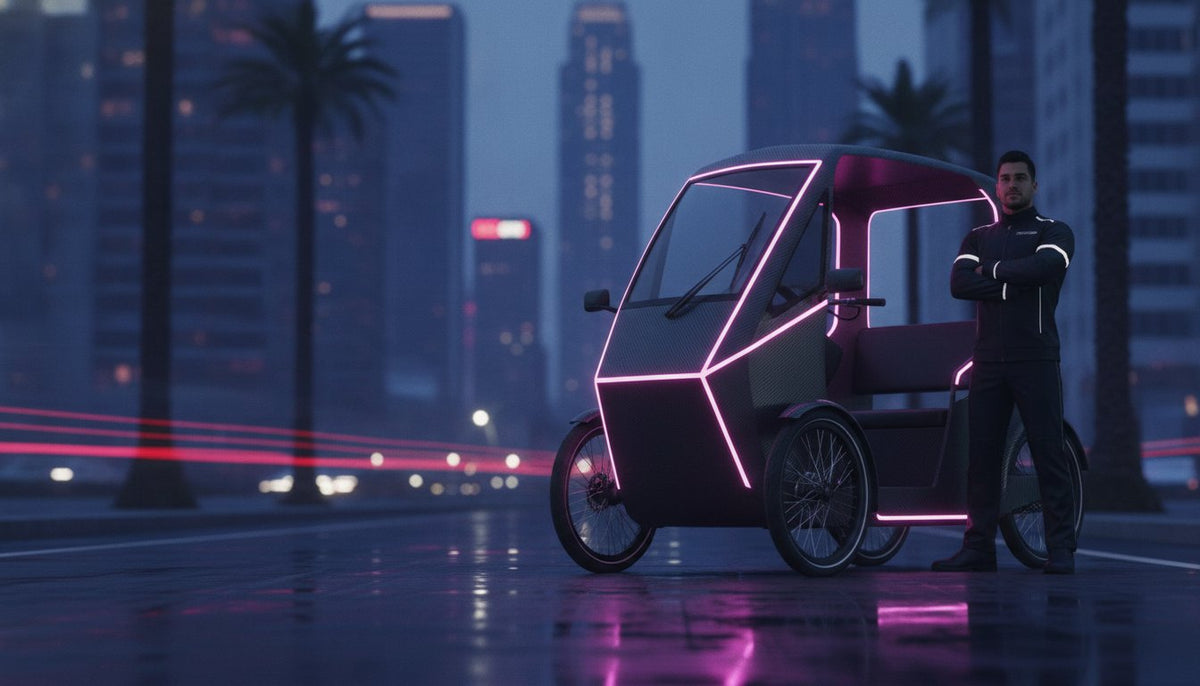
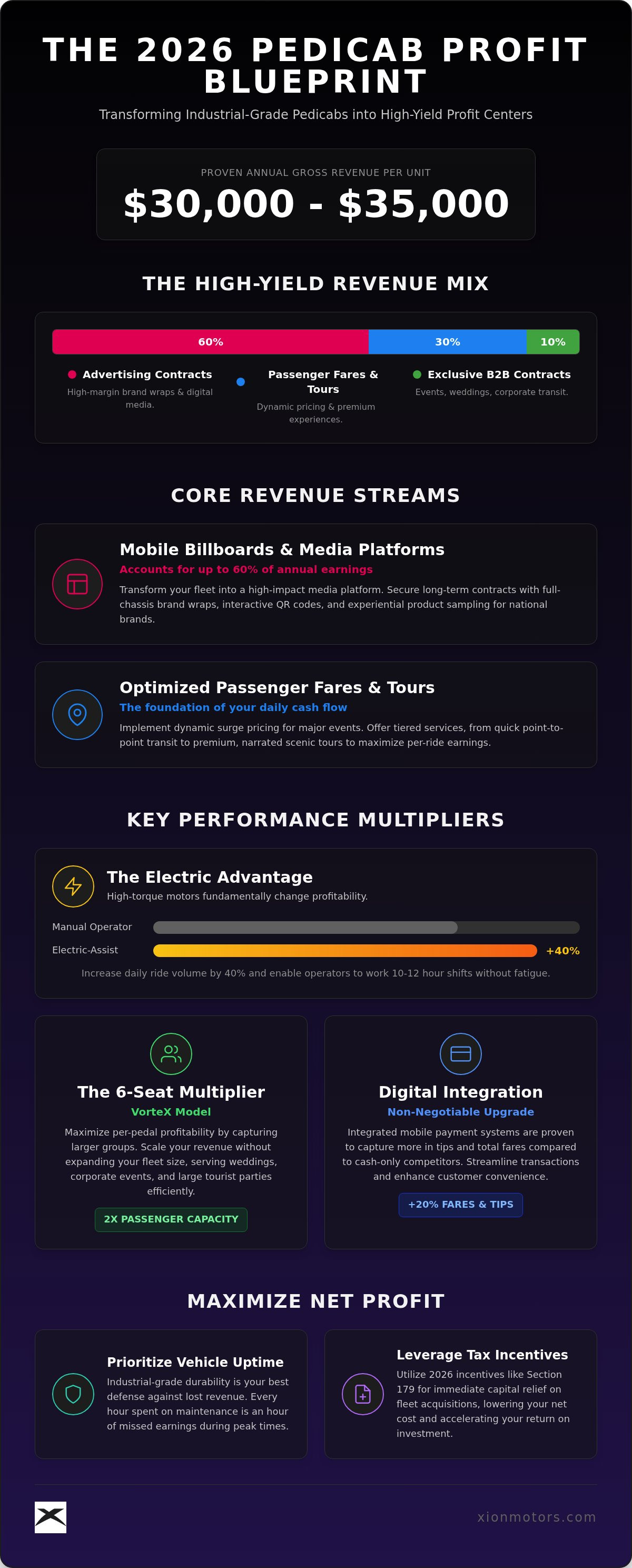
In 2026, a professional pedicab isn't just a vehicle; it's a high-utilization mobile media and logistics platform where engineering durability directly dictates your financial ceiling. You already understand that relying exclusively on seasonal passenger fares creates a volatile bottom line that's vulnerable to weather and shifting foot traffic. This guide explores the diversified pedicab business revenue streams that turn industrial-grade electric units into high-yield profit centers. We've spent over 20 years in the trenches, and we've proven that the right hardware can generate between $30,000 and $35,000 in annual gross revenue per unit. It's time to stop thinking like a bike operator and start thinking like a fleet strategist.
We'll provide a clear roadmap to maximizing your ROI by analyzing the performance differences between 3-seat and 6-seat models like the CyberX and VorteX. You'll learn how to secure lucrative advertising contracts that can account for up to 60% of your annual earnings, providing a stable foundation during off-peak months. We'll also detail operational strategies to minimize maintenance downtime, ensuring your assets stay on the street where they belong. Whether you're scaling a local fleet or launching a new venture, these capital strategies will help you build a resilient, multi-stream business model that dominates the market.
Key Takeaways
- Diversify your pedicab business revenue streams by moving beyond passenger fares to include high-margin brand wraps and exclusive B2B contracts.
- Leverage industrial-grade assets like the CyberX and VorteX to generate up to $35,000 in annual gross revenue through superior commercial durability.
- Discover the multiplier effect of 6-seat models, which allow you to capture larger groups and increase per-pedal profitability without expanding your fleet.
- Turn your fleet into a high-impact media platform by utilizing large-format chassis for full-brand wraps and interactive digital marketing.
- Maximize your net profit by prioritizing vehicle uptime and utilizing 2026 tax incentives like Section 179 for immediate fleet acquisition relief.
The Foundation: Optimizing Passenger Fares and Tour Revenue
Passenger fares and curated tours represent the bedrock of most pedicab business revenue streams. While advertising provides stability, the street-level grind is where you maximize the utility of your fleet. In high-traffic entertainment districts, success isn't about just waiting for a fare; it's about active management of your pricing and routes. You need to implement dynamic pricing that reflects real-time demand. During major national events in 2026, surge pricing isn't just an option, it's a necessity for capturing the full value of the market. The transition from the traditional Cycle rickshaw to modern electric-assisted machines has fundamentally shifted the earning potential of the sector. You aren't just selling a ride; you're selling efficiency and experience.
Implementing Tiered Fare Structures
Differentiate your services to capture every segment of the market. Quick point-to-point transit moves people from bars to hotels, but premium scenic tours allow you to charge a significant premium for storytelling and local insight. Mastering the upsell is where the "Master Practitioner" separates themselves from the amateur. Don't just pedal; narrate. Operators who provide local history or insider tips often see a significant increase in their per-ride earnings through voluntary gratuities and extended tour bookings. If you're operating high-capacity 6-seat vehicles like the VorteX, your group rates should reflect the unique value of keeping a large party together. Adopting digital payment systems is a non-negotiable upgrade. Data shows that operators using integrated mobile payments capture 20% more in tips and total fares compared to cash-only competitors.
The Electric Advantage: More Miles, More Money
Manual labor is a bottleneck for profitability. High-torque motors change the math by allowing operators to work 10 to 12 hour shifts without hitting a wall of physical fatigue. This electric assist technology can increase your daily ride volume by 40% because your drivers aren't slowing down as the day progresses. It also expands your service radius, allowing you to reach high-paying hotel districts that were previously too far from the main entertainment hub. For a deep dive into the hardware that makes this possible, see the CyberX: The Industrial-Grade Electric Pedicab Engineering Standard for 2026. By investing in industrial-grade durability, you ensure your vehicles stay on the road during high-earning windows. Every hour spent in the shop is an hour of lost revenue, making vehicle uptime the most critical metric in your pedicab business revenue streams.
Mobile Billboards: Securing High-Impact Advertising Revenue
Passenger fares provide the daily cash flow, but the most sophisticated pedicab business revenue streams are found in high-margin advertising contracts. In 2026, a pedicab is a high-utilization mobile media platform. Full-chassis brand wraps transform your fleet into mobile billboards that penetrate urban corridors where traditional signage is often restricted. These wraps represent the highest-margin revenue stream in the industry because the operational costs are already covered by your passenger service. When you wrap a vehicle, you're essentially getting paid twice for every mile pedaled. To maximize this potential, you must move beyond local businesses and target national brands looking for experiential reach.
Modern advertising isn't just about static images. Digital integration is now a standard requirement for high-paying corporate clients. By using QR codes and passenger-facing tablets, you create a bridge between physical presence and digital conversion. Brands are increasingly interested in experiential sampling, where your drivers distribute products or promotional materials during the ride. This high-touch interaction builds brand loyalty in a way a highway billboard never could. Securing long-term, year-round contracts is the key to baseline stability. These agreements ensure that your fleet remains profitable even during the quieter winter months or off-peak weekdays.
Pricing Your Advertising Space
Professional agencies buy media based on Cost Per Thousand impressions (CPM). In the out-of-home advertising industry, pedicabs offer a highly competitive CPM ranging from $1 to $4. This efficiency makes your fleet an easy sell for marketing directors. In high-traffic urban markets, a single vehicle can generate between $2,500 and $3,000 in monthly advertising revenue. You must provide data-backed 'proof of presence' reports to justify these rates. Use GPS tracking to generate heat maps of your routes and estimate impressions based on local foot traffic data. This level of transparency builds the trust necessary to move from small seasonal deals to comprehensive fleet packages with annual brand partners.
The VorteX as a Marketing Platform
Size dictates visibility in the media world. The VorteX model provides a significantly larger surface area than standard 3-seat units, which allows it to command 30% higher advertising rates from premium brands. Its industrial-grade chassis is designed to support large-format wraps that maintain their integrity under heavy 24/7 commercial use. When designing these wraps, prioritize high-contrast visuals that preserve the vehicle's rugged aesthetic while maximizing brand legibility from a distance. Ad-wrap ROI is the secondary yield generated by a vehicle’s external surface area independent of its primary transport function. By deploying high-capacity trikes, you aren't just moving more people; you're operating a larger, more profitable media asset.
Exclusive Contracts: Festivals, Weddings, and Corporate Transit
Contracts provide the predictable revenue that street-level hailing lacks. In 2026, savvy operators are diversifying their pedicab business revenue streams by moving into B2B and municipal partnerships. These aren't just rides; they're professional service agreements. Corporate campuses and historic districts often face congestion that traditional vehicles can't handle. Electric pedicabs offer the perfect last-mile solution. Municipalities are increasingly funding these micro-transit programs to reduce carbon footprints and improve urban mobility. Securing these contracts allows you to move from a seasonal operator to a year-round transit partner.
Weddings and private events offer another lucrative channel. These bookings are high-margin and low-mileage. You aren't grinding out 10-hour shifts; you're providing a premium, curated experience for a fixed fee. In 2026, exclusive contracts have become the most stable pedicab business revenue streams for fleet owners. Similarly, securing "official transport" status at major festivals allows you to control the logistics of passenger dispersal. This positioning eliminates competition and guarantees a constant flow of traffic throughout the event. You become part of the event infrastructure, which is a far more powerful position than just being a nearby vendor.
The Professional Pitch for Event Planners
Winning high-level contracts requires more than just having the bikes. You need to present a 'Master Practitioner' fleet portfolio that demonstrates operational reliability. Event planners care about safety and professionalism. You must provide comprehensive insurance and safety documentation to even get in the room. If you're just starting, consult How to Start a Pedicab Company: The 2026 Professional Blueprint for the administrative standards required to play at this level. Showing that you operate industrial-grade equipment like the CyberX proves you're a serious commercial entity, not a hobbyist. Your pitch should focus on reliability and the ability to handle high-pressure environments without equipment failure.
Logistics of High-Volume Shuttles
Managing high-volume events requires precision. Coordinating a fleet of five or more vehicles for rapid passenger dispersal is a management challenge. This is where the VorteX model excels. Its 6-seat capacity effectively halves the number of trips needed to clear a crowd, drastically reducing wait times for large groups. During multi-day festivals, charging logistics become the primary operational hurdle. You need a rotation strategy that keeps your industrial-grade assets on the move while others are on the charger. Success in these environments is measured by uptime and throughput. Scaling your fleet for these contracts ensures your vehicles are revenue-generating assets 24/7.
The 6-Seat Multiplier: Scaling Revenue without Fleet Expansion
Scaling a fleet often implies increasing the number of units and operators, but the 6-seat multiplier offers a more efficient path to growth. By doubling your passenger capacity on a single chassis, you effectively double your potential fare revenue without adding the overhead of additional driver commission or storage space. This shift in the per-pedal profitability model is one of the most effective ways to optimize pedicab business revenue streams in high-density markets. You aren't just moving more people; you're capturing larger family and tour groups that would otherwise be split between multiple 3-seat units or lost to ride-share services.
Advertising agencies also prefer these high-capacity models. The increased surface area provides a superior canvas for brand storytelling, allowing for more complex and visible wraps. This makes 6-seat models the preferred choice for high-value corporate partners who demand maximum visual impact. Managing the operational dynamics of a heavy-duty passenger fleet requires a focus on industrial-grade durability. When you're consistently hauling 1,000+ pounds of passenger weight, the margin for engineering error disappears. Reliability becomes the primary driver of your net profit.
3-Seat vs. 6-Seat Revenue Comparison
The ROI on group fares consistently outperforms individual rides. A single 6-seat booking for a family tour often yields a higher net profit than three separate 2-person fares because it reduces the time spent idling and searching for new passengers. However, this increased load capacity places extreme stress on the vehicle's components. Maintenance differences are stark; industrial-grade parts are non-negotiable for 6-seat loads to prevent premature wear on drivetrain and braking systems. For a detailed breakdown of these operational metrics, read The 2026 Guide to 6 Seat Electric Pedicab Fleet Operations. Using consumer-grade components on a 6-seat frame is a recipe for catastrophic downtime.
High-Torque Performance for Heavy Loads
Maintaining speed and safety under maximum capacity requires specialized engineering. High-torque motors are essential for navigating urban inclines and stop-and-go traffic with a full load of six passengers. The VorteX chassis is built to handle this weight without frame fatigue, utilizing heavy-duty materials that maintain structural integrity over years of 24/7 commercial use. Positioning these high-capacity trikes in resort and entertainment districts allows you to dominate the market by offering a service that smaller competitors simply cannot match. If you're ready to scale your operations with assets designed for maximum throughput, view our electric pedicab fleet packages to find the right configuration for your market.
Operational Excellence: Maximizing Uptime and Net Profit
Revenue generation is only half the battle. Net profit is dictated by how effectively you protect your margins from operational leakage. In the world of 2026 micro-transit, downtime is the ultimate revenue killer. Every hour a vehicle sits in the shop during a peak festival weekend is an hour of zero ROI. To protect your pedicab business revenue streams, you must prioritize industrial-grade durability over low-cost entry points. Rugged chassis design and high-performance components aren't luxuries; they're the insurance policy for your bottom line. Professional operators know that a vehicle is only an asset when it's moving.
For fleet owners scaling in 2026, the financial math is further improved by Section 179 tax deductions. This provision allows for immediate tax relief on fleet acquisitions, enabling you to write off the full purchase price of your vehicles in the year they're put into service. It’s a powerful tool for turning tax liabilities into operational growth. By reinvesting these savings into fleet expansion, you accelerate your path to market dominance. This pragmatic approach to capital management is what separates the Master Practitioner from the casual hobbyist.
The Cost of Cheap Equipment
Consumer-grade e-bikes and low-tier trikes aren't built for the rigors of 24/7 commercial deployment. They fail under the stress of heavy passenger loads and constant thermal cycling. If a single unit goes down for just one week during a mid-season surge, you aren't just losing fares; you're losing the advertising impressions promised to your brand partners. Calculating this lost revenue often reveals that a "cheap" bike costs more in six months than a professional-grade asset. Protect your investment by following a proactive Electric Pedicab Maintenance Guide: Sustaining Industrial-Grade Fleet Performance. This disciplined approach ensures your financed assets remain on the street earning money.
Leveraging Fleet Pricing for Scale
Scaling from a single pilot unit to a dominant regional fleet requires a strategic manufacturing partner. By utilizing Xion Motors' direct-to-operator sales model, you bypass the middleman and secure the best possible unit margins. We coordinate nationwide shipping across all 50 states, ensuring your multi-state fleet deployment is seamless and synchronized. Whether you're targeting corporate campuses or urban entertainment districts, your growth plan depends on hardware that can take a beating and keep earning. Don't leave your 2026 expansion to chance. Contact Xion Motors for a professional consultation and finalize a fleet strategy that turns precision engineering into market leadership.
Dominating the 2026 Micro-Transit Market
Building a resilient operation requires moving beyond the traditional street-hail model. By diversifying your pedicab business revenue streams through high-impact advertising and exclusive corporate contracts, you create a foundation for year-round profitability. The difference between a struggling operator and a market leader often comes down to the reliability of their equipment. Precision engineering isn't just a technical detail; it's the primary driver of your annual ROI and long-term fleet sustainability.
Our industrial-grade CyberX and VorteX engineering is backed by over 20 years of operational roots. We've designed these vehicles to be true revenue-generating assets that can withstand the rigors of 24/7 commercial use. A single professional-grade vehicle has the potential to generate $30,000 to $35,000 in annual gross revenue. It's time to stop treating your fleet as a collection of bikes and start managing them as high-yield capital assets. Don't leave your growth to chance; your market is waiting for a professional transit solution that delivers results.
Start Your Fleet Today with Xion Motors
Frequently Asked Questions
How much revenue can a single electric pedicab generate annually?
A single industrial-grade electric pedicab can generate between $30,000 and $35,000 in annual gross revenue. This figure is achieved by diversifying pedicab business revenue streams to include passenger fares, curated tours, and high-margin advertising wraps. Success at this level requires a high-utilization model where the vehicle remains on the street during peak demand windows. Our 20 years of operational experience confirms that vehicle uptime is the most critical variable in reaching these financial targets.
What are the primary advertising options for pedicab fleets?
Fleet operators primarily utilize full-chassis brand wraps to turn their vehicles into mobile billboards. These wraps provide a high-visibility canvas that commands premium rates from national brands looking for experiential reach. Other options include digital integration through passenger-facing tablets and QR codes, or experiential marketing like product sampling. In established urban markets, advertising revenue can account for as much as 60% of a fleet's total annual earnings, providing a stable financial foundation independent of passenger volume.
Is a 6-seat pedicab more profitable than a 3-seat model?
The 6-seat VorteX model offers a significant profitability multiplier by doubling passenger capacity on a single chassis. This allows you to capture larger family and tour groups that would otherwise require multiple 3-seat units. Additionally, the larger surface area of a 6-seat model typically commands 30% higher advertising rates compared to standard 3-seat units. While the initial investment is higher, the increased per-pedal profitability and enhanced media value make it the superior choice for scaling professional operations.
How do electric assist motors impact daily revenue potential?
Electric assist motors can increase your daily ride volume by 40% by eliminating operator fatigue and maintaining consistent speeds throughout a shift. This technology allows drivers to work 10 to 12 hour shifts even in challenging terrain or under heavy 6-seat loads. By increasing the number of possible rotations per day, high-torque motors directly expand your daily earning ceiling. It also allows your fleet to reach higher-paying districts that are often physically inaccessible to manual operators.
Can I deduct the cost of a new pedicab fleet from my taxes?
Yes, you can leverage Section 179 tax deductions to immediately write off the full purchase price of a new pedicab fleet in 2026. This provision allows business owners to deduct the entire cost of qualifying equipment from their gross income in the year of acquisition. It is a powerful capital strategy that provides immediate tax relief and improves cash flow for growing operations. You should consult with a tax professional to maximize these benefits for your specific fleet configuration.
What types of corporate contracts are most lucrative for pedicab operators?
The most lucrative corporate contracts involve long-term shuttle services for corporate campuses, historic districts, and major festivals. These B2B agreements provide predictable, high-margin revenue that isn't dependent on daily foot traffic. Municipalities also offer contracts for last-mile transit solutions to reduce urban congestion. Wedding transport remains a high-margin niche, offering low-mileage bookings for a premium flat fee. Securing these contracts requires a professional fleet portfolio and documented safety standards to meet corporate insurance requirements.
How do I secure advertising partners for my pedicab business?
Securing advertising partners requires presenting your fleet as a professional media platform backed by concrete data. You must provide advertisers with Cost Per Thousand (CPM) estimates, which typically range from $1 to $4 for pedicab media. High-traffic urban markets can command $2,500 to $3,000 in monthly ad revenue per vehicle. Use GPS tracking to generate "proof of presence" reports and heat maps of your routes. This level of transparency builds the trust necessary to close annual contracts.
Why is industrial-grade engineering important for business revenue?
Industrial-grade engineering is the only way to protect your pedicab business revenue streams from the high cost of downtime. Consumer-grade components fail under the 24/7 stress of commercial use, leading to lost fares and breached advertising contracts. Our CyberX and VorteX models use 4130 Chromoly steel and heavy-duty drivetrains to ensure maximum uptime. Every day a vehicle sits in the shop is a day of zero ROI, making durability the most important factor in your net profit.