A single battery failure at peak hours doesn't just sideline a vehicle; it kills the momentum of a $30,000 annual revenue stream. Professional operators understand that the difference between a profitable season and a logistical nightmare often comes down to the cells beneath the seat. If you've ever dealt with mid-shift downtime or a motor that stutters under a 1,000-pound load, you know that standard e-bike parts won't cut it. Mastering the 2026 industrial landscape requires a deep dive into commercial pedicab battery specifications to ensure your fleet remains a high-performance asset rather than a liability.
We agree that your equipment should be as relentless as your hustle. You're here to eliminate the guesswork and build a fleet that delivers maximum uptime and long-term ROI. In this guide, we'll provide the engineering insights needed to select systems that last over three years in the field. You will learn why the industry is shifting toward 72V architectures for superior torque, how to accurately calculate range for a full eight-hour shift, and which battery chemistries meet the latest UL 2849 safety mandates.
Key Takeaways
- Identify why industrial-grade power systems are mandatory for maintaining high-utilization revenue streams and avoiding costly mid-shift downtime.
- Analyze the critical commercial pedicab battery specifications that separate high-torque 72V systems from underpowered consumer standards.
- Apply the 40-mile operational rule to guarantee your fleet handles full urban shifts even under heavy 1,000lb passenger loads.
- Implement advanced maintenance protocols and thermal management to extend battery lifespans beyond the three-year mark for better ROI.
- Explore how Xion Motors integrates 20 years of fleet experience into the CyberX and VorteX power architectures for maximum industrial durability.
The Critical Role of Battery Specifications in Commercial Pedicab Operations
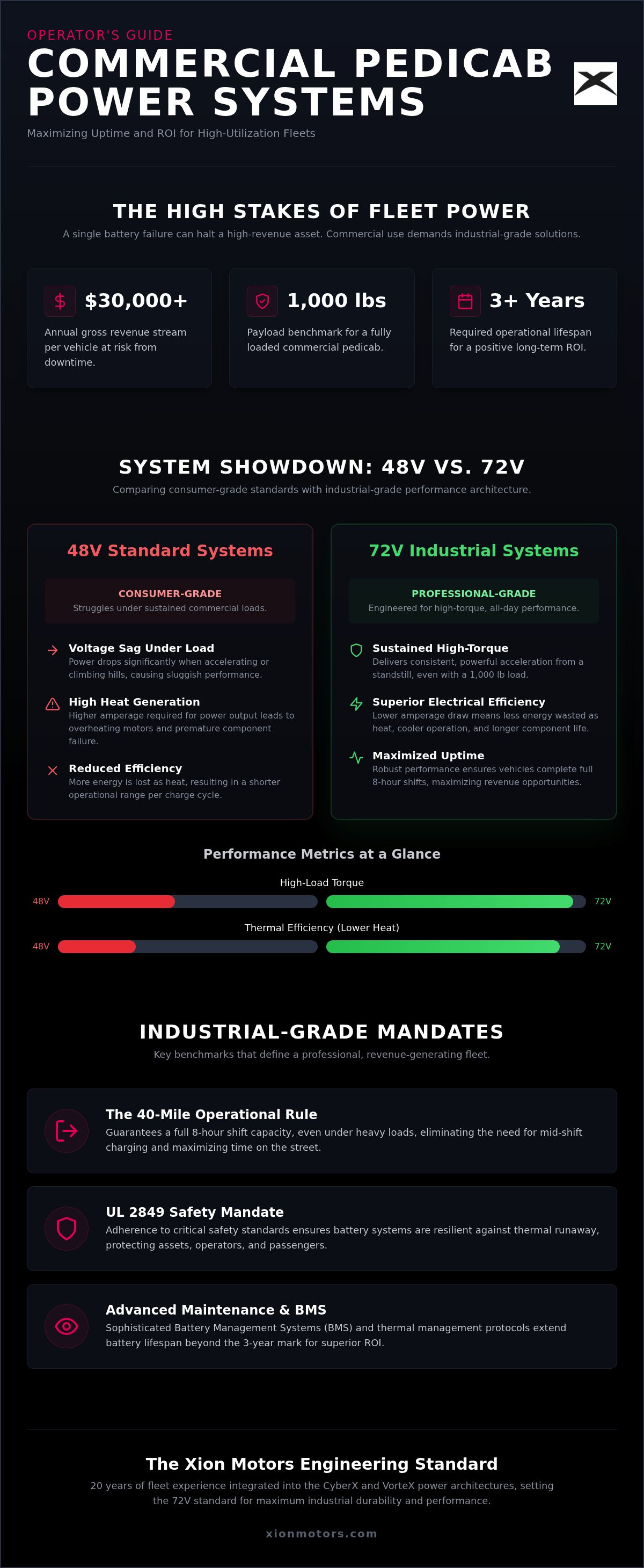
Revenue follows reliability. In the high-stakes environment of urban tourism and entertainment districts, your equipment is either an asset or a bottleneck. Most operators enter the market thinking any lithium pack will do, but they quickly discover that consumer-grade hardware isn't built for the "Duty Cycle" of a professional fleet. A commercial vehicle often runs for ten hours straight, facing constant stop-and-go cycles while carrying immense weight. If your commercial pedicab battery specifications don't match this reality, you'll face "voltage sag." This occurs when the battery cannot provide enough current to the motor under load, causing the system to throttle power exactly when you need it most. This strain doesn't just slow you down; it generates internal heat that leads to motor overheating and premature cell degradation.
Commercial vs. Consumer Power Demands
The physics of passenger transport are unforgiving. A standard electric bike is designed for a 200-pound rider. A professional trike must account for the vehicle weight, the driver, and up to six passengers, often exceeding a 1,000-pound payload benchmark. This massive difference in mass requires sustained high-torque output that would melt a standard commuter battery. While global electric rickshaw battery systems often rely on lower 48V standards for light use, the American commercial market demands more. You need a system that handles peak discharge rates without dropping voltage. Without this industrial-grade capacity, your drivers will struggle on inclines, and your fleet will spend more time at the charging station than on the street.
The Financial Impact of Battery Downtime
Downtime is the silent killer of profitability. A well-managed electric pedicab can generate over $30,000 in annual gross revenue, but that math only works if the bike is moving. Losing a vehicle during a peak Saturday night event because of a dead or degraded battery costs more than just the missed fares; it damages your brand's reputation for reliability. Investing in commercial pedicab battery specifications that prioritize longevity ensures you aren't replacing expensive packs every six months. Cheap cells might save money upfront, but they lack the sophisticated Battery Management Systems (BMS) required to handle thousands of charge cycles. For a deeper look at keeping your fleet operational, consult our Electric Pedicab Maintenance Guide. True ROI isn't found in the purchase price; it's found in the three-plus years of uninterrupted service that industrial-grade engineering provides.
Decoding Core Specs: 72V Systems vs. 48V Standards
Success in the pedicab industry requires moving beyond hobbyist hardware. While many entry-level operators settle for 48V systems, these setups often struggle under the weight of a commercial payload. The shift to a 72V architecture isn't just about speed; it's about electrical efficiency and thermal management. In a 48V system, the motor must pull higher amperage to generate the same wattage as a 72V system. Higher amperage creates more heat in the wiring and the motor, leading to efficiency losses and potential component failure during a long shift. By benchmarking your fleet against professional commercial pedicab battery specifications, you ensure your vehicles can handle the grind of a 1,000-pound passenger load without breaking a sweat.
The 72V Advantage for High-Torque Performance
Torque is the lifeblood of urban transport. A 72V system provides the high-voltage "push" required to move a fully loaded 6-seat model from a dead stop or up a steep incline. Because these systems operate more efficiently, they experience significantly less voltage sag when the driver hits the throttle. This translates to more miles per charge and a motor that runs cooler even in mid-summer heat. Adhering to NHTSA battery safety standards ensures that your high-voltage system isn't just powerful, but also resilient against the thermal runaway risks inherent in cheap, uncertified cells. If you’re looking to upgrade your fleet’s power, exploring industrial-grade components is the first step toward professionalizing your operation.
Understanding Energy Capacity for Shift Planning
Don't let Amp-Hours (Ah) deceive you. While Ah measures the capacity of the battery at its rated voltage, it doesn't tell the whole story of how much "fuel" is in the tank. To find the true energy capacity, you must calculate Watt-Hours (Wh) by multiplying Voltage by Amp-Hours. For example, a 72V 20Ah battery provides 1,440Wh of energy. A 48V 30Ah battery technically offers the same 1,440Wh, but the 72V system will consistently outperform it in the field because it wastes less energy as heat. This efficiency is critical when planning commercial pedicab battery specifications for a fleet that needs to stay on the road for eight or more hours. Watt-Hours represent the most accurate metric for determining real-world pedicab range across varying urban terrains.
Energy density also plays a pivotal role in vehicle design. You need a battery that offers maximum capacity without adding excessive dead weight that your motor has to haul around. Industrial lithium cells provide the high discharge ratings necessary to handle the peak current draws of a high-torque mid-drive motor. Choosing a system with a robust discharge rate prevents the Battery Management System (BMS) from tripping during a heavy climb, keeping your drivers moving and your revenue flowing.
Operational Performance: Calculating Range and Charging Cycles
Precision in shift planning is the hallmark of a veteran fleet operator. While consumer e-bike brands often advertise range based on flat terrain and lightweight riders, professional commercial pedicab battery specifications must account for the brutal reality of urban transport. A fully loaded six-seat vehicle, complete with heavy advertising wraps and sound systems, creates a massive drag on energy reserves. To maintain a profitable operation, you need a system that delivers a reliable 40-mile real-world commercial range. This "40-Mile Rule" ensures that your drivers can navigate a full eight-hour shift in high-traffic urban centers without the anxiety of a mid-tour power failure.
Managing your Depth of Discharge (DoD) is equally critical for the financial health of your fleet. Discharging a lithium battery to 0% repeatedly will accelerate cell degradation, forcing premature replacement. We recommend a protocol that keeps the battery above a 20% state of charge. This safety buffer protects the internal chemistry and ensures that your industrial-grade components reach their full three-to-five-year lifespan. By treating your energy management with the same rigor as your mechanical maintenance, you secure the long-term ROI of your equipment.
Predicting Your Daily Operational Range
Calculating your fleet's true capacity requires a three-step analytical approach. First, determine your Watt-Hours per mile based on your average passenger load; a heavy 1,000-pound payload typically consumes significantly more energy than a solo driver. Second, subtract a 20% safety margin from your total Watt-Hour capacity to prevent deep discharge cycles. Finally, factor in accessory draws. High-output LED lighting and professional audio systems can drain up to 5% of your total capacity over a long shift. Accuracy here prevents the logistical nightmare of towing a dead vehicle during peak revenue hours.
Charging Infrastructure for Fleet Management
Your charging environment is just as important as the battery itself. Lithium-ion stability depends on optimal charging temperatures, ideally between 50°F and 86°F. Charging in extreme heat or freezing cold can permanently damage cell capacity and void warranties. For high-utilization fleets, we advocate for "opportunity charging"-briefly plugging in during driver breaks or between tours to top off the cells. This practice reduces the depth of each discharge cycle and keeps your vehicles on the road longer. For a comprehensive look at managing large-scale deployments, see our guide on 6 Seat Electric Pedicab Fleet Operations. Implementing these industrial protocols ensures your commercial pedicab battery specifications translate into consistent, street-level performance.
Battery Longevity and Industrial Maintenance Protocols
Longevity in a high-utilization fleet is a direct consequence of disciplined maintenance and superior component selection. While entry-level operators treat batteries as disposable commodities, seasoned professionals view them as long-term power assets that require precise management. Maintaining peak performance involves more than just plugging in at night; it requires an understanding of how commercial pedicab battery specifications interact with environmental stressors and discharge patterns. If you ignore the health of your cells, you're effectively burning your profit margins through premature replacement costs. Industrial-grade lithium systems are designed to last three to five years, but reaching that milestone requires a commitment to rigorous operational standards.
BMS: The Silent Guardian of Your Fleet
The Battery Management System (BMS) is the primary safety component in commercial lithium systems. It acts as a digital governor, constantly monitoring voltage, current, and temperature to prevent catastrophic failure. In a high-capacity 72V pack, the BMS performs the critical task of cell balancing. Because no two lithium cells are identical, some may charge or discharge faster than others. Without active balancing, a single weak cell can limit the capacity of the entire pack or, worse, lead to a thermal event. A robust BMS also provides overcharge and over-discharge protection, ensuring that the battery never enters a volatile state. To secure your business with hardware that prioritizes this level of safety, you should invest in professional-grade fleet packages that include integrated management systems.
Maximizing Cycle Life for Better ROI
Return on investment is dictated by the number of usable charge cycles you can extract from a pack. You can significantly extend the life of your fleet by avoiding 100% depth of discharge; staying within the 20% to 80% capacity range can often double the total cycle life of the cells. While high-speed charging is convenient for rapid turnarounds, it generates internal heat that can degrade the lithium chemistry over time. We recommend a balanced approach that uses standard charging for overnight cycles and reserves fast charging for emergency mid-shift needs. Implementing a weekly health check is also essential. Operators should look for specific signs of degradation before they lead to field failure, such as:
- Increased voltage sag when accelerating under a full passenger load.
- Noticeable heat buildup near the battery casing during standard operation.
- A sudden decrease in total range that cannot be explained by terrain or weather.
- Physical swelling or casing irregularities that indicate internal cell stress.
Thermal management is equally vital for seasonal operators. Storing batteries in a "dead" state during the off-season is a guaranteed way to kill capacity. Lithium cells should be stored at approximately 50% charge in a temperature-controlled environment to prevent self-discharge from dropping the voltage below the recovery threshold. By adhering to these commercial pedicab battery specifications for storage and handling, you ensure that your fleet is ready to generate revenue the moment the season begins, rather than facing a massive capital expenditure for new batteries.
Xion Motors Engineering: The 72V Standard for High-Utilization Fleets
Xion Motors didn't just guess at the 72V benchmark; we earned it through two decades of street-level fleet operations. We intentionally moved away from the 48V hobbyist standard because we saw the limitations of lower voltage systems during high-utilization shifts. Our 72V lithium battery system is now the commercial standard for the entire industry, providing the superior torque and thermal efficiency required for heavy-duty models like the CyberX and VorteX. This architecture allows our vehicles to consistently deliver 40+ miles of real-world range, even when hauling a full 1,000lb payload. By optimizing commercial pedicab battery specifications for the grind of the street, we ensure your fleet stays active during the most profitable hours of the day.
Built for the 50-State Commercial Market
We engineer our vehicles for the rigorous demands of the 50-state commercial market. Our power systems are designed to meet evolving safety standards, providing the security you need to operate in highly regulated urban centers. Beyond the hardware, we provide the industrial support infrastructure necessary for national success. From our central operations, we offer direct manufacturer support, a full catalog of vehicle parts, and a 1-year battery warranty on all industrial-grade components. This commitment to legacy and reliability is why CyberX: The Industrial-Grade Engineering Standard is the preferred choice for professional fleet owners who demand zero compromises on the road.
Future-Proofing Your Pedicab Business
Profitability in the modern landscape relies on more than just passenger fares; it requires a platform that can handle multiple revenue streams. Your commercial pedicab battery specifications must account for the added weight of high-revenue advertising wraps and the energy demands of extended shuttle routes. Xion Motors designs for this exact scalability. The CyberX and VorteX are not merely bicycles with motors; they are purpose-built industrial machines where the battery, controller, and motor operate in a closed-loop ecosystem of performance. You can easily integrate additional battery capacity into our 3-seat and 6-seat models to support longer routes without compromising the structural integrity of the chassis.
This flexibility allows you to pivot from late-night entertainment districts to corporate resort shuttles with zero hesitation. Our 20 years of experience are baked into every spec, ensuring your business is built on a foundation of proven financial viability. We don't just sell vehicles; we provide the tools for long-term entrepreneurial success. If you're ready to scale your operation with the best tools in the market, Explore Xion Motors High-Performance Pedicabs today and see the difference that industrial-grade engineering makes for your bottom line.
Dominate the Urban Transit Market with Industrial Power
Transitioning your fleet from hobbyist parts to professional-grade hardware is the most significant move you can make for your bottom line. We've explored how 72V systems provide the thermal stability and torque needed to move 1,000-pound loads without failure. By adhering to these rigorous commercial pedicab battery specifications, you ensure your operation isn't just surviving but leading the market. You now have the blueprint for calculating real-world range and implementing maintenance protocols that protect your investment for the long haul.
Xion Motors brings over 20 years of fleet experience to every vehicle we build. Our 72V high-torque power systems and 40+ mile commercial range are engineered for operators who refuse to settle for second best. It's time to stop worrying about downtime and start focusing on your growth. Scale your fleet with Xion Motors industrial-grade pedicabs and secure your place at the top of the industry. Your future as a market leader starts with the right tools.
Frequently Asked Questions
What is the difference between 48V and 72V pedicab batteries?
A 72V system is the industrial standard for torque and thermal efficiency. While 48V systems are common in light e-bikes, they pull significantly higher amperage to move commercial loads, which generates excessive heat. Our 72V architecture provides the electrical pressure needed to move 1,000-pound payloads with less strain on the motor. This efficiency ensures your components last longer and perform better under pressure.
How many miles can a commercial electric pedicab go on a single charge?
A professional-grade system delivers 40+ miles of real-world range under commercial conditions. While hobbyist estimates often ignore passenger weight, industrial commercial pedicab battery specifications account for full 6-seat payloads and urban stop-and-go traffic. This 40-mile benchmark allows your drivers to complete a full eight-hour shift without the logistical nightmare of mid-tour charging or vehicle swaps.
How long does it take to charge a 72V commercial pedicab battery?
Charging duration depends on the charger's amperage and the battery's depth of discharge. Typically, a full cycle takes between four and six hours with a standard industrial charger. We advocate for "opportunity charging" during driver breaks to keep the voltage high. This practice reduces the total time needed for an overnight top-off and keeps your fleet ready for peak demand hours.
What is the lifespan of a commercial lithium pedicab battery?
You should expect three to five years of service or roughly 500 to 1,000 charge cycles from a quality pack. Lifespan is a direct result of your maintenance protocols and discharge habits. Avoiding 100% depth of discharge and storing cells in temperature-controlled environments are the most effective ways to protect your investment and maximize your long-term ROI.
Can I use standard e-bike batteries in my CyberX or VorteX?
No, standard e-bike batteries lack the discharge ratings and voltage required for our industrial drivetrains. The CyberX and VorteX utilize integrated 72V systems specifically engineered for high-torque commercial use. Attempting to use consumer-grade packs will lead to immediate voltage sag, motor overheating, and potential safety risks. Professional fleets require professional power to maintain consistent revenue streams.
What happens if my pedicab battery gets wet during a shift?
Our commercial battery enclosures are engineered for weather resistance in standard urban rain conditions. While the systems are rugged, you should never submerge the battery or use high-pressure washers directly on the electrical connections. If a pack is exposed to heavy moisture during a shift, ensure the exterior is completely dry before connecting it to a charger or performing maintenance.
How do battery specifications affect the hill-climbing ability of a 6-seat pedicab?
Voltage and discharge ratings are the primary factors in climbing performance. A 72V system provides the necessary electrical pressure to maintain torque on steep inclines even with a 1,000lb payload. High-quality commercial pedicab battery specifications prevent the power loss often seen in lower-voltage systems. This ensures your drivers can navigate hilly terrain without compromising the passenger experience or the motor's health.
Are Xion Motors batteries compliant for shipping to all 50 states?
Yes, our batteries meet the necessary safety standards for commercial shipping and operation across the United States. We maintain a robust support infrastructure to serve national fleet operators from coast to coast. This compliance ensures your business stays mobile and legal regardless of which major metropolitan market you choose to dominate. We handle the technical red tape so you can focus on growth.