A single day of vehicle downtime costs more than just a repair bill. It's a direct hit to your bottom line that can never be recovered. You've likely seen the market flooded with cheap imports that fail under heavy passenger loads, leaving operators stranded and profits stalled. Real growth requires a shift from consumer-grade toys to industrial-grade commercial electric pedicab solutions. These machines are built for the rigors of 2026 transit standards, where reliability is the only metric that matters. We've spent decades in the trenches and know that performance is the foundation of profitability.
You recognize that a fleet is only as strong as its weakest link. We promise to show you how to achieve 300 plus days of operational uptime through superior engineering and a robust national parts supply chain. This article provides a deep dive into high-capacity fleet scaling, the impact of new safety regulations, and strategies to maximize your revenue per seat. Discover how the right hardware transforms a simple transport service into a dominant commercial powerhouse.
Key Takeaways
- Learn how the shift toward the last-mile economy requires a transition to industrial-grade commercial electric pedicab solutions to meet modern transit demands.
- Understand the engineering advantages of the CyberX and VorteX models, featuring reinforced TIG welded steel chassis built for high-frequency fleet use.
- Identify the optimal fleet configuration by comparing the agility of 3-seat models with the high-capacity revenue potential of 6-seat units.
- Eliminate revenue leaks by implementing a professional maintenance guide and securing a direct-to-operator supply chain for critical replacement parts.
- Scale your operation efficiently through manufacturer-direct fleet packages that offer bulk pricing and priority technical support.
The Evolution of Commercial Electric Pedicab Solutions
The era of the manual-first pedicab has officially ended. In 2026, the industry has matured into a sophisticated component of urban transit. We've witnessed The Evolution of Pedicabs from basic bicycle-based transport to high-performance machines capable of replacing traditional short-range shuttles. Today, commercial electric pedicab solutions are the only viable path for operators who intend to scale beyond a single vehicle. The demand for muscle-powered transport has been replaced by a market that values speed, reliability, and group capacity.
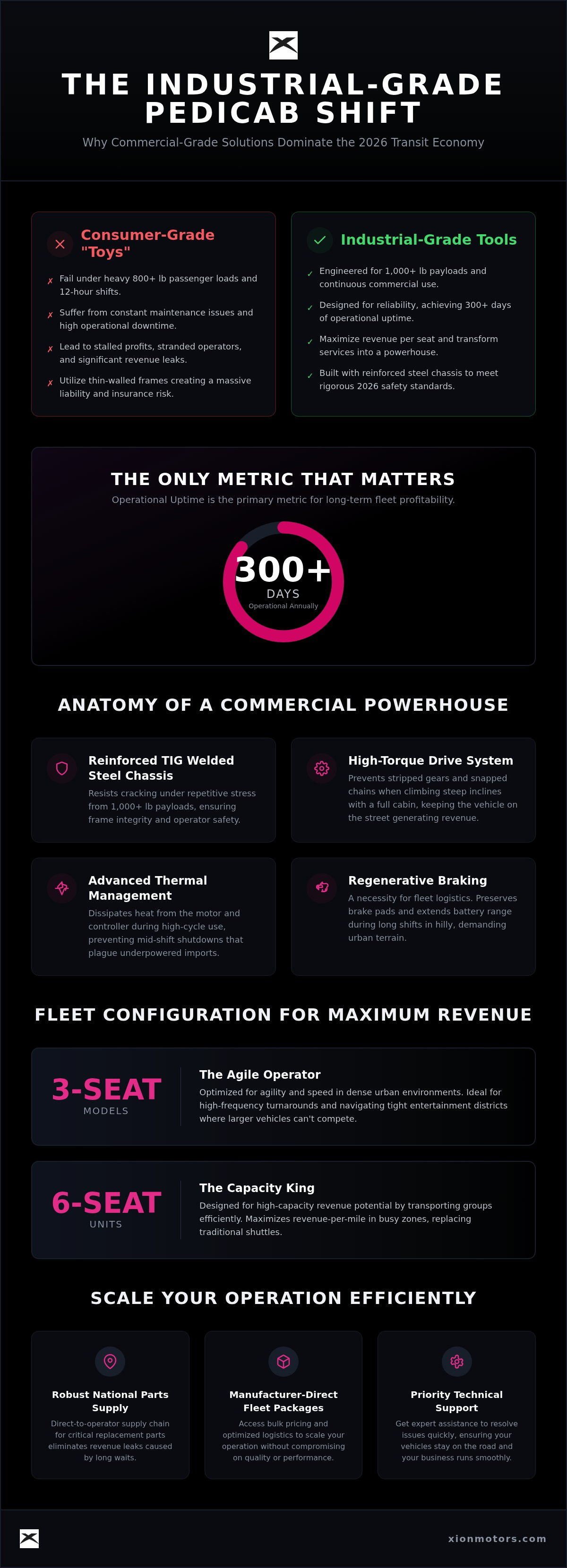
The rise of the last-mile economy has fundamentally changed how people move through city centers. Passengers no longer view a pedicab as a novelty ride; they see it as a functional solution for navigating entertainment districts and historic zones. This shift has forced an evolution in the operator's profile. We're no longer seeing just solo riders looking for a side hustle. The modern operator is a fleet director managing multi-state deployments. Success in this new landscape requires moving away from the "cheap import" trap. Low-cost consumer trikes aren't built for 12-hour shifts or 800-pound passenger loads. They break, they sit in the shop, and they bleed revenue through constant maintenance and downtime.
Market Demands for 2026 Urban Logistics
Modern passengers have high expectations for comfort and transit speed. If your vehicle can't keep pace with urban traffic or stalls under a full load, you're losing money. Electric-assist technology is now the industry standard because it allows for high-frequency turnarounds. If you're starting a pedicab company today, you must adopt an electric-first strategy. High-capacity electric shuttles are dominating entertainment districts because they move groups efficiently while maintaining the open-air appeal that riders crave. This isn't just about moving people; it's about maximizing the revenue-per-mile in congested zones where traditional cars can't compete.
Identifying Industrial-Grade Equipment
There's a massive gap between a standard e-bike and a professional-grade electric vehicle. It starts with the chassis. Industrial-grade commercial electric pedicab solutions utilize reinforced TIG welded steel frames because they have to withstand thousands of miles of heavy-duty use. Frame integrity isn't just about durability; it determines your liability profile. A compromised frame on a consumer-grade trike is a massive insurance risk that can sink a business. Transitioning from hobbyist tools to professional fleet assets means investing in high-torque drive systems and heavy-duty braking. These are the definitive tools for anyone serious about achieving 300 plus days of operational uptime per year.
Engineering the Industrial Standard: CyberX and VorteX
The CyberX engineering philosophy rejects the aesthetics of consumer-grade toys in favor of raw, unyielding durability. While competitors focus on flashy plastic fairings, we prioritize the structural integrity of reinforced TIG welded steel. This is the industrial baseline for any serious fleet. Aluminum frames and thin-walled tubing might save weight, but they crack under the repetitive stress of 1,000 pound payloads. Our commercial electric pedicab solutions are engineered to handle the equivalent of a small car's passenger load without compromising the chassis.
Moving that much weight requires more than just a motor. It requires advanced thermal management and regenerative braking. High-cycle environments generate immense heat in the controller and motor. We've perfected systems that dissipate this energy, preventing the mid-shift shutdowns that plague underpowered imports. Regenerative braking isn't just a feature; it's a necessity for preserving brake pads and extending battery range during long shifts in hilly terrain. If you're ready to secure hardware that actually lasts, you can explore our industrial-grade vehicle parts and chassis designs.
High-Torque Performance and Uptime
Industrial-grade uptime is defined as maintaining 300 or more days of operational service per year, serving as the primary metric for long-term fleet profitability. Achieving this requires high-torque drive systems that don't snap chains or strip gears when climbing steep inclines with a full cabin. We build our drivetrains to exceed the demands of the most aggressive urban topographies. This ensures your vehicles stay on the street where they generate revenue. Our engineering focus includes:
- High-torque motors calibrated for heavy-load startups
- Heavy-duty drive chains and reinforced sprockets
- Integrated thermal sensors to prevent motor burnout
- Modular electronics for rapid field repairs
Chassis and Structural Superiority
The VorteX trike represents the pinnacle of passenger safety through precision weight distribution. By lowering the center of gravity and widening the rear track, we've eliminated the tipping risks common in traditional narrow-frame designs. We use weather-resistant materials and industrial coatings to ensure these assets remain operational in all 50 states, regardless of salt air or winter humidity. This "Master Practitioner" approach comes from twenty years of field-testing hardware in actual fleet environments. Every weld and component choice is a direct result of lessons learned in the trenches of high-volume transit.
Revenue Optimization: 3-Seat vs. 6-Seat Fleet Configurations
Capacity is the primary engine of revenue in the transit industry. When evaluating commercial electric pedicab solutions, you must look beyond the initial purchase price and focus on passenger throughput. The 3-seat model ($13,500) is a surgical tool for high-traffic tourism districts where agility is paramount. It navigates dense foot traffic and narrow alleyways with a precision that larger vehicles cannot match. This model is the baseline for operators who prioritize high-frequency, short-duration rides in congested urban centers.
The 6-seat electric pedicab ($17,500) represents the industrial standard for dominating group transit and event logistics. It allows a single operator to move twice the passenger volume of a standard trike, effectively doubling the revenue potential of a single labor hour. Labor is your highest recurring cost; maximizing the revenue-per-seat of every active rider is the only way to protect your margins in a competitive market. A strategic fleet often utilizes a hybrid mix, deploying 3-seaters for street hails and 6-seaters for pre-booked group tours and corporate events.
The ROI of High-Capacity Seating
The math behind high-capacity models is undeniable. A $4,000 price gap between the 3-seat and 6-seat configurations buys a 100 percent increase in potential seat revenue. In high-volume entertainment districts, this extra capacity allows you to capture large family groups and wedding parties that would otherwise require two separate vehicles. These 6-seat models outcompete traditional golf carts because they offer the same capacity with superior maneuverability and lower operational overhead. Case study insights from major metropolitan fleets show that high-capacity units consistently report a higher revenue-per-mile than their smaller counterparts, especially during peak event windows.
Selecting the Right Tool for Your District
Environment dictates equipment. While resort boulevards and wide city avenues are ideal for the 6-seat powerhouse, specialized business needs might require the Custom VorteX Trike. This model is the definitive choice for operators who need a balance of custom branding and field-tested structural integrity. Navigating historic streets with tight turning radii requires the agility of our 3-seat chassis, while wide resort paths favor the stability of the VorteX. By analyzing your specific district's topography and passenger demographics, you can select the commercial electric pedicab solutions that maximize vehicle utility and minimize idle time.
Operational Logistics and Maintenance for National Fleets
Scaling a transit operation from three units to thirty requires a transition from reactive repairs to industrial logistics. High-performance commercial electric pedicab solutions are only as good as the infrastructure supporting them. Without a rigorous electric pedicab maintenance guide, you're essentially gambling with your uptime. Professional operators understand that revenue is won or lost in the shop. We've built our systems to ensure that preventative maintenance for motors, wheels, and braking systems is streamlined and predictable.
The "waiting on shipping" revenue leak is the silent killer of fleet profitability. When an international component fails, your vehicle sits idle for weeks while parts clear customs. We solve this through a direct-to-operator parts sourcing model. By maintaining a domestic supply chain, we provide the parts continuity required for 24/7 operations. This logistical precision ensures that your fleet remains active during peak seasons when every hour of downtime represents hundreds of dollars in lost fares.
National Support and Parts Continuity
Maintaining a national presence means providing reliable support across all 50 states. Domestic manufacturing isn't just a badge of pride; it's a strategic advantage for parts continuity. International sourcing is plagued by customs delays and inconsistent quality control that can paralyze a growing business. Immediate access to proprietary part availability is the hidden ROI of fleet management because it prevents the compounding costs of extended vehicle downtime. If you want to ensure your operations never skip a beat, you should invest in a reliable supply of industrial vehicle parts from a veteran manufacturer.
Maximizing Battery Cycle Life
Battery management systems (BMS) are the heartbeat of modern commercial electric pedicab solutions. In high-heat environments, thermal management becomes the difference between a three-year battery life and a one-year failure. We recommend utilizing swappable battery packs for operators running double shifts to ensure the motor never stops. High-density lithium-ion systems represent a higher upfront investment, but the long-term economics favor their superior cycle life and consistent power delivery under heavy loads. Implementing a disciplined charging infrastructure is essential for protecting these assets and maximizing your total return on investment.
Scaling Your Business with Xion Motors Fleet Packages
Transitioning from a local operator to a regional powerhouse requires more than just adding vehicles to your inventory; it demands a strategic alignment with a manufacturer that understands the nuances of scale. Our electric pedicab fleet packages provide the structural and financial foundation for this growth. By choosing commercial electric pedicab solutions directly from Xion Motors, you eliminate middleman markups and protect your margins. We offer extensive customization options for branding and specialized business trikes, ensuring your fleet serves as a high-visibility marketing asset. Every vehicle we ship carries the weight of a 20-year legacy of field-tested authority.
From Single Unit to Regional Dominance
We recommend a phased rollout strategy for operators entering new entertainment districts or resort zones. This methodical approach allows you to leverage our expertise to optimize your operational blueprint before full-scale deployment. You aren't just buying hardware; you're gaining access to two decades of experience in building resilient fleets that achieve 300 plus days of revenue generation annually. We've seen what works in the harshest urban environments and we build that knowledge into your scaling strategy. Regional dominance belongs to the operator with the most reliable equipment.
Securing Your 2026 Deployment
Timing is everything in the transit business. We manage national shipping logistics to all 50 states, ensuring your fleet arrives ready for immediate integration into your local market. Lead times for fleet orders are managed with precision to align with your peak season launches. If you're looking to disrupt the status quo in your city, financing the future of urban transit is a logical step toward long-term viability. Don't settle for consumer-grade compromises when you can deploy industrial-grade power. Partner with the industrial leader to secure your 2026 deployment and command your market with the most durable commercial electric pedicab solutions available today.
Command the 2026 Transit Market
Success in the modern last-mile economy isn't built on consumer-level hardware. It's forged through industrial-grade engineering and a commitment to operational uptime. You've seen how high-capacity 6-seat models can double your revenue potential while professional maintenance protocols protect your long-term margins. Transitioning to commercial electric pedicab solutions means moving past the limitations of hobbyist equipment. It's about securing a fleet that works as hard as you do. Build for the long haul.
We bring 20 plus years of operational experience to every vehicle we build. Our industrial-grade CyberX and VorteX models are designed for commercial dominance and backed by nationwide shipping to all 50 states. You don't have to navigate the complexities of fleet scaling alone. Take the decisive step toward regional leadership today. View Industrial-Grade Fleet Packages at Xion Motors. Your growth is our priority.
Frequently Asked Questions
How much does a commercial electric pedicab cost for fleet operations?
Pricing for industrial-grade vehicles depends on seating capacity and specific fleet requirements. While consumer-grade trikes are cheaper, they fail to deliver the 300 plus days of uptime required for professional profitability. Investing in a high-torque drive system and reinforced chassis ensures a lower total cost of ownership over the vehicle's lifespan. These fleet packages often include volume discounts that help you protect your margins while scaling your regional transit operation.
What is the difference between a 3-seat and 6-seat electric pedicab ROI?
A 6-seat model allows a single rider to double their passenger throughput, which significantly increases revenue per labor hour. This configuration is ideal for group tours and large event logistics where demand is high. The 3-seat model offers greater agility in narrow historic districts. Choosing the right commercial electric pedicab solutions depends on your specific district's traffic patterns and the passenger demographics you intend to serve.
Are electric pedicabs street legal across the United States?
Legal requirements for electric-assist vehicles vary by state and municipality. Most jurisdictions classify these vehicles under e-bike regulations if they meet specific power and speed limits. However, certain major metropolitan areas and specific jurisdictions have unique licensing systems and construction requirements. You should always verify local ordinances regarding unibody construction and UL battery certifications before deploying your fleet in a new market to ensure full regulatory compliance.
What is the expected lifespan of an industrial-grade electric pedicab?
An industrial-grade chassis built with reinforced TIG welded steel can last for a decade or more under professional management. While components like batteries and tires require periodic replacement, the structural integrity of the frame is designed for long-term service. Regular preventative maintenance is the key to extending the life of your assets. Our master practitioner engineering ensures these vehicles withstand the rigors of heavy-duty daily commercial use.
How many hours of operation can I expect on a single charge?
Expected run time depends on passenger load, terrain, and battery capacity. Most professional operators achieve a full shift of six to eight hours on a single charge when using high-density lithium-ion systems. For 24/7 operations, we recommend investing in swappable battery packs. This allows you to keep the vehicle on the street while spare batteries charge at your base of operations, eliminating downtime during peak hours.
Do you ship electric pedicabs to all 50 states?
Yes, we provide nationwide shipping to all 50 states from our domestic manufacturing facility. Our logistics team handles the complexities of transporting large-scale fleet orders to ensure they arrive ready for immediate deployment. This domestic supply chain also ensures you have rapid access to replacement parts. By skipping international shipping delays, you minimize the risk of revenue loss due to extended vehicle downtime and customs holdups.
What maintenance is required for a commercial pedicab fleet?
Professional maintenance focuses on daily inspections of braking systems, tire pressure, and drive chain tension. You must also monitor battery health through an integrated management system to maximize cycle life. Following a structured maintenance guide ensures that your commercial electric pedicab solutions maintain peak performance. Preventative care prevents minor wear from turning into catastrophic failures that pull your vehicles off the street during high-revenue windows.
Can I customize the pedicabs with my business branding?
Customization is a core feature of our fleet packages. We offer options for custom powder coating, specialized upholstery, and integrated branding panels that turn your vehicles into mobile billboards. This allows you to generate secondary revenue through out-of-home advertising partnerships. Every trike can be tailored to match your brand identity while maintaining the rugged durability required for heavy-duty commercial transit in demanding urban environments.