The era of the hobbyist pedicab operator is dead. As urban centers increasingly restrict passenger vehicles, your fleet represents a high-performance micro-transit enterprise that requires industrial-grade protection. Securing commercial pedicab insurance in 2026 is no longer about finding the cheapest rate. It's about establishing a risk management framework that respects the power of high-torque 72V drivetrains and the significant value of assets like the CyberX or VorteX. You're building a legacy, and that legacy requires a foundation of professional-grade compliance.
You already know that insurers often view urban transportation with unearned suspicion. The fear that a single accident could bankrupt your growing fleet is a legitimate concern for any serious entrepreneur. This guide provides the definitive blueprint to navigate complex liability requirements and asset protection. We'll examine the specific coverage needed to satisfy 2026 municipal regulations, including evolving e-bike mandates, while showing you how to turn safety certifications into a competitive advantage. It's time to move from surviving to scaling with a fleet that's engineered for over 300 days of annual operation.
Key Takeaways
- Standard general liability often excludes for-hire passenger transport, making specialized commercial pedicab insurance the only viable path for comprehensive fleet protection.
- A professional-grade policy must combine Comprehensive General Liability with physical damage coverage to safeguard high-value assets like the CyberX or VorteX.
- Insurers evaluate risk based on vehicle capacity and motor torque, meaning 6-seat configurations require specific underwriting to manage higher liability exposure.
- Expedite the application process by maintaining rigorous operator logs and leveraging industrial safety certifications to access specialized Excess and Surplus insurance lines.
- Investing in vehicles with reinforced steel chassis and industrial-grade braking systems directly improves your fleet’s insurability and long-term operational viability.
The Critical Role of Commercial Pedicab Insurance in 2026
Operating a fleet of electric trikes in a modern urban environment is an exercise in precision engineering and calculated risk. You aren't just managing a few bikes; you're commanding a high-torque transit operation. Specialized commercial pedicab insurance functions as a comprehensive liability and asset protection package designed specifically for this industrial reality. It's the difference between a scalable enterprise and a vulnerable hobby. This coverage doesn't just check a box for city hall. It secures the massive capital you've invested in high-performance vehicles like the CyberX or VorteX against the unpredictable variables of the street.
The year 2026 marks a definitive shift in how insurers view micro-transit. Regulators have moved past the era of "pedal power" and now classify high-output electric fleets as motorized transport. For instance, new pedicab regulations in the United States increasingly mirror those of the automotive sector. In New Jersey, as of January 19, 2026, all e-bikes are classified as motorized bicycles, requiring specific registration and liability minimums. This regulatory tightening means your "insurable interest" goes beyond simple theft; it covers the operational life of a fleet designed to generate up to $35,000 in annual revenue per unit.
Why General Liability Isn’t Enough
Standard business policies are built for stationary risks. They often classify trikes as "mobile equipment," a category that typically excludes coverage the moment a vehicle enters a public roadway for "for-hire" passenger transport. If you rely on a basic policy, you're likely operating in a coverage vacuum. Professional-grade operations require specific "on-hook" or "in-transit" endorsements to cover passengers during the ride. Without these, a standard insurer will deny claims involving passenger injury or third-party property damage. To build a legitimate business, you need to follow a professional blueprint for starting a pedicab company that prioritizes specialized underwriting from day one.
The Consequences of Under-Insurance
Operating without municipal-compliant coverage is a fast track to permanent de-licensing. Beyond legal fines, the financial impact of a single liability claim can be catastrophic for a growing fleet's credit profile. If a claim exceeds your limits, your personal and business assets are on the line, and future premiums will skyrocket to unsustainable levels. In this industry, operational continuity is defined as the ability to survive a maximum-limit claim without halting your daily deployments. Don't let a lack of commercial pedicab insurance turn a minor street incident into a business-ending event. Professional operators understand that robust coverage is an investment in their fleet's longevity, not an overhead burden to be minimized.
Core Coverage Components for Electric Fleets
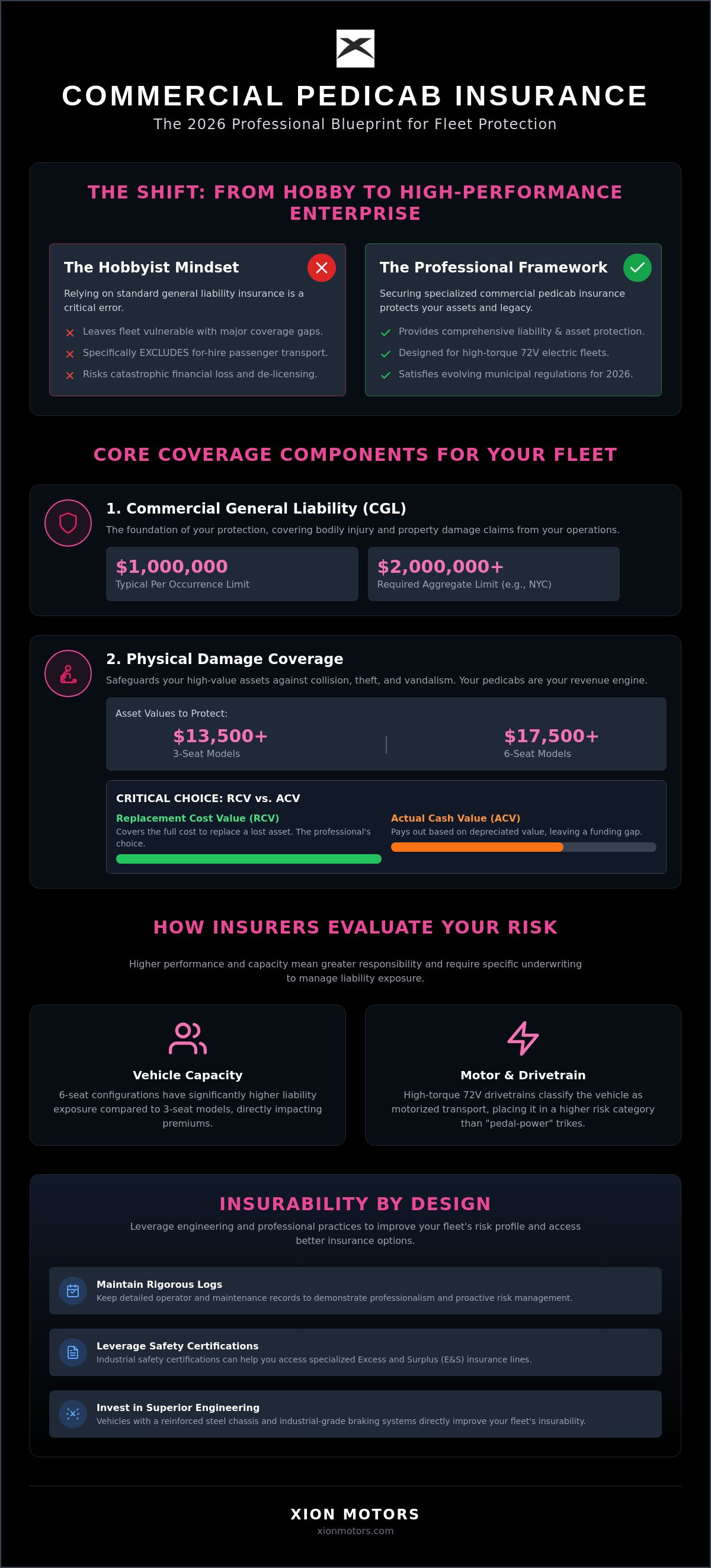
Securing a professional-grade fleet requires a multi-layered approach to risk. You aren't just buying a policy; you're constructing a shield for your capital. The foundation of any commercial pedicab insurance strategy is Commercial General Liability (CGL). This covers bodily injury and property damage claims arising from your daily operations. In high-traffic markets, the baseline is usually a $1,000,000 per occurrence limit with a $2,000,000 aggregate. For instance, reviewing the NYC pedicab insurance requirements reveals that the city mandates a minimum $2,000,000 combined single limit. If you operate in a major tourism hub, these aren't just suggestions. They're the barrier to entry.
Beyond liability, you must protect the physical assets that drive your revenue. A single 3-seat electric pedicab represents a $13,500 investment, while 6-seat models start at $17,500. Physical Damage Coverage safeguards these units against collision, theft, and vandalism. For specialized builds like the CyberX, you should insist on Replacement Cost Value (RCV) rather than Actual Cash Value (ACV). ACV accounts for depreciation, which can leave you short when trying to replace a custom, high-performance trike after a total loss. Inland Marine insurance provides an additional layer, protecting your vehicles while they're being transported to events or stored during the off-season.
Liability Limits and Industry Standards
Modern fleets face higher scrutiny than traditional rickshaws. Aggregate limits are crucial because they represent the total amount the insurer will pay during the policy term. If you have five vehicles on the road, a single $1,000,000 occurrence limit can be exhausted by one major incident. High-capacity 6-seat configurations often trigger "per-seat" liability requirements. Underwriters look at the potential for multiple injuries in a single event. To maintain these high standards and ensure your fleet remains insurable, follow our electric pedicab maintenance guide to keep your braking and steering systems in peak condition.
Asset Protection for High-Value Trikes
Insuring the CyberX or VorteX requires a partner who understands industrial engineering. These aren't consumer e-bikes. They're heavy-duty transit vehicles with 72V systems and reinforced chassis. When you invest in a professional fleet package, you're buying more than just steel and motors; you're buying an asset that generates up to $35,000 in annual revenue. Protecting that revenue stream means ensuring your insurance covers the full utility of the vehicle. Don't settle for "good enough" coverage that treats your industrial equipment like a toy. Demand a policy that reflects the rugged reality of your daily operations.
Evaluating Risk: How Capacity and Speed Affect Premiums
Risk assessment in the micro-transit sector is a granular process. Underwriters aren't just looking at the number of units in your fleet; they're analyzing the kinetic energy and liability potential your operation generates. A standard 3-seat electric pedicab operates within a specific risk envelope that most specialty insurers understand. However, when you move to a 6-seat high-capacity model, the underwriting complexity shifts. More seats mean a higher potential for multiple-party injury claims in a single incident, which necessitates more robust commercial pedicab insurance limits to protect your balance sheet.
The environment where you deploy your fleet also dictates your premium costs. Operating in a quiet historic district presents a vastly different risk profile than navigating a high-traffic entertainment zone saturated with passenger vehicles and distracted pedestrians. Insurers weigh the frequency of potential "interactions" heavily. To mitigate these costs, professional fleet owners implement rigorous operator training programs. An industrial fleet is only as safe as the individuals commanding the high-torque drivetrains, and proving a track record of defensive driving can significantly lower your annual overhead.
Passenger Volume and Underwriting
The math of insurance is unforgiving: increased passenger volume equals increased liability exposure. High-capacity vehicles carry a significantly higher Gross Vehicle Weight Rating (GVWR), which directly impacts braking distances and chassis stress under load. Because 6-seat models can carry double the passenger load of a standard trike, insurers often require higher aggregate limits to account for the potential of multiple injuries during a single intersection event. High-capacity vehicles dictate a more robust risk management strategy that includes enhanced safety protocols and frequent mechanical audits. Underwriters view a fully loaded 6-seat trike as a small bus rather than a bicycle, and your coverage must reflect that reality.
Electric Drivetrain Considerations
The "torque factor" is a primary concern for modern underwriters. High-performance 72V systems deliver immediate power that can catch untrained operators off guard in crowded urban corridors. Insurers prioritize vehicles that demonstrate superior thermal management and battery safety to avoid the risk of fire in storage facilities. Adhering to standards like UL 2271 for batteries and UL 2849 for the entire electrical system is now a prerequisite for securing competitive commercial pedicab insurance rates. These certifications provide a verifiable engineering baseline that allows insurers to quantify the safety of your equipment. Utilizing street-legal, certified drivetrains simplifies the application process, moving your fleet out of the "experimental" category and into the realm of professional-grade transit.
Navigating the Application Process and Compliance
Professional underwriters don't gamble; they calculate. To secure favorable commercial pedicab insurance rates, you must present a data-backed case that your operation is an industrial enterprise rather than a casual venture. This begins with an exhaustive documentation package. You'll need unique VIN numbers for every unit, verified UL 2271 and UL 2849 safety certifications, and digitized operator logs. These logs prove you're monitoring usage and adhering to strict safety protocols. Providing this level of transparency moves your application to the top of the pile.
Specialty transit often falls outside the appetite of standard "admitted" carriers. You'll likely work with "Excess and Surplus" (E&S) lines. These insurers specialize in high-risk or non-standard markets and have a deeper understanding of high-torque electric drivetrains. Presenting your fleet as a low-risk operation requires showing that your equipment is engineered for the rigors of the street, not just assembled from consumer-grade components. When an underwriter sees a fleet of purpose-built vehicles, their confidence in your risk management increases significantly.
The Underwriter’s Checklist
A clean, documented maintenance history is your most powerful tool for negotiating lower premiums. Underwriters look for evidence that you aren't just reacting to failures but are actively preventing them. This is where "Direct-to-Operator" support becomes critical. Having a direct line for vehicle parts and repairs ensures that your fleet remains in peak mechanical condition without long periods of downtime or makeshift fixes. When you understand how to leverage these operational efficiencies, you can effectively begin scaling commercial transit ROI by reducing the long-term cost of risk.
National Compliance Strategies
Navigating insurance requirements across all 50 states requires a dual-track strategy. You must satisfy local municipal mandates, which often focus on specific liability limits, while adhering to federal safety standards that influence national coverage availability. For example, California’s 2026 requirement for UL 2849 certification sets a high bar that many national insurers now use as a baseline for coverage in all states. Adhering to the strictest regional standard often simplifies your national expansion.
Professionalism is also visual. Industrial-grade aesthetics aren't just for branding; they project a sense of professional reliability to both the public and your insurance carrier. A fleet that looks like a coordinated transit service rather than a collection of mismatched bikes signals a higher level of management oversight. If you're ready to upgrade your operation to a professional standard, explore our high-performance pedicab fleet packages to secure the equipment that insurers trust.
Insurability by Design: The Xion Motors Engineering Standard
Superior engineering is your most effective tool for lowering the long-term cost of commercial pedicab insurance. When an underwriter reviews a fleet, they aren't just looking at the operator; they're inspecting the machine. Our reinforced steel chassis significantly reduces the risk of structural failure under the heavy loads typical of high-capacity transit. While others use light-duty bicycle frames, we build with industrial-grade materials designed to withstand over 300 commercial operating days per year. This durability isn't just about longevity. It's about minimizing the mechanical failures that lead to liability claims and costly downtime.
Braking systems represent the most critical safety component for any electric fleet. Our vehicles utilize industrial-grade stopping power specifically calibrated for the Gross Vehicle Weight Rating of a fully loaded 6-seat unit. High-torque 72V systems require precision thermal management to prevent battery-related incidents. By meeting UL 2271 and UL 2849 standards, we provide the documented safety proof that insurance carriers demand. This engineering rigor ensures that your assets aren't just street-legal; they're built to exceed the highest safety thresholds in the industry, making your business a preferred risk for specialty insurers.
Engineering for Safety and Longevity
The CyberX engineering standard sets the benchmark for insurer confidence in 2026. It integrates high-performance components that directly reduce the frequency of maintenance-related accidents. For operators in resort and tourism districts, the VorteX Trike offers a similar level of rugged reliability. These vehicles are engineered to handle constant stop-and-go cycles in dense urban environments without compromising chassis integrity. High-performance components require a higher initial investment, but they pay for themselves by securing lower premiums and maintaining a higher resale value over time.
Partnering for Fleet Success
We don't just sell vehicles; we provide the operational depth needed to secure your business. Xion Motors offers over 20 years of operational data from our affiliated fleets to support your insurance applications. This legacy of performance proves to underwriters that our vehicles are a known, manageable risk with a proven track record of safety. Our national shipping network ensures that you have immediate access to vehicle parts, keeping your fleet on the road and your revenue flowing. When you calculate the total cost of ownership, including the cost of commercial pedicab insurance, the advantage of industrial engineering becomes undeniable. Secure your fleet with Xion Motors high-performance electric pedicabs today.
Secure Your Operational Legacy
The landscape of urban transit is shifting toward heavier regulation and higher engineering benchmarks. Managing commercial pedicab insurance is no longer just a hurdle; it's a competitive filter that separates professional fleets from the amateurs. You've learned that insurability is built directly into the frame and the drivetrain. By prioritizing industrial-grade steel chassis and high-torque motor systems, you demonstrate to underwriters that your risk is calculated, controlled, and professional.
We back your growth with over 20 years of pedicab fleet operational experience. Our national shipping and parts support across all 50 states ensures that your units remain active and your coverage remains valid through documented, consistent maintenance. Don't leave your capital unprotected in an evolving market. The opportunity for urban micro-transit is expanding, and the right equipment is your primary defense against liability. Explore Our Industrial-Grade Fleet Packages to build a foundation that lasts. Claim your territory with the confidence of a master practitioner.
Frequently Asked Questions
How much does commercial pedicab insurance typically cost per year?
Industry averages for $1 million in general liability coverage typically range between $450 and $1,000 per year as of 2026. These figures reflect the baseline for standard operations; however, your actual premium depends on location, claims history, and fleet size. High-capacity operations or those in high-traffic urban zones may see adjusted rates. Securing commercial pedicab insurance at these rates requires proving your fleet meets modern safety standards and professional operational protocols.
Do I need a special license to insure a 6-seat electric pedicab?
Licensing requirements depend entirely on your local municipal regulations and the specific classification of your vehicle. In New Jersey, for example, all e-bikes were reclassified as motorized bicycles in 2026, requiring riders to hold a valid license. Most insurers for 6-seat models will mandate that operators meet these local standards before extending coverage. Always verify your specific city’s "for-hire" permit requirements to ensure your policy remains valid during a claim.
Can I get insurance for my pedicab fleet in all 50 states?
You can secure coverage for your fleet in all 50 states by working with specialized Excess and Surplus insurance lines. While standard carriers often shy away from urban transit, specialty insurers have the appetite for professional-grade electric fleets. Success across different regions requires meeting the highest common denominator of safety, such as California’s mandatory UL 2849 certification. National shipping and parts support further reassure insurers that your fleet is manageable regardless of geography.
Does insurance cover the electric battery and motor systems?
Yes, physical damage coverage is designed to protect your high-value assets, including the 72V battery and high-torque motor systems. This coverage safeguards against theft, vandalism, and collision damage that could otherwise sideline a $17,500 vehicle. To ensure full protection, you should opt for Replacement Cost Value rather than Actual Cash Value. This ensures you can replace specialized components without losing thousands to depreciation during the claims process after an incident.
What is the difference between general liability and commercial auto for pedicabs?
General liability covers your business against third-party bodily injury and property damage, while commercial auto is traditionally reserved for registered motorized vehicles. Because many states are reclassifying electric trikes as motorized transport, the line is blurring. Most operators still utilize a specialized commercial pedicab insurance policy that combines liability with "in-transit" endorsements. This hybrid approach addresses the unique risks of passenger transport that standard auto or general business policies often exclude.
Will my insurance premiums go down if I use industrial-grade vehicles like the CyberX?
Insurers frequently offer more competitive rates for fleets that utilize industrial-grade vehicles like the CyberX. Professional equipment with UL 2271 and UL 2849 certifications provides a verifiable safety baseline that reduces the underwriter’s perceived risk. Reinforced steel chassis and industrial braking systems decrease the frequency of mechanical failures. When you present a fleet engineered for 300 days of annual operation, you move from a high-risk category to a managed-risk professional enterprise.
Is passenger medical payment coverage included in standard policies?
Passenger medical payment coverage is often available as a specific endorsement within a comprehensive liability policy. This coverage handles immediate medical expenses for riders regardless of who is at fault for an incident. It acts as a first line of defense that can prevent minor injuries from escalating into major lawsuits. Professional operators include this to protect their passengers and their brand reputation in crowded entertainment districts where minor accidents are more frequent.
How does the passenger capacity of a trike affect my liability limits?
Increased passenger capacity directly raises your liability exposure and necessitates higher aggregate limits. A 6-seat trike has double the potential for injury claims in a single collision compared to a 3-seat model. Underwriters typically require a $2,000,000 aggregate limit for high-capacity fleets to ensure the business can survive a multi-passenger claim. Managing this higher risk requires a robust management strategy that includes strict operator training and frequent mechanical inspections of the braking systems.
Thinking about starting or scaling a pedicab operation?
See what a pedicab costs ($13,500–$15,000 direct from the manufacturer), explore fleet pricing on 3+ units, or start with $0-down equipment financing. Xion operators earn $30,000–$35,000 per cab per year across 59+ US markets.