Traditional shuttle infrastructure is a sunk cost that stalls in gridlock, yet modern districts require an agile, high-visibility solution to keep revenue moving. You've likely seen the struggle first-hand: historic streets choked by vehicle congestion and visitors who bypass local shops because the "last-mile" walk is simply too far. It's a persistent friction point that limits the economic velocity of even the most popular destinations. When transit fails, the local economy pays the price in lost foot traffic and diminished visitor satisfaction.
This guide demonstrates exactly how pedicabs boost local tourism by transforming urban transit into a high-performance, revenue-generating asset. You'll discover how industrial-grade electric vehicles like the CyberX and VorteX eliminate accessibility barriers while serving as mobile billboards for your district. We will analyze the shift toward high-torque electric fleets, the measurable impact of improved visitor flow on local spend, and why these rugged, commercial-grade machines are the essential economic engine for the 2026 tourism landscape. It's time to move beyond stagnant transit models and embrace a solution built for speed, durability, and real-world results.
Key Takeaways
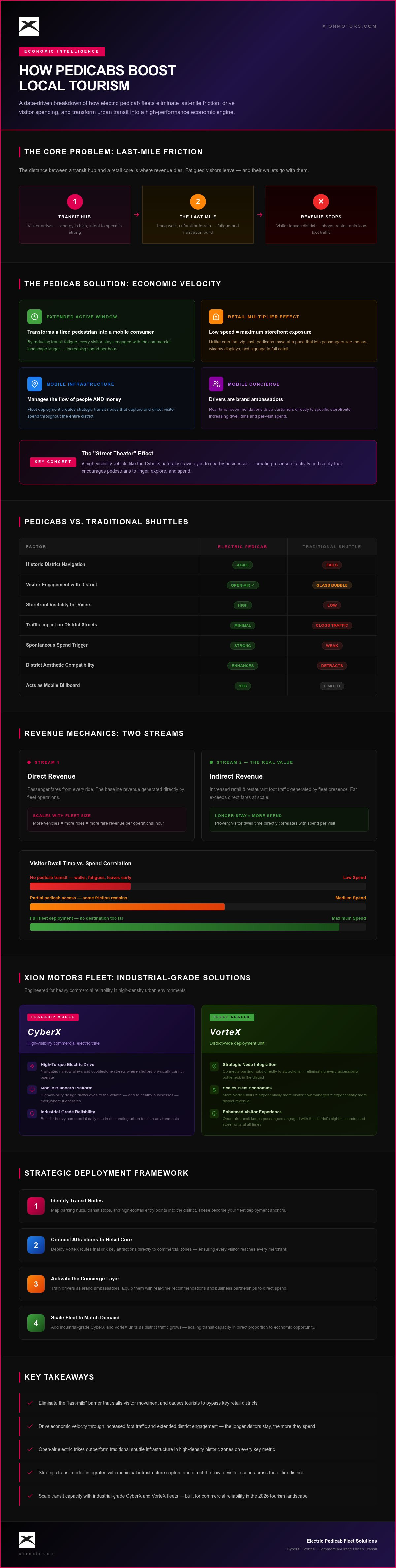
- Eliminate the "last-mile" barrier that stalls visitor movement and causes tourists to bypass key retail districts.
- Discover how pedicabs boost local tourism by driving economic velocity through increased foot traffic and extended district engagement.
- Evaluate the operational superiority of open-air electric trikes over traditional shuttle infrastructure in high-density historic zones.
- Deploy strategic transit nodes that integrate with municipal infrastructure to capture and direct the flow of visitor spend.
- Scale your district’s transit capacity with industrial-grade CyberX and VorteX fleets engineered for heavy commercial reliability.
Solving the Last-Mile Friction in Modern Tourism Districts
Tourism districts suffer when visitor mobility hits a wall. The distance between a transit hub and a retail core is the "last mile," and it's where revenue often dies. If a tourist feels fatigued or frustrated by navigation, they leave. This is exactly how pedicabs boost local tourism: they eliminate the physical and psychological friction that prevents visitors from reaching every corner of your district. By providing a reliable, high-torque transit option, you ensure that every merchant in the zone remains accessible.
The Barrier of Traditional Transit
Traditional vehicles like buses and shuttles create a "transit bubble." Passengers are insulated from their surroundings, staring through glass at storefronts they'll never enter. Walking long distances in unfamiliar territory creates a different kind of friction, often leading to visitor burnout. A modern cycle rickshaw or electric pedicab provides the definitive middle ground. It offers the speed of a vehicle with the high-visibility engagement of a pedestrian. It keeps the visitor in the environment, not just passing through it. This open-air experience encourages spontaneous spending because the passenger remains connected to the sights and sounds of the district.
Enhancing District Accessibility
Historic districts and pedestrian-heavy zones weren't designed for 40-foot shuttles. Narrow alleys and cobblestone streets require agile, industrial-grade solutions. Xion Motors builds the CyberX and VorteX to navigate these tight urban nodes where traditional transit fails. By connecting parking hubs directly to attractions, these vehicles ensure that accessibility isn't a bottleneck for growth. They provide a high-performance alternative to intrusive shuttle buses that often clog traffic and detract from the district's aesthetic appeal.
We are seeing a strategic shift from novelty rides to essential transit infrastructure. Municipalities and private operators are realizing that a fleet of high-torque electric trikes isn't just a fun addition; it's a tactical asset. When you deploy a fleet of VorteX units, you aren't just giving rides. You're managing the flow of people and money through your district. Understanding how pedicabs boost local tourism requires looking at them as mobile infrastructure that increases the economic velocity of the entire area. It's about precision management of the visitor experience, ensuring that no destination is "too far" for a customer to reach.
The Economic Benefits of Pedicabs for Cities and Local Business
Pedicab economic impact is the measurable increase in visitor spend per hour due to reduced transit fatigue. When tourists stop walking because of physical exhaustion, their spending stops with them. By deploying a fleet of industrial-grade electric trikes, a district effectively extends the active window of every visitor. This is precisely how pedicabs boost local tourism: they transform a tired pedestrian into a mobile consumer who remains engaged with the commercial landscape. Academic research into The Rise of the Pedicab confirms that these vehicles are no longer just seasonal novelties but are integrated components of a city's financial engine.
Economic velocity depends on movement. Direct revenue from passenger fares is only the baseline for a successful operation. The real value lies in indirect revenue generated by increased foot traffic for retailers and restaurants. We call this the "Street Theater" effect. A high-visibility vehicle like the CyberX naturally draws eyes toward the businesses it passes. It creates a sense of activity and safety that encourages other pedestrians to linger. This atmosphere of movement is a powerful psychological trigger for consumer engagement.
Boosting Retail and Restaurant Foot Traffic
Low-speed transit is a retail multiplier. Unlike a car that zips past a storefront, a pedicab moves at a pace that allows passengers to actually see menus, window displays, and signage. Drivers act as mobile concierges and brand ambassadors. They provide real-time recommendations that drive customers directly to specific storefronts. This interaction increases the dwell time of visitors in commercial zones. The longer a visitor stays in the district, the more they spend. It is a simple, proven correlation that scales with the size of your fleet.
Job Creation and Entrepreneurial Growth
Scaling a tourism district requires a workforce that is both mobile and knowledgeable. Launching a fleet provides immediate entrepreneurial opportunities with a lower barrier to entry than traditional transit franchises. For those interested in the operational side, starting a pedicab company is a viable path to local leadership. The ripple effect extends to maintenance, logistics, and fleet management. Xion Motors supports this growth by offering specialized fleet packages designed for commercial longevity. Our VorteX and CyberX models are engineered to withstand the rigors of daily tourism operations, ensuring your investment remains on the street and generating revenue. This industrial reliability is the foundation of a sustainable, profitable tourism ecosystem.
Pedicabs vs. Traditional Shuttles: Why Low-Speed Transit Wins
Traditional gas-powered shuttles are often a logistical anchor in high-density districts. They require massive turning radii, dedicated staging areas, and significant fuel overhead. In contrast, industrial-grade electric pedicabs occupy a minimal operational footprint. They move through congested streets where a shuttle would be trapped in gridlock. This agility is a primary reason how pedicabs boost local tourism: they provide a high-frequency service that keeps visitors moving without adding to the district's traffic burden.
Recent industry discussions highlight the need for professionalized fleets that can integrate seamlessly with urban infrastructure. Unlike heavy buses, a pedicab doesn't need specialized charging hubs or dedicated lanes to be effective. It utilizes existing streetscapes, turning every alley and narrow lane into a potential revenue artery. The visibility factor is another critical advantage. Passengers prefer open-air views that allow them to experience the district's architecture and atmosphere, rather than being sealed behind tinted glass.
Operational Efficiency and Agility
Maneuverability is non-negotiable for 2026 operations. A VorteX trike can execute a turn in spaces where an automotive shuttle would require a multi-point maneuver. This speed of response directly impacts your bottom line. Operators can choose between agile 3-seat configurations or a 6 seat electric pedicab to match specific district demand. Maintenance is equally streamlined. You're managing high-performance bike components rather than complex automotive transmissions, which translates to higher uptime and lower overhead.
Environmental and Noise Impact
The acoustic footprint of a transit solution matters in historic or luxury districts. Electric motors provide a near-silent operation that preserves the ambiance of the area. This isn't just about 'being green'; it's about branding. A zero-emissions fleet positions your district as a forward-thinking, premium destination. Additionally, these vehicles don't contribute to the 'heat island' effect caused by idling internal combustion engines. You're creating a more comfortable micro-climate for visitors, which encourages them to stay longer and explore further. Understanding how pedicabs boost local tourism means recognizing that the environment they operate in is as important as the service they provide.
Strategic Deployment: Maximizing Visitor Engagement and Spend
Strategic deployment is the difference between a novelty attraction and a high-performance transit backbone. You must map the "flow" of your district to identify the specific nodes where visitor momentum stalls. By establishing "Transit Circuits" that link hotels, dining clusters, and historic landmarks, you create a closed loop of economic activity. This is fundamentally how pedicabs boost local tourism: they bridge the gaps that traditional infrastructure ignores. When you eliminate the walk-time friction between attractions, you keep the visitor's wallet open for longer periods.
Integration with municipal transit apps and digital maps is the next step in professionalizing your operation. When a visitor sees a pedicab as a legitimate transit option on their smartphone, the vehicle's utility increases exponentially. Each trike also serves as a mobile marketing asset. High-visibility fleet branding allows you to synchronize your vehicles with district-wide campaigns. This turns every street corner into a high-impact touchpoint for your brand, reinforcing the district's identity through constant, moving presence.
Designing the Visitor Journey
"Dead zones" are the silent killers of district revenue. These are the stretches between attractions where visitors often decide to turn back or call a ride-share to leave the area entirely. Pedicabs provide the necessary connectivity to push visitors through these zones and into new retail clusters. You should deploy your fleet for more than just point-to-point transit. Use them for specialized architectural, history, or nightlife tours that add value to the visitor experience. Co-branding opportunities with local landmarks allow you to offset operational costs while deepening the district’s commercial integration.
Leveraging Fleet Data for Planning
Precision management requires actionable data. Tracking high-demand times and pickup locations allows you to optimize vehicle deployment and ensure maximum uptime during peak spend windows. This intelligence doesn't just benefit the operator; it provides municipal planners with a real-time heat map of visitor movement. This data identifies underperforming areas that need better connectivity or marketing support. To execute this at scale, you need equipment like the VorteX or CyberX that can handle constant commercial use. Explore our electric pedicab fleet packages to see how industrial-grade engineering supports long-term ROI. Success in the 2026 tourism market requires a partner who understands the rigors of the street. Browse our commercial fleet solutions to start scaling your district's transit today.
Scaling Tourism Infrastructure with Xion Motors Electric Fleets
Scaling a tourism district requires more than just a handful of vehicles; it demands an industrial-grade infrastructure that can withstand the rigors of high-volume commercial use. In the 2026 market, the novelty phase of micro-mobility has passed. Operators now require hardware that delivers consistent results under heavy loads. This is the core of how pedicabs boost local tourism effectively. By providing a reliable, high-torque transit solution, you ensure that your investment stays on the street rather than in the shop. Xion's affiliated San Diego fleet, VIP Pedicab, runs 130+ city-permitted pedicabs as part of a 1,000+ pedicab national network (20+ years), perfecting the tools necessary for this specific environment.
The CyberX and VorteX lines represent the pinnacle of this evolution. These aren't just larger bicycles. They are heavy-duty commercial machines designed for all-day passenger hauling in high-traffic zones. Transitioning from a small pilot program to a comprehensive transit fleet requires a partner who understands the engineering behind the operation. Our frames are made in the USA, every vehicle is engineered and assembled in San Diego, and we provide the parts support needed to maintain a dominant market position. Our experience ensures that your transition to a full-scale fleet is grounded in proven operational data.
Industrial-Grade Reliability
Frame durability is the primary failure point for under-engineered vehicles. Consumer-grade trikes lack the structural integrity to handle the constant stress of multi-passenger loads and urban road conditions. Our vehicles utilize high-torque electric systems specifically tuned for commercial reliability. This power is essential for navigating inclines and maintaining pace with urban traffic flow. To understand the specifics of our builds, review the CyberX engineering standards. This level of precision is why our vehicles are the industrial standard for modern tourism districts.
Direct-to-Operator Support
Success in fleet deployment hinges on operational uptime. We offer specialized fleet pricing strategies that allow municipal and private operators to scale their infrastructure efficiently. Our support doesn't end at the point of sale. We provide comprehensive maintenance protocols designed to ensure 99% uptime during your busiest peak seasons. Consistency is what builds trust with visitors and city planners alike. You can find detailed procedures in our electric pedicab maintenance guide. This proactive approach to fleet management is how pedicabs boost local tourism while maintaining a healthy bottom line for the operator. Scaling your infrastructure starts with choosing equipment built for the long haul.
Dominating the 2026 Tourism Landscape with Industrial Transit
The shift from seasonal novelty to essential urban infrastructure is already underway. Districts that prioritize agile, high-visibility transit systems capture more visitor spend and eliminate the friction that kills retail momentum. We've analyzed exactly how pedicabs boost local tourism by connecting disparate nodes and extending the time visitors spend engaging with local businesses. It's about precision management of the streetscape using tools specifically engineered for the job.
Xion Motors provides the industrial standard for this transition. Backed by an affiliated fleet network with 20+ years of operation, and with CyberX and VorteX models built on USA-made frames and engineered and assembled in San Diego, we deliver the durability that commercial districts demand. Our national shipping and parts support ensure your fleet remains a reliable revenue driver season after season. It's time to move beyond outdated shuttle models and solve the problem of pedestrian fatigue with a high-performance solution.
View our industrial-grade electric pedicab fleet packages and take command of your local transit economy today. Your district's potential is waiting to be unlocked.
Frequently Asked Questions
How do pedicabs impact city traffic and congestion?
Pedicabs reduce urban congestion by removing bulky, gas-powered vehicles from narrow historic streets. Their small footprint allows for fluid movement through traffic that would trap a traditional shuttle. This increased efficiency is a core part of how pedicabs boost local tourism; they keep visitors moving instead of idling in gridlock. By utilizing existing bike lanes and side streets, a fleet optimizes the available pavement without requiring expensive infrastructure overhauls or new lane construction.
Are electric pedicabs street legal in most tourism districts?
Most tourism districts classify electric pedicabs as low-speed electric vehicles or bicycles, making them street-legal on most city roads. We recommend that operators review specific municipal ordinances regarding weight limits and motor wattage. Xion Motors designs the CyberX and VorteX lines to meet rigorous commercial standards, ensuring they integrate seamlessly into established transit frameworks. Our team provides the technical documentation needed to assist fleet owners in navigating the local permitting and licensing process effectively.
What is the typical ROI for a commercial electric pedicab fleet?
Commercial ROI is achieved through a combination of high-frequency passenger fares and high-visibility mobile advertising revenue. Because industrial-grade machines like the CyberX are built for 24/7 durability, they stay on the road longer than consumer-grade alternatives. This maximized uptime is how pedicabs boost local tourism while securing the operator's bottom line. Each cab has $30,000–$35,000 revenue potential per year (top operators generate more; results vary by market), and payback is typically under 12 months through consistent daily operations and strategic partnerships with local hospitality brands.
How much maintenance do industrial-grade electric trikes require?
Industrial-grade electric trikes require significantly less maintenance than automotive-grade shuttles, though regular inspections are mandatory for commercial safety. Focus your efforts on the high-torque motor system, hydraulic braking components, and tire pressure to ensure peak performance. Xion Motors supports long-term operations by providing a comprehensive, USA-stocked inventory of replacement parts. The 20+ years of experience across our affiliated fleet network has allowed us to refine maintenance protocols that minimize downtime and extend the operational life of every vehicle.
Can 6-seat pedicabs replace traditional gas-powered shuttles?
Six-seat models effectively replace traditional shuttles for short-haul, high-frequency transit within concentrated tourism nodes. They offer superior maneuverability and a smaller operational footprint than bulky gas-powered vans. Unlike enclosed vehicles, the open-air design of a 6-seat VorteX keeps passengers engaged with the district's atmosphere. This visibility encourages spontaneous stops at retailers and restaurants, driving more revenue into the local economy than a shuttle that insulates visitors from their surroundings.
What are the safety standards for commercial pedicab operations?
Commercial safety standards focus on structural integrity, visibility, and braking power. Every Xion Motors vehicle is engineered with a reinforced steel frame and high-performance hydraulic brakes to handle multi-passenger loads safely. We integrate LED lighting systems and reflective branding to ensure high visibility during night operations. These industrial-grade standards protect both the passenger and the operator's investment, providing the reliability required for the intense demands of high-traffic tourism and entertainment districts.
How do pedicabs perform in hilly or high-incline districts?
High-torque electric systems are specifically engineered to handle the steep inclines found in many historic districts. The CyberX and VorteX lines utilize advanced motor controllers that deliver consistent power without overheating during heavy-duty cycles. This performance capability allows operators to expand their service area into hilly terrain that would be impossible for traditional pedal-only rickshaws. Our engineering focus ensures that your fleet maintains its speed and safety regardless of the local topography or passenger weight.
Do cities need to change infrastructure to support pedicab fleets?
Cities don't need to modify their existing infrastructure to support a professional pedicab fleet. These vehicles function as "mobile infrastructure" that utilizes current bike lanes, alleys, and secondary streets to bypass congestion. Their ability to integrate into the existing urban fabric makes them a low-cost, high-impact transit solution. By bridging the gap between parking hubs and attractions without new construction, pedicabs provide an immediate boost to a district’s accessibility and overall economic velocity.