In the high-stakes world of commercial transit, a single mechanical failure isn't just a repair bill; it's a direct hit to your reputation and your bottom line. You didn't invest in a $17,500 CyberX to let it sit in the shop while tourists wait on the curb. We know that unplanned downtime during peak season is the ultimate nightmare for any fleet operator. Implementing a rigorous electric pedicab maintenance schedule is the only way to transform your fleet from a liability into a high-performance profit engine.
This 2026 blueprint delivers the exact protocols we've perfected over two decades in the trenches. You'll master the specific metrics required to extend your vehicle's lifespan beyond five years and eliminate on-street failures entirely. From precise torque ratings to DOT 4 hydraulic flushes, we're laying out the granular operational insights you need to secure your investment. We will move from daily pre-trip inspections to long-term battery management strategies that ensure your fleet stays on the road and out of the graveyard.
Key Takeaways
- Identify why commercial transit physics demand a more rigorous industrial protocol than standard consumer e-bike care.
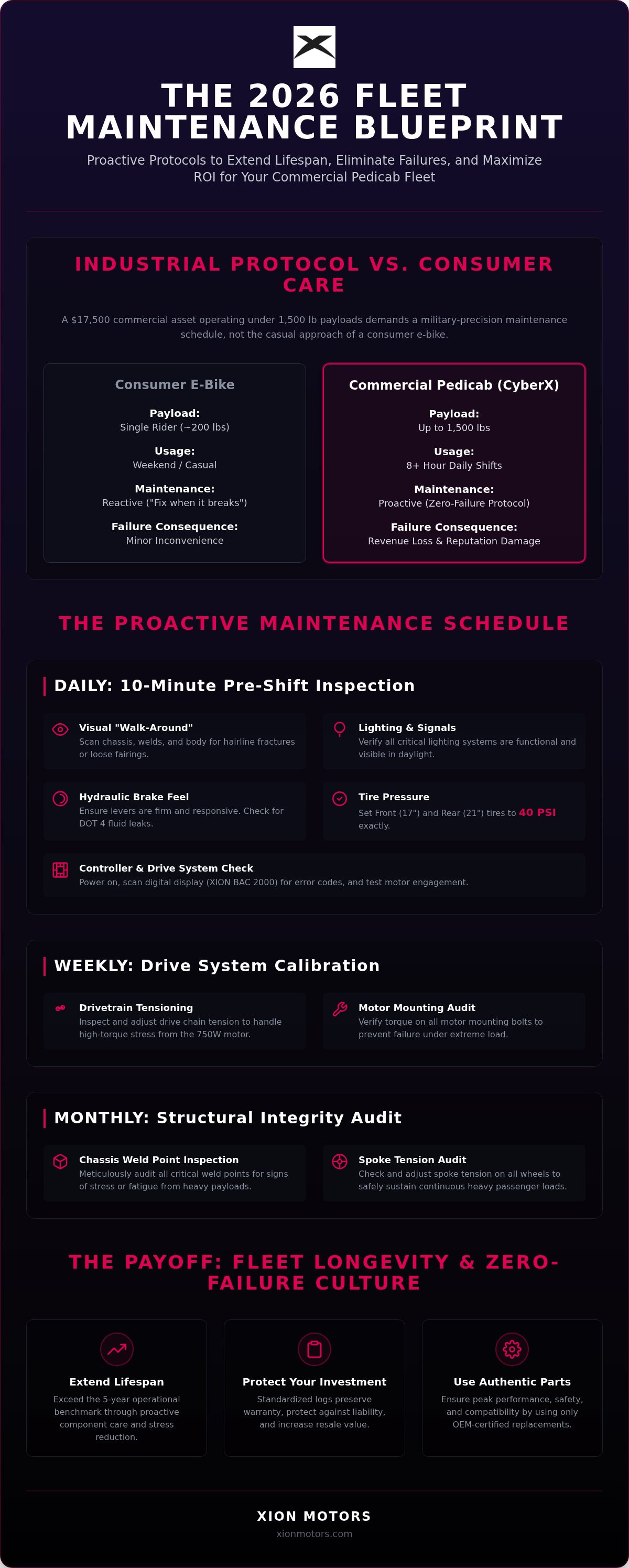
- Implement a 10-minute daily "Walk-Around" protocol to verify hydraulic brake feel and critical lighting systems before every shift.
- Master a weekly electric pedicab maintenance schedule that prioritizes drivetrain tensioning and motor mounting to handle high-torque stress.
- Execute monthly structural audits of chassis weld points and spoke tension to safely sustain heavy passenger payloads.
- Protect your fleet's ROI and warranty by standardizing maintenance logs and utilizing authentic vehicle parts for all replacements.
Beyond Consumer E-Bikes: Why Commercial Pedicabs Demand Industrial Scheduling
The gap between a consumer e-bike and a professional fleet vehicle is measured in tons of pressure and thousands of dollars in potential revenue. While a weekend rider might ignore a squeaky chain, a commercial operator knows that sound is the first warning of a catastrophic service disruption. Treating a high-capacity vehicle like a hobbyist toy is a fast track to insolvency. A professional Cycle rickshaw operation requires a rigid electric pedicab maintenance schedule designed for 1,500 lb payloads and continuous 8-hour shifts. This is the Master Practitioner’s approach. It prioritizes technical precision over guesswork and total uptime over short-term convenience.
Standard bike shops often fail commercial operators because they lack the industrial infrastructure to handle heavy-duty machines. Most local shops aren't equipped to manage DOT 4 hydraulic fluid flushes or diagnose 750W direct-drive transaxle motors. They operate on a "fix it when it breaks" mentality that's incompatible with professional fleet management. Relying on consumer-grade service centers leads to extended downtime and compromised safety standards. Professional operations demand a dedicated, in-house protocol that accounts for the unique stresses of the urban environment.
The Payload Factor: Stress-Testing the Schedule
The mechanical load on a 6 seat electric pedicab is fundamentally different from any standard bicycle. When you haul a full passenger load, your drivetrain and braking systems experience extreme torque levels that would shatter consumer-grade components. Frequent stop-and-go cycles in dense urban environments accelerate this wear. Every time the motor engages to move a half-ton of weight, it tests the integrity of the drive chain and axle. Industrial-grade engineering reduces the frequency of these service needs, but it doesn't eliminate the necessity for systematic oversight. High-torque motors require specific mounting bolt audits that a standard bike schedule simply ignores.
Commercial Continuity and Revenue Protection
Reactive maintenance is the most expensive way to run a business. Waiting for a part to snap on a busy holiday weekend means losing peak-hour fares and paying for emergency logistics. Proactive maintenance logs do more than prevent breakdowns; they preserve the resale value of your $17,500 investment and provide a clear paper trail for liability protection. Establishing a zero-failure culture within your team starts with the expectation that every vehicle is inspected with military precision before it ever touches the pavement. Industrial maintenance is the systematic prevention of revenue loss. This proactive approach applies to all commercial hardware; for those also operating off-road equipment, Diesel Freak offers essential guidance on maintaining visibility systems to ensure safe operation in any environment.
Success in commercial transit is built on the foundation of repetitive, disciplined action. The daily 10-minute inspection isn't a suggestion; it's the frontline defense in your electric pedicab maintenance schedule. This protocol ensures that every vehicle leaving the depot is mechanically sound and commercially viable. While it's true that electric drivetrains require less maintenance than conventional vehicles, the extreme weight loads of a pedicab demand a higher level of vigilance. A minor oversight at the depot can escalate into a catastrophic failure on a busy thoroughfare.
The 'Walk-Around' protocol is your visual audit. Start with a systematic scan of the chassis and body, looking for hairline fractures or loose fairings. Check the critical safety systems next. Your lighting and signals must be visible even in direct sunlight. Test the hydraulic brake feel by pulling the levers; they should be firm and responsive. If the lever pulls to the grip, you likely have air in the system or a DOT 4 fluid leak. Finally, optimize your tire pressure. Both the front 17" and rear 21" tires must be set to exactly 40 psi. This precision maximizes your 72V battery range and ensures passenger comfort over uneven urban pavement.
The Morning Pre-Flight Routine
Power up the CyberX and immediately scan the digital display for any error codes or voltage irregularities. The XION BAC 2000 controller provides real-time diagnostics that can save you hours of troubleshooting later. Test the high-torque drive system response in a controlled environment before any passengers board. The motor should engage smoothly without stuttering. Don't forget the passenger cabin. Ensure safety belts are intact and branding is clean. A professional appearance is just as vital for fleet ROI as mechanical reliability.
Post-Shift Data Logging
The maintenance cycle doesn't end when the sun goes down. Operators must report "ghost noises" or subtle changes in vibration the moment they return to the depot. These auditory clues are often the first sign of a bearing reaching its limit or a motor mount loosening under stress. Log the daily mileage for every vehicle. Since our service intervals are mileage-dependent, accurate data is essential for triggering weekly and monthly audits. Finish the shift with a quick cleaning to remove road salt and grime. This simple step protects your electrical contacts from corrosion. If you identify worn components during your checks, you can find authentic Vehicle Parts to maintain your fleet's integrity.
Weekly Drive System Calibrations: Managing High-Torque Stress Points
High-performance fleets don't leave uptime to chance. While the daily walk-around captures visual defects, your weekly electric pedicab maintenance schedule must dive into the high-stress mechanical junctions that power your business. Precision drivetrain tensioning is your first priority to prevent chain skip under heavy load. Our 20 years of fleet experience proves that a loose chain doesn't just slip; it destroys sprocket teeth and forces expensive replacements. Use a chain wear tool to check for stretch and replace the chain immediately if it hits the 0.75% threshold. This proactive swap saves your transaxle from premature wear.
The 750W direct-drive transaxle motor generates significant torque that can eventually back out mounting bolts. Audit these bolts weekly to ensure the motor stays perfectly seated. A slight misalignment under load can lead to housing damage or catastrophic axle failure. You must also perform a detailed brake pad wear analysis. Commercial pads disappear faster than consumer equivalents because they're stopping up to 1,500 lbs of passenger and vehicle weight. Replace front disc pads when less than 1 mm of compound remains and rear pads at 1.5 mm. Finally, inspect the electrical harness for heat-related insulation wear. High amperage draw during steep climbs can cause brittle spots or discoloration near the controller that lead to shorts.
Optimizing the High-Torque Motor
Thermal management is critical for motor longevity and consistent power delivery. Inspect the motor heat sinks for road debris or mud that causes thermal throttling and reduces your operational efficiency. Check the phase wire connectors for signs of arcing or heat stress, which often manifest as melted plastic or blackened metal. For granular motor tuning specifics and performance optimization, consult our comprehensive electric pedicab maintenance guide. Keeping the motor cool and the connections tight ensures your vehicle maintains its 5-6 hour runtime under full commercial load.
Braking System Integrity
Safety is a liability concern that demands zero hesitation. Check your DOT 4 hydraulic fluid levels and scan every union for signs of a leak. Heavy downhill braking with a full passenger load creates immense heat that can warp rotors over time. Replace front rotors if they drop below 1.8 mm thickness to maintain structural integrity. As more professional operators adopt EVs for Fleets, the industry standard is moving toward these rigid, data-driven service intervals. Calibrate your calipers weekly for symmetrical stopping power. This precision prevents uneven tire wear and ensures your operators can stop with confidence in any urban environment.
Monthly Structural Audits: Chassis Integrity for Heavy Payloads
A high-performance fleet is only as strong as its foundation. While weekly calibrations manage the moving parts, your monthly electric pedicab maintenance schedule must address the structural integrity of the vehicle itself. Carrying 1,500 lbs of passenger weight day after day creates immense stress on the frame, particularly at the junctions near the rear axle. These high-stress points are where metal fatigue is most likely to manifest. A professional operator doesn't wait for a failure; they hunt for it with a high-intensity light and a critical eye.
Inspect every weld point for micro-fractures. These often appear as hairline cracks in the powder coating or paint long before the metal actually separates. Focus your attention on the motor housing mounts and the suspension attachment points. If you detect any movement in the suspension bushings or hear a dry, grinding sound, it's time for replacement. Lubricate these pivot points with heavy-duty grease to prevent metal-on-metal wear and eliminate the creaks that signal impending fatigue to your passengers. Secure all cabin attachment bolts and verify the floorboard integrity to ensure a premium ride experience for every fare.
Chassis and Frame Structural Audits
The CyberX is engineered with a reinforced steel frame designed to handle commercial abuse, but even industrial-grade materials require oversight. Cleaning the frame monthly allows you to spot issues that road grime might hide. Re-greasing pivot points isn't just about noise reduction; it's about maintaining the precise geometry required for stable handling at speed. If a frame shows signs of bowing or misalignment, it must be pulled from service immediately for professional assessment. This level of scrutiny protects your investment and ensures a vehicle lifespan well beyond the five-year mark.
Wheel and Tire Management
Heavy-duty commercial rims demand monthly spoke tensioning to stay true. A single loose spoke under a full load can trigger a chain reaction that collapses the entire wheel during a turn. Rotate your tires during this audit to even out wear patterns, especially in rear-drive configurations where the drive wheels bear the brunt of the motor's torque. When wear reaches the safety indicators, follow our pedicab wheel replacement protocols to ensure the new assembly is correctly balanced. Check the axle bearings for any play or grinding. If you identify worn bearings or damaged rims, secure authentic Vehicle Parts immediately to maintain your fleet's industrial reliability.
Implementing a Fleet-Wide Maintenance Lifecycle with Xion Motors
Scaling a fleet from two vehicles to twenty requires a transition from manual oversight to a standardized electric pedicab maintenance schedule. You can't rely on the memory of individual operators to keep your assets on the road. Implementing a centralized lifecycle management system ensures that every vehicle receives identical care regardless of which technician is on shift. This starts with a signed daily log for every unit. These logs are not just paperwork; they are the legal and technical backbone of your operation. They provide the data necessary to trigger mileage-based interventions and protect your warranty standing with the manufacturer.
The integrity of your fleet depends entirely on the components you install. We insist on the use of authentic vehicle parts because third-party alternatives often lack the heat-treated durability required for 1,500 lb payloads. Saving a few dollars on a generic chain or sensor is a false economy that leads to premature failure and safety liability. Train your riders to be your first line of mechanical defense. A rider who understands how to identify a loose motor mount or a fading brake pad can prevent a minor adjustment from turning into a major overhaul. At the 10,000-mile benchmark, every vehicle should undergo a comprehensive teardown to evaluate frame fatigue and motor efficiency.
Inventory Management for Fleet Continuity
Professional continuity requires an on-site inventory of high-wear components. You should always maintain a stock of tubes, brake pads, drive chains, and throttle sensors to minimize downtime. Waiting for a part to arrive during a holiday weekend is a failure of management. Xion Motors provides nationwide shipping to all 50 states, ensuring that your replenishment orders arrive before your local stock hits zero. Use the off-season to perform deep overhauls. This is the time to flush hydraulic systems and inspect every electrical connection without the pressure of daily deployment.
The Xion Motors Professional Support Advantage
Our team brings 20+ years of fleet operation experience to your business. We don't just sell hardware; we provide the technical bulletins and fleet-specific resources necessary to solve complex mechanical issues. When you partner with us, you gain access to the same engineering standards we use to build the CyberX. This legacy of performance is your competitive advantage in a crowded market. Secure your fleet's future with authentic Xion Motors parts and support and ensure your operation remains the dominant force in your city.
Dominating the Market Through Mechanical Precision
Success in commercial transit is built on the foundation of repetitive, disciplined action. You've learned that a rigid electric pedicab maintenance schedule is the primary tool for transforming a $17,500 investment into a high-performance profit engine. By mastering daily checklists, weekly torque audits, and monthly chassis inspections, you eliminate the risk of unplanned downtime during your most profitable seasons. These protocols ensure that your fleet operates with 100% predictability and safety, protecting both your passengers and your bottom line.
We bring an industry-leading 20-year heritage of fleet excellence to your operation, offering the industrial-grade CyberX engineering and nationwide parts support required for commercial continuity. Our commitment to your growth extends to all 50 states, ensuring you never lose a day of revenue to logistics delays or inferior third-party components. It's time to stop reacting to failures and start engineering your success through proactive management and professional-grade standards.
Scale your operation with Xion Motors Fleet Packages and secure your position as a master practitioner in the urban transit landscape. The road to scale starts with a commitment to excellence, and we're ready to help you lead the way.
Frequently Asked Questions
How often should I service my electric pedicab's motor?
You should audit motor mounting bolts weekly to ensure the 750W direct-drive transaxle remains seated under high torque. Deep cleaning of the external heat sinks should occur monthly to prevent thermal throttling. While these units are designed for industrial durability, a full internal inspection is required at the 10,000-mile overhaul benchmark. Consistent oversight prevents minor vibrations from escalating into catastrophic axle or housing failures during your peak season.
What is the lifespan of a commercial electric pedicab battery?
Commercial batteries typically require replacement once their capacity drops below 80% of the original 58Ah rating. In a high-utilization fleet environment, this usually occurs after 500 to 800 full charge cycles, or roughly one to two years of service. You can extend this lifespan by avoiding deep discharges and ensuring the 72V system is only charged with XION-supplied equipment. Heat is the primary enemy of lithium chemistry, so always charge in a controlled environment.
Can I use standard bicycle parts for my Xion Motors pedicab?
You cannot safely use standard bicycle parts for a commercial vehicle designed to haul 1,500 lbs. Consumer-grade chains, brake pads, and spokes lack the metallurgy required to withstand the extreme torque of a professional electric pedicab maintenance schedule. Using non-authentic components voids your warranty and introduces significant safety liabilities. While industrial fleets require specialized parts, for your personal or standard e-bike maintenance needs, you can discover Pedalinx Bike Shop to find a high-quality selection of retail components. We ship industrial-grade replacement parts nationwide to all 50 states to ensure your fleet maintains its structural integrity and operational continuity.
How do I identify structural fatigue in a 6-seat pedicab frame?
Identify structural fatigue by scanning for micro-fractures in the powder coating at high-stress junctions near the rear axle. These hairline cracks often appear before the underlying steel actually fails. You should also listen for persistent creaking or metallic popping sounds during heavy acceleration or cornering. If the chassis shows any signs of bowing or if the suspension bushings exhibit excessive play, pull the vehicle from service immediately for a professional frame audit.
What tire pressure is best for a fully loaded commercial trike?
The optimal tire pressure for a fully loaded commercial trike is exactly 40 psi for both the 17" front and 21" rear tires. Maintaining this specific pressure is critical for reducing rolling resistance and maximizing your 72V battery range. Under-inflated tires increase the motor's amperage draw and accelerate sidewall wear, while over-inflation compromises passenger comfort. Check these levels daily as part of your pre-shift safety protocol to ensure consistent performance and safety.
How much downtime should I plan for weekly maintenance per vehicle?
Plan for approximately 60 to 90 minutes of dedicated downtime per vehicle to complete a thorough weekly drive system calibration. This window allows your team to perform drivetrain tensioning, brake pad wear analysis, and electrical harness inspections without rushing. Standardizing this window within your operational calendar prevents mechanical issues from snowballing into multi-day repairs. Efficient fleet management treats this time as a strategic investment in uptime rather than a loss of productivity.
Do I need a certified mechanic to maintain my electric pedicab fleet?
You don't strictly need a certified motorcycle mechanic for basic service, but your team must be trained in industrial-grade electrical and hydraulic systems. Maintaining a BAC 2000 controller and direct-drive transaxle requires more technical precision than a standard bike shop can provide. We recommend designating a lead technician who has mastered our technical bulletins and maintenance resources. This internal expertise ensures that your fleet's safety and performance standards remain under your direct control.
What are the signs of high-torque motor overheating?
The primary signs of high-torque motor overheating include a noticeable drop in power delivery, known as thermal throttling, and specific error codes on the digital display. You might also detect a distinct smell of hot electrical insulation or notice discoloration on the phase wire connectors. If the motor housing is too hot to touch after a standard climb, the heat sinks are likely obstructed. Stop the vehicle immediately to prevent permanent damage to the internal windings.