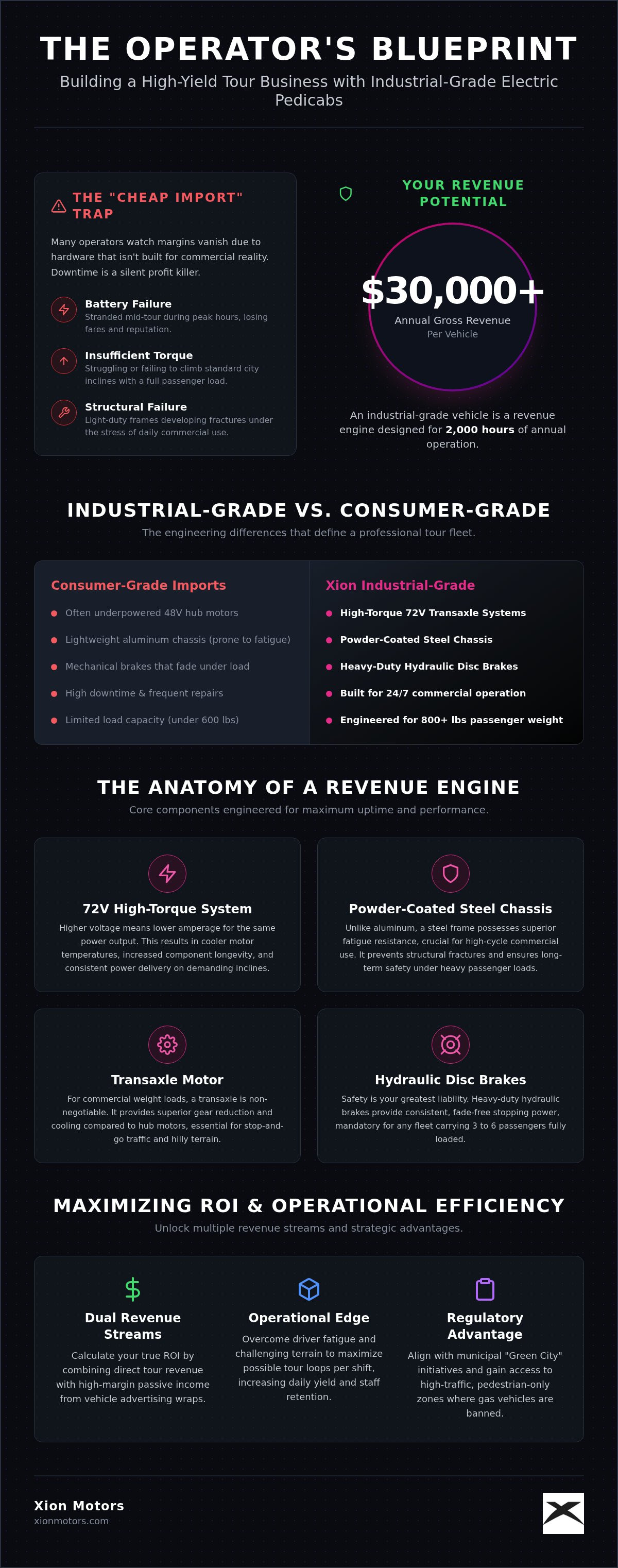
A single industrial-grade vehicle in your fleet can generate over $30,000 in annual gross revenue, yet many operators watch their margins vanish into the "cheap import" trap. You've likely experienced the frustration of a battery failing during peak hours or a motor that lacks the torque to clear a standard city incline with a full load. Scaling a high-yield business requires more than just a bike; it demands a professional-grade engine designed for 2,000 hours of annual operation. This is why choosing the right electric pedicabs for tour operators is the most critical capital investment you'll make this year.
We understand that downtime is a silent profit killer. You need hardware that handles the grind of daily tours while ensuring passenger safety and comfort. This guide provides the blueprint to master the technical and financial requirements of a modern fleet. We'll analyze the 2026 regulatory landscape, compare the durability of the CyberX and VorteX platforms, and show you how to maximize tours per day. From high-torque 72V systems to generating thousands in monthly advertising revenue via wraps, you're about to learn how to build a dominant tour business that stays on the street and off the repair stand.
Key Takeaways
- Master the technical specifications of 72V high-torque systems to ensure your fleet maintains peak performance during demanding back-to-back tour schedules.
- Identify the critical engineering benchmarks, like powder-coated steel chassis, that prevent the high maintenance costs associated with lower-grade imports.
- Analyze the strategic advantages of different fleet configurations to select the best electric pedicabs for tour operators based on your local terrain and passenger volume.
- Calculate your true ROI by integrating direct tour revenue with the high-margin passive income potential of vehicle advertising wraps.
- Streamline your scaling process by utilizing a direct-to-operator model that provides industrial-grade hardware and veteran industry support.
Why Modern Tour Operators are Transitioning to Electric Cycle Rickshaws
The era of the exhausted driver is over. If your business model still relies on manual labor, you're operating in the past. The history of cycle rickshaws shows a clear evolution from basic human power to the industrial-grade electric systems we see today. Successful tour companies recognize that electric pedicabs for tour operators are the only viable path to scale a high-output business in 2026. Manual pedaling isn't just inefficient; it's a liability for driver retention. You can't build a reliable fleet if your staff burns out after three days of navigating city inclines.
Ditch the gas-powered shuttles and the overhead that comes with them. The costs of maintaining internal combustion engines, paying for rising fuel prices, and navigating astronomical commercial insurance for motor vehicles can gut your margins. Electric trikes offer a leaner, more agile alternative. They require a fraction of the maintenance and cost pennies to charge. This transition allows you to lower your operational floor while raising your revenue ceiling. It's a move toward entrepreneurial pragmatism that prioritizes long-term financial viability.
Modern tourists demand immersion. They want the air, the sounds, and the unobstructed views that only an open-air vehicle provides. A van is a cage that separates the passenger from the destination. A rickshaw is a front-row seat to the city. By utilizing electric pedicabs for tour operators, you deliver the high-speed efficiency of a motorized tour without sacrificing the "experience economy" appeal that drives premium ticket pricing.
Overcoming Terrain and Driver Fatigue
High-torque 72V motors change the math of your routes. You no longer have to avoid hilly historic districts or cut tours short because a driver is spent. These systems provide consistent power delivery, ensuring every loop stays on schedule regardless of elevation. When you reduce physical strain, you expand your hiring pool to a broader range of professional operators. This isn't just about comfort; it's about increasing the number of possible tour loops per shift to maximize your daily yield.
The Environmental and Regulatory Edge
Cities are increasingly closing their centers to cars. Pedestrian-only zones are becoming the norm in major markets, yet electric pedicabs often bypass these restrictions. By operating vehicles that meet Class 2 e-bike designations, you align your business with municipal "Green City" initiatives. This proactive stance makes the permitting process smoother. It positions your brand as a leader in sustainable tourism while ensuring you have access to the high-traffic streets where gas vehicles are now banned.
Critical Specifications: What Defines an Industrial-Grade Commercial Rickshaw?
Success in the tour industry depends on hardware that survives the street. You aren't buying a recreational toy; you're investing in a revenue engine that must endure 24/7 operation. Industrial-grade electric pedicabs for tour operators start with a powder-coated steel chassis. While aluminum might seem lighter, it lacks the fatigue resistance required for high-cycle commercial use. A steel frame designed and tested for heavy passenger loads ensures your vehicle doesn't develop structural fractures after six months of service.
Performance is dictated by voltage. We utilize 72V high-torque systems because they provide the "punch" needed to move 800+ pounds of passenger weight without overheating the motor. Higher voltage means lower current draw for the same power output, which directly translates to cooler operating temperatures and increased component longevity. These systems offer substantial benefits of electric vehicles, including a massive reduction in moving parts compared to gas alternatives. For commercial weight loads, prioritize a transaxle motor over a hub motor. A transaxle provides superior gear reduction and cooling, making it the only choice for hilly terrain or constant stop-and-go traffic.
Safety is your greatest liability. You cannot compromise on braking. Heavy-duty hydraulic disc brakes are a mandatory requirement for any professional fleet. They provide consistent, fade-free stopping power even when the vehicle is fully loaded with three or six passengers. If you're comparing models, look for the CyberX or VorteX lines, which are engineered specifically for these high-stress environments. You can examine our professional-grade vehicle parts to see the level of engineering required for street-legal safety.
Battery Systems for All-Day Tours
Range anxiety kills profits. To maximize your tours per day, your battery system must deliver at least 40 miles of real-world range under load. Lithium-ion is the industry standard for 2026, offering a lifespan of three to five years compared to the six to ten months seen with outdated lead-acid batteries. Focus on architectures that support rapid charging or swappable packs. This allows your fleet to stay in constant rotation during peak festival seasons or busy weekend shifts without waiting hours for a recharge.
Passenger Comfort and Safety Features
The passenger experience determines your reviews and repeat business. High-performance suspension is essential for navigating historic cobblestones or uneven urban asphalt without jarring your guests. Every unit should feature a reinforced canopy for all-weather operation, protecting riders from intense sun and sudden rain. This focus on durability is shared by premium adventure brands like Desert Detour, who rely on top-tier hardware to ensure safety in extreme environments. Integrated LED lighting systems are equally vital. They don't just enable evening tours; they ensure your vehicle remains highly visible to motorists, significantly reducing the risk of collisions in high-traffic areas.
Your fleet configuration is a strategic decision that dictates your daily revenue ceiling. High-yield electric pedicabs for tour operators generally fall into two categories: the agile 3-seat cruiser and the high-density 6-seat transporter. You must analyze your local tour volume before committing capital. If your routes involve narrow, historic alleys or dense foot traffic, maneuverability takes priority over raw seating capacity. Conversely, if you're servicing wide avenues or major event venues, passenger density is the only metric that matters.
Maneuverability involves more than just a turning radius. It’s about the ability to park in high-foot-traffic areas without becoming a nuisance. A smaller trike like the CyberX can pivot in tight urban corridors, allowing your drivers to pick up street hails that larger vehicles have to pass by. In contrast, high-capacity models like the VorteX require more space but offer a level of group service that smaller trikes cannot match. We've spent 20 years in the trenches of fleet operation, and we know that the right mix often includes both configurations to capture every segment of the market. Our USA-made frames are designed in San Diego to withstand the rigors of American streets, ensuring that regardless of size, your vehicle remains a reliable asset.
The 3-Seat Strategic Use Case
For entrepreneurs starting a pedicab company, the 3-seat configuration offers a lower initial investment. It’s the perfect entry point for testing market demand without overextending your budget. These vehicles are ideal for "on-demand" street hails and quick point-to-point transit where solo travelers or couples are your primary demographic. Their agility allows for higher driver speed in dense urban entertainment districts, meaning more loops per shift. When you prioritize a compact footprint, you gain access to the tightest corners of the city, ensuring your brand is visible where the crowds are thickest.
The 6-Seat High-Capacity Advantage
The 6-seat "Force" model is the definitive answer for operators targeting the group market. Think bachelorette parties, family reunions, and corporate events. By doubling your passenger capacity, you effectively double your revenue per tour loop without increasing your driver labor costs. It's a high-efficiency play for those positioning their fleet as an electric shuttle for entertainment districts. While you sacrifice some turning radius, the financial trade-off is often undeniable in high-volume markets. Dominating the group tour market requires the scale that only a 6-seat vehicle can provide, turning a single driver's time into a multi-passenger profit center.
Calculating ROI: Revenue Potential and Operational Efficiency
Profitability in the tour sector is a math problem, not a guessing game. While a single vehicle in a professional fleet can generate between $30,000 and $35,000 in annual gross revenue, the most successful operators look beyond ticket sales. You must leverage every square inch of your asset to maximize yield. This means diversifying your income streams through a mix of scheduled tours, on-demand street hails, and high-margin private event bookings for weddings or corporate festivals. Transitioning to electric pedicabs for tour operators slashes your fuel and insurance overhead, turning what used to be gas expenses into pure bottom-line profit.
Operational efficiency is the difference between a side hustle and a scalable enterprise. Charging a 72V lithium-ion battery costs pennies compared to the daily fuel requirements of a gas shuttle. The reduced number of moving parts in an electric drivetrain means fewer catastrophic failures. You're trading complex engine repairs for simple, preventative maintenance. This predictability allows you to forecast your margins with precision, ensuring your business remains financially viable year after year. Every hour your vehicle spends on the street instead of in the shop is an hour of active revenue generation.
The Advertising Wrap Opportunity
Your vehicles are moving billboards. In high-traffic urban zones, a single pedicab wrap can command between $500 and $3,000 in monthly passive income. This revenue often covers the vehicle's entire monthly operating cost before the first passenger even sits down. Local businesses are desperate for high-visibility placements that cut through the noise of static signage. By deploying the CyberX, you offer advertisers a sleek, modern canvas that reflects their own brand's commitment to innovation and quality. It's a professional-grade presentation that attracts premium advertising contracts.
Maintenance and Continuity
Uptime is your only real metric of success. A vehicle on a repair stand earns zero dollars. This is why parts availability is more critical than the initial purchase price. You must budget for commercial trike replacement parts and maintain a local inventory of high-wear items like tires, brake pads, and chains. Building a preventative maintenance schedule ensures 99% fleet uptime, even during the grueling 12-hour shifts of peak festival seasons. If you want to scale, you need a partner who understands the street. Explore our fleet packages to secure the hardware and support required for a high-output tour operation.
Scaling Your Tour Business with Xion Motors Fleet Solutions
Scaling a tour business is a high-stakes maneuver that requires a partner who has survived the street. We don't just manufacture hardware; we provide a blueprint for industrial-grade success based on 20 years of operational experience. By choosing a direct-to-operator model, you cut out the middleman markups that often inflate startup costs. This entrepreneurial pragmatism ensures your capital goes toward the vehicles themselves, not a distributor's commission. When you deploy electric pedicabs for tour operators, you need the security of a veteran team that understands the grind of daily tours. This focus on professional standards and expert logistics is what allows travelers to discover Adrenalin Rush Trail for premium guided motorcycle expeditions.
Our legacy is built on the durability of our frames. Whether you choose the agile CyberX or the high-capacity VorteX, you have the ability to tailor each unit to your brand identity. We ship nationwide and provide lifetime US-based technical support for all 50 states. This isn't a transactional relationship. It's a long-term alliance designed to keep your revenue engine running through every season. We build what we know works because we've been in the trenches ourselves.
Fleet Package Benefits
Volume discounts are available for operators deploying five or more vehicles. This allows you to scale quickly while standardizing your parts inventory. When every unit in your fleet utilizes the same 72V high-torque components, your maintenance protocols become streamlined and predictable. You also gain priority access to our engineering support and replacement parts. This ensures that a single breakdown never derails your entire operation, keeping your fleet on the street where it belongs.
Getting Started: From Order to Operation
Every vehicle undergoes a rigorous assembly and road-testing process to ensure it is commercially ready the moment it arrives. We don't just ship boxes. We deliver tools for growth. Our team also provides consulting on fleet deployment strategies for new markets, helping you identify high-yield zones and navigate local regulations. To begin your expansion, you can View our Electric Pedicab Fleet Packages and see how we turn industrial engineering into financial momentum.
Dominate Your Market with Industrial-Grade Performance
The transition to a high-yield tour operation requires more than just enthusiasm; it demands the right hardware. You've learned that success hinges on industrial engineering benchmarks like 72V high-torque systems and powder-coated steel chassis that survive the daily urban grind. By strategically mixing agile 3-seat models with high-capacity 6-seat transporters, you can capture every segment of the market while maximizing your revenue per tour loop. It's about building a business that stays on the street and off the repair stand.
Investing in electric pedicabs for tour operators is the definitive move to secure your financial future. We bring over 20 years of fleet operation experience to every vehicle we build, ensuring your investment is backed by real-world results. With USA-made frames and lifetime technical support, you're not just buying a trike; you're gaining a veteran partner invested in your growth. The opportunities in 2026 are vast for those who refuse to settle for cheap imports. Take command of your territory and start scaling today. Build Your Fleet with Xion Motors and turn your vision into a high-performance reality.
Frequently Asked Questions
What is the average range of an electric cycle rickshaw on a single charge?
An industrial electric pedicab typically achieves 40 to 50 miles of real-world range on a single charge when under load. This performance depends on terrain and passenger weight. Lithium-ion battery systems are the 2026 industry standard because they maintain consistent power delivery throughout the discharge cycle. To maximize your daily tours, we recommend utilizing rapid-charging architectures or swappable battery packs to eliminate downtime during peak operational hours.
Are electric pedicabs street legal for tour operations in the US?
Electric pedicabs for tour operators are generally street legal across the US when configured as Class 2 e-bikes with 750W systems. However, municipal regulations vary significantly between cities. For example, New York City requires scannable registration plates and metered fares as of August 2026. Always verify local ordinances regarding vehicle width, length, and specific roadway speed limits, which are often capped at 35 mph for safe operation.
How many passengers can a commercial electric rickshaw safely carry?
Commercial electric rickshaws are engineered in two primary configurations to carry either three or six passengers safely. The 3-seat CyberX is the agile choice for couples and solo travelers, while the 6-seat VorteX is designed for high-density group tours and corporate events. Every unit features a reinforced chassis and heavy-duty hydraulic disc brakes to manage these commercial weight loads without compromising stopping power or structural integrity.
What is the lifespan of a lithium-ion battery in a commercial pedicab?
A high-quality lithium-ion battery in a commercial environment typically lasts between three and five years. This is a massive improvement over traditional lead-acid batteries, which often fail after six to ten months of heavy use. Proper maintenance protocols, such as avoiding total discharge and storing batteries in temperature-controlled environments, can help you exceed 500 charge cycles while sustaining the high-torque performance your routes demand.
Can electric cycle rickshaws handle steep hills with a full passenger load?
Yes, industrial-grade vehicles equipped with 72V high-torque systems handle steep inclines with ease, even under a full passenger load. Our engineering focuses on transaxle motors rather than hub motors because they provide the necessary gear reduction for climbing. This ensures your tour timing remains consistent regardless of the local topography. You won't have to bypass historic hilly districts or worry about motor overheating during back-to-back loops.
What maintenance is required for a commercial electric pedicab fleet?
Commercial fleets require a proactive preventative maintenance schedule to ensure 99% uptime. Key tasks include weekly inspections of hydraulic brake pads, chain tensioning, and tire pressure monitoring. You should also conduct monthly battery health diagnostics and check all electrical connections for integrity. Standardizing your fleet with high-quality components ensures that replacement parts are readily available, reducing the risk of a vehicle sitting idle during your busiest season.
Do I need a special license to operate an electric cycle rickshaw business?
Licensing requirements depend entirely on your local municipality. In cities like St. Augustine, Florida, operators must pass background checks and hold a valid state driver's license as of July 2026. Other regions, such as New Orleans, cap the total number of permits available to manage congestion. It is your responsibility to research city-specific operator permits and safety training courses required to maintain a legal and insured tour business.
How do electric pedicabs compare to golf carts for resort transportation?
Electric pedicabs offer superior maneuverability and access compared to traditional golf carts in resort environments. Because they often qualify as bicycles, pedicabs can navigate narrow paths and pedestrian zones where motor vehicles are restricted. They provide a more immersive, open-air experience that tourists prefer for sightseeing. Additionally, the lower insurance overhead and the ability to generate passive revenue through advertising wraps make pedicabs a more viable financial engine.