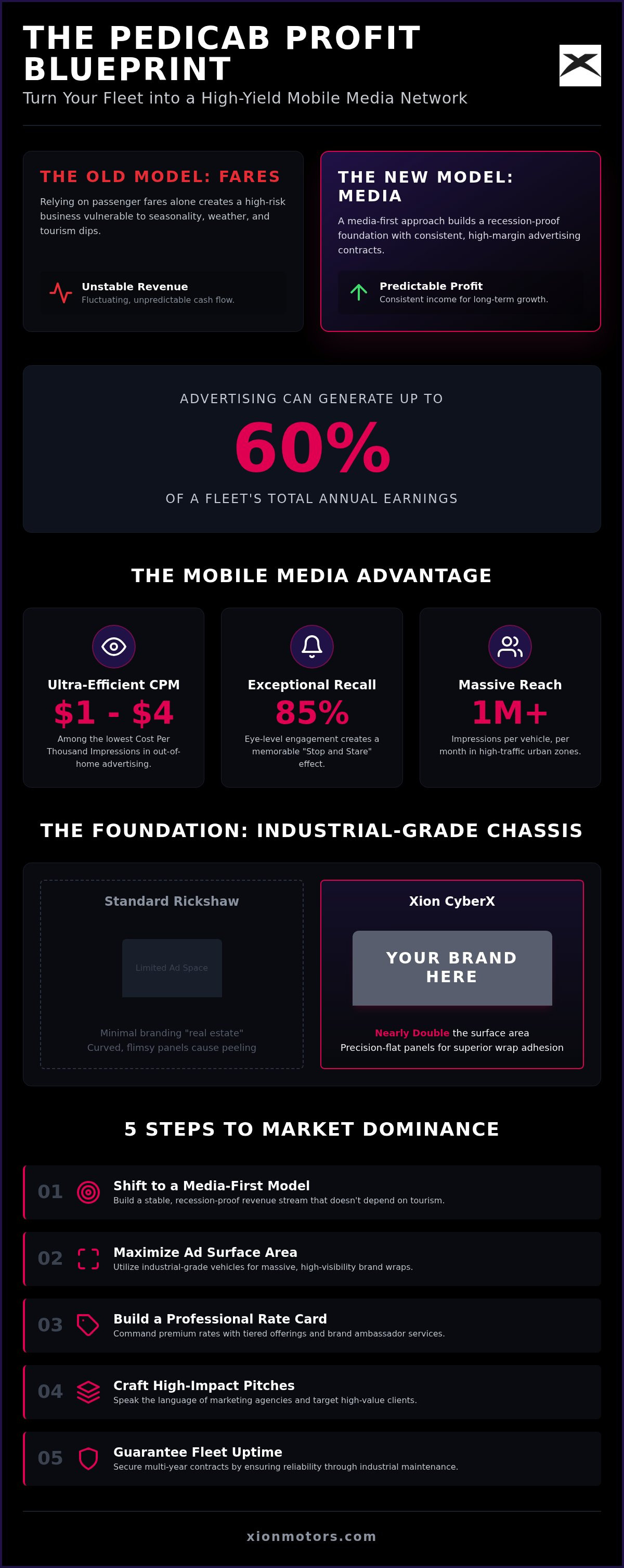
In established urban markets, advertising revenue from pedicabs now accounts for as much as 60% of a fleet's total annual earnings. You likely built your business to move people, but the most aggressive growth comes from moving brands. We know the struggle of seasonal fluctuations and the difficulty of pitching to professional marketing agencies when your equipment doesn't look the part. It's time to stop viewing your fleet as a simple taxi service. You're sitting on a high-performance media asset that should be generating passive profit every hour it's on the street.
This blueprint will transform your operation into a high-yield mobile media network. You'll learn to build a professional rate card that commands respect and how to secure multi-year contracts that eliminate the stress of vehicle downtime. We'll demonstrate why industrial-grade engineering, specifically the expanded surface area of the CyberX and VorteX, is the foundation of contract longevity. We're moving beyond basic wraps to explore GPS-tracked impressions and experiential sponsorships. Prepare to build a fleet that pays for itself through elite brand partnerships.
Key Takeaways
- Shift your business focus from unpredictable passenger fares to a media-first model to build a recession-proof revenue stream that remains stable regardless of seasonal tourism dips.
- Maximize your advertising revenue from pedicabs by selecting industrial-grade vehicles like the CyberX that provide massive, high-visibility surface area for brand wraps.
- Build a professional, tiered rate card that commands higher premiums by including specialized brand-ambassador services from your driving team.
- Learn to craft high-impact pitch decks that speak the language of professional marketing agencies and target high-value industries like tech and real estate.
- Secure multi-year contracts by guaranteeing fleet uptime through the implementation of industrial maintenance standards and reliable vehicle engineering.
The Economic Engine: Why Advertising Revenue is the Lifeblood of Pedicab Operations
Relying solely on passenger fares is a high-risk strategy that leaves your business vulnerable to the whims of weather and tourism cycles. To build a truly dominant enterprise, you must pivot. The modern Cycle rickshaw (pedicab) is no longer just a transport vehicle; it is a mobile media asset capable of generating consistent, high-margin profit. In 2026, savvy operators are prioritizing advertising revenue from pedicabs to create a recession-proof financial foundation. While fares fluctuate, a signed ad contract provides the rugged certainty required for long-term growth.
Traditional static billboards are losing their edge. They've become background noise in a saturated urban environment. Pedicabs, however, offer a Cost Per Thousand (CPM) impressions between $1 and $4. This is among the lowest in the out-of-home advertising industry. Brands are noticing this efficiency. They're shifting budgets toward high-engagement, human-scale media that moves exactly where the people move. You aren't just selling a ride. You're selling access to a captive audience in high-value zones.
Stabilizing Cash Flow with Multi-Month Contracts
Chasing daily fares is exhausting. Shifting to monthly retainers changes the fundamental math of your business. When you secure a six-month or yearly ad contract, you gain the liquidity to scale your operations without hesitation. This predictable income stream is what allows professional operators to invest in electric pedicab fleet packages. The ad revenue effectively subsidizes the hardware. You stop being a driver and start acting as a media mogul, managing a network of high-visibility inventory that pays for itself. It's the difference between surviving the season and owning the market.
The 85% Recall Advantage of Mobile Media
Pedicabs outperform transit bus wraps because they operate at eye level and move at a pace that allows for genuine engagement. Research indicates that mobile media in pedestrian-heavy zones can achieve significantly higher recall rates than traditional transit ads. It's the "Stop and Stare" effect in action. In high-traffic environments like Austin, a single vehicle can secure as many as one million impressions per month. You aren't just capturing "dead time" in traffic; you're turning every red light and congested corner into a premium brand exposure event. This level of intimacy with the consumer is something a highway billboard simply cannot replicate.
Engineering Your Inventory: Maximizing Ad Surface Area on Industrial-Grade Chassis
The foundation of consistent advertising revenue from pedicabs is the vehicle's physical footprint. A standard rickshaw provides minimal "real estate," but industrial-grade models are designed as mobile canvases. When you evaluate the ad potential of a 3-seat versus a 6-seat model, you aren't just looking at passenger capacity; you're measuring square footage. The 6-seat chassis functions as a panoramic billboard, offering nearly double the lateral surface area for brand messaging. This scale allows for larger typography and more complex visual narratives that capture attention from across a busy intersection.
Engineering dictates visibility. The CyberX chassis is built with precision-flat panels that provide superior wrap adhesion compared to curved, flimsy alternatives. This ensures that high-end vinyl wraps remain professional and bubble-free even after months of 24/7 industrial exposure. Durability is a financial requirement. If your wrap peels or your chassis rusts, you've violated your ad contract. Following the California Vehicle Code on Pedicabs or similar local regulations ensures your fleet remains street-legal while maximizing this high-impact inventory. You can explore our industrial fleet options to see how these chassis are optimized for maximum brand exposure.
Static Wraps vs. Digital OOH Integration
The 2026 market demands more than just vinyl. Digital Out-of-Home (DOOH) integration is the new standard for elite fleets. Incorporating high-brightness LED screens on rear panels allows you to rotate multiple clients on a single vehicle, effectively tripling your revenue potential per unit. This transition requires significant electrical overhead. Xion Motors’ high-capacity battery systems are engineered to handle these digital loads alongside the motor, ensuring your ads stay bright through a full double shift. Hybrid inventory, combining static side wraps for brand identity with rotating digital rear displays for tactical promotions, represents the current peak of fleet monetization.
Experiential Add-ons: Beyond the Wrap
True brand activations go beyond the chassis. Custom wheel covers and branded canopy extensions turn a transport service into an immersive experience. For high-end activations, the Custom VorteX Trike serves as a mobile pop-up station for product sampling or audio-visual displays. This experiential approach allows you to charge premium rates that far exceed standard wrap fees. By offering a fleet that includes sampling platforms and integrated sound systems, you position yourself as a full-service marketing partner rather than a simple transit provider.
The Professional Rate Card: Strategic Pricing for Local and National Brands
A professional rate card is more than a price list; it's a declaration of your fleet's market value. To maximize advertising revenue from pedicabs, you must move beyond flat-rate quotes and adopt a tiered inventory model. This approach allows you to capture diverse budgets while protecting your premium assets for high-spend clients. You're pricing visibility, proximity, and engagement. It's about quantifying the influence your fleet has on the street.
Your pricing must also account for the physical scale of your hardware. Industrial-grade units like the 6 seat electric pedicab command higher premiums because they offer nearly double the visual impact of standard 3-seaters. When building your card, include "Bonus Value" items such as driver brand-ambassador services. A driver trained to deliver a brand's talking points transforms a mobile billboard into an interactive experience. This level of service justifies the rates required to sustain a professional fleet and ensures your partnerships are more than just passive wraps.
Tiered Inventory Pricing Models
Structure your offerings to accommodate different entry points for various business sizes. Tier 1 focuses on rear or side panel spots, ideal for local businesses looking for consistent neighborhood presence. Tier 2 moves into full vehicle wraps for regional brands seeking high-impact saturation. Tier 3 is the "Full Fleet Takeover," reserved for national product launches and major event activations where every vehicle in your fleet carries the same creative. This tiered system ensures you never leave money on the table when negotiating with different marketing scales.
Pricing must also remain dynamic to account for market demand. During high-traffic festivals or conventions, your fleet's value spikes. Understanding the municipal regulation of the pedicab industry is critical here; compliant, fully insured fleets are the only ones national agencies will trust with their six-figure activation budgets. Professionalism in your paperwork is as important as the quality of your wraps.
Measuring Impressions and ROI for Clients
Agencies buy data, not just pretty pictures. Use GPS tracking to provide clients with heat maps showing exactly where their brand traveled and where it lingered in high-traffic zones. You can estimate street-level impressions by cross-referencing your routes with local pedestrian foot traffic data. While digital social ads often carry a CPM of $10 to $20, pedicab media delivers high-impact street visibility for a CPM of $1 to $4. Maximizing advertising revenue from pedicabs requires proving the physical impact of your mobile media through this kind of data-backed transparency.
Pitching to Win: Turning Your Fleet into a High-Impact Media Network
Securing elite advertising revenue from pedicabs requires more than a casual phone call to local business owners. You must present a solution that fits seamlessly into a marketing director's quarterly strategy. Professionalism is your primary currency. A high-impact pitch deck should lead with data, high-resolution photography of your fleet, and a clear understanding of the brand's target audience. You aren't just selling a wrap; you're selling a high-visibility mobile billboard that bypasses the digital noise of social media.
Targeting the right industries is essential for high-margin contracts. Alcohol brands, tech companies, and tourism boards often have dedicated out-of-home (OOH) budgets and seek the "unmissable" nature of a branded fleet. Local real estate firms also value the hyper-local saturation your vehicles provide in specific neighborhoods. While the "green" angle is a powerful secondary benefit in 2026, lead with the performance metrics. Position your electric fleet as a sustainable, high-engagement alternative to traditional gas-guzzling shuttles that brands will be proud to associate with.
The 5-Step Pitching Framework
Even highly specialized sectors like biotechnology and life sciences are beginning to see the value in unique brand visibility. For those interested in the rigorous standards that these scientific industries maintain, you can visit Onyx Biolabs to learn about their high-purity research peptides. Bringing this same level of scientific precision to your fleet's data and presentation will help you win over the most discerning corporate clients.
- Step 1: Identify high-foot-traffic corridors in your city where traditional billboards are restricted or absent.
- Step 2: Match brand demographics to your passenger profiles to ensure the messaging resonates with the street-level audience.
- Step 3: Highlight the industrial design of your vehicles, emphasizing that the CyberX chassis ensures a clean, professional aesthetic that protects brand integrity.
- Step 4: Offer experiential value-adds, such as "sponsored free ride" hours, to create a positive, direct connection between the consumer and the brand.
- Step 5: Close with long-term contract incentives that reward multi-month commitments with reduced production fees or priority placement.
Building Relationships with OOH Ad Agencies
To scale beyond local contracts, you must speak the language of national media buying platforms. Agencies prioritize professional response times and precise creative specs. They need to know that your fleet is reliable and that their creative will be displayed on well-maintained hardware. Using a proven starting a pedicab company blueprint demonstrates the operational maturity required to handle six-figure agency accounts. When you prove that your maintenance and uptime are guaranteed, you move from being a local vendor to a trusted national media partner. If you are ready to upgrade your inventory to meet these professional standards, view our fleet-ready electric pedicabs today.
Scaling for Dominance: How Uptime and Maintenance Secure Multi-Year Contracts
National marketing agencies don't just buy impressions; they buy reliability. These brands demand an uptime guarantee because their campaign success depends on constant visibility in high-value zones. A broken vehicle is more than a mechanical failure; it's a "dark" billboard that results in costly rebates and damaged reputations. To secure the highest levels of advertising revenue from pedicabs, your operation must function with the precision of a professional media network. This requires hardware that can withstand the brutal reality of 24/7 commercial use.
Xion Motors provides the industrial infrastructure necessary for modern media moguls to dominate their markets. Maximizing advertising revenue from pedicabs requires hardware that doesn't quit when the demand spikes. By engineering vehicles specifically for heavy-duty transit, we eliminate the downtime that plagues inferior fleets. When your equipment is built to last, your ad contracts are built to last. It's the difference between a seasonal hobby and a scalable, multi-year revenue engine.
Durability as a Revenue Driver
Every hour your vehicle spends in the shop is an hour of lost revenue and a potential breach of contract. The VorteX and CyberX chassis are engineered to withstand the constant vibration and stress of urban deployment, ensuring your wraps stay pristine and your presence remains uninterrupted. High-torque motors ensure your branded fleet consistently reaches hilly terrain and high-demand urban zones where pedestrian traffic is densest. This mechanical superiority allows you to promise, and deliver, the impressions that national brands expect. Protecting the visual integrity of the brand asset is your primary job as a media provider.
Future-Proofing Your Media Fleet
Scaling to city-wide dominance requires a standardized approach to equipment and maintenance. National product launches require uniform ad creative deployment across an entire fleet, which is only possible when your vehicles are identical in spec and condition. Utilizing the electric pedicab maintenance guide ensures your team sustains industrial-grade performance across every unit. Maintaining a robust inventory of replacement parts is also essential to ensure that minor wear doesn't result in major downtime. Ready to dominate? Explore Xion Motors Fleet Packages today.
Dominating the Urban Media Landscape
The shift from a passenger-fare model to a media-first strategy is the only way to build a recession-proof fleet. By treating your vehicles as high-impact mobile billboards, you unlock consistent advertising revenue from pedicabs that remains stable throughout the year. Success in this field requires more than just a sales pitch; it demands industrial-grade hardware that never misses an impression. We've shown how strategic pricing and rigorous maintenance form the foundation of multi-year agency contracts.
You don't have to build this network alone. Xion Motors provides the industrial infrastructure needed to scale, backed by over 20 years of operational expertise. Our industrial-grade CyberX engineering ensures your fleet maintains the professional aesthetic required by national brands. With national 50-state shipping, we're ready to deploy the tools you need to own your market. It's time to stop chasing fares and start building an empire. Build Your High-Revenue Fleet with Xion Motors and secure your position as a market leader today.
Frequently Asked Questions
How much advertising revenue can a single pedicab generate monthly?
A single pedicab can generate between $2,500 and $3,000 in monthly advertising revenue in high-traffic urban markets. This figure fluctuates based on the city's event schedule and the specific location of your routes. Operators in convention-heavy cities often see higher yields during major festivals or trade shows. By focusing on multi-month contracts, you stabilize this income and protect your business from the seasonal dips typical of passenger-only fare models.
Do I need special permits to sell advertising on my pedicab fleet?
Permit requirements vary significantly by municipality, so you must check your local transit and business regulations. Most cities require a standard pedicab operator license, but some have specific codes governing mobile billboards or commercial wraps. For instance, regulations in certain markets mandate that your ad doesn't obstruct safety lights or visibility. Always ensure your fleet is fully compliant with local laws to avoid fines that could jeopardize your advertising revenue from pedicabs.
What is the best type of wrap material for long-term pedicab ads?
High-performance cast vinyl with a UV-resistant laminate is the industry standard for long-term durability. This material withstands 24/7 exposure to sun, rain, and road debris without fading or peeling. Selecting a "bubble-free" adhesive technology is also critical for the flat panels found on the CyberX chassis. Professional-grade materials ensure the brand's creative remains sharp and professional throughout the duration of the contract, which is essential for securing renewals from elite national agencies.
How do I track impressions for my pedicab advertising clients?
You can track impressions by integrating GPS units into your fleet to generate route heatmaps for your clients. These maps show exactly where the ads traveled and where they lingered in high-density pedestrian zones. Many operators also include scannable QR codes on the wraps to provide trackable calls to action. By cross-referencing your GPS data with municipal foot traffic statistics, you can provide advertisers with a data-backed estimate of their total street-level brand exposure.
Can I sell digital advertising on an electric pedicab?
Yes, selling digital advertising is a growing trend for 2026 and allows you to rotate multiple clients on a single vehicle. High-brightness LED screens can be mounted on the rear panels to capture the attention of trailing traffic and pedestrians. Because this hardware requires significant power, it's vital to use a vehicle with a robust battery system. Digital inventory significantly increases your profit potential by allowing you to sell the same physical space to several non-competing brands.
What industries are the best targets for pedicab advertising sponsorships?
What industries are the best targets for pedicab advertising sponsorships?
Vehicle downtime can be catastrophic for your contracts because national brands typically include uptime clauses in their agreements. If a pedicab is in the shop, the ad isn't being seen, which often triggers prorated rebates or financial penalties. This is why investing in industrial-grade engineering is a commercial necessity rather than a luxury. Reliable vehicles ensure you never miss a day of impressions, protecting both your professional reputation and your guaranteed monthly retainer income.
Is a 6-seat pedicab more profitable for advertising than a 3-seat model?
A 6-seat pedicab is generally more profitable for advertising because it offers significantly more surface area for brand messaging. The elongated chassis functions as a panoramic billboard, commanding higher premiums from agencies that want maximum visual impact. While the initial investment is higher, the increased ad real estate allows you to charge more for full wraps. This extra space makes your fleet more attractive to national brands looking for the most dominant presence possible on the street.