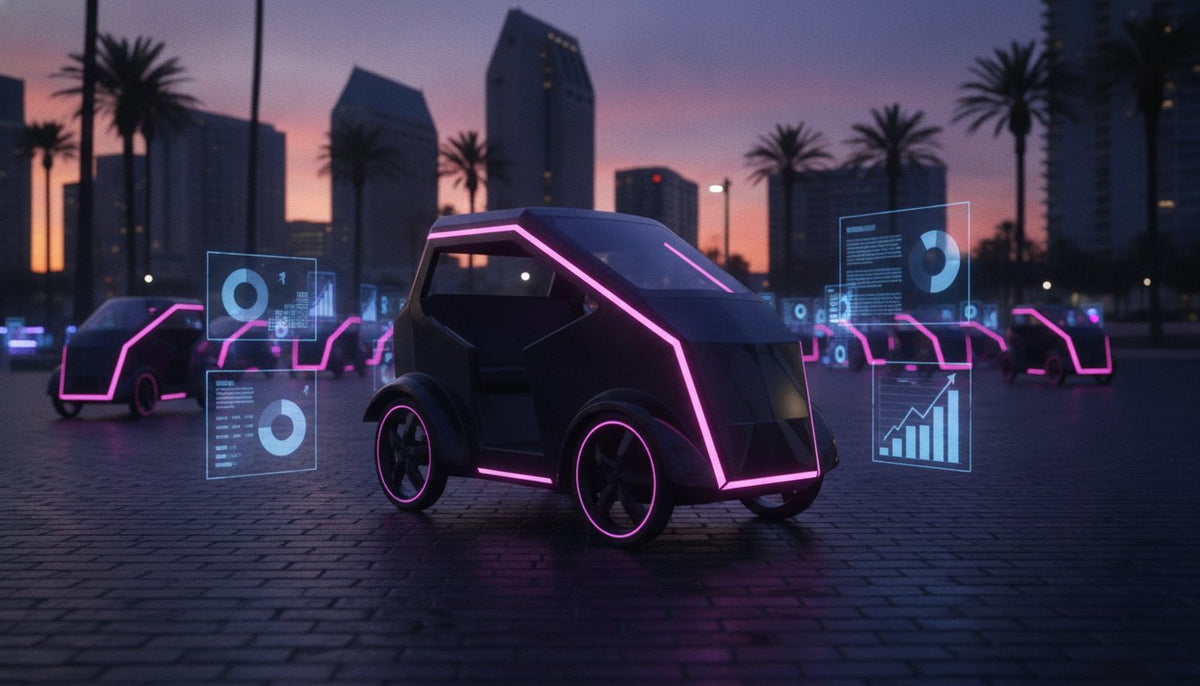
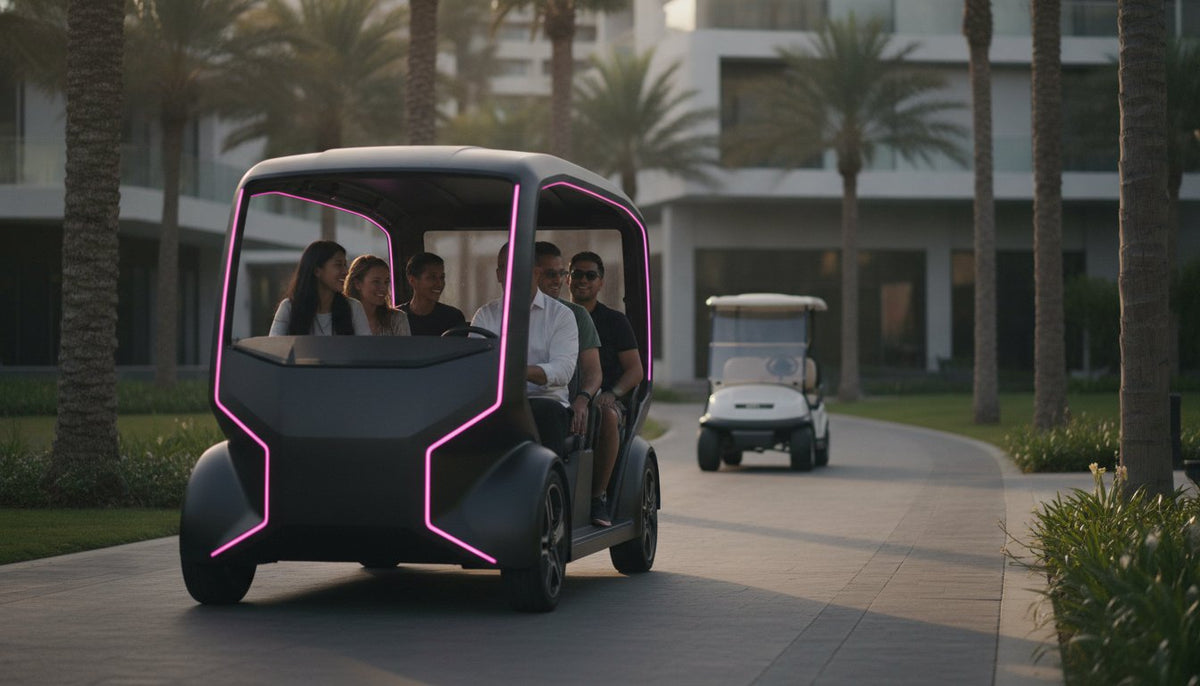
The difference between a recreational trike and a professional fleet asset is measured in uptime and raw torque. If you've attempted to scale a transit business with under-engineered equipment, you've likely faced the frustration of snapped axles and motors that fail on the first hill. Deploying electric pedicabs for downtown entertainment districts requires more than just a battery and three wheels. It demands a vehicle built for 365-day operation and the structural integrity to carry heavy passenger loads without constant maintenance downtime. We've spent over 20 years in the industry; we know that profitability starts with hardware designed for the street, not the sidewalk.
You understand that the demand for urban mobility is exploding, but you need a fleet that provides a guaranteed path to ROI. This 2026 guide masters the technical specifications and operational strategies required to turn high-capacity trikes into profitable business assets. We'll analyze the industrial engineering of the CyberX and Custom VorteX Trike lines, examine the financial viability of 3-seat models at $13,500 and 6-seat configurations at $17,500, and provide a blueprint for managing fleet logistics in the most demanding urban environments.
Key Takeaways
- Learn why industrial-grade engineering is non-negotiable for electric pedicabs for downtown entertainment districts to survive high-intensity commercial duty cycles.
- Master the technical requirements of high-torque mid-drive motors and 48V-72V battery systems to ensure consistent performance on steep urban grades.
- Compare the ROI of 3-seat models ($13,500) and 6-seat configurations ($17,500) to determine the ideal passenger capacity for your specific market.
- Establish a preventative maintenance schedule backed by a domestic supply chain to minimize downtime and maximize the lifespan of your fleet assets.
- Discover how 20 years of field-tested engineering in the CyberX and Custom VorteX Trike lines translates into a definitive competitive advantage.
Beyond the Toy: Defining Industrial Electric Pedicabs for Entertainment Districts
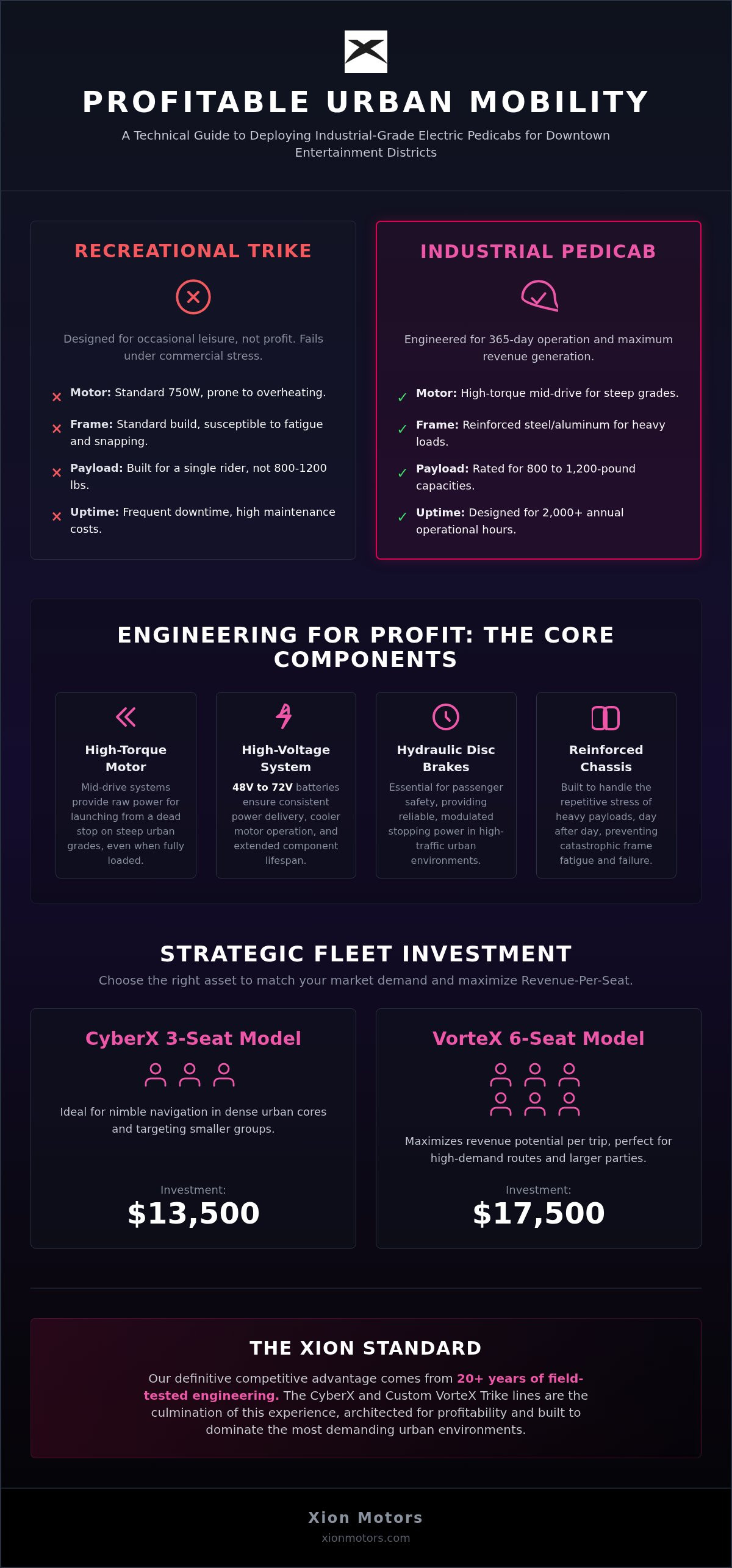
Consumer e-bikes are built for weekend leisure. Industrial electric pedicabs for downtown entertainment districts are built for profit. The gap between these two categories is wider than most new operators realize. While a recreational trike might look the part, it lacks the structural DNA required for high-intensity commercial service. We define an industrial-grade vehicle as one engineered for a minimum of 2,000 annual operational hours under full load. Anything less is a liability that will drain your maintenance budget before you reach ROI.
Success in this industry hinges on a single metric: Revenue-Per-Seat. Every seat in your fleet represents a stream of income, but that income evaporates if the vehicle is sidelined for repairs. Investing $13,500 for a 3-seat model or $17,500 for a 6-seat configuration is a strategic decision that pays for itself through consistent uptime. A Cycle rickshaw may have started as a simple manual vehicle, but the modern commercial iteration is a sophisticated piece of transit machinery designed to move people and generate capital simultaneously.
The Commercial Duty Cycle Difference
Standard 750W consumer motors are designed for a single rider on flat ground. They fail almost immediately when asked to move three or six passengers through a crowded district. The Commercial Duty Cycle involves constant low-speed, high-weight starts, which generates immense heat and torque stress. Without high-torque drive systems, your drive train will disintegrate within months. Frame fatigue is another critical failure point; reinforced steel or aluminum is non-negotiable because standard frames simply cannot handle the repetitive stress of 800 to 1,200-pound payloads day after day.
Safety Standards for Urban Operations
Stopping power is as important as pulling power. When you're hauling a full load in a high-traffic area, cable-actuated brakes aren't enough. Heavy-duty hydraulic disc brakes provide the consistent, modulated stopping power required for passenger safety. Nighttime visibility is equally vital. High-output lighting and integrated signaling systems ensure your fleet remains visible in the chaotic environment of a downtown district after dark. Our engineering focus on the Custom VorteX Trike ensures every component meets these rigorous standards, keeping your passengers safe and your business operational.
Engineering for Profit: High-Torque Powertrains and Structural Integrity
Torque is the engine of revenue. While consumer e-bikes focus on cadence and speed, industrial trikes prioritize the raw Newton-meters (Nm) required to launch a fully loaded vehicle from a dead stop. In the stop-and-go environment of electric pedicabs for downtown entertainment districts, high-torque mid-drive motors are the only viable solution for constant urban hill climbing and heavy passenger loads. If your powertrain can't handle the climb, your business can't handle the demand.
Powertrain Performance Metrics
Top speed is a secondary metric for commercial operators; torque and range consistency are what drive the bottom line. We utilize 48V to 72V battery systems to ensure that power delivery remains constant even as the charge depletes throughout a shift. A robust Battery Management System (BMS) is essential for multi-shift business operations, protecting the cells from the heat generated during high-intensity use. The CyberX has emerged as the engineering standard for 2026, offering a powertrain designed specifically for the rigors of commercial transit rather than recreational riding.
As academic research on Municipal Regulation of an Emerging Industry indicates, the professionalization of the sector requires vehicles that perform reliably under strict operational standards. High-voltage systems reduce the current draw, which keeps the motor cooler and extends the lifespan of every electrical component in the fleet.
Industrial Materials and Chassis Durability
Frame failure is the fastest way to kill a profit margin. We compare aircraft-grade aluminum and high-tensile steel based on the specific needs of the district; aluminum offers weight savings for better range, while steel provides unmatched ruggedness for high-impact environments. A low center of gravity is engineered into every chassis to ensure stability during sharp turns with multiple passengers. This structural integrity is supported by industrial suspension systems that absorb street vibrations, reducing component fatigue and improving the passenger experience.
Heavy-duty wheelsets are equally critical. Standard bicycle spokes will snap under the 1,000-pound payloads common in electric pedicabs for downtown entertainment districts. By utilizing reinforced rims and high-gauge spokes, operators minimize frame flex and prevent the catastrophic component failures that plague consumer-grade equipment. If you're ready to upgrade your operations, explore our fleet packages to see how industrial engineering translates into long-term durability.
Strategic Deployment: 3-Seat vs. 6-Seat Passenger Configurations
Choosing the right configuration is a calculated business decision that dictates your daily operational ceiling. Deploying electric pedicabs for downtown entertainment districts requires a deep understanding of your local street geography and passenger demographics. A mixed fleet often provides the best hedge against market fluctuations, allowing you to capture both high-volume group bookings and individual passenger fares. Your equipment must match the specific traffic patterns of your district to ensure maximum uptime and profitability.
The 3-Seat Advantage: Agility and Intimacy
The 3-seat model, priced at $13,500, serves as the agile backbone of most urban fleets. It's the definitive choice for VIP transport and narrow street navigation where larger vehicles might struggle to maneuver. Because of its smaller footprint, storage and charging logistics are simplified, making it a lower entry point for new operators. These units excel in intimate tour scenarios, such as couples heading to dinner or small groups needing a nimble shuttle between venues. The lower weight of the 3-seat chassis also translates to less wear on the powertrain, extending the lifespan of your core components.
- Ideal Use Cases: Couples tours, VIP transport, and high-density alleyway navigation.
- Lower Footprint: Easier storage and charging logistics for smaller urban facilities.
- Entry Point: The $13,500 price offers a faster path to initial fleet ROI.
The 6-Seat Force: High-Volume Revenue
For high-volume districts and resort environments, the 6-seat electric pedicab is a superior alternative to traditional golf carts. At a $17,500 price point, the revenue potential per trip doubles compared to smaller models. This is where industrial engineering becomes critical; stabilizing a 6-passenger load requires a reinforced chassis and precise weight distribution to maintain safety in urban traffic. These vehicles are the workhorses for major event logistics where moving large groups quickly is the primary objective.
When you evaluate operational costs per passenger, the 6-seat model often wins on paper, but only if you have the consistent demand to fill it. In dense downtown entertainment districts, maneuverability constraints are a reality. A 6-seat vehicle requires a wider turning radius and more deliberate navigation than its smaller counterparts. Conversely, the 3-seat model offers unparalleled agility, allowing drivers to take shortcuts or navigate congested paths that larger vehicles must avoid. Your fleet ROI depends on balancing these two capabilities to ensure every seat is generating income throughout the shift.
Fleet Sustainability: Maintenance Protocols and Component Availability
Scaling a transit operation requires transitioning from a hobbyist mindset to a rigorous logistical framework. For operators of electric pedicabs for downtown entertainment districts, sustainability isn't about being "green"; it's about staying in the black. A single mechanical failure on a busy Saturday night doesn't just cost a fare; it damages your brand's reputation for reliability. We've built our legacy on the reality that industrial vehicles require industrial-grade oversight to remain profitable year-round.
Preventative Maintenance Checklist
Industrial trikes endure extreme torque and heavy payloads, which accelerates wear on standard components far faster than recreational use. A daily inspection protocol is your first line of defense against catastrophic failure. Focus on these critical points before every shift:
- Brake pad wear: Heavy passenger loads require maximum stopping power and consistent heat dissipation.
- Tire pressure: Maintaining optimal PSI reduces motor strain and extends your battery range.
- Chain tension: High-torque motors put immense stress on the drive train, requiring regular lubrication and adjustment.
For a comprehensive breakdown of these procedures, refer to our electric pedicab maintenance guide. By utilizing high-torque specific components, you reduce the frequency of these repairs and keep your fleet on the road where it belongs.
The Replacement Part Lifeline
You can't run a professional business with "off-the-shelf" consumer parts. Those components are designed for casual riding, not 8-hour commercial shifts in demanding urban environments. Using USA-manufactured components for electric pedicabs for downtown entertainment districts ensures that your fleet remains standardized and easy to service. When a part fails, you need a domestic supply chain that can deliver replacements immediately. Downtime is the primary killer of pedicab business profitability. If your vehicle is in the shop, it's a liability, not an asset.
Managing battery health is equally vital for multi-shift consistency. Operators should avoid deep discharges and ensure batteries are stored in climate-controlled environments to prevent cell degradation. Training your drivers to use smooth acceleration profiles will also preserve both the battery and the mechanical drive system. If your fleet requires a refresh, browse our industrial-grade replacement parts to ensure your vehicles meet the high standards required for commercial transit.
The Xion Standard: Architecting the Future of Commercial Transit
Experience in this industry isn't bought; it's earned through decades of street-level operations. Xion Motors brings over 20 years of pedicab fleet experience to every chassis we manufacture in the USA. We don't just sell vehicles; we provide the industrial-grade tools required to dominate electric pedicabs for downtown entertainment districts. By managing every stage of the engineering process, we've eliminated the vulnerabilities common in mass-market imports, ensuring that your investment translates into measurable growth and long-term fleet stability.
Our commitment to your success extends far beyond the factory floor. We utilize a direct-to-operator sales model that removes unnecessary markups and establishes a direct line of communication with our engineering team. With national shipping and part support available for all 50 states, we ensure that your fleet remains operational regardless of your location. We position ourselves as a business partner invested in your operational growth, providing the rugged authority of a veteran manufacturer with the agility of a modern tech innovator.
Precision Engineering: VorteX and CyberX
The CyberX and Custom VorteX Trike lines represent the pinnacle of 2026 transit technology. These vehicles are engineered for the entrepreneur who demands performance without compromise. Choosing a 3-seat model at $13,500 or a 6-seat configuration at $17,500 isn't just a purchase; it's a strategic move to secure financial viability in a competitive market. Our high-torque drive systems and industrial-grade chassis are designed to endure the high-intensity commercial duty cycles that cause consumer-grade trikes to fail under pressure.
Scaling Your Business with Xion
Building a successful fleet requires more than just hardware; it requires a proven operational strategy. We've developed a professional blueprint for starting a pedicab company to help you navigate the complexities of urban transit. For established operators looking to grow, our fleet packages provide the most efficient path to scaling your ROI while maintaining a standardized maintenance protocol. Don't settle for equipment that limits your potential. View our 3-seat and 6-seat commercial models today and start building a fleet that defines the standard of downtown transit.
Building Your Commercial Legacy in Urban Transit
Success in the micro-mobility sector isn't about finding the cheapest equipment; it's about deploying assets that withstand the daily grind of city streets. We've established that high-torque powertrains and reinforced structural engineering are the foundations of profitable electric pedicabs for downtown entertainment districts. By prioritizing industrial-grade durability and strategic seating configurations, you eliminate the frequent mechanical failures that stall revenue and drain maintenance budgets. Your business deserves equipment that works as hard as you do.
Xion Motors provides the rugged authority of a seasoned veteran with over 20 years of fleet operational experience. Our USA-manufactured industrial chassis and national shipping support ensure your business remains operational regardless of the intensity of your environment. We offer comprehensive part support for all 50 states to guarantee that your fleet never sits idle during peak demand. It's time to transition from under-powered recreational toys to professional transit solutions that deliver consistent, long-term ROI. Invest in Industrial-Grade Passenger Trikes and secure your place at the forefront of modern urban transport. Your path to a dominant downtown fleet starts here.
Frequently Asked Questions
Are electric pedicabs street legal for business use in entertainment districts?
Legality varies by jurisdiction, but most states currently classify these vehicles as electric bicycles, which simplifies the licensing and operational process. Many municipalities are professionalizing the industry by moving oversight to transit commissions to standardize safety requirements and meter rates. This regulatory shift benefits professional operators of electric pedicabs for downtown entertainment districts by creating a stable market that favors high-quality industrial equipment over uncertified consumer-grade alternatives.
What is the maximum payload capacity for a 6-seat electric passenger tricycle?
Our 6-seat models are engineered to support payloads exceeding 1,200 pounds, including the weight of the driver and all passengers. This high capacity is supported by an industrial-grade chassis and reinforced wheelsets designed for the rigors of heavy-duty commercial transit. At a $17,500 price point, these vehicles provide the structural integrity required to move large groups safely without the frame flex or component failure common in lighter recreational equipment.
How much revenue can an electric pedicab generate annually in a high-traffic district?
An industrial-grade vehicle typically generates between $30,000 and $35,000 in annual gross revenue through a combination of passenger fares and corporate sponsorships. Because these vehicles serve as high-visibility mobile billboards, advertising revenue often covers a significant portion of the initial investment. With a payback period usually under 12 months, scaling a fleet becomes a predictable financial exercise for operators in high-traffic urban centers.
What is the expected battery range for a fully loaded commercial trike?
Commercial trikes equipped with 48V to 72V systems are designed to operate for a full 8-hour shift under heavy load. While actual mileage depends on the terrain and passenger weight, our high-torque powertrains ensure that power delivery remains consistent throughout the day. To maximize the operational window of electric pedicabs for downtown entertainment districts, we recommend utilizing high-capacity battery packs and establishing a centralized charging protocol between shifts.
How do electric passenger trikes compare to gas-powered shuttles for ROI?
Electric trikes offer a superior ROI compared to gas-powered shuttles due to the near-total elimination of fuel costs and complex engine maintenance. Annual operating costs for an electric unit drop significantly after the first year, often ranging between $2,000 and $4,000. Additionally, the nimble nature of a trike allows for more frequent trips in congested areas, maximizing the revenue potential per hour without the overhead of traditional commercial vehicles.
Does Xion Motors ship electric pedicabs to all 50 states?
Yes, Xion Motors provides national shipping and comprehensive part support to all 50 states. We manage a direct-to-operator supply chain that ensures your fleet equipment and replacement components arrive quickly, regardless of your location. This national reach is backed by over 20 years of fleet experience, providing you with a reliable partner for expanding your operations into any market across the country.
What maintenance is required for a commercial electric trike fleet?
Commercial maintenance focuses on daily inspections of high-wear components like hydraulic brake pads, tire pressure, and chain tension. High-torque motors put extreme stress on the drive train, requiring regular lubrication and structural checks to ensure 365-day uptime. By following a preventative maintenance schedule and using industrial-grade replacement parts, you minimize the risk of costly downtime during peak hours when passenger demand is at its highest.
Can I customize an electric passenger trike for my specific business branding?
Every vehicle in our lineup can be customized to match your specific branding and operational requirements. The Custom VorteX Trike is specifically designed to act as a bespoke business solution, offering options for specialized wraps and functional modifications. Professional branding not only increases passenger trust but also enhances the vehicle's value as an advertising asset, allowing you to secure higher-tier sponsorship contracts for your fleet.