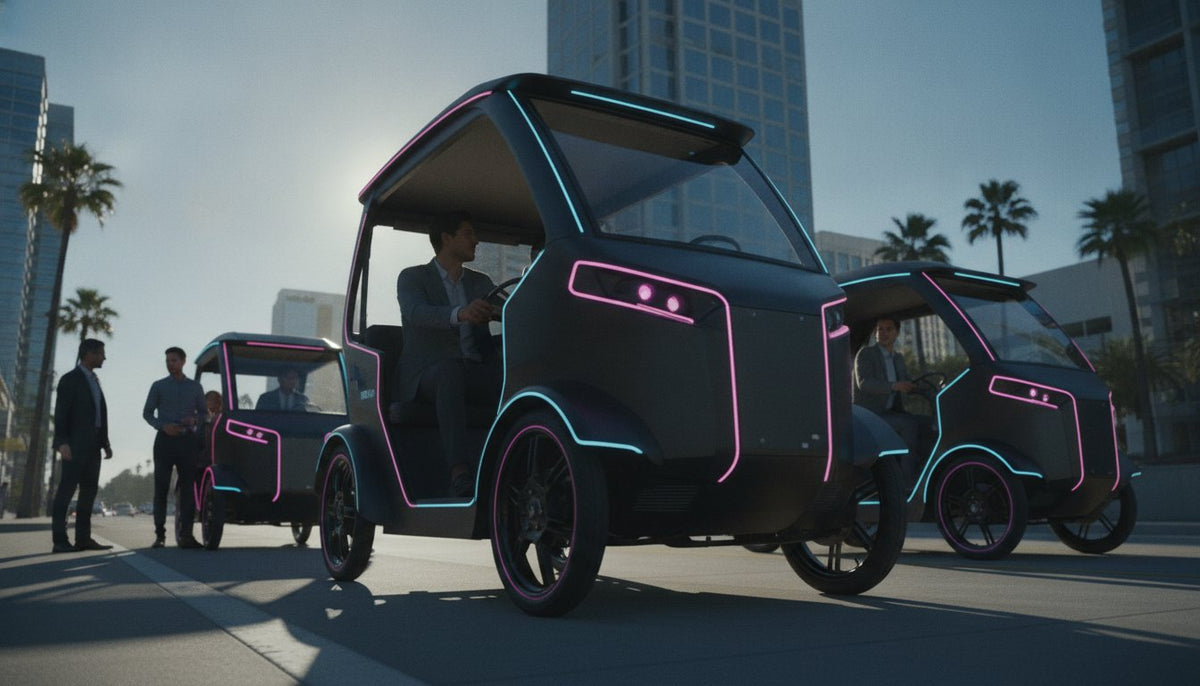
A single electric pedicab isn't just a vehicle; it's a high-yield mobile asset capable of generating over $30,000 in annual revenue. You recognize that the micro-mobility market is surging, but the upfront cost for industrial-grade equipment often feels like a significant hurdle. Uncertainty about daily returns and long-term maintenance can stall even the most ambitious entrepreneurs. We've spent over 20 years in the trenches of fleet operations to eliminate that guesswork. Use our pedicab fleet ROI calculator to transform vague projections into a concrete financial blueprint for your operation.
This article delivers the data you need to secure funding from investors or lenders with absolute confidence. We provide a side-by-side profitability comparison of our $13,500 3-seat models and our high-capacity $17,500 6-seat units. You'll see exactly how the rugged engineering of a CyberX or VorteX chassis converts into sustained commercial dominance rather than mounting repair bills. Stop speculating about your margins. Follow this veteran analysis to master the economics of electric transit and scale your fleet for maximum profitability in 2026.
Key Takeaways
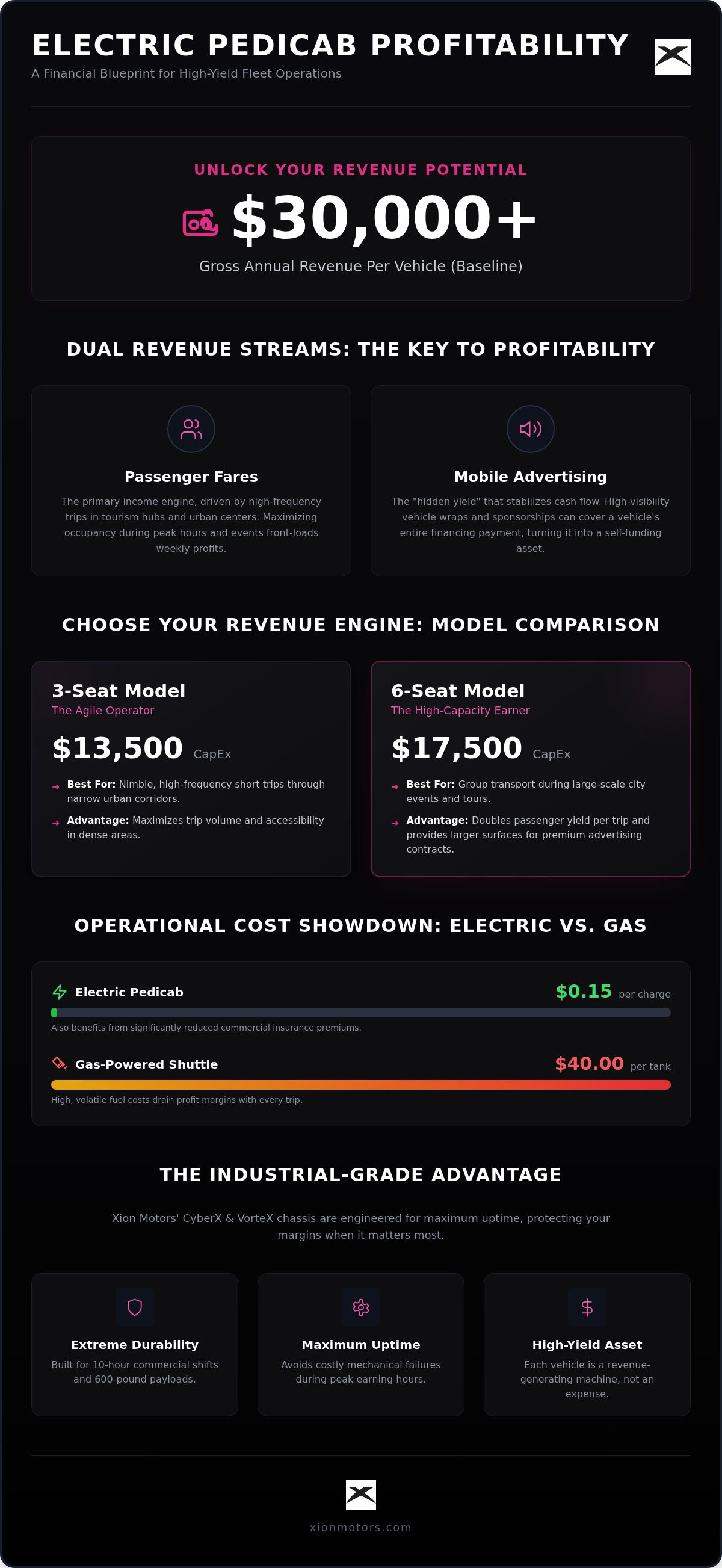
- Discover how to unlock $30,000+ in annual revenue per vehicle by combining high-margin passenger fares with lucrative mobile advertising contracts.
- Utilize our comprehensive pedicab fleet ROI calculator to project your 2026 profitability based on the specific CapEx for 3-seat and 6-seat industrial-grade models.
- Learn why electric pedicabs outperform gas shuttles with operational costs as low as $0.15 per charge and significantly reduced commercial insurance premiums.
- Identify the structural advantages of the CyberX and VorteX chassis that ensure long-term durability and minimize maintenance-related downtime.
- Master the "Master Practitioner" approach to scaling from a single unit to a high-leverage fleet package for exponential market dominance.
Beyond the Purchase Price: The Unique Economics of Electric Pedicab Fleets
True profitability in the micro-mobility sector isn't found in a simple spreadsheet. It's the aggressive intersection of industrial durability and diversified revenue streams. Real ROI for a pedicab fleet is the product of minimal operational overhead and maximized passenger yield. Most generic tools fail because they only look at fares. Our pedicab fleet ROI calculator factors in the high-margin world of mobile advertising, which frequently doubles your per-vehicle earnings without adding a single mile of wear to the chassis.
Starting at $13,500 for a 3-seat model, these vehicles are capital expenditures designed for extreme utilization. We don't view them as equipment; we view them as revenue-generating machines. Cheap consumer-grade bikes fail under commercial pressure. A consumer bike might cost less upfront, but it isn't designed for 10-hour shifts with a 600-pound payload. Mechanical failure during a peak festival weekend doesn't just cost you a repair bill; it wipes out your highest-earning hours. Industrial-grade engineering is the only way to protect your margins. While our focus remains on industrial assets, those looking for premium consumer-grade electric ride-ons for kids can learn more about Hoveroo.
The Asset vs. Expense Mindset
Don't view a pedicab as a delivery cost. It's a high-yield asset. Xion Motors has spent over 20 years refining this economic model through real-world fleet management in the most demanding urban environments. Success hinges on your utilization rate. This is the percentage of time your vehicle is active and earning. By treating each trike as a mobile billboard and a transit solution, you diversify your income. This dual-revenue approach ensures that even on slow passenger days, your fleet remains profitable through active ad contracts.
Why Electric Power Changes the Math
Fuel costs are a relic of the past. In 2026, charging an electric trike costs roughly $0.15 per cycle. Compare that to gas-powered shuttles that drain your margins with every $40 tank. High-torque electric motors allow operators to complete more trips per shift without hitting the wall of physical fatigue. You get faster turnarounds and happier drivers. This efficiency is backed by CyberX engineering standards, which prioritize uptime over fragile aesthetics. When your fleet stays on the street, your pedicab fleet ROI calculator starts showing the numbers that attract serious investors.
Key Revenue Drivers: How a Single Pedicab Generates $30,000+ Annually
Revenue isn't a guess; it's a projection of street-level variables. While competitors focus on saving pennies on maintenance, the elite operator focuses on capturing dollars. A single unit in a high-traffic district can easily surpass $30,000 in gross annual revenue. This figure is the baseline for our pedicab fleet ROI calculator. It accounts for the synergy between active transit and passive media exposure. You aren't just selling a ride; you're selling a high-visibility experience in the heart of the city.
The Fare Revenue Breakdown
Passenger fares are your primary engine. In 2026 tourism hubs, riders expect premium, efficient transport. A standard 6-hour shift with a 70% occupancy rate allows for consistent cash flow. A 3-seat model is perfect for nimble, high-frequency short trips through narrow corridors. However, the 6-seat configuration changes the math entirely. It allows you to double your passenger yield per trip without doubling your labor costs. More seats mean more revenue per mile, especially during large-scale city events where group transport is at a premium. By maximizing your occupancy during peak windows, you front-load your profits for the entire week.
Advertising and Sponsorship ROI
Mobile advertising is the "hidden" yield that stabilizes your business. High-visibility vehicle wraps turn your fleet into a localized media network. In major entertainment districts, a single monthly sponsorship can often cover the entire financing payment for the vehicle. This turns your equipment into a self-funding asset. For those looking to maximize ad real estate, our 6-seat fleet operations guide details how to leverage larger chassis surfaces for higher sponsorship tiers. More surface area equals higher CPM for your brand partners.
Beyond daily fares and ads, event contracts provide massive lump-sum opportunities. Corporate festivals and sports championships often seek "buy-outs" where they pay a flat fee for your entire fleet to provide free rides to attendees. This eliminates the uncertainty of individual fares and guarantees high-margin utilization. Additionally, the electric assist on our trikes isn't just for speed; it's for driver retention. Drivers who aren't exhausted by physical exertion provide better service, which directly correlates to higher tips and gratuities. If you're ready to build your own high-yield fleet, explore our Pedicab Fleet Packages to see the industrial-grade difference.
Operating Costs vs. Revenue: Pedicabs vs. Gas-Powered Shuttles
Efficiency is the bedrock of commercial scaling. When you input your data into a pedicab fleet ROI calculator, the most aggressive variance doesn't come from revenue spikes; it comes from the elimination of operational bleed. Traditional gas-powered shuttles are profit-killers in a modern urban environment. A standard commercial van requires $40 or more for a single tank of fuel. In contrast, an electric pedicab costs approximately $0.15 per full charge. Over a 300-day operating season, that single metric saves you nearly $12,000 per vehicle. This isn't just a marginal gain. It's the difference between a struggling service and a dominant fleet.
Insurance premiums reinforce this advantage. Low-speed electric trikes carry significantly lower liability profiles than heavy commercial vans. You don't just save on monthly payments; you simplify your entire risk management strategy. While internal combustion engines face steep depreciation as parts wear and emissions standards tighten, the industrial-grade Xion chassis retains its value. Our engineering focuses on structural longevity, ensuring your 3-seat or 6-seat asset remains a liquid and valuable piece of equipment for years. High resale value is a critical component of long-term profitability that many amateur operators overlook.
Maintenance and Longevity Protocols
Reliability is a function of engineering, not luck. Our pedicab maintenance guide outlines the exact protocols required to sustain peak performance. Electric motors eliminate the hundreds of moving parts found in gas engines. There are no oil changes, transmission flushes, or exhaust systems to manage. Xion Motors utilizes modular parts, allowing your team to swap components in minutes rather than days. This approach minimizes downtime and ensures a lower total cost of ownership over a 5-year lifecycle. When your vehicles stay on the street, your revenue remains uninterrupted.
Regulatory and Licensing Savings
The regulatory landscape in 2026 heavily favors micro-mobility. Operating a gas shuttle often requires drivers to hold a Commercial Driver's License (CDL), which narrows your hiring pool and increases labor costs. Most jurisdictions permit electric pedicabs with standard licensing and simple municipal permits. Additionally, many regions offer aggressive tax incentives for deploying zero-emission fleets. These savings, combined with the ability to navigate congested entertainment districts where vans are banned, provide a level of operational agility that gas-powered competitors cannot match. By accounting for these regulatory wins in your pedicab fleet ROI calculator, you see a much faster path to net profit.
Building Your Custom ROI Model: A Step-by-Step Calculation Guide
Transforming your business vision into a mathematical certainty requires a disciplined approach. Use this framework as your internal pedicab fleet ROI calculator to strip away the guesswork and define your 2026 targets. We've refined this process over two decades of street-level operations; it's designed to withstand the scrutiny of lenders and the reality of urban transit.
- Step 1: Determine Capital Expenditure (CapEx). Start with the base price of your chosen units. A 3-seat model is $13,500, while a 6-seat unit is $17,500. Factor in any custom branding or fleet package discounts.
- Step 2: Project Daily Revenue. Combine your average passenger fares with prorated daily advertising income. Aim for a conservative $150 to $250 per unit during peak operating windows.
- Step 3: Subtract Monthly Operational Expenses (OpEx). Include the $0.15 charging cost per cycle, commercial insurance, and a small reserve for wear-and-tear parts like tires and brake pads.
- Step 4: Calculate the Payback Period. Divide your total CapEx by your monthly net profit. This reveals exactly how many months it takes for the vehicle to pay for itself and start generating pure profit.
The 3-Seat CyberX Calculation
The CyberX model, priced at $13,500, is the definitive choice for solo operators or contractors focusing on high-frequency, short-distance transit. In a "Solo Operator" scenario, you retain 100% of the fare and tip revenue. If you use a "Contractor" model, you lease the vehicle to drivers for a flat daily fee, typically ranging from $50 to $100 depending on the shift. This provides a predictable, passive income stream that covers your financing costs quickly. Most operators see a break-even point on a single 3-seat unit within four to six months of active seasonal operation.
The 6-Seat VorteX Calculation
For high-capacity transit, the $17,500 VorteX model offers a superior revenue ceiling. You are effectively doubling your passenger capacity on the exact same labor cost as a 3-seat unit. This leverage is critical for event-based operations and corporate contracts. When you review our VorteX engineering case studies, you'll see how the industrial-grade chassis handles the increased payload without sacrificing speed or uptime. The higher CapEx is offset by the ability to secure larger advertising wraps and premium group fares. If you're ready to scale, it's time to invest in a high-yield fleet package that fits your specific market needs.
Scaling Your Success: Industrial-Grade Fleet Packages from Xion Motors
Growth in the micro-mobility sector follows a non-linear path. While a single vehicle establishes your presence, a fleet of five or more units creates a dominant market force. This scale exponentially increases your advertising leverage. Brands don't just want a single trike; they want a city-wide takeover. By deploying a coordinated fleet, you command higher sponsorship rates and secure the large-scale event contracts that amateur operators can't touch. Our pedicab fleet ROI calculator demonstrates that as your fleet size increases, your fixed costs per unit drop, and your revenue ceiling rises.
The Fleet Package Advantage
Efficiency at scale requires standardization. Our scaling guide for fleet packages details how to transition from a solo venture to a commercial transit operation. Every Xion Motors build is a turn-key solution, engineered with modular components to ensure your entire fleet stays operational. Standardizing your equipment with our $13,500 3-seat and $17,500 6-seat models means your maintenance protocols remain identical across every vehicle. This consistency reduces downtime and simplifies parts management, protecting the profitability you projected in your initial calculations.
Starting Your Professional Blueprint
Success in this industry isn't accidental. It's the result of following a proven blueprint for starting a pedicab company. Xion Motors provides more than just hardware; we offer the "Master Practitioner" support that only 20 years of street-level experience can produce. We offer national shipping and competitive fleet pricing to lower the CapEx barrier for serious entrepreneurs. Whether you're eyeing the nimble CyberX or the high-capacity VorteX, our engineers are available for direct consultation to help you refine your custom pedicab fleet ROI calculator projections.
The math is clear. The demand for zero-emission urban transit in 2026 is at an all-time high. It's time to stop running numbers and start generating revenue. Review the latest specs for our 3-seat and 6-seat configurations and take the decisive step from operator to market leader.
Secure Your Market Dominance in 2026
The 2026 micro-mobility market demands more than just vehicles; it requires high-performance assets that generate consistent returns. You've seen how the dual-revenue model of passenger fares and mobile advertising creates a path to $30,000 in annual revenue per vehicle. Industrial-grade engineering isn't a luxury. It's the only way to ensure your fleet stays on the street during peak earning windows. By utilizing our pedicab fleet ROI calculator, you've moved from speculation to a professional financial blueprint.
Xion Motors brings 20+ years of operational expertise to your expansion. Our CyberX and VorteX chassis are built for the rigors of commercial transit, backed by the reliability of a veteran manufacturer who knows the street-level math. We offer national shipping to all 50 states to ensure your fleet is ready for the upcoming season. Don't leave your profitability to chance. Take the next step toward building a high-yield transit network that dominates your local market.
Calculate Your Potential: Contact Xion Motors for Fleet Pricing
Build your legacy with tools designed for the street.
Frequently Asked Questions
What is the average payback period for a 3-seat electric pedicab?
Most operators achieve a full return on investment within four to six months of active seasonal use. This timeline assumes consistent utilization in a high-traffic district and a mix of passenger fares and sponsorship revenue. By using our pedicab fleet ROI calculator, you can map out your specific break-even point based on local permit fees and driver labor structures. High-durability engineering ensures the vehicle stays on the street, which is critical for hitting these short-term financial targets.
How much can I realistically charge for advertising on a 6-seat pedicab?
Market rates for full vehicle wraps on a 6-seat VorteX typically range from $300 to $800 per month depending on the location's foot traffic. Because these units offer double the surface area of standard trikes, they command premium sponsorship tiers. A single high-value contract can often cover the monthly financing or operational costs of the entire vehicle. This passive income stream stabilizes your cash flow during slower passenger periods, making the 6-seat model a powerful asset for diversified revenue.
Do electric pedicabs require a special commercial drivers license (CDL)?
No, electric pedicabs generally don't require a Commercial Driver's License (CDL) because they're classified as low-speed electric vehicles or bicycles in most jurisdictions. This regulatory advantage significantly lowers your barrier to entry and expands your potential hiring pool. It's always best to verify specific local municipal codes regarding pedicab permits. Avoiding the rigorous training and insurance requirements of CDL-class vehicles like gas shuttles keeps your overhead low and your operational agility high.
What are the primary maintenance costs for an industrial-grade electric trike?
Primary maintenance for an industrial-grade electric trike focuses on high-wear components like tires, brake pads, and drive chains. Unlike internal combustion engines, there are no oil changes or complex transmission repairs. You should budget approximately $500 to $800 annually per vehicle for routine parts replacement. Xion Motors supplies modular vehicle parts to ensure repairs are fast and simple. This predictable maintenance schedule prevents the expensive, unplanned downtime that often destroys the profitability of lower-quality consumer-grade equipment.
Can I finance a pedicab fleet through Xion Motors?
Xion Motors focuses on direct-to-operator sales and manufacturing excellence. While we don't provide in-house financing directly, we offer comprehensive data and custom ROI projections to help you secure funding through third-party commercial lenders or investors. Our 20 years of operational experience allow us to provide the historical revenue data and durability proof points that banks require for equipment loans. We also offer specialized fleet pricing packages to help reduce the initial capital expenditure for multi-unit operations.
How does the ROI of a pedicab compare to a traditional gas-powered golf cart?
Pedicabs offer a significantly higher ROI than gas-powered golf carts due to the total elimination of fuel costs and lower insurance premiums. A gas cart can cost $40 per day in fuel, while an electric trike costs roughly $0.15 per charge. Additionally, pedicabs can navigate narrow pedestrian zones and congested areas where golf carts are often prohibited. This increased access leads to higher utilization rates and more passenger pickups, directly boosting the figures in your pedicab fleet ROI calculator.
What is the expected lifespan of a CyberX chassis in a commercial fleet?
The industrial-grade CyberX chassis is engineered for a commercial lifespan of 10 or more years under heavy daily use. We utilize high-tensile steel and precision welding to withstand the constant vibration and heavy payloads of urban transit. While components like tires and batteries will need periodic replacement, the core structural frame remains a long-term asset. This durability ensures that your vehicle retains a high resale value, which is a critical but often overlooked component of total commercial profitability.
How do battery replacement costs impact long-term ROI calculations?
Battery replacement is a planned capital expense that typically occurs every three to five years depending on your cycle depth and climate. While the upfront cost for a high-capacity lithium pack is a consideration, it's offset by the thousands of dollars saved in gas and engine maintenance over that same period. Modern battery technology in 2026 provides higher energy density and longer cycle life. Factoring these scheduled replacements into your long-term ROI model ensures your business remains solvent and profitable over a decade-long horizon.