An electric pedicab isn't just a vehicle; it's a high-yield industrial asset where durability dictates every cent of your net profit. You already understand that the sticker price is just the entry fee to a much larger financial game. Between the looming threat of battery failure and the shifting landscape of municipal permit fees, the fear of unexpected downtime keeps many operators from scaling their business. It's a valid concern because a unit sitting in the shop is a unit losing money.
This guide will help you master the electric pedicab total cost of ownership by providing the precise financial math required to maximize your ROI. We've built this framework from decades of experience in the trenches of industrial engineering and commercial transport. You'll learn how to achieve a clear 12-month payback plan and minimize lifetime maintenance expenses through superior component selection. We're moving beyond the whimsical hype to focus on the rugged reality of street-level operations. We will analyze predictable annual expenses and revenue streams to ensure your fleet remains a dominant force in the market.
Key Takeaways
- Calculated Investment: Learn to master the electric pedicab total cost of ownership by factoring in industrial-grade durability and long-term operational uptime.
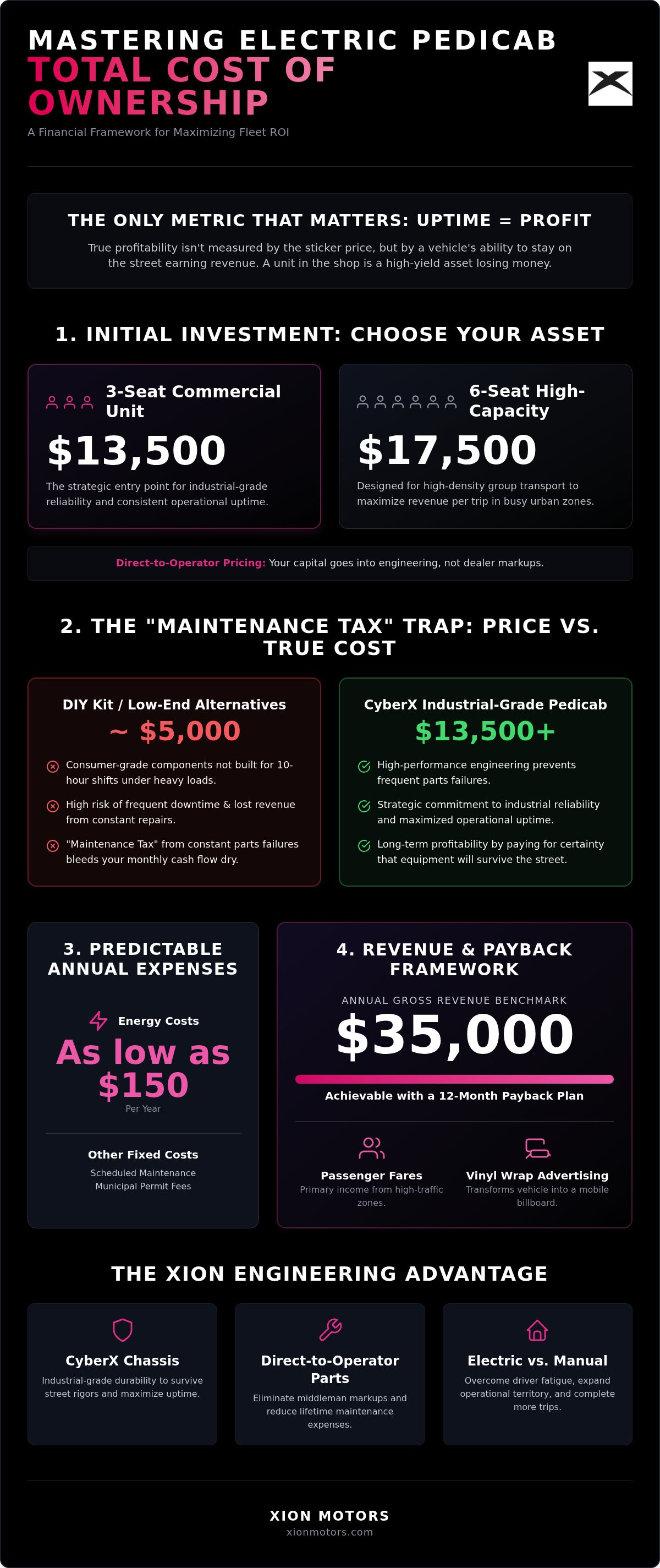
- Capital Strategy: Analyze the financial impact of the $13,500 entry point for 3-seat units versus the high-capacity $17,500 6-seat models.
- Revenue Maximization: Discover how to reach the $35,000 annual gross revenue benchmark by integrating passenger fares with professional vinyl wrap advertising.
- Engineering Advantage: Reduce lifetime maintenance expenses by utilizing the CyberX chassis and direct-to-operator parts availability to eliminate middleman markups.
- Operational Efficiency: Forecast predictable annual expenses, including energy costs as low as $150, to ensure your fleet remains a high-yield commercial asset.
Beyond the Sticker Price: Why TCO Dictates Pedicab Profitability
Smart fleet operators don't look at a price tag; they look at a balance sheet. The initial purchase price of a vehicle is merely the opening move in a long-term financial strategy. To dominate a local market, you must understand that the electric pedicab total cost of ownership is the only metric that actually determines your take-home profit at the end of the year. This figure represents the comprehensive sum of acquisition, daily operational energy, regulatory compliance, and scheduled maintenance over the vehicle's functional lifespan.
In the commercial sector, uptime is the primary driver of revenue. When a vehicle is sidelined due to a sheared axle or a fried controller, your income doesn't just stall; it evaporates while your fixed overhead remains constant. For a foundational understanding of the industry's economic roots, this Cycle rickshaw overview provides context on how these vehicles transitioned from manual labor to high-yield electric assets. Total Cost of Ownership (TCO) in commercial micro-transit is the total financial burden of keeping a unit on the street and earning every single day.
The Difference Between Price and Cost
Choosing a $5,000 DIY conversion kit might seem like a shortcut to growth, but it often triggers a "Maintenance Tax" that bleeds your monthly cash flow dry. These consumer-grade components aren't designed for 10-hour shifts under heavy loads. In contrast, a $13,500 investment in a CyberX represents a strategic commitment to industrial reliability. High-performance engineering prevents the frequent parts failures that plague cheaper alternatives. You're paying for the certainty that your equipment will survive the rigors of the street without constant, expensive interventions.
The Hidden Costs of Manual Fleet Operations
Operating a manual fleet in 2026 is a recipe for high turnover and stagnant growth. Human power has limits, and those limits translate directly into lost territory and missed fares. Electric assist isn't just a convenience; it's a force multiplier that expands your operational radius. Consider these operational drains found in manual fleets:
- Driver Fatigue: Exhausted operators take more breaks and quit sooner, forcing you into a constant, costly cycle of hiring and training.
- Slow Turnover: Manual units move slower, meaning fewer completed trips during peak "surge" pricing windows.
- Territory Restrictions: Without high-torque motors, hilly districts or high-speed corridors remain off-limits, handing that revenue to your competitors.
By investing in a professional-grade fleet, you optimize your electric pedicab total cost of ownership by trading low-quality labor for high-efficiency technology. This shift ensures your units stay in the high-traffic zones where the real money is made.
Capital Expenditure (CapEx): Analyzing Initial Fleet Investment Costs
Capital Expenditure represents the heavy lifting phase of your business deployment. While the sticker price is the most visible number, it's only the foundation of a successful electric pedicab total cost of ownership strategy. For a 3-seat commercial unit, the entry point is $13,500. This is a strategic investment in a vehicle built for industrial longevity. If your business model targets high-density group transport, the 6-seat high-capacity models require a $17,500 investment. These figures are direct-to-operator; we eliminate dealer markups to ensure your capital goes directly into the engineering of the frame and drivetrain.
Analyzing these costs requires the same rigor used by municipal planners. Research regarding the Total Cost of Ownership for Public Fleets shows that professional operators often save significantly by prioritizing electric infrastructure despite higher initial costs. Your fleet operates on the same logic. Beyond the base price, you must budget for freight shipping and professional vinyl branding wraps. These wraps transform your vehicle into a mobile billboard, creating a secondary revenue stream that offsets your initial outlay.
3-Seat vs. 6-Seat: Which Fits Your Business Model?
Revenue per mile is the heartbeat of your operation. A 6-seat unit generates higher fare potential per trip, yet it requires wider lanes and more aggressive torque management. Conversely, the 3-seat model offers superior operational agility in tight historical districts where passenger turnover is high. Choosing the wrong size creates a mismatch between your equipment and your environment. Refer to our 6 seat electric pedicab guide to determine which capacity best supports your specific route planning and passenger density goals.
Volume Procurement and Fleet Discounts
Scaling your operation quickly is the most effective way to protect your market territory. We incentivize rapid growth through aggressive pricing tiers. A fleet of 3 to 9 units qualifies for a 10% discount. For those deploying 10 or more units, a 15% discount applies. This brings the effective per-unit price of a 3-seat model down to approximately $11,475. Utilizing electric pedicab fleet packages allows you to amortize the initial purchase over a 5-year vehicle lifespan, drastically lowering your annual CapEx burden. If you're ready to calculate your specific deployment costs, you can view our current fleet options to start your ROI modeling.
Variable Operating Costs: Maintenance, Energy, and Regulatory Fees
Managing a fleet requires moving beyond the excitement of the initial purchase and into the granular reality of daily operation. Energy is cheap; downtime is expensive. While electricity costs are remarkably low, typically averaging between $50 and $150 per year for charging cycles, they represent just one facet of the variable expenses that define the electric pedicab total cost of ownership. High-performance operators focus on the "Parts Continuity" factor; they understand that using authentic commercial trike replacement parts is the only way to ensure industrial-grade performance. Cutting corners with third-party components often leads to a cascade of mechanical failures that erode your net margins.
Predicting Maintenance and Downtime
A 3,000-mile wear analysis reveals the stark divide between consumer-grade hubs and industrial motors. In a commercial environment, standard e-bike kits often face catastrophic failure within the first quarter of operation. Industrial high-torque systems reduce drivetrain stress by distributing power more efficiently across heavy-duty chains and axles. This engineering precision is vital because a single "Day Off the Road" (DOR) can cost a busy operator upwards of $150 in lost fares and advertising visibility. To maintain a competitive electric pedicab total cost of ownership, your crew should master these weekly tasks:
- Hydraulic Brake Inspection: Checking fluid levels and pad wear to ensure stopping power under max load.
- Drivetrain Calibration: Adjusting chain tension and lubricating high-torque contact points.
- Tire Pressure Optimization: Maintaining exact PSI to minimize rolling resistance and maximize battery range.
Regulatory and Compliance Costs
The regulatory landscape is shifting, as seen in recent legislative updates requiring stricter registration and insurance for electric micro-mobility. National averages for city operator permits currently range from $200 to $800, while vehicle registration typically adds another $50 to $200 per unit. Commercial liability insurance is a non-negotiable expense, often costing between $1,200 and $2,400 in the first year. Understanding your EV Fleet TCO with Tax Credits can help mitigate these costs, as federal incentives often apply to commercial electric fleet deployments.
Compliance begins with your hardware. Utilizing street legal electric pedicabs is essential for clearing the permit approval process in major metropolitan districts. Regulators prioritize safety and structural integrity, so operating vehicles that meet industrial standards is the fastest way to secure your city permits and keep your fleet earning. By planning for these variable costs upfront, you transform unpredictable emergencies into manageable line items on your monthly P&L statement.
Revenue Modeling and the 12-Month Payback Framework
Revenue is the only metric that justifies the machine. In the commercial pedicab industry, a single unit typically generates between $30,000 and $35,000 in annual gross revenue. This isn't a speculative projection; it's the documented benchmark for professional operators utilizing industrial-grade equipment. By subtracting your calculated operating expenses from this gross total, you arrive at a net ROI that supports a definitive 12-month payback period. When you master the electric pedicab total cost of ownership, you stop viewing the vehicle as an expense and start managing it as a high-velocity cash generator.
Scaling the model further accelerates your path to profitability. A 5-unit fleet deployment allows you to amortize fixed costs, such as storage and insurance, across multiple assets while commanding higher advertising rates. This structural advantage ensures that your business reaches the break-even point faster than a single-unit operation. Success in this field requires an aggressive, revenue-first mindset that prioritizes uptime and market visibility.
Passenger Fare Dynamics
Fare revenue remains your primary engine for daily cash flow. In high-traffic entertainment districts, operators typically charge between $5 and $10 per person per ride, which can generate upwards of $25,000 annually in fare revenue alone. High-torque electric motors are essential here because they allow for faster passenger turnover during peak surge windows. If you're currently in the planning phase, our professional blueprint for starting a pedicab company provides the strategic framework needed to manage seasonal variances and maintain consistent earnings throughout the year.
Unlocking Advertising Revenue
Passive income is the secret weapon of the elite fleet operator. A professional vinyl wrap transforms your chassis into a high-value mobile billboard, commanding between $800 and $2,500 per month in advertising spend from local business partners. These wraps do more than generate passive profit; they provide an extra layer of protection for the vehicle's structural finish, preserving its long-term resale value. This "Double Revenue" model ensures that even on slow fare days, your equipment is still earning. By integrating these two streams, you maximize the utility of every unit in your fleet.
Ready to model your own fleet's profitability? Explore our high-performance electric pedicabs and secure your market territory today.
Engineering for Longevity: How Xion Motors Minimizes Lifetime TCO
Engineering is the final, most critical pillar of your financial strategy. When you evaluate the electric pedicab total cost of ownership, the frame's structural integrity is the ultimate variable that determines if your asset lasts three years or twenty. The CyberX chassis outlasts consumer-grade frames by utilizing industrial-grade materials and reinforced stress points designed specifically for high-torque loads. We sell direct-to-operator to eliminate the parasitic dealer markups and middleman fees that inflate your initial CapEx. This direct approach ensures every dollar you spend is an investment in the vehicle's engineering rather than a distributor's commission. For operations requiring specialized configurations or extreme durability, the Custom VorteX Trike stands as the gold standard for heavy-duty business use.
USA-Built Quality vs. Overseas Imports
Choosing an overseas import might save a few dollars upfront, but the real cost surfaces the moment a critical component fails. Waiting weeks for international shipping on replacement parts creates a DOR (Day Off the Road) crisis that can bankrupt a small fleet. We provide national parts support across all 50 states to ensure commercial continuity. Our precision engineering doesn't just keep you on the road; it protects your long-term vehicle resale value. Xion’s 20-year legacy in fleet operations serves as a proven record of durability that no newcomer can match. National shipping availability ensures that whether you're operating a single unit or a massive fleet, you have immediate access to the components required for maximum uptime.
Optimizing Your Fleet for 2026 and Beyond
Future-proofing your investment requires a focus on energy density and charging efficiency. We equip our units with high-capacity battery systems designed to handle the rigorous duty cycles of modern urban transit. This hardware ensures your fleet remains competitive as city regulations and passenger expectations evolve. Xion Motors provides more than just a vehicle; we deliver a perfected industrial tool designed to maximize your ROI. For the serious operator, choosing Xion means securing a partner invested in your growth and a fleet built to dominate the market for years to come. We don't just build trikes; we build the infrastructure for your entrepreneurial success.
Securing Your Market Position with Industrial-Grade Assets
Mastering the electric pedicab total cost of ownership is the difference between running a hobby and managing a high-yield commercial enterprise. You've seen how industrial reliability and aggressive revenue modeling turn a vehicle into a cash-generating engine. By prioritizing uptime through superior engineering, you eliminate the hidden costs that drain lesser fleets. Xion Motors provides the definitive tools to dominate your local district. We offer direct-to-operator pricing and industrial-grade CyberX engineering to ensure your capital works as hard as your drivers do. With national shipping to all 50 states and a proven 12-month payback period, the path to scaling your operation is clear and predictable. It's time to transition from manual uncertainty to electric precision. Trust the craftsmanship of a veteran manufacturer and build a legacy of performance on every street you serve.
View Xion Motors Fleet Pricing and Build Your ROI Model. Your future as a market leader starts with the right equipment.
Frequently Asked Questions
How much does a commercial electric pedicab cost in 2026?
A new 3-seat commercial electric pedicab costs $13,500, while the high-capacity 6-seat model is priced at $17,500. These figures reflect direct-to-operator pricing, which eliminates middleman markups and ensures your capital is invested directly into industrial-grade engineering. These prices provide the baseline for calculating your electric pedicab total cost of ownership. By purchasing directly from the manufacturer, you secure high-torque performance and structural integrity without the hidden fees common in third-party dealerships.
What is the average lifespan of an industrial-grade electric pedicab?
Industrial-grade units like the CyberX are engineered for a service life that far exceeds consumer-grade alternatives. While many operators amortize their initial investment over a 5-year vehicle lifespan, the reinforced chassis and heavy-duty drivetrain components are built to survive the rigors of daily commercial use for a decade or more with proper maintenance. Xion Motors draws on over 20 years of fleet experience to ensure every weld and component withstands the high-torque demands of modern urban transit.
How much can I expect to earn per year with one electric pedicab?
A single unit can generate between $30,000 and $35,000 in annual gross revenue. This industry benchmark is achieved through a combination of passenger fares and high-value vinyl wrap advertising. In a busy market, fare revenue alone typically accounts for $20,000 to $25,000 per year. When you integrate passive advertising income from local sponsors, your fleet becomes a high-yield asset that significantly offsets the initial electric pedicab total cost of ownership within the first year of operation.
What are the typical maintenance costs for an electric pedicab fleet?
Annual maintenance and energy expenses are remarkably manageable for a professional fleet. Expect to spend between $300 and $800 per unit on wear items like brake pads, tires, and chain tensioning. Electricity for daily charging cycles is highly efficient, typically costing between $50 and $150 annually. By following a proactive maintenance protocol and using authentic vehicle parts, you minimize the risk of expensive downtime and ensure your fleet remains operational during peak earning windows.
Do Xion Motors electric pedicabs come with a warranty?
Xion Motors provides robust national parts support and technical expertise to keep your fleet on the road. While specific coverage details vary by component, our focus remains on providing industrial-grade reliability and immediate access to replacement parts across all 50 states. We prioritize commercial continuity by manufacturing our units with precision engineering. This authoritative support ensures that operators have a reliable partner for maintaining fleet performance and protecting their long-term investment in micro-mobility infrastructure.
How long does it take for an electric pedicab to pay for itself?
Most operators achieve a full return on their investment in under 12 months. This rapid payback period is driven by the dual-revenue model of fares and mobile billboard advertising. Because our units are built for maximum uptime, you don't lose precious earning days to mechanical failures. By the second year of operation, your fixed costs drop significantly, allowing the vast majority of your gross revenue to flow directly into net profit for your business.
Are there financing or fleet discounts available for new operators?
We offer aggressive fleet discounts to help operators scale their businesses quickly. Fleets consisting of 3 to 9 units qualify for a 10% discount, while deployments of 10 or more units receive a 15% discount. This volume pricing allows you to lower your per-unit entry cost and accelerate your path to profitability. These packages are designed for serious entrepreneurs who recognize the market opportunity in high-density entertainment districts and national tourism hubs.
What is the difference in TCO between a 3-seat and 6-seat model?
The primary difference lies in the initial $4,000 capital expenditure and the specific revenue density of your operational district. A 6-seat model offers higher fare potential per trip, but it requires more torque and has a slightly larger footprint. A 3-seat model provides superior agility in narrow historical corridors. Both models benefit from the same low energy costs, but your choice should depend on whether your strategy prioritizes high-volume group transport or high-frequency passenger turnover.