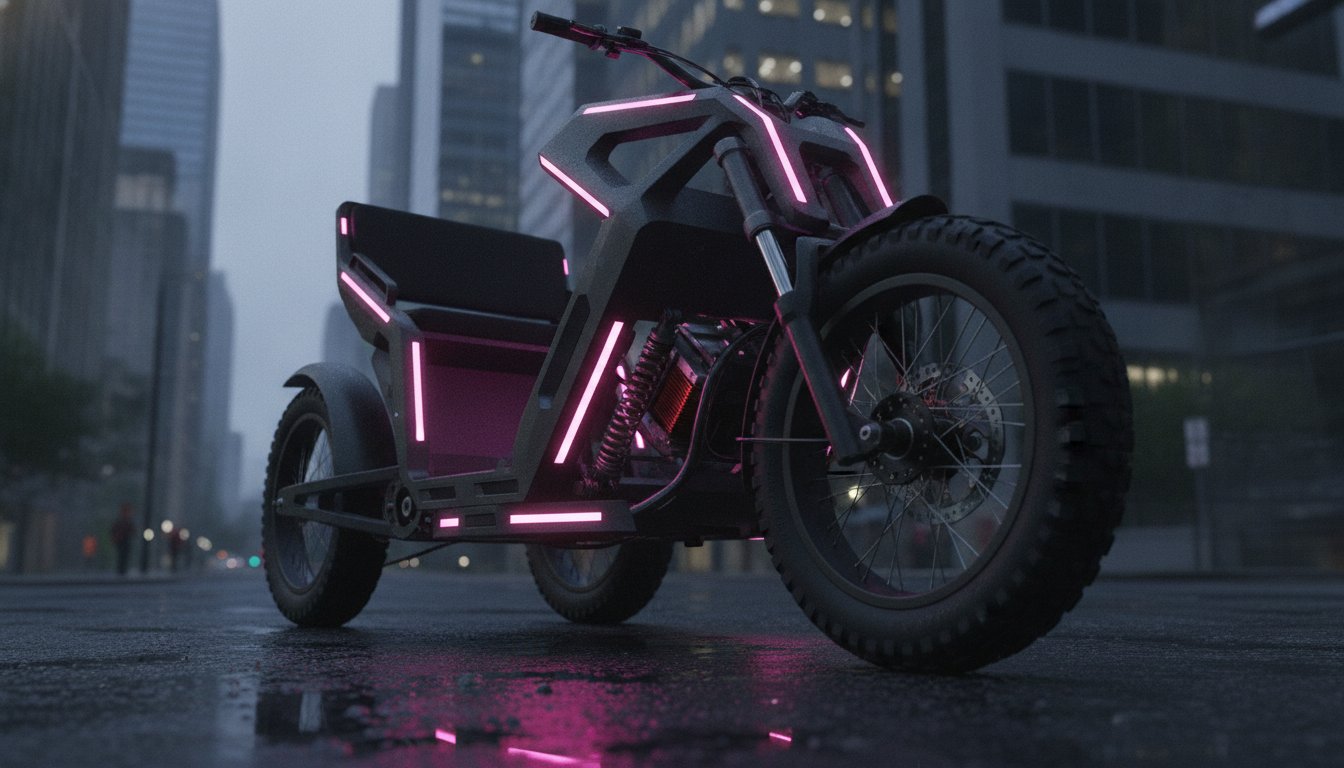
If you're still treating your fleet like a collection of upgraded bicycles, you're leaving serious annual revenue on the table. The era of the hobbyist operator is over. Success in today's market requires more than just a motor and three wheels. Transitioning to commercial electric pedicabs isn't just about going green; it's about deploying industrial-grade machines built for the relentless demands of modern urban transit. You need equipment that works as hard as your drivers do, day after day, without fail.
We know the frustration of navigating complex regulatory shifts like the new licensing frameworks in London or California's strict UL safety standards while managing the high maintenance costs of unreliable builds. You need gear that stands up to the street, not a toy that spends half its life in the repair shop. This guide provides the high-ROI blueprint you need to scale your operations with total confidence. We'll examine the technical requirements for a professional fleet, identify the massive revenue potential of electric trikes, and show you how to select a manufacturer with the engineering pedigree to ensure your investment lasts for years.
Key Takeaways
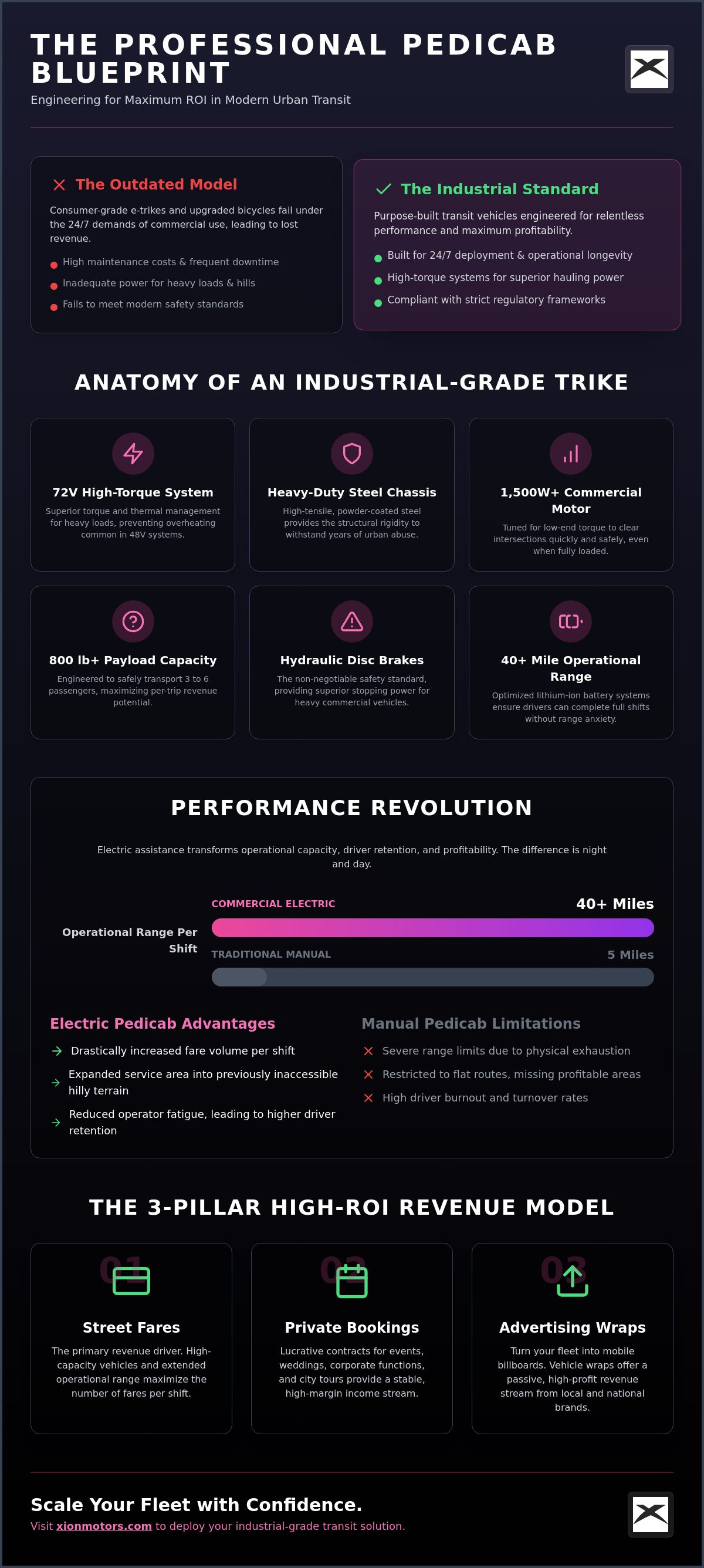
- Understand the engineering requirements of industrial-grade transit, from high-torque 72V systems to heavy-duty steel chassis built for 24/7 deployment.
- Unlock the three-pillar revenue model that empowers commercial electric pedicabs to deliver high-ROI results through fares, private bookings, and advertising wraps.
- Master the 2026 regulatory requirements and safety standards to ensure your fleet remains street-legal without compromising on-road performance.
- Evaluate the scaling potential of various fleet packages to select the right mix of 3-seater and 6-seater vehicles like the VorteX for your territory.
- Identify the critical maintenance protocols and essential vehicle parts needed to maximize the operational longevity of your industrial trike investment.
The Evolution of Commercial Electric Pedicabs in 2026
The urban transit market has fundamentally shifted. We're no longer looking at leisure toys or modified bicycles; we're looking at industrial assets. Industrial-grade electric pedicabs are purpose-built three-wheeled transit vehicles designed for heavy-duty commercial use. They represent a massive leap from the rickshaws of the past. To understand where the industry stands today, we have to look at The Evolution of Commercial Electric Pedicabs from simple manual frames to high-torque 72V electric drive systems. This transition isn't just a technical upgrade. It's a total reimagining of what micro-transit can achieve for a fleet operator's bottom line.
Defining the Modern Commercial Standard
A true commercial unit starts with raw power. We're talking 1,500W+ motors capable of hauling 800lb+ payloads without breaking a sweat. This power is what allows for the expansion from traditional 3-seater models to high-capacity 6-seater units that maximize per-trip revenue. These vehicles must maintain Class 2 e-bike compliance to remain street-legal while delivering the torque required for heavy passenger loads. Industrial-grade isn't a marketing term. It's the engineering metric that determines whether your fleet lasts three months or three years in the trenches. Precision management of these assets is what separates the veterans from the amateurs.
Electric vs. Traditional Manual Units
The math is simple. A manual operator might cover five miles before physical exhaustion sets in. With electric assistance, that operational range explodes to 40+ miles per shift. This allows your drivers to stay on the road longer, increasing fare volume and drastically improving driver retention. You're also no longer limited by geography. Hills and varied terrain that were once "no-go" zones for manual trikes are now profitable routes for commercial electric pedicabs. By reducing operator fatigue, you ensure consistent service quality and a higher level of professionalism across your entire fleet.
Engineering for Revenue: Anatomy of an Industrial-Grade Trike
Revenue isn't generated in a showroom; it's earned on the hot pavement of a Friday night shift. If your vehicle is in the repair shop, it's a liability rather than an asset. Truly commercial electric pedicabs must be engineered as industrial machines from the ground up. This starts with a heavy-duty, powder-coated steel chassis. Unlike lightweight aluminum frames that fatigue and crack under constant stress, high-tensile steel provides the structural rigidity required for 24/7 operations. It's the only material capable of withstanding the relentless vibration, curb hops, and potholes of a metropolitan environment for years of service.
Power delivery is where many fleet operators make a fatal mistake. Standard 48V systems are sufficient for solo commuters, but they choke under the weight of three adult passengers on a 10% grade. 72V systems provide the superior torque and thermal management necessary for commercial duty. This high-voltage architecture ensures that the motor operates at peak efficiency, reducing heat buildup in the controller and extending the total lifespan of your electronics. When you're hauling 1,000+ lbs of combined vehicle and passenger weight, you need the stopping power of hydraulic disc brakes. Mechanical rim brakes are a relic of the past; hydraulic systems are the non-negotiable safety standard for professional transit.
High-Torque Drive Systems and Battery Longevity
Wattage alone doesn't tell the whole story. You need a motor specifically tuned for low-end torque to clear busy intersections quickly and safely. Our lithium-ion battery management systems are optimized to deliver up to 40 miles of range on a single charge, ensuring your drivers finish their shifts without range anxiety. When a component eventually wears out, you need modular vehicle parts that can be swapped in minutes to keep the fleet moving. Accessibility for maintenance is a key engineering priority because downtime is the ultimate enemy of ROI.
Structural Integrity and Payload Capacity
Your frame geometry must be precision-engineered to handle 800lb to 1,200lb payloads without flexing. This requires reinforced wheelsets and industrial tires designed to resist the glass and urban debris that shred standard bicycle rubber. Comfort is also a revenue driver. Weatherproof canopies and ergonomic passenger seating allow you to operate in marginal weather, turning a seasonal business into a year-round enterprise. Compliance is equally vital for long-term viability. A Class 2 electric bicycle is defined as a vehicle equipped with a motor that provides assistance up to 20 mph via a throttle, ensuring your fleet meets necessary safety standards and Pedicab Operating Responsibilities without the legal hurdles of motorcycle registration.
Maximizing ROI: How Electric Pedicabs Generate Business Value
Owning a fleet isn't just about moving people; it's about engineering a high-yield financial asset. Data from established operators reveals that commercial electric pedicabs can generate between $25,000 and $35,000 in annual revenue per vehicle. This isn't a theoretical projection. It's a result of a diversified revenue model that traditional gas shuttles or golf carts simply cannot match. While a gas-powered shuttle burns through profit with fuel costs and heavy mechanical maintenance, an industrial electric trike operates for pennies per charge. You're trading high overhead for high margins.
The Power of Mobile Billboard Advertising
Think of your fleet as a rolling media empire. Advertising wraps are often the most overlooked part of the ROI equation, yet they frequently cover the entire monthly financing cost of the vehicle before it even picks up its first passenger. In high-foot-traffic entertainment districts, brands are desperate for eyes. A pedicab provides intimate, slow-speed exposure that a standard billboard cannot replicate. By partnering with local businesses for long-term fleet sponsorship deals, you lock in guaranteed monthly revenue that stabilizes your bottom line against seasonal fluctuations.
Private Events and Resort Transportation
The "Experience Economy" is driving tourists to pay a premium for open-air, electric transport. This demand makes commercial electric pedicabs the perfect solution for resort transit, corporate campuses, and large-scale festivals. Positioning your fleet for high-end weddings or private city tours allows you to command luxury rates that far exceed standard street fares. As you look toward scaling operations with electric pedicab fleet packages, remember that your growth is limited only by your ability to capture these high-value segments. Success in this field belongs to the practitioner who views their fleet as a versatile tool for urban engagement.
Operational Essentials: Maintenance, Compliance, and Longevity
Operational excellence is the bridge between owning a vehicle and running a profitable business. You can't afford to guess when it comes to the longevity of your assets. Managing a fleet of commercial electric pedicabs requires a rigorous approach to maintenance and a deep understanding of the evolving legal landscape. In 2026, the difference between a thriving operation and a shuttered one often comes down to compliance and parts availability. If your trike is waiting on a slow-boat shipment for a proprietary axle, your revenue is zero. You need a supply chain of authentic vehicle parts to ensure commercial continuity.
Navigating Class 2 E-Bike Compliance
The 20 mph speed cap isn't just a safety suggestion; it's the 'sweet spot' for city regulation. By adhering to Class 2 standards, your fleet bypasses the complex registration and insurance hurdles required for motorcycles while remaining fast enough to navigate urban traffic. Throttle-assist is critical here. It allows your drivers to get 1,500lb loads moving from a dead stop at a red light without physical strain. This is a core pillar in our starting a pedicab company blueprint. As of 2026, states like California require UL 2849 safety certification for all new e-bikes, making industrial compliance a mandatory part of your procurement strategy.
Sustaining Performance with Professional Maintenance
Street grit and heavy payloads are the natural enemies of your hardware. Professional fleet operators must implement a zero-failure maintenance culture. This starts with proactive battery care. You maximize life cycles by avoiding deep discharges and following strict charging protocols. Brake pads and tires on a high-capacity trike are high-frequency wear points. They require weekly inspections to prevent costly rotor damage or mid-shift flats. For a deep dive into these protocols, consult our electric pedicab maintenance guide.
A reliable fleet also demands a standardized checklist system to catch issues before they become liabilities:
- Daily: Verify tire pressure, test hydraulic brake response, and check battery health indicators.
- Monthly: Inspect frame welds for stress, lubricate the drive chain, and torque all structural bolts.
- Quarterly: Perform a full diagnostic on the 72V controller and motor hub connections.
Driver training is the final piece of the puzzle. Your drivers are both safety officers and brand ambassadors. Teach them how to use the high-torque motor efficiently to preserve battery range while maximizing the passenger experience. When your team knows how to handle the equipment, your maintenance costs drop and your brand reputation grows. Ready to build a resilient transit business? Explore our professional fleet packages to secure the industrial hardware your territory demands.
Scaling Your Fleet with Xion Motors Technology
Success in the micro-transit sector isn't accidental. It's the result of deploying the right hardware at the right scale. Xion Motors stands as the industry benchmark for USA-manufactured industrial trikes because we don't just build vehicles; we build business foundations. Our engineering team has baked 20 years of fleet operational experience into every weld and wiring harness. When you choose our commercial electric pedicabs, you're leveraging two decades of street-level data to ensure your operation remains profitable from day one. We understand the rigors of the road because we've been in the trenches since the beginning.
CyberX and VorteX: Engineering for Different Market Needs
Choosing the right tool for your specific territory is the first step toward a high-ROI deployment. The CyberX is our go-to powerhouse for high-maneuverability urban tours. Its tighter turning radius and responsive handling make it the ideal asset for navigating dense city centers and historic districts where agility is a safety requirement. It's the athlete of the fleet, designed for precision and speed in high-traffic environments where every second of the tour counts.
For operators focused on volume, the VorteX trike is the undisputed heavyweight champion. This high-capacity 6-seater is engineered to maximize passenger throughput at resorts, corporate campuses, and large-scale events. By doubling the passenger count of a standard trike, the VorteX allows you to command higher group rates and move more people with fewer drivers. We also offer custom configurations. This allows you to tailor your seating and storage to meet specific commercial requirements, whether you're focusing on high-end passenger transit or cargo logistics.
From Single Unit to National Fleet Deployment
Scaling an operation requires a manufacturer that can keep pace with your ambition. We maintain robust shipping capabilities to all 50 states, ensuring that whether you're launching in Miami or Seattle, your hardware arrives ready for the street. To manage these assets effectively, we've developed the Chariot app integration. This tool puts professional fleet tracking at your fingertips, allowing you to monitor vehicle health, track driver locations, and manage fares in real-time. It's the digital backbone that transforms a group of trikes into a coordinated transit network.
Getting started is a straightforward process designed for business growth. We offer specialized fleet pricing for orders of 3+ units, providing the economic leverage you need to dominate your local market. Xion Motors is a partner in operator growth, not just a hardware vendor. We provide the industrial-grade tools and strategic support necessary to turn a single-unit pilot into a national fleet presence. Don't settle for consumer-grade compromises. Invest in the master-practitioner engineering that the 2026 urban landscape demands.
Dominating the 2026 Urban Transit Landscape
The transition toward micro-transit is no longer a future prediction; it's a present-day reality for savvy operators. Success in this market requires moving beyond consumer-grade hardware. It demands the industrial durability of a steel chassis and the high-torque reliability of 72V systems. By mastering Class 2 compliance and leveraging a diversified revenue model, you can transform your city's streets into a high-margin territory. These commercial electric pedicabs are the tools of a master practitioner, built to survive the street and deliver consistent results.
Xion Motors provides the professional-grade foundations to make this vision a reality. We bring USA-manufactured quality and over 20 years of fleet operational experience to your business. Our units are proven to generate $25,000 to $35,000 in annual revenue per vehicle, providing the financial security you need to scale with confidence. Don't wait for the competition to claim your district. Explore Xion Motors' Industrial Electric Pedicab Lineup and secure your place at the forefront of urban transit. Your territory is ready for a leader. Claim it today.
Frequently Asked Questions
Are commercial electric pedicabs street legal in most cities?
Yes, provided they adhere to Class 2 or Class 3 e-bike regulations. Most jurisdictions require a 20 mph speed cap and specific safety features like reflectors and hydraulic brakes to maintain street-legal status. In 2026, cities like London and various U.S. municipalities have introduced mandatory licensing and UL safety certifications. Always verify your local municipal code to ensure your fleet meets the specific insurance and registration standards for your territory.
How much weight can a 3-seat electric pedicab safely carry?
Industrial-grade units are engineered to handle total payloads between 800 lbs and 1,200 lbs. This capacity includes the driver, passengers, and any additional cargo or equipment. Unlike consumer trikes that flex under pressure, commercial electric pedicabs utilize reinforced powder-coated steel frames to maintain structural integrity. This heavy-duty construction ensures the vehicle remains stable and responsive even when operating at maximum weight capacity during peak transit hours.
What is the typical battery range for a commercial pedicab shift?
A professional-grade lithium-ion battery system typically delivers up to 40 miles of range on a single charge. This range is optimized by high-torque 72V systems that manage power more efficiently than standard consumer setups. Real-world mileage varies based on passenger load, terrain incline, and driver throttle habits. Most fleet operators utilize modular battery swaps to keep vehicles on the road for back-to-back shifts without downtime for charging.
How do electric pedicabs compare to golf carts for resort transit?
Pedicabs offer superior maneuverability and a higher ROI in dense resort environments. While golf carts require wider paths and more intensive maintenance, a pedicab can navigate narrow pedestrian walkways and historic districts with ease. From a revenue perspective, pedicabs tap into the "experience economy" by providing open-air views that tourists prefer. They also eliminate the high fuel and mechanical costs associated with traditional gas-powered resort shuttles.
What kind of maintenance do electric pedicabs require compared to bikes?
Commercial units require a more rigorous, industrial maintenance protocol focused on heavy-duty wear points. You must perform daily checks on hydraulic brake fluid levels and tire pressure to handle consistent 1,500lb loads. Monthly inspections should focus on frame weld integrity, chain tension, and battery health diagnostics. While a standard bike is a hobbyist tool, a commercial trike is a transit asset that demands a proactive, zero-failure maintenance culture.
Can I customize the branding on my electric pedicab fleet?
Full-body vinyl wraps are the industry standard for transforming your fleet into a mobile media empire. These wraps allow you to display high-impact advertising for local brands or maintain a cohesive corporate identity for resort transit. Because pedicabs move at slower speeds in high-foot-traffic areas, they offer intimate brand exposure that traditional billboards cannot match. This customization is a primary revenue pillar that often covers the vehicle's monthly financing costs.
How much revenue can a single electric pedicab generate per year?
A single unit can generate between $25,000 and $35,000 in annual revenue when deployed in a high-traffic district. This figure is achieved through a diversified model of passenger fares, private event bookings, and long-term advertising sponsorships. By treating commercial electric pedicabs as multi-stream assets, operators can maximize their earnings across different dayparts. Success depends on high vehicle uptime and strategic positioning in entertainment or historic zones where demand for micro-transit is peaked.
What is the difference between a 48V and a 72V pedicab system?
A 72V system provides the superior torque and thermal management required for professional transit, while 48V is generally reserved for consumer-grade use. Higher voltage allows the motor to haul heavy passenger loads up steep inclines without the risk of overheating the controller. It also ensures more consistent power delivery throughout a long shift. For a fleet operator, the 72V architecture is the non-negotiable standard for industrial performance and long-term hardware reliability.
Thinking about starting or scaling a pedicab operation?
See what a pedicab costs ($13,500–$15,000 direct from the manufacturer), explore fleet pricing on 3+ units, or start with $0-down equipment financing. Xion operators earn $30,000–$35,000 per cab per year across 59+ US markets.