What if your local officials stopped viewing your fleet as a tourist novelty and started seeing it as a critical pillar of urban micro-transit? Most entrepreneurs hit a wall of regulatory red tape because they lack the professional-grade data needed to dismantle council skepticism. You've likely felt the sting of being dismissed by planners who prioritize traditional transit over innovative, electric solutions. This guide changes that dynamic by providing a data-driven roadmap for convincing city council on pedicab service in a competitive 2026 landscape. We have spent over 20 years in the trenches of fleet operations, and we know exactly which metrics move the needle during a public hearing.
You deserve a seat at the table, but securing it requires more than just passion; it demands a technical masterclass in safety and economic viability. We will master the arguments that bridge the gap between entrepreneurial ambition and municipal requirements. This blueprint delivers the exact technical specs, safety compliance frameworks, and economic impact data points needed to prove your operation is a professional-grade asset to the city. From analyzing the 52.9 billion dollar global micromobility market to detailing industrial-grade chassis durability, you're about to learn how to present a business case that makes approval the only logical choice.
Key Takeaways
- Reframe your business as a professional micro-transit solution for the "Last Mile" problem to move beyond the limiting "rickshaw" label.
- Secure approval by convincing city council on pedicab service through data that quantifies increased local foot traffic and regional job creation.
- Neutralize safety concerns by presenting technical specs on industrial-grade hydraulic braking systems and high-performance engineering.
- Develop a professional operational blueprint using geofencing and designated stands to eliminate urban clutter and manage traffic flow.
- Deploy high-end equipment like the VorteX models to project an image of durability and commercial-grade excellence that regulators trust.
Reframing the Narrative: From Novelty Rides to Micro-Transit
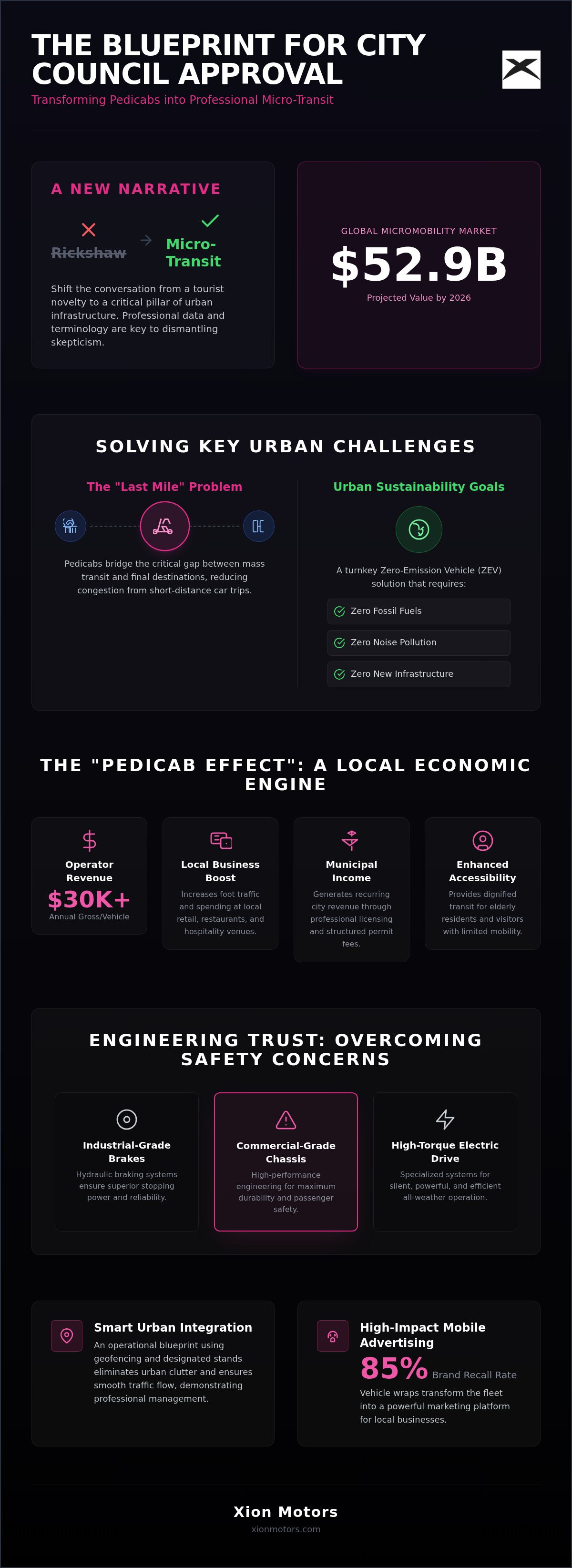
Winning the room at City Hall starts with a tactical vocabulary shift. If you walk into a hearing using the word "rickshaw," you've already lost the professional high ground. That term implies a novelty, a toy, or a whimsical distraction. In 2026, the global micromobility market is projected to reach $52.9 billion. You aren't pitching a ride; you're pitching a micro-transit solution. Understanding the global micro-transit history helps frame where the industry started, but your focus must remain on where it's going: industrial-grade electrification and commercial reliability.
Successful entrepreneurs know that convincing city council on pedicab service requires targeting the right stakeholders early. You need to speak the language of the Transportation Committee and the Tourism Board simultaneously. The Transportation Committee prioritizes congestion and throughput, while the Tourism Board focuses on visitor experience and local spending. By positioning your fleet as a professional micro-transit network, you solve the "Last Mile" problem that plagues urban planners. You're not just moving people; you're optimizing the city's existing transit investments.
The Last-Mile Connectivity Problem
Pedicabs are the connective tissue of a modern city. They bridge the gap between mass transit hubs and a passenger's final destination. Most urban car trips are under three miles. These short-distance journeys create the most congestion and emissions. High-capacity vehicles like the 6-seat VorteX complement buses and light rail by providing flexible, door-to-door service that fixed-route systems can't match. It's a pragmatic expansion of the existing transit grid that reduces the reliance on ride-share vehicles that clog up traffic lanes while idling.
Aligning with Urban Sustainability Goals
Every city council in 2026 is hunting for Zero-Emission Vehicle (ZEV) solutions to meet aggressive climate targets. Electric pedicabs meet these goals without requiring the multi-million dollar infrastructure of new bus lanes or rail extensions. These vehicles operate with specialized high-torque electric drive systems that produce zero noise pollution. This is a critical advantage for late-night operations in residential or historic districts where gas engines are prohibited. Convincing city council on pedicab service becomes significantly easier when you present a solution that requires zero new pavement and zero fossil fuels. You're offering a turnkey transit upgrade that's ready for the street today.
Building the Economic Case for Your Local District
A pedicab fleet is an economic force for any commercial district. When you are convincing city council on pedicab service, focus on the measurable "Pedicab Effect" on local commerce. A single industrial-grade trike can generate over $30,000 in annual gross revenue. This isn't just money for the operator; it's a vehicle that delivers high-spending passengers directly to the entrances of restaurants and retail shops. Unlike cars that disappear into parking garages, pedicabs keep consumers on the street, where they are more likely to engage with local storefronts. This increased visibility directly supports the growth of the hospitality and retail sectors.
Municipalities gain direct financial benefits through structured licensing and permit fees. By establishing a professional permitting framework, cities can generate recurring revenue while maintaining strict oversight of the vehicles on the road. This inclusivity also extends to the community's most vulnerable members. Elderly residents and visitors with limited mobility gain a reliable, dignified way to navigate entertainment zones without the physical strain of long walks. This ensures that every demographic can participate in and contribute to the local economy, regardless of their physical ability to traverse large urban areas.
Boosting Tourism and Entertainment District ROI
Experiential transit is a powerful tool for increasing the "stay time" of visitors in historic districts. When tourists aren't exhausted by walking, they spend more time and money in the district. This is a symbiotic relationship. Pedicab advertising has a high brand recall rate of 85 percent, allowing local businesses to use vehicle wraps as a mobile marketing platform. This creates an additional revenue stream that supports the local business ecosystem. If you are looking to revitalize a specific district, consider how professional fleet packages can provide the necessary infrastructure for rapid economic growth.
Job Creation and Entrepreneurial Opportunity
Scaling a pedicab operation creates a diverse range of local employment opportunities. Research shows that bicycle and pedestrian infrastructure projects create approximately 11.4 jobs for every $1 million invested, which is significantly higher than road-only projects. Your fleet will require not just drivers, but fleet managers and specialized maintenance technicians who can handle high-torque electric drive systems and industrial-grade chassis. This professionalizes the local labor market and provides a structured path for entrepreneurs. Convincing city council on pedicab service is ultimately a pitch for a more resilient, job-rich local economy that isn't dependent on fossil fuels or massive parking expansions.
Engineering Safety: Overcoming Regulatory Skepticism
Safety isn't a marketing buzzword; it's a rigorous engineering requirement. When you're convincing city council on pedicab service, your primary objective is to dismantle the "danger" narrative with technical data. Most officials harbor a deep-seated fear that lightweight vehicles cannot survive in modern traffic. You counter this by presenting a vehicle that is not a bicycle, but a precision-engineered commercial trike. Every component must be built for the stresses of a 1,000-pound payload and high-frequency stop-and-go cycles. This is where industrial-grade hardware becomes your strongest argument.
The core of your safety pitch must focus on stopping power. Hydraulic disc brakes are non-negotiable for a professional fleet. Unlike cable-actuated systems found on consumer bikes, hydraulic systems provide consistent, high-pressure clamping force that doesn't fade under heavy loads. You should also highlight the role of electronic speed limiters. By hard-capping the motor's top speed to 15 or 20 mph, you prove to the council that your fleet is designed for predictable, controlled urban movement. Combine this with DOT-approved LED lighting arrays and 360-degree reflectors to ensure your vehicles are visible from every angle, even in poor weather conditions.
The Industrial-Grade Engineering Standard
There is a massive gulf between a consumer e-bike and a vehicle like the CyberX. You must emphasize the importance of a USA-manufactured, reinforced steel chassis. These frames are built to handle the torque of specialized motor systems and the physical impact of daily street use. High-torque motors are essential not just for speed, but for safety. They allow a fully loaded 6-seat trike to clear an intersection quickly or climb a steep grade without stalling in the path of traffic. A robust chassis acts as a protective cage for your passengers, providing a level of durability that consumer-grade imports simply cannot match.
Standardizing Safety Protocols
Professionalism extends beyond the machine to the operator. You win council approval by proposing a mandatory safety inspection checklist for every vehicle in your fleet. This ensures that brakes, steering linkages, and lighting are verified daily. Furthermore, your blueprint should include strict driver training requirements. Every operator must pass a background check and complete a safety course that covers defensive driving and passenger management. By setting these high standards yourself, you show the council that you are a partner in public safety, not a liability. You're bringing a disciplined, industrial approach to the city's transit network.
The Operational Blueprint: Routes, Parking, and Insurance
Managing the physical presence of a fleet is the final hurdle in convincing city council on pedicab service. Planners fear chaos; you offer precision. Modern geofencing technology allows you to virtually lock vehicles out of high-speed arterial roads. If a driver attempts to enter a restricted zone, the electric assist can be programmed to de-activate or alert dispatch. This level of control transforms a perceived nuisance into a disciplined transit layer that respects the city's existing traffic hierarchy. You aren't just putting trikes on the road; you're deploying a managed network.
Orderly pickup and drop-off are equally vital for municipal harmony. You must propose designated "Pedicab Stands" in high-traffic areas to prevent sidewalk clutter. These zones act as organized hubs, similar to taxi ranks, ensuring that pedestrians and cyclists have clear paths. On the back end, your insurance portfolio must be bulletproof. Most municipalities require general liability coverage between $1 million and $2 million per occurrence. As of February 2026, the average cost for $1 million in coverage in the U.S. ranges from $450 to $1,000 per year per vehicle. Presenting these numbers upfront shows you've done the math on risk management and professional liability.
Route Planning and Traffic Flow
Propose "Green Zones" where pedicabs have priority, such as historic waterfronts or entertainment districts. These areas benefit most from low-speed, high-visibility transit that doesn't produce exhaust. You can use GPS tracking data to prove route compliance to the council in real-time. This isn't just a promise; it's a verifiable audit trail. A seasonal operational calendar ensures your fleet scales up for major festivals and down during off-peak months, preventing unnecessary congestion. This data-driven transparency is your most persuasive tool for convincing city council on pedicab service approval.
Professional Fleet Management
A professional fleet requires industrial-grade upkeep to maintain public trust. Following detailed electric pedicab maintenance guides ensures your vehicles stay on the street and out of the shop. This high uptime is critical for maintaining a shift-based model that can provide reliable service availability during peak tourism weeks. The Master Practitioner approach means scaling with intention. Moving from one vehicle to a fleet of 20 requires a centralized management system that tracks battery health and driver performance. If you are ready to deploy a professional-grade fleet, explore our industrial pedicab fleet packages today.
Presenting the Fleet: Why High-End Equipment Wins Approvals
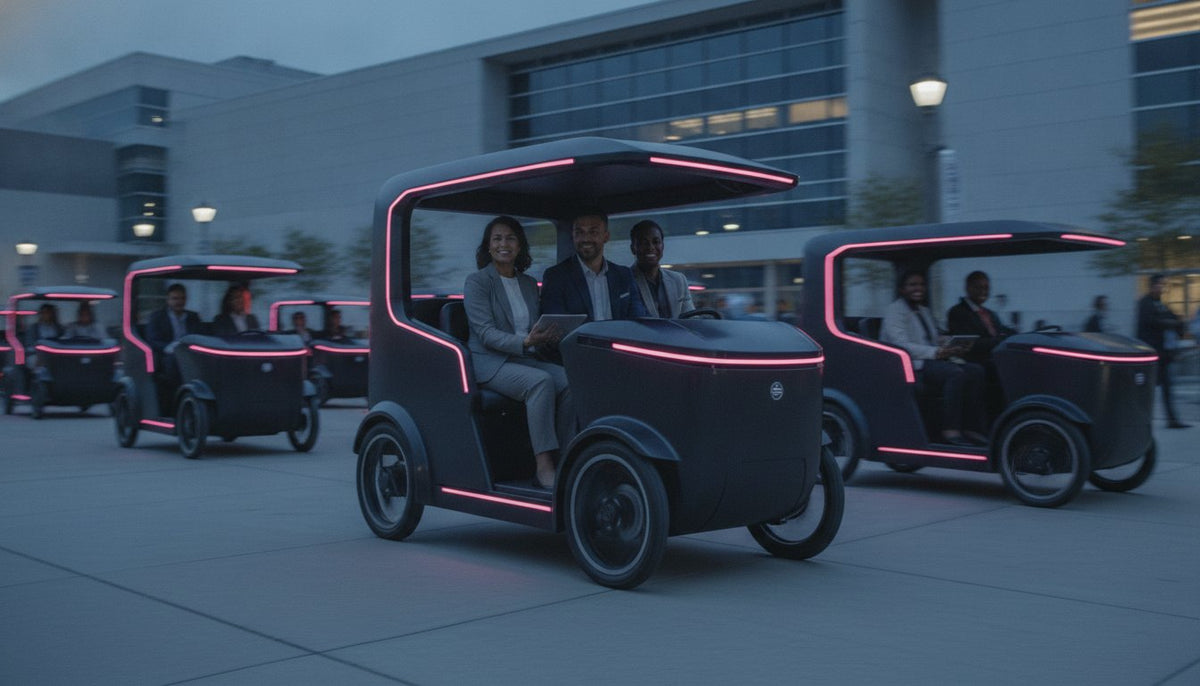
Your fleet is your resume. When you present a collection of high-end, uniform vehicles, you signal to the city that you are a serious commercial partner rather than a hobbyist. Regulators are often hesitant to approve new transit layers because they fear a disorganized influx of low-quality equipment. You overcome this hurdle by convincing city council on pedicab service through the lens of industrial excellence. High-performance vehicles like the 3-seat ($13,500) and 6-seat ($17,500) VorteX models are designed to meet the most stringent street-legal requirements. These aren't modified bicycles; they are purpose-built commercial trikes with USA-manufactured chassis.
The "Xion Advantage" is built on 20 years of operational data. We don't just manufacture these vehicles; we have spent decades managing them in the field. This legacy means every bolt and drive system has been tested against the realities of urban wear and tear. When you stand before the council, you aren't just pitching your vision. You are pitching two decades of proven engineering and financial viability. Leading with this level of authority makes the approval process a discussion about logistics rather than a debate about safety.
The Aesthetic Impact on City Branding
Modern cities are obsessed with their visual brand. Clean, futuristic vehicles like the CyberX enhance the city's appeal to tourists and residents alike. Uniformity in your fleet is essential for building public trust and ensuring a professional presence in historic or entertainment districts. We utilize stainless steel and industrial finishes to ensure every vehicle maintains its professional-grade appearance through year-round use. A fleet that looks like a cohesive transit system is far more likely to receive favorable regulations than a mismatched collection of consumer-grade imports.
Finalizing the Proposal
The final step in your blueprint is the Technical Appendix. This document should include the exact engineering specs for your Xion Motors fleet, from high-torque motor performance to hydraulic braking certifications. You should also include a section on starting a pedicab company to demonstrate that your business model is grounded in a successful, repeatable framework. This proves to the council that you have a master plan for maintenance, driver training, and long-term operations. Adopt the Master Practitioner mindset: lead with hard data, back it with industrial engineering, and leave no room for hesitation in your delivery. You are the expert the city needs to modernize its transit grid.
Securing Your Seat in the Urban Transit Grid
You now possess the definitive blueprint for transforming municipal skepticism into regulatory approval. By reframing your operation as a professional micro-transit solution and anchoring your pitch in hard economic data, you move from being a permit applicant to a strategic city partner. Success in convincing city council on pedicab service hinges on your ability to prove that your fleet is built for the rigors of the street. We back our partners with 20+ years of fleet operation experience and USA-built industrial-grade chassis that are currently utilized by top operators across the country's most demanding urban environments.
Don't let regulatory red tape stall your entrepreneurial ambition. The global micromobility market is accelerating, and the cities that act now will define the future of the "Last Mile" experience. It's time to lead with authority and deploy a fleet that commands respect from planners and passengers alike. View Industrial-Grade Pedicab Fleet Packages to begin scaling your commercial transit ROI with equipment designed for the long haul. Your city's modernized transit grid is waiting for a leader; go out and claim your territory.
Expert Guidance: Frequently Asked Questions
How do I start the process of getting a pedicab permit from my city council?
Start by identifying the specific department that oversees small vehicle for hire regulations, typically the City Clerk or the Department of Transportation. You'll need to submit a comprehensive application that includes your business license, proof of insurance, and detailed vehicle specifications. It's vital to research local caps on operator numbers, as some cities implemented strict limits in early 2026 to manage market saturation and ensure professional standards.
What are the typical insurance requirements for a commercial pedicab fleet?
Commercial fleets usually require a general liability policy with limits between $1 million and $2 million per occurrence. Most municipalities mandate that the city be named as an additional insured on the policy to mitigate public liability. This coverage protects your business against third-party bodily injury and property damage claims. Professional operators often secure specialized policies that specifically account for the unique risks of passenger trike operations in high-traffic urban zones.
Do electric pedicabs need to be registered like motor vehicles?
Registration requirements depend on your local municipal code, but many cities now require scannable registration plates or decals for every active vehicle. This trend toward professionalization helps councils track fleet size and ensure every trike on the street has passed a safety inspection. While they aren't always classified as motor vehicles at the state level, city-level registration is a standard hurdle for any operator looking to build a legitimate, long-term transit business.
How much does a commercial-grade electric pedicab cost in 2026?
Industrial-grade electric pedicabs require a significant capital investment compared to consumer e-bikes due to their reinforced chassis and high-torque drive systems. You should budget for equipment that is specifically engineered for the 1,000-pound payloads typical of commercial service. While used or entry-level models exist, investing in high-performance new equipment ensures lower maintenance downtime and a higher return on investment over the vehicle's operational lifespan, which can span several years of heavy daily use.
Can city councils limit the number of pedicabs allowed to operate?
Yes, many municipalities implement caps on the total number of permits issued to prevent congestion and maintain order. When you are convincing city council on pedicab service viability, you should advocate for merit-based permit systems. This approach favors operators who deploy high-end, safe equipment and maintain rigorous driver training standards. By supporting a cap, you can actually protect your market share from fly-by-night operators who might otherwise dilute the professional reputation of the industry.
What is the best way to address traffic congestion concerns during a pitch?
Address congestion by presenting data that shows how your fleet serves as a "Last Mile" solution, effectively reducing the number of short car trips in the city core. Highlight the maneuverability of electric trikes and their ability to utilize "Green Zones" or waterfront paths where traditional cars cannot go. You can also propose geofencing protocols that prevent your drivers from entering high-speed arterial roads, ensuring your fleet remains a complement to the city's traffic flow goals.
Are there federal grants available for starting an eco-friendly micro-transit service?
Federal and state grants often support Zero-Emission Vehicle (ZEV) initiatives and projects that improve connectivity to public transit hubs. Programs managed by the Department of Transportation frequently provide funding for micromobility infrastructure that reduces carbon footprints. Position your fleet as a sustainable transit layer that supports local job creation. Since pedestrian and bicycle-centric projects create more jobs per dollar invested than road-only projects, your business aligns perfectly with many modern economic development grant criteria.
How do I prove the safety of electric trikes to skeptical city planners?
Proving safety requires a technical presentation of your vehicle's industrial-grade components, such as hydraulic disc brakes and DOT-approved lighting. Convincing city council on pedicab service safety is easiest when you provide a mandatory daily inspection checklist and proof of rigorous driver background checks. Show the planners that your equipment is built to a commercial standard rather than a consumer one. This Master Practitioner approach demonstrates that you've prioritized public safety in every aspect of your operational blueprint.