A standard e-bike motor is a liability when you're hauling a 1,500-pound payload up a steep incline in mid-July heat. While many operators focus on top speed, the real metric for fleet survival is thermal management. If your current drive system stutters under full passenger loads or smells of scorched copper, you're not just facing a technical glitch; you're looking at a compromised ROI. Finding the right electric pedicab replacement motor is the difference between a profitable season and a garage full of dead assets.
We understand that your equipment has to work as hard as you do. You need components that meet the 2026 UL 2849 safety standards while delivering the raw torque required for heavy-duty commercial operations. This guide will teach you how to identify terminal motor fatigue, navigate the complexities of industrial-grade replacements, and execute a professional upgrade. We'll move beyond flimsy universal kits to explore high-torque solutions that restore your vehicle's original performance. By the end of this article, you'll know exactly how to harden your fleet against the demands of the modern urban market and protect your bottom line for the long haul.
Key Takeaways
- Recognize the critical warning signs of internal gear wear and thermal degradation before a mid-shift failure sidelines your vehicle.
- Prioritize high-torque specifications over top speed to ensure your fleet maintains consistent performance under heavy commercial payloads.
- Eliminate compatibility issues by selecting a precision-engineered electric pedicab replacement motor that integrates seamlessly with your existing wiring and axle assembly.
- Execute a professional-grade installation using a strategic guide to axle disassembly and battery system isolation.
- Implement rigorous thermal inspection and cleaning protocols to extend component lifespan and maximize your long-term fleet ROI.
Identifying the Need: When to Replace vs. Upgrade Your Pedicab Motor
Commercial pedicab operations are brutal on hardware. While consumer e-bikes might last years on a single motor, a professional fleet vehicle often faces terminal wear in a fraction of that time. Identifying the exact moment to source an electric pedicab replacement motor is a critical skill for any fleet manager. You aren't just looking for a dead motor; you're looking for the subtle signs of mechanical fatigue that precede a catastrophic mid-shift breakdown. Proactive management is the only way to protect your revenue stream during the high-demand summer months.
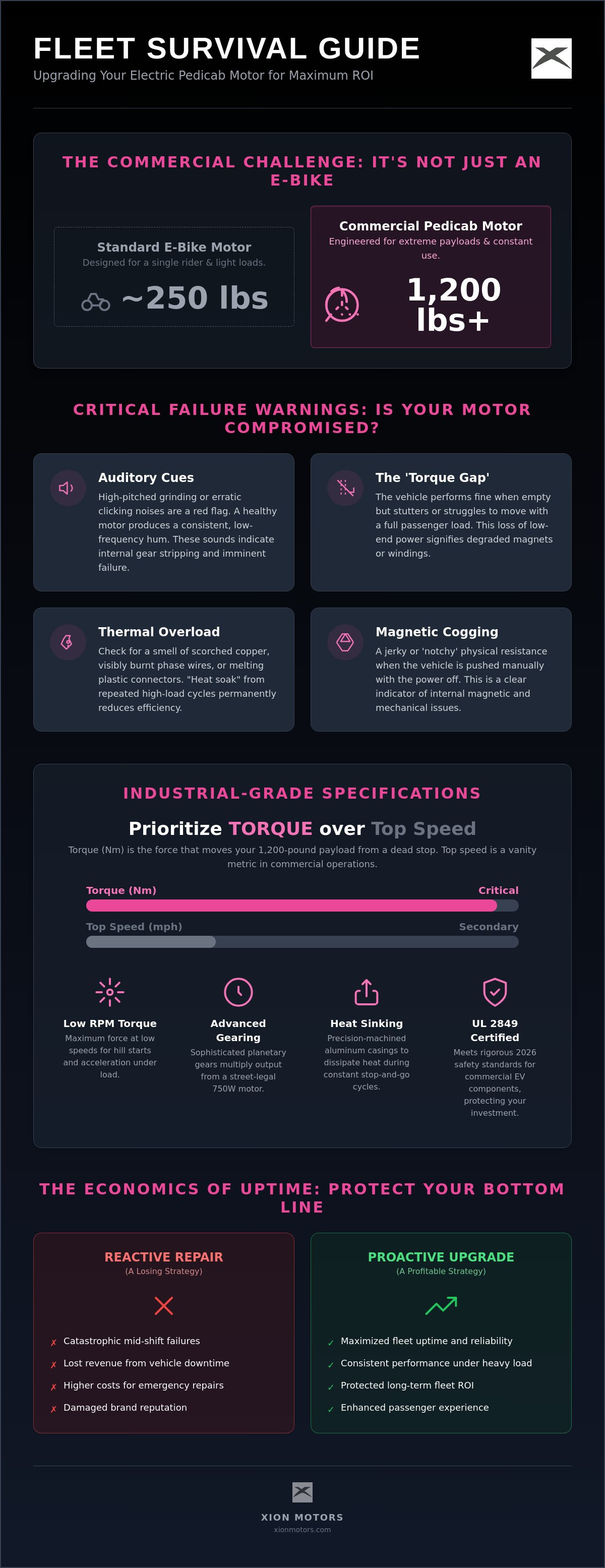
Internal gear wear often manifests as a change in the vehicle's acoustic profile. A healthy transaxle drive system produces a consistent, low-frequency hum. If you begin to hear high-pitched grinding or erratic clicking, the internal nylon or steel gears are likely stripping. This is often accompanied by the "Torque Gap." You might notice the trike performs fine while empty but struggles to initiate movement with a full 1,500-pound passenger load. This loss of low-end grunt indicates that the motor's internal magnets or windings have degraded beyond their peak efficiency. Understanding Electric rickshaw motor basics helps clarify why these systems fail under the constant strain of commercial use. Don't ignore these auditory cues. A noisy motor is a failing motor, and a failing motor is a liability.
Performance Degradation and Heat Issues
Thermal management is the primary bottleneck in urban environments. During peak operation in high-traffic districts, your motor experiences "heat soak." This occurs when the internal temperature rises faster than the casing can dissipate it. Repeated high-load cycles lead to thermal degradation of the copper windings, which permanently reduces efficiency. You can identify this by checking for burnt phase wires or melting points at the plastic connectors. If the vehicle feels jerky or "notchy" when pushed manually, you're likely experiencing magnetic cogging. This physical resistance is a clear indicator that it's time for an electric pedicab replacement motor upgrade to restore the smooth, professional passenger experience your brand demands.
Economic Indicators for Fleet Replacement
Downtime is the silent killer of profitability. A pedicab sitting in the shop earns zero revenue while still incurring storage and overhead costs. Calculating the cost of a single week of lost fares often reveals that a proactive motor upgrade is the more fiscally responsible choice. Patching consumer-grade motors with cheap, off-the-shelf parts is a losing strategy. These units aren't built for the 1,500-pound total payloads common in professional use. When inspecting your drive unit, assess the entire axle assembly. If the motor is showing signs of failure, the differential and bearings are often close behind. Replacing the entire unit ensures your vehicle returns to the street with maximum reliability and a refreshed ROI.
Industrial Specifications: What Defines a High-Performance Pedicab Motor?
Top speed is a vanity metric in the commercial pedicab industry. While a consumer e-bike focuses on miles per hour, a professional fleet operator prioritizes Newton-meters (Nm). Torque is the specific force that moves your 1,500-pound payload from a dead stop on a steep grade. An electric pedicab replacement motor must be engineered to deliver maximum torque at low RPMs without exceeding the federal 750W limit for street-legal operation. This requires a direct-drive transaxle that routes power through a differential to multiply usable output, allowing a legal 750W unit to outperform high-wattage alternatives that lack this mechanical advantage.
Adhering to EV maintenance and safety standards is not just about regulatory compliance; it is about protecting your capital investment. High-performance motors utilize precision-machined aluminum heat sinking to pull heat away from the core. This is essential for vehicles like the CyberX, which operate in dense urban environments with constant stop-and-go cycles. You need a drive system that balances raw output with the durability of an industrial tool. If you are rebuilding a rig, sourcing professional-grade vehicle parts ensures your upgrade meets these rigorous industrial benchmarks.
The Torque-to-Weight Ratio for Heavy Loads
Standard e-bike motors are designed for a 200-pound rider on a lightweight frame. They fail almost immediately when subjected to the 1,500-pound payloads of a commercial trike. Industrial-grade motors solve this through high copper fill and increased winding density. By packing more copper into the stator, the motor generates a stronger magnetic field per watt of input. This density allows for a high-duty cycle, meaning the motor can operate at peak torque for hours without internal degradation. It's the difference between a motor that can pull a load and one that is built to pull it.
Thermal Mass and Duty Cycles
Heat is the primary enemy of the permanent magnets found in modern commercial drive motors. Industrial units use weather-sealed housings that protect internal components while maximizing external surface area for cooling. This prevents debris buildup in cooling fins, which is a common cause of premature failure in high-mileage fleets. Thermal soak is the point at which a motor's internal components reach a critical temperature that prevents further heat dissipation, leading to immediate performance loss or permanent magnet damage. Selecting a robust electric pedicab replacement motor with high thermal mass ensures your drivers stay on the road during the hottest hours of the day.
Selecting the Right Replacement: OEM Precision vs. Universal Kits
Choosing an electric pedicab replacement motor isn't just a maintenance task; it's a strategic procurement decision. You'll find the market flooded with "universal" e-bike kits that promise easy installation at a fraction of the cost. Don't be misled. These consumer-grade units are often built with nylon planetary gears that shear under the stress of 1,500-pound commercial loads. In contrast, Xion Motors OEM replacements utilize hardened steel gears and high-density copper windings. We've spent decades in the trenches. We know that "universal" usually means "doesn't fit anything correctly," leading to expensive modifications that negate any initial savings.
Fleet operators prioritize manufacturer-backed components because they understand the value of direct support. When you source an OEM part, you aren't just buying hardware; you're securing the reliability of a traditional craftsman. These units come with the assurance of a warranty that actually accounts for commercial duty cycles. This level of security is non-existent with generic sellers on secondary markets. If your goal is long-term fleet ROI, you need parts that are as ambitious as your business goals.
Compatibility with Commercial Axle Assemblies
Precision alignment is non-negotiable for high-mileage vehicles. A motor that is even a few millimeters out of spec creates lateral stress that destroys bearings and differentials within weeks. Xion OEM motors are designed for the specific tolerances of our axle assemblies, ensuring a perfect seat and optimal power transfer every time. Our plug-and-play wiring harnesses eliminate the need for dangerous soldering or "vampire" clips that lead to resistance-based heat failure. These motors are engineered to synchronize perfectly with modern electric pedicab battery systems, managing high-amp draws without tripping safety breakers.
The ROI of Industrial Quality
Think of your motor as the heart of your commercial revenue engine. A cheap generic motor might save you money on the purchase order, but the hidden costs of frequent replacements will gut your profitability. An OEM unit provides a significantly longer lifecycle, often outlasting generic alternatives by a factor of three under heavy load. This durability reduces the mechanical strain on the entire CyberX drivetrain, preventing a chain reaction of component failures. When you invest in professional-grade parts, you're ensuring your vehicle stays on the street, generating revenue.
How to Upgrade Your Electric Pedicab Motor: A Professional Step-by-Step Guide
Execution is where the master practitioner separates themselves from the hobbyist. A professional installation of an electric pedicab replacement motor requires more than basic tools; it demands a systematic approach to vehicle stability and electrical safety. Begin by elevating the pedicab using industrial-grade jack stands positioned at the primary frame rails. Never rely on a single hydraulic jack for commercial maintenance. Once the vehicle is secure, isolate the battery system by disconnecting the main power lead to eliminate the risk of accidental discharge during the mechanical swap. This proactive step protects both your technician and the vehicle's sensitive logic boards.
Mechanical Removal and Installation
Removing a drive unit from a heavy-duty chassis requires precision to avoid damaging the differential or axle splines. After disconnecting the phase wires, unbolt the motor from the mounting brackets while supporting its weight to prevent stress on the axle housing. This is the ideal moment to inspect your bearings and splines for signs of uneven wear or metal fatigue. Motor mounting bolts must be torqued to exactly 60 Newton-meters to ensure a secure, vibration-resistant fit within the commercial chassis. Re-indexing the new motor into the frame requires perfect alignment to ensure the drive chain or gears mesh without lateral tension, which is the primary cause of premature gear failure.
Electrical Integration and Phase Matching
Integrating the new power unit with your existing controller is a high-precision task. You must map the phase wires and Hall sensors correctly to ensure smooth, stutter-free acceleration from a dead stop. Incorrect mapping leads to high-amp spikes that can fry a controller in seconds. Once the physical connections are made, use your programming interface to calibrate the controller’s torque curve to the specific output of the new motor. Apply dielectric grease and heat-shrink tubing to all connections to maintain operational continuity in wet weather. This attention to detail prevents moisture ingress from sidelining your vehicle during a profitable rainy-day shift.
Final testing must simulate real-world conditions. Spinning the wheels on a stand tells you nothing about the motor's performance under load. Execute a series of full-capacity start-and-stop tests on a known incline to verify that the thermal management system and torque output meet your fleet's operational standards. For those looking to secure the highest quality components for this process, you can find industrial-grade vehicle parts designed for seamless integration and maximum street-time.
Maximizing Motor Longevity: Fleet Maintenance Protocols
Securing a professional-grade electric pedicab replacement motor is a significant capital investment; protecting that investment requires a disciplined maintenance culture. High-performance drive motors don't fail without warning. They degrade due to cumulative thermal stress and environmental contamination. We've seen fleets double their component lifespan simply by implementing a routine thermal inspection schedule. You must treat your drive units like the industrial tools they are. By following a structured electric pedicab maintenance guide, you move from reactive repairs to proactive asset management.
Debris buildup is a silent killer. Road grime and dust act as an insulating blanket on motor cooling fins, trapping heat inside the core where it destroys magnet strength. Establish a weekly cleaning protocol using compressed air or soft brushes to clear these channels. You should also monitor electrical resistance across the wiring harness. Corroded connectors create high-resistance bottlenecks that cause voltage spikes, which can eventually slag your motor windings. Precision monitoring is the hallmark of a master practitioner. If your resistance readings fluctuate, it's time to clean the contacts or replace the lead before it damages the motor.
Preventative Cooling Strategies
Thermal management starts with the driver. Educate your team on managing passenger loads during peak heat hours, especially on steep urban inclines. Forcing a motor to work at low RPM under maximum load is the fastest way to trigger a thermal shutdown. Maintaining proper tire pressure is equally vital. Low pressure increases the rolling resistance, forcing the motor to draw more current to maintain speed. Use the real-time data on your LCD display to track amp draw and temperature. If you see numbers climbing, it's time to back off the throttle and preserve the hardware. This operational discipline prevents the "heat soak" issues discussed in previous sections.
Sourcing Quality Replacement Parts
Reliability is built on a foundation of quality components. For operators managing large electric pedicab fleet packages, maintaining an on-site inventory of OEM motors is a strategic necessity. You can't afford to wait weeks for international shipping when a vehicle is sidelined. Sourcing from a USA-based partner ensures you have access to national logistics and expert technical support when you need it most. Don't settle for generic substitutes that compromise your vehicle's engineering integrity. Upgrade your fleet today with Xion Motors industrial-grade replacement parts.
Dominate Your District with Industrial-Grade Power
Maintaining a commercial fleet is an exercise in calculated risk management. You've learned that torque and thermal management are the true benchmarks of a professional drive system. By prioritizing OEM precision over flimsy universal kits, you ensure your vehicles remain profitable assets rather than mechanical liabilities. Sourcing the correct electric pedicab replacement motor is the first step toward reclaiming your operational uptime and protecting your brand's reputation for street-level reliability. Precision engineering isn't a luxury; it's a requirement for those who intend to lead the market.
Xion Motors brings over 20 years of fleet operational experience directly to your shop. We manufacture industrial-grade components specifically engineered to handle payloads up to 1,500 pounds under extreme conditions. Our direct-to-operator shipping reaches all 50 states, ensuring you have the hardware required to keep your team moving. Don't compromise your revenue by settling for consumer-level hardware that wasn't built for the rigors of your business. Secure Your Fleet’s Performance with Xion OEM Replacement Motors. Your business deserves equipment that works as hard as you do. Build for the long haul and win.
Frequently Asked Questions
How long does a commercial electric pedicab motor typically last?
A high-performance commercial motor typically lasts between 1,000 and 3,000 operational hours depending on the intensity of your duty cycle and local terrain. While consumer e-bike motors often fail within months under commercial strain, an industrial-grade unit is engineered for the long haul. Factors like average payload weight and routine thermal management play a decisive role in determining the actual lifespan of your drive system.
Can I use a 1000W motor if my pedicab was originally 750W?
You can physically install a 1000W motor, but you must verify that your controller and battery system can handle the increased amperage. Additionally, check your local street-legal regulations, as many jurisdictions cap commercial e-bikes at 750W for operation in public districts. Upgrading to a more powerful electric pedicab replacement motor often requires a total system recalibration to prevent damaging your existing electrical logic boards.
What is the difference between a hub motor and a direct-drive transaxle for pedicabs?
A direct-drive transaxle routes power through a differential to both rear wheels, making it the superior choice for moving heavy 1,500-pound payloads from a dead stop. Single-wheel hub motors concentrate force on one wheel and lack the balanced traction and low-end mechanical advantage needed to start a fully loaded trike on an incline. For professional fleet operations where starting torque is the primary requirement, a 750W direct-drive transaxle provides the necessary industrial performance.
How do I know if my motor is overheating or just running hot?
A motor is overheating if you notice a distinct smell of scorched copper or a sudden drop in torque during operation. While it's normal for the aluminum casing to feel hot to the touch, internal temperatures shouldn't exceed the threshold where phase wires begin to soften. Monitoring real-time data on your LCD display is the most reliable way to distinguish between normal operating heat and terminal thermal soak.
Will a new motor increase my pedicab’s passenger capacity?
A motor upgrade improves the vehicle's ability to handle current loads, but it doesn't increase the physical weight limit of the chassis. Your passenger capacity is determined by the structural integrity of the frame and axle assembly. However, an industrial-grade electric pedicab replacement motor ensures that your trike maintains consistent speed and reliability when operating at its maximum 1,500-pound rated payload capacity.
Do I need to replace my controller when I replace my motor?
You don't always need to replace the controller if the new motor’s voltage and amperage requirements match your current system's specifications. However, we recommend a matched set to ensure the torque curve is properly calibrated. Using an old controller with a high-performance motor can lead to efficiency losses or stuttering acceleration if the Hall sensor mapping is not perfectly synchronized with the new hardware.
Is it possible to repair an electric pedicab motor instead of replacing it?
Minor repairs like replacing Hall sensors or phase wires are possible, but internal gear stripping or magnet degradation usually necessitates a full replacement. From a fleet management perspective, the labor cost of a teardown often exceeds the price of a new OEM unit. Replacing the motor is the most pragmatic way to restore original vehicle performance and ensure long-term reliability for your revenue-generating assets.
How much downtime should I expect for a professional motor replacement?
A professional motor swap typically requires two to four hours of shop time if you have the correct OEM parts on hand. This timeframe includes the mechanical disassembly of the axle, the physical motor swap, and the electrical calibration testing. Having a standardized maintenance protocol and an inventory of replacement parts allows you to return the vehicle to the fleet within a single shift.