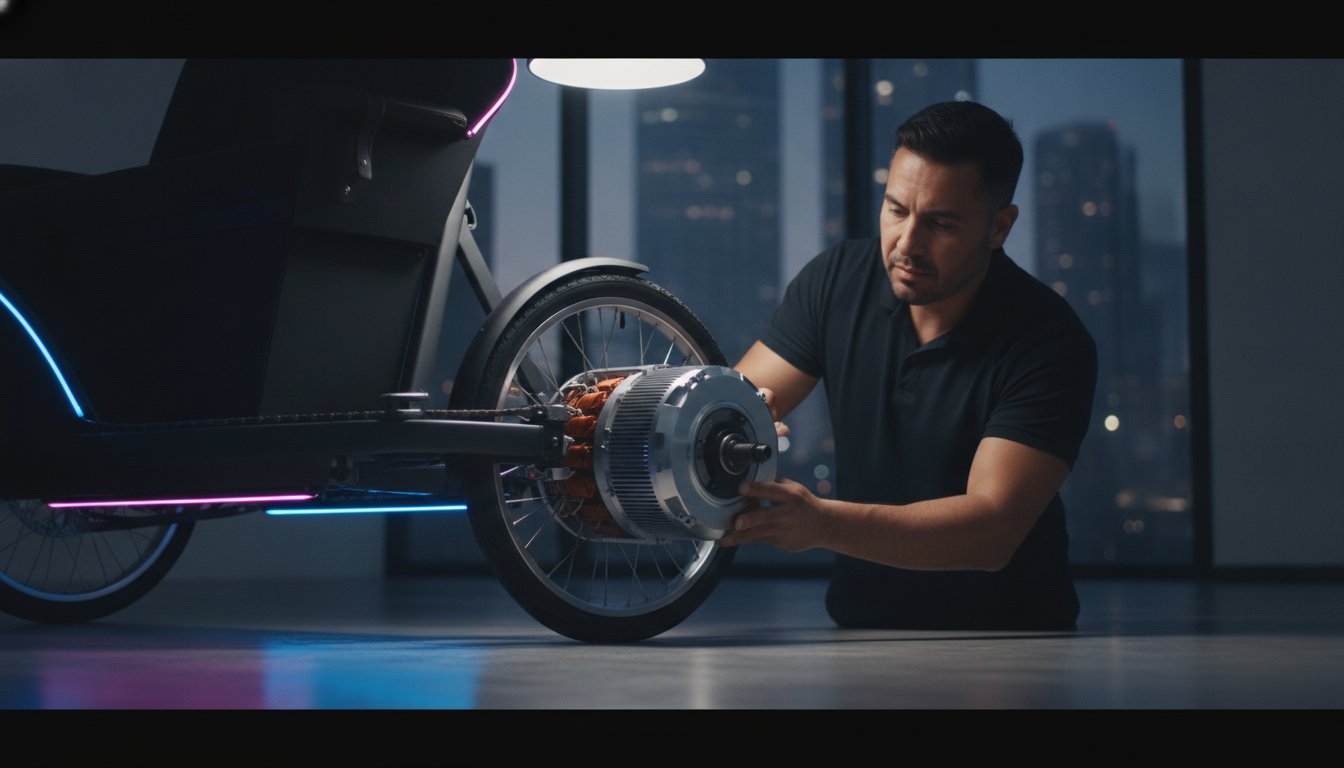
Most pedicab operations fail because they treat industrial transit like a weekend hobby. If you are still running modified bicycles on commercial routes, you are leaving money on the table and risking your reputation on inferior hardware. Investing in industrial-grade electric pedicab fleet packages is the only way to ensure your business survives the shift toward regulated urban mobility. We have spent decades in the trenches engineering vehicles that withstand the rigors of 12 hour shifts and heavy passenger loads.
You understand that every hour a trike spends in the shop is an hour of lost revenue. It's a common pain point for operators facing high maintenance downtime and the constant struggle of battery life management during double-shift operations. This reference guide provides the exact operational frameworks required to manage and scale a professional fleet for maximum ROI. We will examine the 2026 industrial requirements, including UL 2849 safety certifications and the transition to high-torque 72V drive systems. You will gain a clear understanding of the repeatable blueprint needed to minimize downtime and dominate your local market.
Key Takeaways
- Master the transition from simple bicycle repair to industrial-grade fleet orchestration. Learn to treat your hardware as a high-performance transit asset to ensure maximum uptime.
- Implement rigorous "check-before-flight" maintenance protocols and standardized battery management. Protecting your 72V power systems is critical for sustaining multi-shift operations without performance degradation.
- Develop a "Master Practitioner" driver certification program focused on high-torque safety. Training your team for precision braking and acceleration with full passenger loads is essential for professional liability management.
- Maximize your ROI by deploying professional electric pedicab fleet packages in high-density entertainment districts. Integrate advertising wraps to create a secondary, passive revenue stream that fuels your growth.
- Build your legacy on the durability of the CyberX and VorteX chassis. These industrial-grade frames are engineered to withstand the brutal demands of daily commercial use.
The Fundamentals of Professional Pedicab Fleet Management
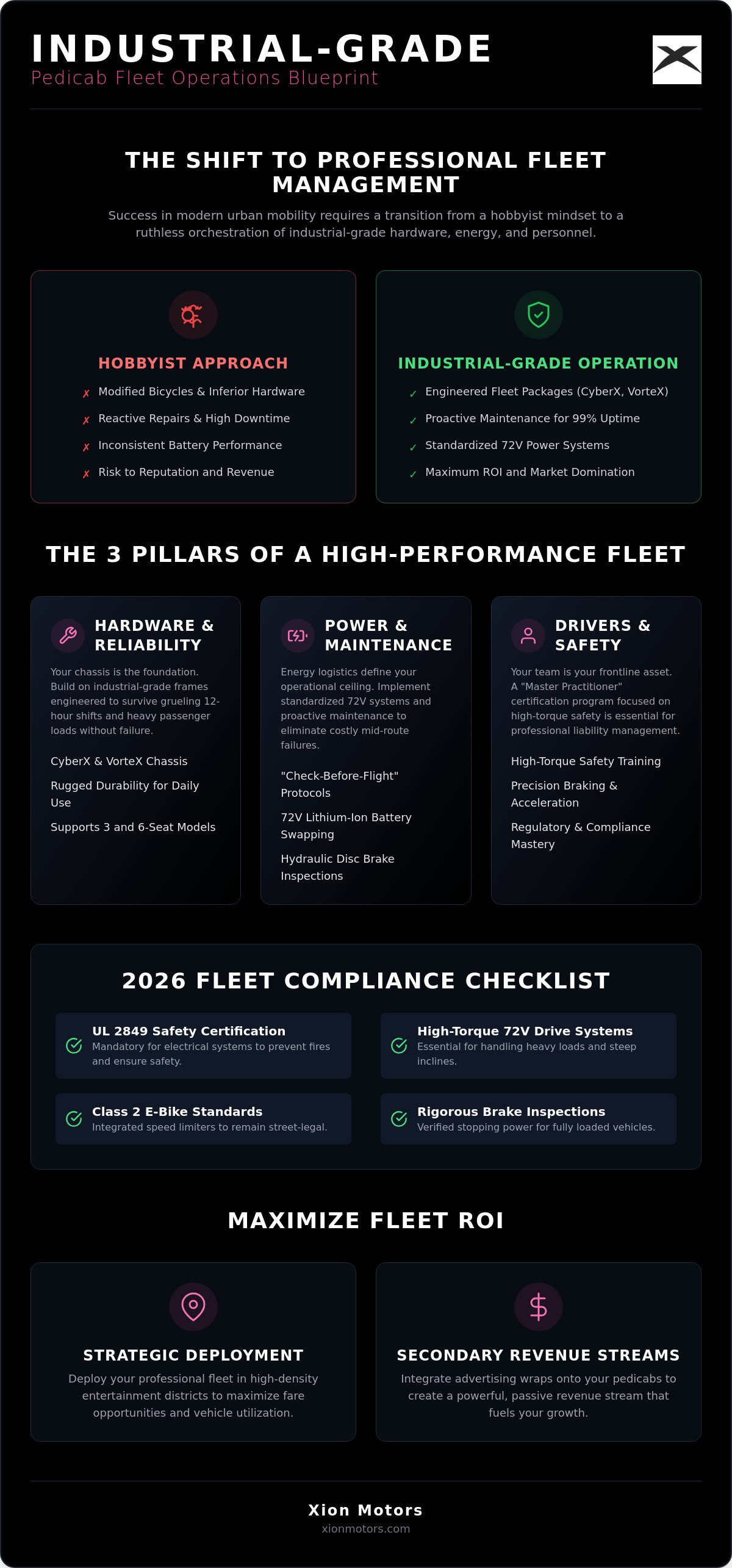
Professional fleet management is the ruthless orchestration of hardware, energy, and personnel. It's no longer about simple bicycle maintenance or keeping a few chains greased. In 2026, success belongs to operators who view their fleet as a high-performance transit network rather than a collection of trikes. Choosing the right electric pedicab fleet packages is the foundation of this industrial approach. You aren't just buying vehicles; you're investing in a revenue-generating ecosystem that demands 99% uptime to remain profitable.
The industry has evolved far beyond the foundational Cycle Rickshaw History. Today's commercial-grade standards demand precision engineering and rugged durability. You must build your operation on three non-negotiable pillars: reliability that survives grueling twelve-hour shifts, regulatory compliance that protects you from legal liability, and revenue density that maximizes every square inch of the vehicle. If your hardware can't handle a double-shift on a Friday night, your business model is fundamentally flawed.
Transitioning from Manual to Electric Operations
Manual fleets are obsolete in modern, high-demand entertainment districts. They simply cannot compete with the speed and turnaround capacity of motorized units. High-torque 72V systems have redefined route viability, allowing operators to conquer steep inclines and carry heavier passenger loads that were previously unreachable. Electric assist doesn't just help the driver; it effectively doubles the potential daily operational hours. By reducing physical fatigue, your drivers stay on the road longer and maintain a higher level of service from the first fare to the last.
The 2026 Regulatory Landscape
Compliance is your primary shield against vehicle impoundment and heavy fines. In 2026, every vehicle in your fleet must strictly adhere to Class 2 e-bike standards. This includes integrated speed limiters and certified electrical systems that meet the latest safety protocols. It's vital to invest in commercial electric pedicabs that meet national safety standards such as UL 2849. Whether you're operating 3-seat or 6-seat models, your hardware must pass rigorous weight limit and passenger safety inspections to remain street-legal. Ignoring these industrial-grade requirements is a fast track to operational shutdown.
Industrial Power Systems and Maintenance Cycles
Maintenance isn't a chore; it's the preservation of your profit margin. In a high-stakes transit environment, reactive repairs are a recipe for bankruptcy. You must implement a "check-before-flight" protocol for every vehicle in your fleet. This aviation-style approach ensures that every trike leaving the depot is mechanically sound and electronically optimized. Your drivers should verify tire pressure, lighting systems, and throttle response before every shift to prevent minor issues from becoming catastrophic mid-route failures.
High-torque motor calibration is the defining factor for heavy-duty passenger loads. If your controllers aren't tuned for the specific weight of a three- or six-seat configuration, you risk premature motor burnout and erratic power delivery. Stopping power is equally critical. Establish a rigorous schedule for hydraulic disc brake inspections and fluid replacement. Municipalities often set the bar for these safety benchmarks. For example, Austin's electric pedicab ordinance highlights the necessity of reliable motorized assist and braking standards for commercial street operations. Adhering to these industrial-grade requirements keeps your fleet legal and your passengers safe.
Battery Rotation and Energy Logistics
Energy logistics define your operational ceiling. To run double-shift fleets, you need a charging hub designed for rapid turnover. Standardize your 72V lithium-ion battery management system (BMS) to prevent deep discharge, which is the primary killer of expensive power cells. When evaluating electric pedicab fleet packages, look for systems that allow for easy battery swapping and real-time health monitoring. Predicting a failure before it happens saves you the cost of a recovery vehicle and a lost fare. In extreme climates, implement thermal management strategies to keep your lithium packs within the optimal temperature range during both charging and discharge cycles.
Structural Integrity and Chassis Care
Commercial trikes face brutal daily abuse. Inspecting powder-coated steel frames for stress points is mandatory when you're hauling 1,500 lbs payloads through urban potholes. Pay close attention to heavy-duty wheel and spoke tension; these are the most common failure points in high-mileage operations. For a granular breakdown of how to handle these components, leverage the electric pedicab maintenance guide for detailed part-by-part protocols. Keeping your chassis in peak condition isn't just about safety; it's about extending the total lifecycle of your investment. If you want to dominate the market, you must treat your hardware with the respect it deserves by using professional-grade vehicle parts for every replacement.
Driver Training and Safety Standards
Hardware is only half of the equation. Even the most advanced electric pedicab fleet packages will fail if the operators behind the handlebars aren't trained to an industrial standard. You must view your drivers as skilled technicians of urban transit, not just seasonal laborers. Developing a standardized "Master Practitioner" certification for your fleet ensures that every driver understands the specific physics of three-wheeled, high-torque vehicles. This isn't just about safety; it's about protecting your capital investment from operator error.
Training must focus heavily on the dynamics of high-torque acceleration and braking distances under full passenger loads. Launching a six-seat pedicab requires a controlled application of power to avoid drivetrain strain or passenger discomfort. Conversely, stopping a 1,500 lb vehicle in heavy traffic demands an intuitive understanding of hydraulic brake modulation. Drivers need to practice emergency maneuvers to master the tipping points unique to three-wheeled chassis. Understanding center-of-gravity shifts during sharp turns is the difference between a smooth ride and a costly incident report.
Operational Safety Protocols
Visibility is your primary defense in high-traffic zones. Your safety protocol must mandate daily lighting and signal checks to ensure 24/7 operational readiness. Implement a robust driver communication system that allows for real-time fleet coordination and hazard reporting. If an incident does occur, your documentation must be surgical. Standardized reporting for every minor scrape or mechanical hiccup creates a data trail that simplifies insurance renewals and liability management. It's about building a culture of accountability that mirrors aviation standards.
Customer Experience and Professionalism
Professionalism is the engine of your revenue density. A standardized passenger greeting and safety briefing should be the first interaction every customer has with your brand. This isn't just polite; it's a critical step in establishing authority and ensuring passenger compliance with safety rules. Drivers should be experts at managing on-board amenities, from climate control to interactive iPad systems for guided tours. There is a direct, proven link between driver professionalism and high-tip revenue generation. When your team carries themselves as master practitioners, the market responds with higher ratings and increased private booking requests.
Maximizing Fleet ROI Through Strategic Deployment
Scaling from a single vehicle to a multi-unit operation requires a shift from tactical survival to strategic dominance. You can't rely on luck to find fares; you must analyze route density to position your assets exactly where the demand is highest. High-foot-traffic entertainment districts are the primary battlegrounds for revenue. By saturating these zones during peak windows, you create a visible presence that drives spontaneous bookings. Scaling this presence is most efficient when utilizing electric pedicab fleet packages, which reduce your per-unit acquisition costs and ensure your entire fleet maintains a uniform, professional aesthetic.
Data-driven dispatching is the secret to minimizing "deadhead" miles. Every minute a driver spends circling without a passenger is a drain on your battery and your bottom line. Use real-time tracking to move vehicles toward emerging hotspots before the demand peaks. This proactive management ensures your fleet is always in the right place at the right time. Beyond fares, you should integrate advertising wraps as a secondary, passive revenue stream. A fully wrapped vehicle acts as a mobile billboard, often generating enough monthly income to cover its own financing costs before the first passenger even boards.
Revenue Optimization Strategies
Success in this industry depends on choosing the right tool for the job. You must calculate the real-world ROI of 3-seat versus 6-seat models based on your specific market demographics. While 3-seat units offer agility in tight traffic, 6-seat models are powerhouses for bachelor parties and family tours where per-fare revenue is significantly higher. Implement dynamic pricing models during festivals and high-demand windows to capture the true market value of your service. Leveraging long-term advertising partnerships can effectively neutralize your initial hardware investment, allowing your fare revenue to become pure profit. If you're ready to start building your empire, view our industrial fleet solutions today.
Data-Driven Fleet Scaling
You can't manage what you don't measure. Tracking "Revenue Per Hour" (RPH) across your entire fleet allows you to identify top-performing drivers and routes with surgical precision. Expansion shouldn't be a guess; it should be triggered by consistent RPH benchmarks that indicate your market has reached a saturation point for your current unit count. Managing the lifecycle of your vehicles is equally vital. Establish a clear timeline for when a unit moves from front-line deployment to a secondary backup role, and finally to resale or part-out. This lifecycle management ensures your brand is always represented by high-performance hardware while you recoup capital for the next generation of vehicles.
The Xion Motors Advantage: Industrial-Grade Fleet Solutions
Choosing a manufacturer is a defining moment for your business. You don't need a vendor; you need a veteran partner who has survived the evolution of urban transit. Xion Motors stands as the authoritative leader for serious operators who demand more than just a vehicle. Our electric pedicab fleet packages are engineered for the relentless pace of modern commercial use. We provide the rugged authority of a seasoned industry veteran, ensuring that every trike in your fleet is a high-performance asset designed for maximum financial viability.
Durability is the bedrock of our engineering philosophy. The CyberX and VorteX chassis are built to withstand the brutal demands of multi-shift operations without structural compromise. While other manufacturers cut corners with consumer-grade components, we double down on industrial strength. We maintain a massive inventory of authentic vehicle parts ready for national shipping. This ensures that your fleet stays on the road, where it belongs, rather than sitting idle in a repair bay waiting for a specialized component to cross an ocean.
Engineering for the Long Haul
The CyberX has established itself as the industrial benchmark for 2026. It features a U.S.-made frame and a high-torque direct-drive transaxle motor that delivers consistent power under the heaviest passenger loads. These aren't fragile machines. They are precision tools crafted for the specific rigors of urban logistics and resort transport. We offer extensive customization options to tailor your fleet to your specific environment. Whether you need specialized cargo configurations or unique seating arrangements, our engineering team delivers solutions that meet your exact operational requirements.
Partnering for Growth
Scaling a fleet is a complex operation that requires more than just hardware. Xion Motors supports your growth through dedicated phone and email technical support provided by experts who know these vehicles inside and out. We handle the logistics of national shipping for both complete fleet packages and individual replacement components with surgical precision. If you're just entering the market, consult with our team on starting a pedicab company to avoid the common pitfalls that sink less-prepared operators. We share the perfected tools and blueprints we've developed over decades in the trenches. Contact us today for a direct consultation to configure a fleet that will dominate your local market and deliver the ROI your ambition deserves.
Dominate the Urban Transit Market
The future of urban mobility belongs to those who treat their operations with industrial precision. You've seen how standardized maintenance cycles and specialized driver training transform a simple service into a high-performance transit network. Strategic deployment in high-density zones ensures your assets are always generating revenue rather than burning battery life in deadhead miles. Success isn't a matter of luck. It's the result of deploying the right hardware and following a proven operational blueprint.
Investing in professional electric pedicab fleet packages is the definitive step toward market leadership. We back our hardware with over 20 years of fleet operation experience and provide U.S.-made frames with lifetime support to ensure your long-term success. Our operators have demonstrated the financial viability of this model, with proven revenue of $30,000 or more annually per vehicle. It's time to stop managing a hobby and start leading an industry.
Request a custom quote for your electric pedicab fleet package today and secure your place at the forefront of the transit landscape. Your growth starts with the right foundation.
Frequently Asked Questions
How many hours of operation can I expect from a single battery charge in a fleet setting?
A single charge typically yields 6 to 8 hours of continuous operation under standard commercial loads. This duration varies based on the terrain and the total weight of the passengers. For 12 hour double-shifts, we recommend a secondary battery rotation strategy. High-capacity 72V lithium packs ensure that your drivers maintain peak performance throughout their entire window without significant power sag.
What is the average maintenance cost per vehicle for an industrial-grade electric pedicab?
Maintenance costs remain low when compared to the high revenue potential of industrial-grade trikes. Most expenses are tied to standard consumables such as brake pads, tires, and chain lubricants. By implementing a "check-before-flight" protocol, you prevent major mechanical failures that lead to expensive downtime. Consistent inspections ensure that your operational overhead remains predictable and manageable over the vehicle's lifecycle.
Are electric pedicabs street-legal in all 50 states?
Most electric pedicabs are classified as Class 2 e-bikes, making them street-legal in the majority of states. However, municipal regulations vary significantly between cities. Some regions require specific lighting, reflectors, or safety certifications to comply with local transit laws. It's vital to check your specific city ordinances before deploying your electric pedicab fleet packages to ensure full regulatory compliance and avoid impoundment.
How do I manage the weight distribution in a 6-seat pedicab for maximum stability?
Proper weight distribution requires placing the heaviest passengers over the rear axle to maintain a low center of gravity. This positioning prevents the front wheel from losing traction during acceleration and improves overall chassis stability. Drivers should always instruct passengers on where to sit before departing. Correct loading protects the structural integrity of the frame and ensures a smoother, safer ride for the customers.
What is the expected lifespan of a Xion Motors heavy-duty steel frame?
Our heavy-duty steel frames are engineered to last for decades under rigorous commercial use. We use industrial-grade powder coating to prevent corrosion and reinforce stress points to handle payloads up to 1,500 lbs. While components like motors and batteries eventually require replacement, the core chassis remains a permanent asset. We provide lifetime support for our U.S.-made frames to guarantee the long-term success of your operation.
How do I train drivers to handle the high-torque 72V motor system safely?
Training must focus on progressive throttle control to manage the immediate power of a 72V system. Drivers must practice "feathering" the accelerator to avoid jerking passengers or straining the drivetrain. We also emphasize braking distance drills with full loads. Mastery of these dynamics is essential for navigating congested urban environments where split-second decisions are the difference between safety and a costly incident report.
Can I integrate my own GPS and dispatching software into Xion vehicles?
Yes, our vehicles feature an open-system architecture that allows for the integration of third-party GPS and dispatching software. Most operators install rugged tablets or smartphones to handle real-time navigation and fare management. The electrical systems are designed to support these auxiliary devices without compromising the main drive power. This flexibility allows you to synchronize your fleet with your existing digital infrastructure for seamless coordination.
What parts should I keep in stock to ensure 99% fleet uptime?
To maintain 99% uptime, you should always stock essential consumables like brake pads, inner tubes, tires, and chains. Keeping a few spare throttles and display units on hand is also a smart move for quick repairs. Having these electric pedicab fleet packages supported by a local parts inventory means you can swap components in minutes. This proactive approach keeps your vehicles on the street generating revenue rather than sitting in the shop.
Thinking about starting or scaling a pedicab operation?
See what a pedicab costs ($13,500–$15,000 direct from the manufacturer), explore fleet pricing on 3+ units, or start with $0-down equipment financing. Xion operators earn $30,000–$35,000 per cab per year across 59+ US markets.