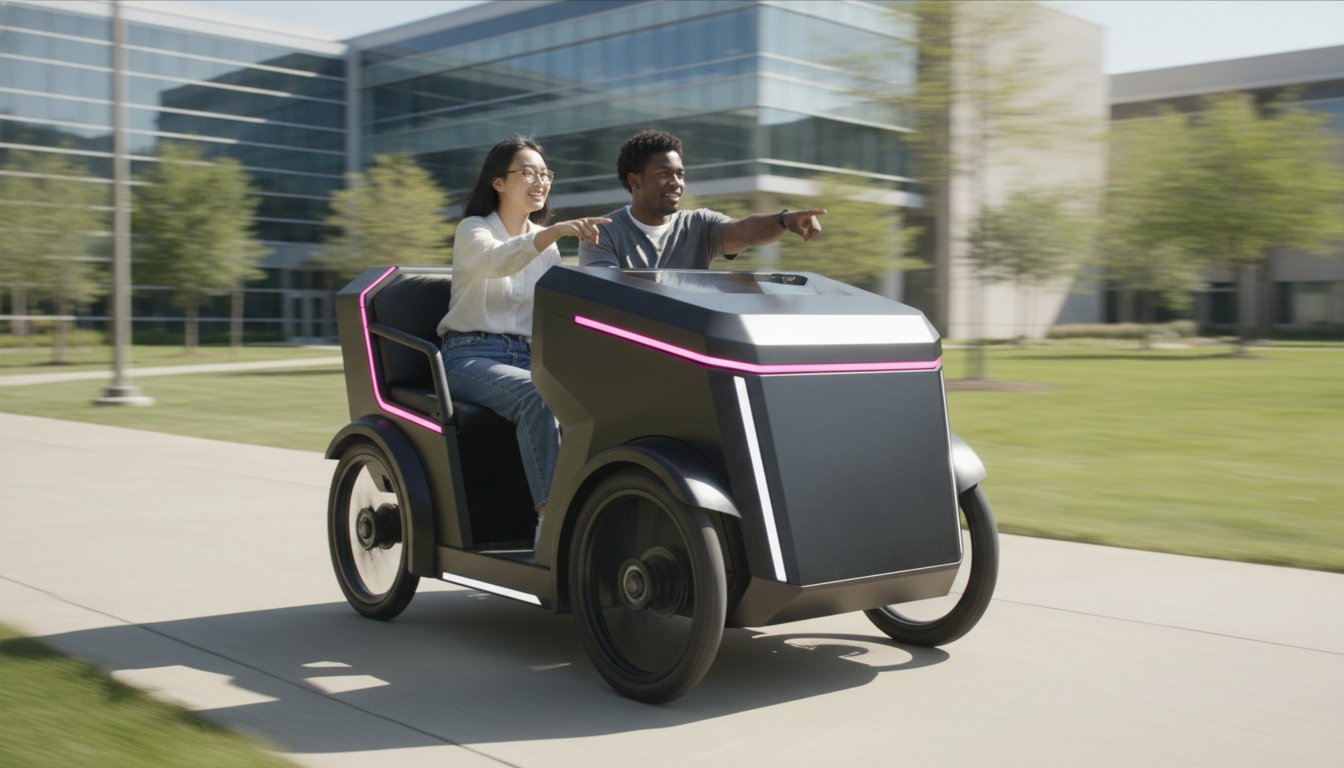
In 2026, the real secret to pedicab business profitability isn't found in a flashy ride-sharing app; it's forged in the structural integrity of your fleet's chassis. You've likely seen the data showing the global micromobility market reaching $52.9 billion this year, yet many operators continue to bleed margins on consumer-grade hardware that fails during peak seasonal demand. It's a common struggle to maintain revenue density when light-duty e-bikes require constant, expensive repairs.
This guide will show you how industrial-grade, high-capacity electric pedicabs are outperforming traditional micromobility models to deliver a superior ROI. By deploying vehicles like the CyberX or VorteX that are engineered for commercial abuse, you can maximize revenue per battery charge and secure long-term contracts with high-traffic districts. We'll explore the shift toward 6-seat configurations, the mechanics of a 5-year fleet lifespan, and the strategies needed to capture a share of the record $9.46 billion out-of-home advertising market.
Key Takeaways
- Industrial-grade hardware is the new standard for 2026. Learn why the transition to heavy-duty, integrated transit models is replacing the fragile, high-turnover shared scooter era.
- Maximize your pedicab business profitability by deploying high-capacity 6-seat vehicles that generate significantly higher revenue density than single-rider devices.
- Diversify your income streams beyond simple passenger fares. Discover how to leverage your fleet as high-recall mobile advertising platforms that command premium rates from national brands.
- Stop overpaying for maintenance by identifying the critical engineering requirements, from chassis strength to high-torque motors, that ensure a fleet life of five years or more.
- Master the professional blueprint for scaling your operation. Learn how to transition from a single-vehicle owner to a multi-city fleet manager using strategic procurement and national logistics.
The 2026 Micromobility Landscape: Shifting Toward Professional Fleets
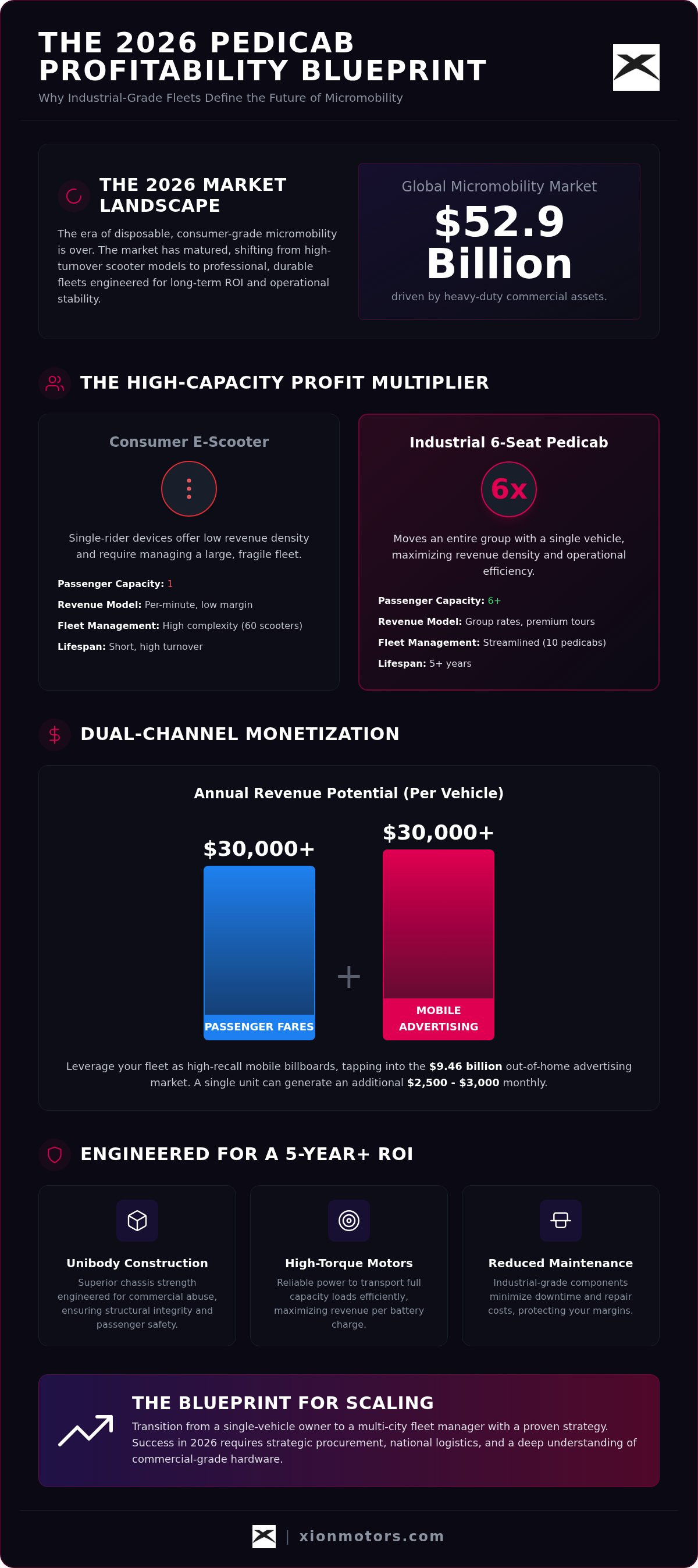
The era of disposable micromobility is dead. In 2026, the market has matured beyond the experimental chaos of venture-backed scooter startups. Operators realized that the 'move fast and break things' approach destroyed long-term ROI. High maintenance costs and hardware failure during peak seasons forced a pivot toward professionalized, industrial-grade fleets. Today, the global micromobility market is projected to reach $52.9 billion, but this growth is driven by heavy-duty assets designed for precision and longevity rather than planned obsolescence.
Regulatory stability has finally arrived. Cities have moved from outright bans to standardized licensing and safety requirements. For example, Chicago now requires unibody construction for new pedicab licenses and has set specific limits on fleet decals and term dates. These rules protect established businesses from low-quality competition. This legislative maturity is a foundational element of pedicab business profitability, as it allows for predictable five-year planning instead of reactive survival. While the modern electric trike is a high-tech machine, it evolved from the traditional Cycle rickshaw, proving that human-scale transit remains a permanent fixture of urban design.
Defining the High-Capacity Opportunity
The distinction between personal mobility and commercial passenger transit is now clear. A single-rider scooter offers low revenue density; it takes up significant curb space while only moving one fare. In contrast, a 6 seat electric pedicab allows an operator to move an entire family or tour group with a single battery charge. This maximizes the earnings per square foot of road space. High-traffic zones like university campuses and car-free tourist districts now demand these high-capacity solutions to move crowds efficiently without the heavy congestion of traditional buses.
The Shift to Private Fleet Ownership
Local operators are reclaiming the streets from Silicon Valley conglomerates. Independent ownership allows for absolute control over branding and maintenance schedules. By utilizing direct-to-operator models, business owners avoid the middleman fees that often erode pedicab business profitability. This shift empowers operators to capture niche regional markets, such as resort shuttles or specialized urban tours, where local knowledge and reliable hardware dictate success. It's about building a rugged legacy fleet that serves as a durable profit center for years, not just a single season.
High-Capacity Passenger Transit: A Deep Dive into Profitability
Profitability in the micromobility sector is a game of volume and density. While single-rider scooters struggle with low margins and high turnover, high-capacity electric trikes offer a different economic reality. A single vehicle capable of transporting six passengers creates a force multiplier for every hour of operation. In high-density entertainment hubs, the ability to move a full group on one battery charge significantly lowers the cost per passenger mile. This shift toward high-capacity transit is supported by a more mature understanding of municipal regulation of the pedicab industry, which now favors professional operators over disorganized, experimental fleets.
Managing a fleet of ten 6-seat vehicles is vastly more efficient than maintaining sixty individual scooters. You reduce your mechanical points of failure and streamline your charging logistics. For a professional operator, this means less downtime and more consistent uptime during peak demand. Industry data from 2026 suggests that a single well-maintained electric pedicab can generate over $30,000 in annual gross revenue. When you factor in secondary income streams like mobile advertising, which can pull in an additional $2,500 to $3,000 monthly per unit, the business case for high-capacity hardware becomes undeniable.
Revenue Comparison: Pedicabs vs. Traditional Micromobility
The unit economics of a 6-seat vehicle outperform single-rider devices by a wide margin. Most shared scooters command a small unlock fee and a per-minute rate, whereas high-capacity trikes often utilize flat group rates or premium tour pricing. Families and corporate groups consistently pay premium rates for the shared experience of traveling together rather than being separated on individual bikes. The revenue-per-battery-charge metric measures the total gross income generated between charging cycles, favoring high-capacity vehicles that can secure larger group fares on a single kilowatt-hour. This efficiency ensures that your hardware is working for you, not sitting in a repair bay.
High-Margin Niche Markets
Identifying the right district is as critical as selecting the right hardware. Resort and hotel shuttles represent a massive opportunity for operators to act as a premium guest amenity. High-tier properties are increasingly moving away from gas-powered shuttles in favor of quiet, efficient electric transit. Similarly, university campuses and large-scale festivals require the precise, nimble movement that only a high-torque trike can provide. To capitalize on these opportunities quickly, many successful operators utilize electric pedicab fleet packages to standardize their operations from day one. Investing in industrial-grade electric pedicabs allows you to enter these high-margin niches with the confidence that your equipment will withstand 12-hour shifts in demanding environments.
Monetization Strategies for Commercial Micromobility Operators
Relying solely on passenger fares is a strategy for hobbyists, not professionals. To maximize pedicab business profitability in 2026, you must view your fleet as a multi-functional commercial asset. High-capacity hardware isn't just a transport tool; it's a high-impact media asset and a B2B service platform. Successful operators build a layered revenue model where fares provide the daily cash flow, while advertising and long-term contracts provide the scalable growth capital. This diversified approach ensures that your fleet remains profitable even during off-peak hours or shoulder seasons.
The most resilient businesses in this sector move beyond the "pay-per-ride" mentality. They secure recurring revenue through corporate partnerships and municipal service agreements. Whether you are running a standard route or deploying custom electric trikes for business, the goal is to embed your fleet into the local economic infrastructure. When your vehicles become essential to a resort's guest experience or a district's transit plan, you transition from a vendor to a vital partner.
Advertising and Sponsorship Models
Pedicab advertising is currently one of the most effective forms of Out-of-Home (OOH) media. Data from 2026 shows that pedicab advertising achieves a high brand recall rate of 85%. This is significantly higher than traditional static billboards because the vehicles operate at eye level in high-density pedestrian zones. Daily rates for a branded pedicab currently range between $250 and $500, with convention packages for major events starting at $2,500 per unit. With a cost per thousand impressions (CPM) between $1 and $4, you can offer local and national brands a high-value alternative to digital ads. A single unit can generate up to $3,000 in monthly advertising revenue, often covering the vehicle's entire monthly operational cost before the first passenger even boards.
Tours, Experiences, and Contracted Shuttles
Curated experiences allow you to command premium hourly rates that far exceed standard point-to-point fares. Designing specialized sightseeing tours or "nightlife circuits" positions your fleet as an entertainment service. Beyond individual riders, there is a massive "white-label" opportunity in 2026. This involves operating your fleet on behalf of luxury brands or hotels, where the vehicles are fully wrapped in their identity and the service is offered as a complimentary amenity to their guests. Securing fixed-route contracts for last-mile shuttles in business districts provides a guaranteed revenue floor. These B2B contracts are the backbone of a professional operation, allowing you to project earnings with precision and scale your fleet with confidence.
Engineering for ROI: Why Industrial-Grade Hardware Dictates Success
Cheap hardware is a liability, not an asset. Many new operators fall into the Total Cost of Ownership (TCO) trap by purchasing consumer-grade e-bikes or unbranded imports to save on initial capital. This decision often proves fatal for pedicab business profitability within the first six months. While a modified consumer bike might survive a light weekend, it cannot withstand the mechanical stress of 1,000-pound payloads and constant stop-and-go cycles in dense urban environments. Industrial-grade engineering ensures that your fleet stays on the street during peak demand rather than sitting in a repair bay waiting for obscure parts.
High-payload transit requires a fundamental shift in structural requirements. You need reinforced steel chassis, heavy-duty suspension systems, and high-torque motor systems specifically wound for low-end power. Standard e-bike motors often overheat and fail when tasked with moving multiple passengers up an incline. To ensure your investment delivers for years, following a rigorous electric pedicab maintenance guide is critical for sustaining uptime and protecting your fleet's resale value. Reliability is the only metric that matters when your reputation and revenue are on the line.
The Anatomy of a Commercial Vehicle
The CyberX engineering standard represents the pinnacle of 2026 commercial design. It utilizes multi-piston hydraulic braking systems and motorcycle-grade tires because bicycle components simply lack the stopping power and durability required for 6-passenger safety. The battery management systems (BMS) are engineered for rapid turnaround, allowing for fast-charging cycles that keep the vehicle operational for 12-hour shifts. Every component is selected for its ability to endure commercial abuse while maintaining a smooth, professional ride for the fare.
Minimizing Downtime through Parts Availability
Downtime is the silent killer of ROI. Relying on unbranded imports often means waiting weeks for international shipping on proprietary components, which can cost you thousands in lost revenue during peak season. Domestic parts support is essential for any professional operator who values longevity and scale. Modular component design is essential for street-side repairs because it allows your technicians to swap out critical systems in minutes without transporting the entire vehicle back to a central warehouse. By standardizing your fleet with high-performance hardware, you simplify your inventory and ensure your drivers are always earning. To build a fleet that lasts, browse our electric pedicabs and invest in industrial-grade performance.
Scaling Your Fleet with Xion Motors: The Professional Blueprint
Scaling an operation requires more than just adding vehicles; it requires a systematic approach to asset management. To dominate a local market, you must transition from a hands-on operator to a strategic fleet manager. This evolution relies on having a manufacturing partner who understands the granular realities of street-level transit. Xion Motors provides the infrastructure needed to bridge this gap, offering the hardware and the operational insight to maximize pedicab business profitability at scale. By integrating real-time software dashboards with industrial hardware, you gain absolute visibility into your fleet's performance and driver efficiency.
The leap to multi-city management is a test of your logistics. You need a partner that can handle the heavy lifting of equipment procurement while you focus on securing contracts and training staff. If you're currently in the planning stages, understanding the foundational steps for starting a pedicab company with a focus on long-term growth will save you from the common pitfalls that stall smaller operators.
Leveraging Professional Fleet Packages
Success at scale depends on vehicle versatility. A professional fleet isn't a monolith; it's a calculated mix of 3-seat and 6-seat units tailored to your specific market density. High-traffic entertainment districts often require the 6-seat CyberX to handle group volume, while 3-seat models might serve better for nimble point-to-point transit in tighter urban corridors. Xion Motors supports this growth through direct-to-operator fleet pricing models that reward expansion. With national shipping to all 50 states, we ensure that your expansion isn't limited by your geography. You can deploy a standardized, high-performance fleet in any city, maintaining brand consistency and maintenance simplicity across your entire organization.
The Master Practitioner Advantage
Reliability is the cornerstone of your brand reputation. In 2026, clients and municipal partners look for operators who use professional-grade equipment. Xion Motors brings 20 years of operational experience to the table, ensuring that every vehicle we build is designed for the rigors of commercial use. Our USA-manufactured frames provide the structural integrity that imported alternatives lack, giving you a fleet that lasts five years or more. This longevity is the ultimate driver of pedicab business profitability, as it allows you to move past the payback period and into pure profit territory. Don't settle for experimental hardware when you can lead the market with proven industrial excellence. Request a fleet consultation from Xion Motors today and take the first step toward building a dominant micromobility organization.
Dominating the 2026 Micromobility Market
Success in this industry is no longer about testing the waters; it's about deploying the right assets to capture high-density revenue. We've established that pedicab business profitability hinges on the shift toward high-capacity hardware and diversified monetization through advertising and corporate contracts. By moving away from disposable consumer-grade bikes and investing in industrial-grade engineering, you secure a fleet that works as hard as you do. The era of experimental transit is over. Professional fleet management has arrived.
Xion Motors stands as your manufacturing partner, bringing over 20 years of street-level operational experience to every vehicle we build. Our 3-seat and 6-seat models are engineered for commercial 24/7 use, ensuring your business stays operational when demand peaks. With national shipping available to all 50 states, you can scale your vision across any district with total confidence in your equipment's longevity and performance. The tools for market leadership are ready. Explore Industrial-Grade Fleet Packages for Your Business and start building your legacy today.
Frequently Asked Questions
What are the most profitable niches for a pedicab business in 2026?
Historic districts, resort corridors, and large-scale convention hubs are the top-performing niches this year. These areas allow you to combine high-frequency passenger fares with premium advertising rates. Success in these zones requires hardware that can handle 12-hour shifts without mechanical failure. By positioning your fleet in high-density pedestrian environments, you maximize the visibility of your mobile billboards and ensure your drivers stay busy throughout the day.
How much revenue can a single 6-seat electric pedicab generate annually?
A single 6-seat electric trike can generate upwards of $30,000 in gross annual revenue from passenger transport. When you integrate mobile advertising, which can pull in $2,500 to $3,000 monthly, the total earning potential increases significantly. This dual-income model is the foundation of pedicab business profitability in 2026. It allows you to cover your operational overhead through sponsorships while keeping passenger fares as pure growth capital.
What is the difference between consumer-grade and industrial-grade pedicabs?
The primary difference lies in the structural integrity and component selection. Industrial-grade vehicles use reinforced unibody frames and motorcycle-grade hydraulic brakes to manage 1,000-pound payloads safely. Consumer-grade e-bikes are built for light personal use and often suffer from frame fatigue or motor burnout under commercial stress. Choosing professional hardware ensures your fleet remains on the street for five years instead of ending up in a scrap yard after one season.
How do I secure advertising sponsorships for my pedicab fleet?
Start by building a media kit that highlights your fleet's high brand recall rate of 85%. Target local businesses in your operating district or national brands looking for eye-level engagement in tourist zones. Since pedicab advertising offers a low cost per thousand impressions (CPM), you can compete directly with digital ad spend. Securing seasonal wraps or convention packages provides the recurring revenue needed to scale your operation quickly.
Is a 6-seat electric pedicab street legal across the United States?
Most jurisdictions classify electric pedicabs as bicycles or low-speed vehicles, but specific rules vary by city. For example, Chicago has strict unibody construction requirements and licensing limits for operators. You must consult your local Department of Transportation to confirm width restrictions and safety equipment standards. National shipping is available to all 50 states, but compliance with municipal code remains the responsibility of the local fleet owner.
What are the typical maintenance costs for a commercial electric trike?
Annual maintenance for a commercial-grade fleet typically ranges between $1,200 and $2,400 per unit. This includes routine tire replacement, brake pad servicing, and battery health checks. Using industrial hardware with modular designs helps keep these costs manageable by allowing for rapid component swaps. Preventative maintenance is essential for protecting your investment and ensuring your vehicles don't experience downtime during your most profitable peak seasons.
Can electric pedicabs be used for corporate shuttle contracts?
High-capacity electric trikes are becoming the standard for "last-mile" corporate and campus shuttles. Their ability to move six passengers quietly and efficiently makes them a superior choice for universities and large corporate campuses with car-free zones. Securing these B2B contracts provides a stable revenue floor and professionalizes your brand. It's a high-margin strategy that moves your business beyond the unpredictability of street-hail passenger fares.
What is the expected lifespan of an industrial-grade electric pedicab chassis?
A professional-grade chassis is engineered for a lifespan of at least five years under heavy commercial use. This longevity is a critical factor in pedicab business profitability, as it extends the vehicle's utility far beyond the initial payback period. While cheaper imports might fail within 18 months, a USA-manufactured frame provides the rugged durability needed for long-term ROI. Reliability isn't just a feature; it's the backbone of your fleet's financial viability.