A cheap import might look like a bargain on a spreadsheet, but it's a liability waiting to snap under the pressure of a 1,500W motor and 800 pounds of passenger weight. You've likely seen the frustration of a vehicle sidelined by hairline fractures or catastrophic weld failures right when the tourist season hits its peak. Most operators realize too late that pedicab frame durability isn't just a marketing buzzword; it's the thin line between a profitable fleet and a graveyard of scrap metal. We understand that your vehicles must be rugged, reliable assets that perform without hesitation under the most demanding commercial conditions.
This guide will help you master the industrial engineering standards and material specifications required to secure a five to ten year operational lifespan for your fleet. You'll learn how to evaluate chassis integrity and why heavy-duty steel alloys are non-negotiable for high-torque electric systems. We'll examine the critical shift from bicycle-level components to motorized transit engineering, covering everything from weld penetration to the impact of mandatory UL 2849 safety standards. By the end, you'll have the technical roadmap needed to maximize passenger safety and eliminate structural maintenance from your daily operations.
Key Takeaways
- Understand why defining pedicab frame durability as the ability to resist cyclical loading is the key to protecting your annual fleet ROI.
- Discover why 4130 Chromoly and high-tensile steel outperform aluminum in the strength-to-weight ratios required for heavy-duty electric trikes.
- Learn how to engineer chassis reinforcements that withstand the extreme forces generated by high-torque electric propulsion systems.
- Identify the structural stress factors, from curb hops to emergency braking, that require Finite Element Analysis (FEA) to ensure passenger safety.
- Master the industrial standards set by the CyberX chassis, featuring precision TIG welding and purpose-built transit engineering.
The Foundation of Fleet ROI: Why Pedicab Frame Durability Matters
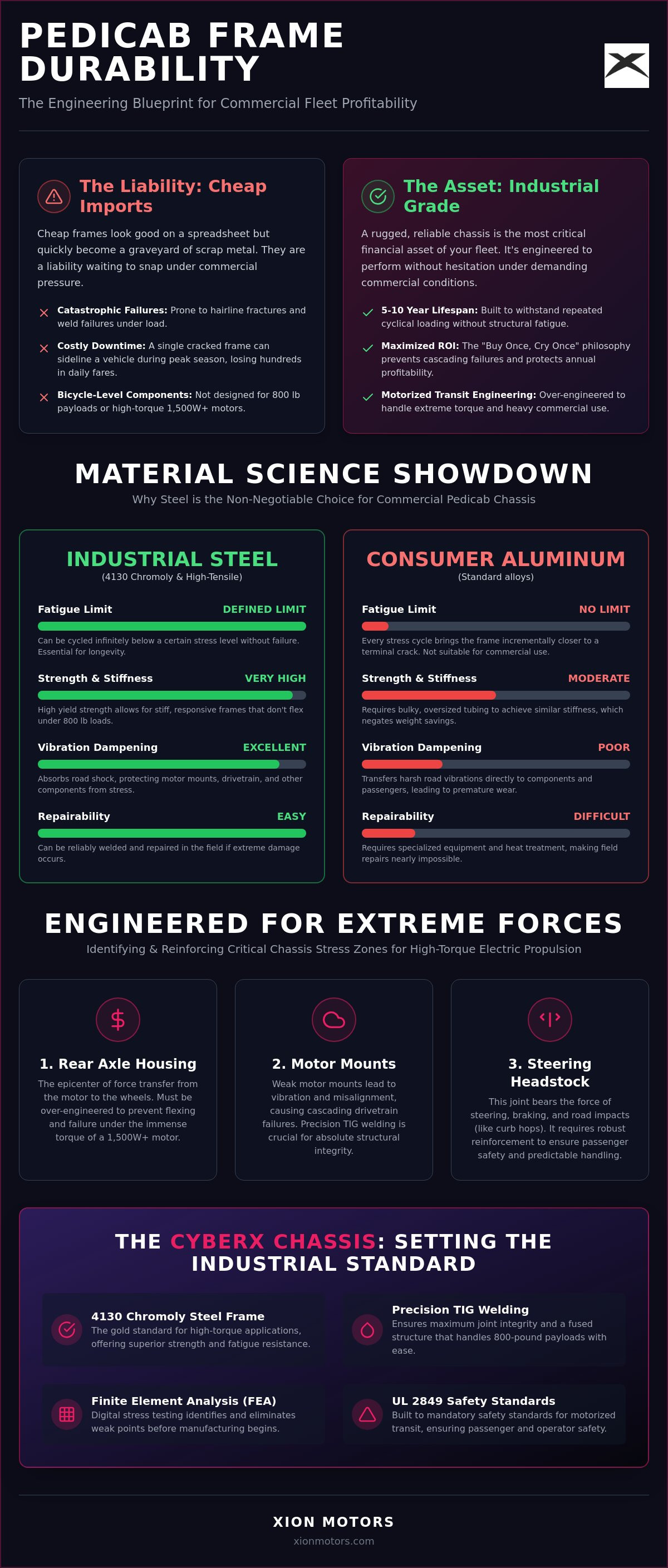
The chassis of a commercial vehicle is its most critical financial asset. If the frame fails, the business stops. In the world of urban transit, pedicab frame durability is formally defined as a structure's capacity to withstand repeated cyclical loading without succumbing to structural fatigue. Every curb hop, emergency stop, and heavy passenger load sends a shockwave through the metal. While a standard Cycle rickshaw (pedicab) might survive a few seasons of light use, a professional fleet vehicle must endure thousands of hours of high-torque operation without a single hairline fracture.
There's a direct, measurable correlation between chassis integrity and your annual fleet profitability. We've spent decades in the trenches and have seen how a "Buy Once, Cry Once" philosophy separates successful operators from those who go under. Investing in industrial-grade frames prevents the cascading failures that occur when a weak chassis begins to flex, which then puts undue stress on the drivetrain and wheels. High-stress zones, specifically the rear axle housing, motor mounts, and steering headstock, are where the battle for longevity is won or lost. If these areas aren't over-engineered for the torque of a 1,500W+ motor, the vehicle becomes a ticking clock of maintenance downtime.
The Economic Impact of Structural Failure
Downtime is the silent killer of fleet growth. When a frame cracks during a peak tourist weekend, you aren't just losing the cost of the weld repair. You're losing hundreds of dollars in daily fares and potentially damaging your brand's reputation for reliability. There's also the looming shadow of liability. A catastrophic frame failure while transporting three passengers is a risk that no seasoned professional is willing to take. Commercial continuity is the primary goal of industrial-grade engineering.
Commercial Grade vs. Consumer Grade Standards
Don't mistake a reinforced e-bike for a commercial transit vehicle. Consumer-grade frames are built for the casual rider who might put 500 miles on a bike per year. In contrast, a fleet vehicle handles that mileage in a week. Off-the-shelf bicycle components simply aren't designed for 12-hour shifts or 800-pound payloads. If you're currently starting a pedicab company, your first priority must be the acquisition of assets that are built to a motorized transit standard. Precision-engineered chassis are the only way to ensure your fleet stays on the street and out of the welding shop.
Material Science in Commercial Chassis: Steel vs. Aluminum Standards
Choosing the right material isn't about aesthetics; it's about the physics of long-term commercial survival. While the Engineering Innovation in Road Biking has pushed the limits of speed and weight, commercial transit requires a different set of priorities. For a fleet operator, the strength-to-weight ratio is a secondary concern to the fatigue limit. Steel possesses a distinct fatigue limit, which is a stress level below which the metal can be cycled infinitely without failure. Aluminum lacks this threshold. This means every mile an aluminum frame travels brings it incrementally closer to a terminal crack, whereas a properly engineered steel frame can last a decade. Superior pedicab frame durability depends on understanding these molecular-level differences before you sign a purchase order.
Steel: The Industrial Standard for Longevity
High-grade steel alloys like 4130 Chromoly are the gold standard for high-torque applications. Chromoly offers a significantly higher yield strength than standard high-tensile steel, allowing for thinner, lighter tubing that remains stiffer under load. The vibration-dampening properties of steel also protect other vehicle components by absorbing road shock rather than transferring it to the motor mounts. We utilize precision TIG welding to ensure joint integrity, creating a fused structure that handles 800-pound payloads with ease. This rugged construction is exactly what we provide in our electric pedicab fleet packages, where reliability is the primary metric for success.
Aluminum and Composites: The Lightweight Alternative
Aluminum is often marketed for its corrosion resistance in coastal or high-salt environments. However, the trade-off is structural bulk. To match the stiffness of a steel chassis, aluminum frames require significantly thicker tubing, which often negates the weight advantage. Common failure points in aluminum trike designs occur at the weld heat-affected zones, where the metal becomes brittle over time. In a high-torque electric environment, these brittle zones are prone to sudden, catastrophic failure under heavy braking or acceleration.
Repairability is the ultimate tie-breaker in a fleet shop environment. A steel frame can be ground down and re-welded by any competent technician with a MIG or TIG setup, getting the vehicle back on the street in hours. Aluminum requires specialized heat treatment after welding to restore its strength, a process that is rarely feasible for a busy operator. If you're focused on maximizing uptime, you should consider exploring our industrial-grade vehicle lineup built on proven steel architecture. Precision engineering ensures that your investment remains structural sound for years of heavy-duty service.
Engineering for High-Torque Electric Propulsion Systems
Electric propulsion changes the structural requirements of a vehicle entirely. While traditional engineering innovation in bicycle frames focuses on human output, a high torque electric pedicab introduces mechanical forces that can twist a standard chassis into scrap. The motor doesn't just push the vehicle forward; it attempts to tear itself away from its mounts every time the throttle is engaged. This instant torque creates a massive leverage effect on the rear axle and chainstay area. Without industrial-grade reinforcements, this flex leads to "ghost shifting" and premature chain failure. True pedicab frame durability in the electric age requires a chassis designed specifically to handle the 1,500W+ power plants that modern fleets demand.
Transporting up to six passengers plus a heavy battery pack adds a static load that compounds these dynamic forces. You aren't just building a bike; you're building a transit asset. This necessitates heavy gusseting at every major junction and reinforced motor brackets that can withstand peak amperage spikes without shearing. Engineering for a 800-pound payload requires a shift in perspective from "lightweight" to "indestructible."
Motor Mount Integrity and Torsional Rigidity
Torsional rigidity is the chassis's ability to resist twisting along its longitudinal axis. In a trike configuration, poor rigidity causes the frame to "corkscrew" under load, misaligning the drivetrain and causing the chain to jump or snap. We use overbuilt motor mounts and triangulated bracing to ensure the drive system remains perfectly aligned regardless of the passenger count. Electric-first engineering begins at the chassis, not the battery.
Axle and Drivetrain Reinforcement
The transition from bicycle-grade components to industrial hardware is non-negotiable for fleet survival. We've replaced standard bicycle axles with 1-inch cold-rolled steel axles that won't bend under extreme payloads. These are supported by heavy-duty pillow block bearings, which distribute weight more effectively than standard hub bearings found in cheap imports. The CyberX platform takes this further by optimizing weight distribution over the rear axle, ensuring the center of gravity remains low and the frame remains stable during emergency maneuvers. This level of precision ensures that your drivetrain components aren't fighting a flexing frame every time your driver hits the throttle.
Structural Integrity Testing and Real-World Stress Factors
Engineering excellence is never the result of guesswork. We rely on Finite Element Analysis (FEA) to guarantee pedicab frame durability before the first bead of weld is even laid. This computational process allows us to simulate the extreme forces of urban transit in a digital environment, identifying potential fatigue points that would otherwise take years to appear on the street. Real-world conditions are an unforgiving laboratory. Cobblestones act as a constant jackhammer on your chassis, while curb hops and emergency braking with a full payload introduce sudden, massive G-loads. If your frame hasn't been validated through rigorous FEA testing, it's not a commercial vehicle; it's a liability.
A 1,500 lb weight capacity is the commercial standard for a professional fleet. Any vehicle rated below this threshold is a consumer-grade product that will eventually buckle under the combined weight of passengers, high-capacity batteries, and the driver. Your chassis must be over-engineered to handle these static and dynamic loads without permanent deformation. To maintain your fleet at peak performance, perform these structural integrity inspections monthly:
- Examine all weld junctions for "stress bloom," which appears as flaking or cracking paint.
- Check motor mounts for signs of torsional elongation or bracket bending.
- Verify rear axle alignment to ensure no frame twisting has occurred under high-torque acceleration.
- Inspect the steering headstock for hairline fractures, particularly after any impact or curb strike.
The Impact of Road Surface on Frame Fatigue
Vibration is the primary architect of structural fatigue. Constant oscillation from uneven pavement creates microscopic fissures in weld joints that eventually propagate into terminal failures. While a rigid frame might seem simpler, it forces the chassis to absorb 100% of the road shock. A professional suspension system acts as a sacrificial buffer, protecting the frame from the destructive energy of shock loading. If you notice "stress bloom" at the junctions, the metal is likely reaching its elastic limit and requires immediate reinforcement.
Passenger Load Dynamics and Center of Gravity
Passenger placement dictates the dynamic stresses your frame must survive during every shift. Cornering forces on a fully loaded trike create lateral loads that attempt to "peel" the rear axle away from the main chassis. This is why the engineering of a 6-seat model requires significantly more lateral bracing than a 3-seat CyberX. For detailed instructions on protecting your structural assets, consult our electric pedicab maintenance guide. Ensuring your vehicles remain within factory tolerances is the only way to sustain industrial-grade performance.
Secure your fleet's future with the most durable chassis in the industry. Browse our commercial electric pedicab packages and invest in vehicles built for the long haul.
The CyberX Chassis: Setting the Industrial Standard for 2026
The CyberX represents a fundamental shift in how commercial trikes are built. It isn't a reinforced bicycle; it's a purpose-built electric transit vehicle designed for the rigors of 2026 urban mobility. We've utilized industrial-grade materials and precision TIG welding to create a chassis that finally solves the industry's most persistent problem: catastrophic structural fatigue. By integrating the motor and battery housing directly into the frame architecture, we've created a structural member that significantly enhances the vehicle's torsional rigidity. This design choice ensures that pedicab frame durability is a foundational feature rather than an afterthought. Xion Motors stands as the master practitioner in this field, delivering equipment that survives where others fail.
Rugged Authority in Every Weld
Precision is the cornerstone of our manufacturing process. Every frame that leaves our facility undergoes a rigorous quality control protocol to verify weld penetration and structural alignment. We don't guess at durability. Our designs are the direct result of over 20 years of fleet operational experience in the most demanding urban environments. This history has taught us that an over-engineered approach is the only responsible way to manage passenger safety. We build for the worst-case scenario so your fleet can perform at its best every single day. Our frames don't just meet standards; they set them.
Future-Proofing Your Fleet
A vehicle should be a long-term asset, not a recurring expense. The modularity of the VorteX and CyberX frames ensures that your fleet remains relevant as propulsion technology advances. Because our frames are built to last five to ten years, they easily support multiple motor and battery lifecycles. You can upgrade your drive systems without the massive capital expenditure of replacing the entire vehicle. This structural longevity is the ultimate hedge against market volatility and equipment obsolescence. It's time to stop repairing cheap imports and start managing a professional transit operation with assets that hold their value.
Explore Xion Motors Industrial Pedicabs and secure the backbone of your fleet today.
Securing Your Fleet’s Structural Legacy
The era of treating pedicabs as oversized bicycles is over. To dominate your market, you must view your fleet as a collection of high-performance transit assets. We have detailed how industrial-grade materials like 4130 Chromoly and precision TIG welding form the backbone of a profitable operation. Mastering pedicab frame durability is the single most important decision you'll make to ensure your vehicles withstand high-torque electric propulsion and heavy passenger loads over a five to ten year lifespan.
Don't settle for equipment that fails when the tourist season hits its peak. Xion Motors provides the engineering depth you need to eliminate maintenance downtime and maximize passenger safety. We are a veteran-owned company with over 20 years of operational roots, and our industrial-grade TIG welded chassis are built to set the standard for 2026 and beyond. With national shipping available to all 50 states, the professional tools for your business growth are ready for deployment.
Build Your Industrial Fleet with Xion Motors and invest in a vehicle that works as hard as you do.
Frequently Asked Questions
What is the best material for a commercial pedicab frame?
High-grade steel alloys like 4130 Chromoly are the industrial standard for professional fleets. Unlike aluminum, steel possesses a defined fatigue limit, which allows the chassis to endure infinite stress cycles without structural failure. This molecular advantage is the primary driver of long-term pedicab frame durability in high-torque electric applications. It provides the rugged authority needed for heavy-duty transit.
How long should a professional pedicab frame last in a high-volume fleet?
A purpose-built industrial chassis should remain in operation for five to ten years with routine inspections. While cheap imports often succumb to metal fatigue within two seasons, a precision-engineered frame is a decade-long asset. This longevity directly impacts your ROI by spreading the capital cost over thousands of high-revenue shifts. We build our vehicles to be the permanent backbone of your business.
Can a cracked pedicab frame be safely repaired?
Steel frames can be safely repaired by a qualified technician using TIG or MIG welding processes. Aluminum frames are much more difficult to salvage because they require specialized heat treatment to restore structural integrity after welding. Steel's superior repairability ensures that minor damage doesn't turn into a total loss. This allows your fleet to maintain maximum uptime even after a collision or impact.
How does electric motor torque affect the lifespan of a trike frame?
High-torque motors exert intense twisting forces that can warp or "corkscrew" a weak chassis during acceleration. This torsional stress is concentrated at the motor mounts and rear axle housing. Industrial-grade frames utilize reinforced brackets and heavy gusseting to neutralize these forces. Without this specific engineering, a frame will eventually misalign the drivetrain and cause catastrophic chain or axle failure.
What is the weight capacity of an industrial-grade electric pedicab?
A commercial-grade pedicab must support a payload of 1,500 pounds to be considered viable for fleet use. This rating covers the combined weight of the driver, up to six passengers, and the high-capacity battery systems. Our CyberX and VorteX models are engineered to these exact transit standards. They ensure safety and stability even when the vehicle is operating at its maximum mechanical limit.
What are the signs of structural fatigue I should look for during inspections?
Look for "stress bloom," which appears as flaking or cracked paint around weld junctions and high-load areas. This is a clear indicator that the metal is flexing beyond its elastic limit and is approaching failure. You should also inspect the steering headstock and motor mounts for hairline fractures or visible deformation. Early detection during a monthly inspection prevents a minor fracture from becoming a catastrophic structural event.
Why are bicycle-standard frames insufficient for commercial pedicab use?
Bicycle frames are designed for human power and light loads, not the 1,500W+ torque and 800-pound payloads of a transit asset. A standard bicycle tube will buckle or snap under the cyclical loading of a 12-hour commercial shift. We treat the pedicab as a motorized vehicle, utilizing industrial-grade tubing and transit-level engineering. This shift in manufacturing philosophy is what separates a professional tool from a hobbyist toy.
Does frame weight significantly impact the battery range of an electric pedicab?
Frame weight has a negligible impact on range when compared to the weight of the passengers and the efficiency of the motor. The structural security of a steel frame far outweighs the minor weight savings of aluminum. A slightly heavier, reinforced chassis provides the rigidity needed for efficient power transfer to the road. You'll gain more range from a stiff, aligned drivetrain than you'll ever lose from a few extra pounds of steel.
Thinking about starting or scaling a pedicab operation?
See what a pedicab costs ($13,500–$15,000 direct from the manufacturer), explore fleet pricing on 3+ units, or start with $0-down equipment financing. Xion operators earn $30,000–$35,000 per cab per year across 59+ US markets.