A standard bicycle wheel is a hobbyist component, but a wheel engineered for a 1,500 lb capacity is a piece of industrial infrastructure. If you treat your fleet maintenance like a simple trip to the local bike shop, you're inviting catastrophic failure during your busiest tourism season. Professional pedicab wheel replacement requires an uncompromising engineering mindset that prioritizes structural integrity over retail convenience. You've likely felt the frustration of watching a vehicle sit idle because a consumer-grade rim buckled under a heavy passenger load. It's an expensive bottleneck that drains your revenue and damages your reputation for reliability.
We understand that in this high-stakes industry, uptime is the only metric that truly matters. This guide delivers the master protocols for identifying and sourcing the heavy-duty components required for the 2026 market. You'll learn how to implement industrial-grade maintenance cycles that ensure zero-fail performance even under the most demanding urban conditions. We're moving beyond simple repairs to a system of fleet management that lowers your long-term cost per mile. From sourcing 48-spoke 12-gauge steel configurations to meeting the latest unibody safety standards, this checklist is your blueprint for a dominant, high-yield operation.
Key Takeaways
- Identify the critical engineering markers for pedicab wheel replacement, from rim sidewall thinning to recurring spoke fatigue.
- Discover the structural necessity of high-gauge spokes and why consumer-grade components inevitably fail under heavy passenger loads.
- Master a professional safety protocol for securing the chassis and disconnecting electrical systems during high-stakes maintenance.
- Maximize your fleet's return on investment by implementing standardized break-in inspections and rigorous spoke tensioning cycles.
Identifying Critical Wear: When to Schedule a Pedicab Wheel Replacement
Reactive maintenance is a profit killer. In a high-stakes tourism environment, waiting for a component to fail means losing revenue and risking passenger safety. A professional cycle rickshaw fleet requires a rigorous inspection schedule that identifies structural degradation long before it leads to a breakdown. Your primary goal is to spot the markers of fatigue that indicate a necessary pedicab wheel replacement. This isn't just about keeping the vehicle moving; it's about protecting the long-term viability of your capital assets.
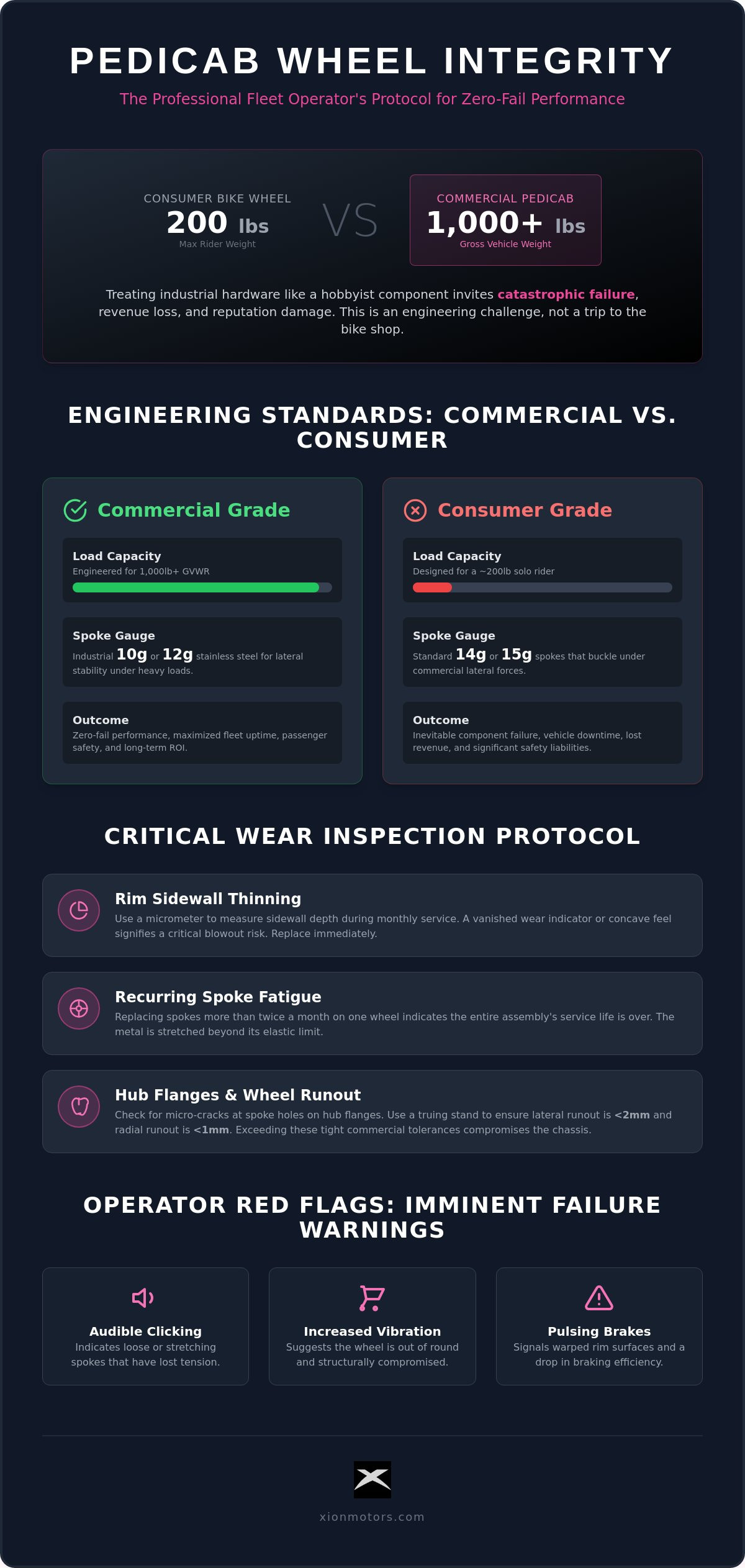
Rim sidewall thickness is your first line of defense. Heavy-duty braking systems on a fully loaded trike generate immense friction. This friction eventually thins the aluminum or alloy walls of the rim. Use a micrometer to measure the sidewall depth during every monthly service. If the wear-indicator groove has vanished or the wall feels concave, the rim is no longer capable of holding high-pressure tires under load. A thin sidewall is a blowout risk that can lead to a total loss of vehicle control during a descent.
Recurring spoke fatigue is the second major red flag. If your technicians are replacing individual spokes more than twice a month on the same wheel, the entire assembly has likely reached the end of its service life. The metal has been stretched beyond its elastic limit. At this stage, the wheel loses its ability to distribute the 1,500 lb capacity evenly. You're no longer performing a repair; you're simply delaying a catastrophic failure. A comprehensive pedicab wheel replacement is the only way to restore the structural integrity required for commercial operation.
Examine the hub flanges and check for runout tolerances. Hub flanges take the brunt of lateral torque, especially during sharp turns with three or more passengers. Look for micro-cracks originating at the spoke holes. Additionally, assess the lateral and radial runout using a professional truing stand. Commercial safety tolerances are much tighter than consumer bike standards. A wheel that wobbles more than 2mm laterally or hops 1mm vertically creates uneven stress on the chassis and drivetrain. It's a clear signal that the wheel's internal tension is compromised beyond the point of a simple tune-up.
Visual Inspection for Fleet Safety
Check the eyelets of the rim for micro-fractures. High-tension spokes can pull through the rim surface over time. On high-torque electric models, verify the integrity of the hub-to-axle interface. Any play in this connection will quickly escalate into a sheared axle or a destroyed motor housing. Finally, look for uneven tire wear. If one side of the tread is balding faster than the other, your wheel is misaligned or the rim is warped beyond the point of recovery.
Performance Indicators of Imminent Failure
Operators are your best diagnostic tool. Listen for audible clicking sounds while the vehicle is in motion; this usually indicates loose or stretching spokes that have lost their tension. An increase in vibration during high-speed passenger transport suggests the wheel is out of round. Finally, if braking efficiency drops or you feel a pulsing sensation in the brake lever, the rim surfaces are likely warped. These performance dips are precursors to a total wheel failure that could sideline your vehicle for days.
Engineering Standards: Commercial-Grade vs. Consumer Bike Wheels
Standard bicycle wheels are built for a 200-pound rider; they aren't engineered for the 1,500-pound capacity of a commercial trike. When you load three to six passengers into a vehicle, the lateral forces generated during a simple turn can exceed 300 pounds of pressure on a single wheel. Retail-grade wheels lack the structural reinforcement to handle this stress, leading to collapsed rims and sheared spokes. A professional pedicab wheel replacement must utilize components designed for industrial load-bearing, not weekend cycling. If you're sourcing parts from a local bike shop, you're building a liability into your fleet.
Spoke gauge is the most critical factor in lateral stability. While standard bikes use 14g or 15g spokes, a commercial wheel requires 10g or 12g stainless steel. These thicker diameters provide the stiffness necessary to prevent wheel flex under heavy cargo. Utilizing professional wheel building techniques, such as specific lacing patterns and high-tension truing, ensures that the wheel remains a rigid, reliable unit. We prioritize 48-spoke configurations because they distribute weight more effectively across the rim bed than the 32 or 36-spoke versions found in consumer shops. The result is a wheel that stays true even after thousands of miles of urban service.
Hub architecture also separates the amateurs from the masters. Loose ball bearing systems are prone to contamination and require frequent, labor-intensive adjustments. Industrial wheels utilize sealed cartridge bearings. These units are press-fitted to exclude road grime and moisture, significantly extending the service life of the axle assembly. When the bearings eventually wear, you simply replace the cartridge rather than the entire hub. This modular approach to maintenance reduces your long-term operational costs and keeps your vehicles on the street where they belong.
Anatomy of an Industrial Pedicab Wheel
The rim itself must be a double-wall design, typically extruded from 6061-T6 aluminum or high-tensile steel. This construction provides a box-section profile that resists denting and twisting. Reinforced spoke beds are mandatory; they prevent the nipple from pulling through the rim under the high torque of a standing start. High-flange hubs are used to create a wider bracing angle, which increases the wheel's resistance to side-loading during aggressive cornering. These aren't luxury upgrades; they're the baseline for commercial viability.
The Impact of Electric Drive Systems
Modern fleets demand more from their wheels than ever before. You must manage the massive torque output of an electric pedicab replacement motor, which puts immediate, intense stress on the spoke elbows. Integrated hub motors generate significant heat during sustained climbs, requiring wheels that can dissipate thermal energy without compromising the tire bead. Regenerative braking forces add another layer of complexity, applying reverse torque every time the operator slows down. Choosing the right Vehicle Parts is the only way to ensure your electric fleet remains profitable and safe.
The Professional Replacement Protocol: A Step-by-Step Safety Checklist
Executing a pedicab wheel replacement on a commercial vehicle is an industrial operation, not a casual bicycle repair. When you're managing a chassis designed for a 1,500 lb capacity, the margin for error disappears. A wheel that isn't seated with precision or torqued to exact specifications is a liability that can lead to catastrophic axle failure or total loss of vehicle control. You must treat every replacement as a mission-critical procedure that directly impacts your fleet's safety and profitability. Professionalism in the workshop translates to reliability on the street.
Stability is your first priority. Never attempt to lift a commercial trike using standard bicycle work stands or makeshift blocks. Utilize industrial-grade jack stands positioned at the manufacturer's designated lift points to prevent the vehicle from tipping during the procedure. For electric models, you must disconnect the integrated electrical harnesses before the wheel is removed. Hub-motor equipped vehicles require careful handling of the phase wires and sensor cables; a snagged harness can lead to an expensive electronics repair that dwarfs the cost of the wheel itself. Precision is the baseline for every action you take in the bay.
Torque management is where most amateur mechanics fail. Hand-tightening axle nuts is unacceptable for commercial transport. Utilize calibrated torque wrenches to meet the specific Newton-meter requirements of your vehicle's manufacturer. Over-tightening can crush bearings and stretch axle threads, while under-tightening allows for vibration that will eventually back the nut off the shaft. Once the installation is complete, perform a high-load stress test. This involves a short, controlled circuit with a simulated passenger load to verify that the assembly remains true and the hardware remains seated under real-world pressure.
Preparation and Safety Procedures
Begin by clearing the passenger cabin entirely. An empty vehicle ensures a predictable center of gravity when lifting. Lock the parking brake and chock the remaining wheels to prevent any forward or backward movement. Organize your station with professional-grade tools, including deep-well sockets and high-leverage torque drivers. A clean, organized workspace is the hallmark of a master practitioner and ensures no critical washers or spacers are lost during the swap.
Installation and Alignment Standards
Correct seating of the axle within the dropouts or swingarm is non-negotiable. If the axle is slightly canted, it will create uneven wear on your tires and drivetrain. Align the brake rotor with the caliper to ensure zero-rub performance; even a minor drag will reduce your battery range and increase component heat. Finally, verify the chain or belt tension on drive-side replacements. Proper tensioning prevents skipped teeth under the high torque of a standing start, ensuring your pedicab wheel replacement delivers immediate, reliable performance.
Sourcing Industrial Components: Selecting Hubs, Spokes, and Rims
Procuring components for a pedicab wheel replacement is a strategic business decision that dictates your fleet's operational overhead. You cannot afford to gamble on generic parts that lack documented load ratings. Engineering tolerances on the CyberX chassis require exact hub widths and axle diameters to maintain drivetrain alignment and braking efficiency. Utilizing substandard components introduces variables that lead to premature wear on the frame and motor. Prioritize OEM commercial trike replacement parts to guarantee fitment and preserve the structural integrity of your high-performance vehicles.
Analyze the business case for complete wheel assemblies versus individual part rebuilds. While rebuilding a wheel in-house might seem cost-effective, the labor hours required for professional lacing and tensioning often exceed the price of a factory-certified assembly. A complete assembly ensures that the rim, spokes, and hub are balanced and tested as a single unit before they ever reach your shop. This modular approach minimizes downtime during peak tourism seasons. If you choose to rebuild, you must verify the load ratings for every individual component. A 12-gauge spoke is useless if it is paired with a rim eyelet that cannot handle the necessary tension.
Choosing the Right Rim and Tire Combo
Match your rim width to high-volume commercial tires like the Maxxis Hookworm 26x2.5. A wide rim provides a better contact patch and prevents tire squirm under heavy passenger loads. Evaluate the shift toward tubeless systems for your fleet operations; they offer superior puncture resistance and the ability to run lower pressures for increased passenger comfort. Ensure your valve stems remain easily accessible. In a fast-paced environment, a technician should be able to perform a pressure check in seconds without fighting tight spoke clearances.
High-Torque Hub and Spoke Selection
Lacing patterns are the foundation of wheel strength. We recommend a 4-cross pattern for 48-spoke wheels to provide maximum tangential strength against motor torque. For hub motor replacements, distinguish between internal gearing and direct drive systems; each has unique heat dissipation needs and spoke bracing angles. Brass nipples are the industrial standard for longevity. Unlike aluminum, brass won't gall or corrode when exposed to road salt and moisture, ensuring your wheels remain serviceable for years. For the highest level of reliability, invest in professional-grade Vehicle Parts that meet these exact specifications.
Maximizing Fleet ROI: Post-Replacement Maintenance and Tuning
A professional pedicab wheel replacement is not a "set and forget" task. It's the beginning of a new service cycle for a high-stress industrial asset. In the first 50 miles of operation, new spokes and nipples undergo a seating process where they physically settle into the rim bed and hub flanges. Skipping a post-installation inspection during this window is a recipe for premature failure. You must mandate a 50-mile "break-in" check to re-verify spoke tension and axle torque. This single step prevents the minor hardware settling that often leads to wheel wobble or spoke snapping under heavy loads.
Data is your most powerful tool for fleet longevity. Document every replacement in a centralized log to track the lifespan of your components across different vehicles and operators. By standardizing spoke tension checks as part of your electric pedicab maintenance guide protocols, you transform maintenance from a reactive chore into a predictable system. Consistent tensioning doesn't just prevent breaks; it maintains the wheel's lateral stiffness, which is essential for handling the high torque of modern electric drive systems. If you aren't measuring, you aren't managing.
Operator training is the final link in the safety chain. Your drivers are on the front lines and can identify early warning signs before they escalate into mechanical disasters. Train them to perform a "pluck test" on spokes and a visual check for rim cracks during every pre-shift inspection. A well-trained operator who catches a loose axle nut or a slightly out-of-true wheel saves the fleet hours of downtime. Empower your team to be the first line of defense in your maintenance strategy.
The Financial Case for Preventive Maintenance
The math of fleet management is simple: scheduled downtime is significantly cheaper than emergency repairs. A mid-shift failure during a peak tourism window doesn't just cost you a wheel; it costs you towing fees, lost fares, and potential damage to your brand's reputation for safety. Proper tensioning and truing can double the lifespan of industrial spokes, spreading the cost of the hardware over thousands of additional miles. Furthermore, a perfectly true wheel reduces uneven tire wear, ensuring you get the maximum return on every rubber investment.
Fleet Management Integration
Use your maintenance logs to identify high-stress routes that might be accelerating wear on your wheels. If a specific area of your city is notorious for potholes or steep grades, you can adjust your inspection intervals accordingly. To ensure maximum uptime, optimize your electric pedicab fleet packages by maintaining a ready-to-go spare wheel inventory. Having a pre-built, high-tension wheel on the rack means a replacement takes minutes rather than days. For professional support and industrial-grade components that keep your business moving, contact Xion Motors to secure the parts your fleet deserves.
Dominating the Urban Transit Market Through Engineering Excellence
Reliability is the foundation of a profitable fleet. By transitioning from reactive repairs to a structured industrial protocol, you've positioned your business to outpace the competition. You now understand that a professional pedicab wheel replacement is more than a mechanical task; it's a strategic investment in vehicle uptime and passenger safety. From selecting 12-gauge spokes to implementing rigorous 50-mile break-in inspections, every decision you make in the workshop impacts your bottom line on the street.
Don't settle for consumer-grade components that aren't built for the demands of a 1,500 lb capacity. Xion Motors brings over 20 years of fleet operations experience to your workshop, providing the rugged authority required to sustain a high-performance operation. We offer specialized parts engineered specifically for CyberX and VorteX models, ensuring a perfect fit and industrial durability. With shipping available to all 50 states, the tools for your success are always within reach. Secure Your Fleet with Industrial-Grade Xion Motors Replacement Parts and ensure your vehicles remain the dominant force in your market. Your commitment to excellence starts with the right hardware.
Professional Fleet Maintenance: Frequently Asked Questions
How often should commercial pedicab wheels be replaced?
Commercial wheels don't have a fixed expiration date but require replacement when structural fatigue markers appear. Monitor your fleet for thinned rim sidewalls and recurring spoke breakage. If a wheel requires truing more than once a month or shows micro-fractures at the eyelets, it has reached its end of life. High-intensity tourism operations often see a full service cycle every 12 to 18 months depending on road conditions and passenger weight.
Can I use standard bicycle spokes for my electric pedicab?
You cannot use standard 14g bicycle spokes for commercial electric operations. These thin components lack the tensile strength to manage the high torque of a 72V motor and the lateral pressure of a 1,500 lb capacity. Professional pedicab wheel replacement demands 10-gauge or 12-gauge stainless steel spokes. Using consumer-grade parts leads to immediate spoke fatigue and catastrophic wheel collapse during high-speed transport.
What is the recommended torque for pedicab axle nuts?
Recommended torque values vary by chassis, but most heavy-duty electric rear axles require between 40 and 60 Newton-meters. Always consult the specific engineering standards for your VorteX or CyberX model. Utilizing a calibrated torque wrench is mandatory to prevent bearing crush or axle nut backing. Hand-tightening is a liability that invites vibration and hardware failure on the street. Precision in the workshop ensures safety on the route.
Do I need to replace the hub motor if the rim is damaged?
You don't need to scrap a functional hub motor because of a bent or cracked rim. Most industrial motors can be unlaced and rebuilt into a fresh double-wall rim using new high-gauge spokes. This process is a standard part of professional pedicab wheel replacement. However, if the motor casing shows signs of heat damage or flange cracking, a complete motor assembly replacement is the safer, more profitable long-term choice for your fleet.
How do I know if my pedicab wheel is out of true?
A wheel is out of true if you observe side-to-side wobble or a vertical hop while the wheel spins. You'll often feel this as a distinct vibration through the chassis or hear the rhythmic scuffing of a brake rotor against the caliper. Use a professional truing stand to measure runout. If the lateral deviation exceeds 2mm, the wheel requires immediate tensioning to prevent uneven load distribution across the spokes and hub.
What are the risks of using consumer-grade wheels on a 6-seat pedicab?
Using consumer-grade wheels on a 6-seat vehicle is a high-risk operational error. These wheels are designed for single riders, not the massive combined weight of a large-capacity trike. You face a high probability of total wheel collapse during cornering, which creates immense legal liability and immediate operational downtime. Industrial-grade wheels with reinforced spoke beds are the only viable option for multi-passenger commercial transit. Don't gamble with passenger safety.
Should I replace all wheels at the same time for fleet consistency?
You don't have to replace every wheel simultaneously, but maintaining consistency across an axle is a best practice. Replacing both rear wheels at once ensures even traction and braking performance. Instead of mass replacements, focus on building a spare inventory of pre-built assemblies. This allows you to swap a damaged unit in minutes, keeping your fleet active while the old wheel is assessed for rebuild or recycling.
How does tire pressure affect wheel longevity on heavy trikes?
Tire pressure is a direct factor in wheel survival. Under-inflated tires allow the rim to bottom out against curbs or potholes, causing flat spots and sidewall damage. Conversely, over-inflation increases the vibration transferred directly to the spokes, accelerating metal fatigue. Maintain pressures within the manufacturer's specified range for high-volume commercial tires. This balance protects the structural integrity of the rim while ensuring passenger comfort.
Thinking about starting or scaling a pedicab operation?
See what a pedicab costs ($13,500–$15,000 direct from the manufacturer), explore fleet pricing on 3+ units, or start with $0-down equipment financing. Xion operators earn $30,000–$35,000 per cab per year across 59+ US markets.