In the high-stakes world of urban transport, the era of the hobbyist pedicab is officially over. You've likely seen the fallout of under-engineered trikes: motor burnouts on moderate inclines and battery range that vanishes during the most profitable peak hours. This commercial electric pedicab buying guide cuts through the noise of consumer-grade e-bikes to deliver the industrial standards your fleet needs to thrive in 2026. We understand the grind because we've lived it. Reliability isn't just a spec; it's the difference between a vehicle that sits in the shop and one that generates over $30,000 in annual revenue.
You deserve a fleet that works as hard as your drivers do without the constant headache of sourcing proprietary parts or failing safety inspections. We agree that operational uptime is the only metric that truly matters when the crowds are thick and the fares are high. This guide provides a masterclass in high-performance requirements, from 72V drive systems to the mandatory UL 2849 certifications now required in major markets. We will examine the engineering must-haves that ensure zero mid-shift downtime and the commercial strategies to maximize your long-term ROI.
Key Takeaways
- Identify why 72V high-torque drive systems are now the non-negotiable standard for maintaining performance under heavy commercial payloads.
- Compare the revenue potential of the 3-seat CyberX against the high-volume 6-seat Custom VorteX Trike to align your fleet with local market demands.
- Use this commercial electric pedicab buying guide to navigate the 2026 regulatory landscape, ensuring every vehicle in your fleet meets mandatory UL certifications.
- Shift your focus from initial purchase price to "Total Cost of Ownership" to eliminate the hidden expenses of mid-shift downtime and frequent motor failures.
- Learn how to leverage fleet packages and direct-to-operator shipping from Xion Motors to scale your business with professional-grade equipment built for the long haul.
The 2026 Business Case: Why Electric Pedicabs are the New Standard for Urban Transit
The transition from human-powered effort to industrial-electric dominance isn't just a trend; it's an economic necessity for 2026 operators. Historically, the Cycle rickshaw relied on the physical stamina of the driver, which naturally capped passenger turnover and limited operations to flat terrain. Modern fleet owners have moved past these limitations. This commercial electric pedicab buying guide identifies the shift toward high-torque electric systems as the primary driver of modern fleet success. By removing the physical barrier of pedaling heavy loads, operators can maintain high speeds and consistent service throughout a full 12-hour shift.
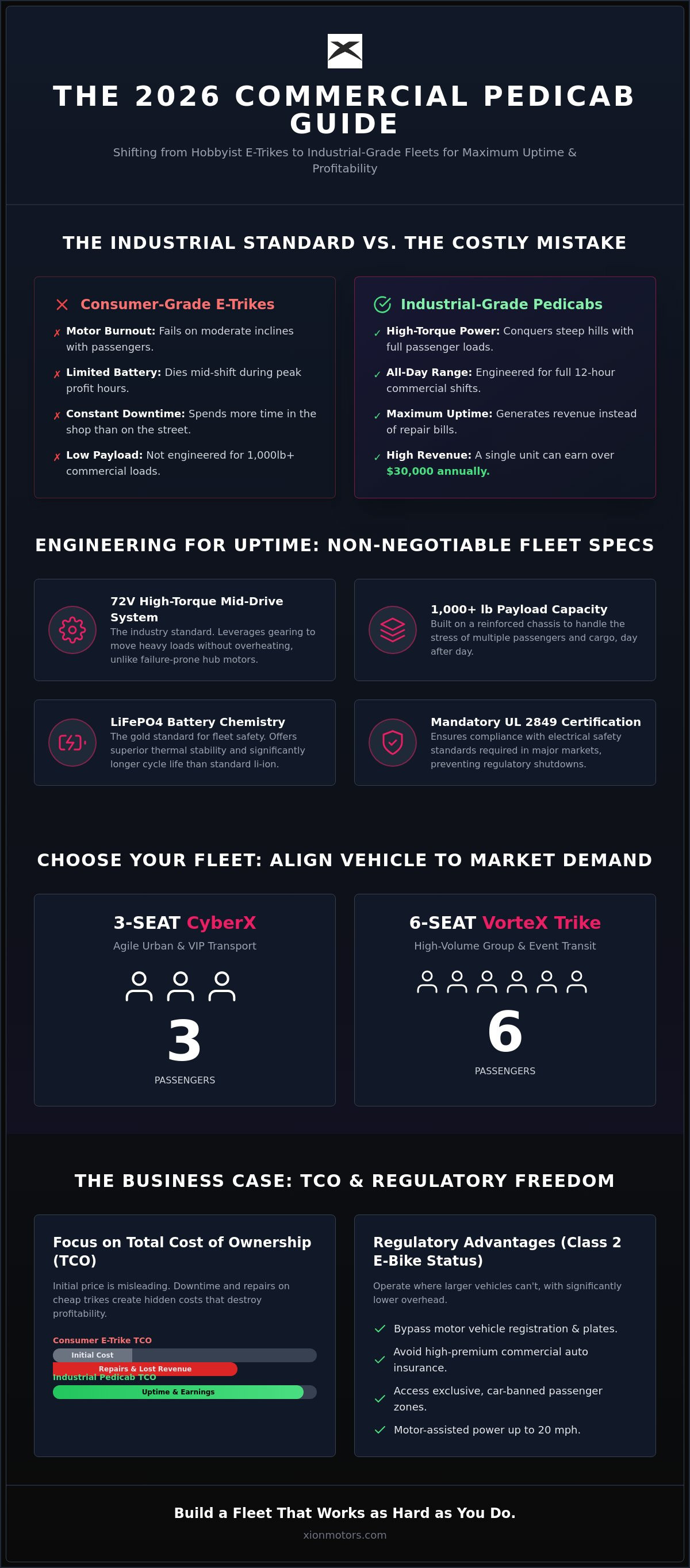
Industrial-grade equipment is the only viable path to profitability in high-traffic environments. Consumer-level e-trikes fail because they aren't engineered for the brutal duty cycles of a commercial fleet. While a consumer bike might handle a weekend cruise, it will crumble under the weight of 1,500lb payloads and constant stop-and-go stress. True industrial vehicles utilize reinforced chassis and 72V drive systems to ensure the motor stays cool while the revenue keeps climbing. A single high-capacity unit in a prime entertainment district or resort can generate over $30,000 in annual revenue. This level of production is only possible when the vehicle remains on the street instead of sitting in a repair bay.
The ROI of High-Capacity Electric Transit
Maximizing your daily earnings starts with passenger seat count. Every extra seat is a direct multiplier of your hourly rate, especially in high-volume districts where group transit is in demand. High-capacity electric pedicabs outperform traditional gas shuttles by eliminating fuel costs and drastically reducing maintenance overhead. When you analyze the numbers, the low cost per mile of an electric fleet allows for a much faster path to total capital recovery. For operators looking to expand, understanding the logistics of electric pedicab fleet packages is essential for calculating the exact ROI of multi-vehicle deployments in major metropolitan centers.
Regulatory Advantages of Class 2 E-Bike Status
Regulatory compliance is often the hidden hurdle that stops a transit business before it starts. Electric pedicabs offer a distinct advantage over golf carts and low-speed vehicles because they often qualify for Class 2 e-bike status. This allows operators to bypass the expensive overhead of motor vehicle registration, license plates, and high-premium commercial auto insurance required for larger shuttles. You can navigate restricted historic centers and urban corridors where cars are banned, giving you exclusive access to the most profitable passenger zones. In 2026, the regulatory sweet spot for electric pedicabs is defined by the ability to provide motor-assisted power up to 20 mph while maintaining the legal status of a bicycle to ensure maximum route flexibility and minimal bureaucratic friction.
Engineering for Uptime: Critical Specs to Evaluate Before Buying
Uptime is the currency of the street. If your vehicle is in the shop, you aren't making money. This commercial electric pedicab buying guide emphasizes that engineering choices made at the time of purchase dictate your fleet's survival. You can't treat a 1,500lb+ payload vehicle like a standard bicycle. It requires a reinforced chassis and high-torque drive systems designed for relentless hill climbing and constant passenger turnover. True industrial-grade hardware is built to endure the abuse of 12-hour shifts, day after day, without mechanical fatigue.
A 750W direct-drive transaxle is the definitive choice for 2026. Unlike the lightweight hub motors common in cheap imports, which often overheat and fail under the stress of full passenger loads on steep inclines, a direct-drive transaxle sends power straight to the rear axle through a differential. This delivers the mechanical leverage needed to move heavy weights without burning out the motor, and it adjusts from 750W of continuous output up to 3,000W of peak power for demanding startups and steep climbs. Pair this with LiFePO4 battery chemistry. It's the gold standard for fleet safety because it offers superior thermal stability and a significantly longer cycle life than standard lithium-ion. Investing in these compliant systems can also qualify you for the commercial clean vehicle credit, making the upgrade to industrial-grade hardware even more fiscally sound.
Voltage and Power Delivery
The 72V advantage is about more than just speed; it's about efficiency and longevity. Standard 48V consumer setups struggle with resistance, leading to excessive heat buildup during long shifts. High voltage allows the system to deliver the same power at lower amperage, which preserves the motor and extends the life of your electrical components. For a technical deep-dive into how we've perfected this architecture, see our CyberX engineering guide. It's the blueprint for vehicles that don't quit when the temperature rises.
Braking and Suspension Standards
Safety is non-negotiable when you're carrying three to six passengers through congested city streets. Hydraulic disc brakes are the only acceptable standard for stopping a fully loaded trike in all weather conditions. Mechanical brakes simply don't have the bite required for commercial safety. Additionally, look for heavy-duty suspension systems that utilize motorcycle-grade components to soak up the abuse of urban cobblestones and uneven pavement. If you want to see these standards in action, explore our current range of electric pedicabs designed for the most demanding urban environments.
Choosing Your Model: 3-Seat CyberX vs. 6-Seat Custom VorteX Trike
Selecting the right vehicle for your fleet is a calculation of geography and passenger density. You can't maximize profit if your vehicle is too large for narrow historic alleys or too small to handle the surge of a stadium crowd. This commercial electric pedicab buying guide identifies two distinct paths for operators: the agile 3-seat CyberX and the high-capacity 6-seat Custom VorteX Trike. Both models utilize our 72V industrial architecture, yet they serve different operational roles in a professional transit network. Your choice depends on whether you prioritize nimble movement and advertising visibility or raw passenger volume per mile.
Operational Use Cases for the CyberX
The CyberX is the surgical tool of the pedicab world. It's designed for solo operators and fleets focusing on nimble urban tours or mobile billboard contracts. Because of its tighter footprint, the CyberX excels in congested entertainment districts where lane-splitting and quick turnarounds are essential. It features a high-torque motor system that provides instant acceleration, even when loaded with three large passengers. This model is a favorite for advertising agencies because its sleek design attracts attention without overwhelming the sidewalk. Check out the CyberX collection for current lead times and specific configuration options for your district.
The Business Case for the 6-Seat VorteX
If your goal is to dominate high-volume transit routes, the Custom VorteX Trike is the industrial solution. It effectively doubles your revenue potential per trip by accommodating group tours and large families that would otherwise require two separate vehicles. Engineering a 6-passenger load requires more than just a longer frame; it demands a reinforced chassis and specialized suspension to manage the significant payload shift. The VorteX is the preferred choice for resort shuttles and event-based transport where passenger turnover is the primary metric of success. When deploying these larger units, operators must ensure they align with municipal pedicab regulations regarding vehicle dimensions and safety standards for high-capacity commercial transit.
- CyberX: Ideal for 1-3 passengers; maximum agility; high advertising impact; lower initial investment.
- Custom VorteX Trike: Ideal for 4-6 passengers; maximum revenue per mile; heavy-duty payload capacity; best for group tours.
- Maneuverability: CyberX handles tight radius turns; VorteX requires wider corridors and professional driver training.
Maneuverability and volume are often at odds. You must evaluate your service area's street width and passenger expectations before committing to a specific model. A mixed fleet often provides the best balance, allowing you to deploy nimble units for on-demand rides and high-capacity trikes for scheduled tours or event shuttles. Regardless of the model, ensure your choice reflects the industrial standards required to survive the daily grind of commercial operation.
Sustaining Operations: Maintenance and Replacement Part Logistics
Buying a vehicle is a transaction. Sustaining a fleet is a strategy. This commercial electric pedicab buying guide emphasizes that the initial purchase price is often a decoy for inexperienced operators. You must evaluate the Total Cost of Ownership (TCO) before committing your capital. A cheap import might save you money on day one, but it will drain your bank account when a proprietary controller fails in the middle of your busiest season. If you can't fix a vehicle in 24 hours, you don't own an asset; you own a liability. True profitability comes from vehicles that stay on the street, not ones that sit in the garage waiting for international shipping.
We build our trikes in San Diego because we know the value of a domestic supply chain. High-performance fleets prioritize parts availability over low entry costs. When you choose a manufacturer with a deep inventory of standardized components, you eliminate the risk of fatal downtime. Our engineering process focuses on durability, but we also ensure that every wear item is accessible and replaceable. This pragmatic approach to design is born from 20 years of operating our own fleets. We don't just sell these machines; we know exactly what it takes to keep them running through a double shift.
The Spare Parts Ecosystem
Downtime is the silent killer of fleet ROI. Overseas manufacturers often use proprietary connectors or non-standard motor mounts that force you into a monopoly for repairs. Xion Motors maintains a robust inventory with 50-state shipping to ensure your vehicles remain active. It's vital to establish a rigorous service schedule to catch minor issues before they become mechanical failures. Refer to our electric pedicab maintenance guide to establish service intervals that protect your investment and ensure passenger safety.
Training and Driver Safety
Your drivers are the first line of defense for your equipment. Even an industrial-grade 72V system can be damaged by improper use. Training protocols must include techniques for managing battery depletion and avoiding motor strain during heavy-load startups on inclines. Daily pre-shift inspections are non-negotiable for professional operators. Check the hydraulic fluid, tire pressure, and battery connections every morning. For a complete operational framework, our guide on starting a pedicab company provides the blueprints for professional driver training and safety management.
Maintain your competitive edge by sourcing high-performance Vehicle Parts directly from a manufacturer that understands the demands of the street.
Scaling Your Fleet: Leveraging Fleet Packages and Direct Shipping
Scaling a transit operation is a test of systems and logistics. You aren't just managing a bike; you're commanding a revenue-generating network. This commercial electric pedicab buying guide identifies the transition from a single-unit operator to a multi-vehicle fleet as the most critical phase for long-term growth. Bulk purchasing isn't just a way to save on capital expenditure. It's a strategic move to standardize your equipment, which simplifies everything from driver training to spare parts management. When every vehicle in your fleet shares the same industrial-grade 72V architecture, your operational complexity drops while your profit margins expand.
Xion Motors provides more than just hardware; we provide a legacy of street-tested expertise. We've spent over 20 years in the trenches of the pedicab industry, and that experience is built into every weld of our chassis. We understand the friction of national logistics, which is why we've perfected direct-to-operator shipping to all 50 states. Your vehicles arrive professionally crated and ready for immediate deployment. This ensures you don't lose a single day of the peak season to assembly or shipping delays. We handle the heavy lifting of logistics so you can focus on dominating your local market.
Fleet Operator Programs
Standardization is the primary driver of efficiency in a professional fleet. When your drivers can move between a CyberX and a VorteX without learning new control layouts, you reduce the risk of accidents and equipment strain. Uniformity also allows you to negotiate higher-value advertising contracts, as a fleet of identical, high-performance vehicles offers a more professional canvas for brand partners. Xion Motors vehicles are engineered as high-yield commercial assets that maintain their structural integrity and resale value far longer than consumer-grade alternatives.
Final Selection Checklist
Before you finalize your order, run a final audit of your operational environment. Ensure your district's topography matches your motor choice, favoring the 72V high-torque systems for any area with significant inclines. Finalize your seat-count strategy by analyzing your market volume; use the 6-seat VorteX for group-heavy resort zones and the 3-seat CyberX for nimble urban tours. This commercial electric pedicab buying guide is your blueprint for building a fleet that dominates the street. Browse the full Xion Motors pedicab collection and fleet packages to start your deployment today.
Dominate the Urban Transit Market in 2026
Success in the pedicab industry isn't about luck; it's about the precision of your equipment and the reliability of your supply chain. This commercial electric pedicab buying guide has outlined the non-negotiable standards for 2026, from the 72V high-torque systems required for heavy payloads to the domestic parts logistics that eliminate fatal downtime. We've spent over 20 years in the trenches building the vehicles we actually use. We don't just manufacture trikes; we engineer high-yield assets designed to survive 12-hour shifts in the most demanding urban environments.
Standardizing your fleet with industrial-grade hardware is the only way to protect your ROI as regulations tighten and passenger expectations rise. Whether you're deploying the nimble CyberX or the high-capacity VorteX, your focus must remain on operational uptime. Our 50-state shipping ensures your fleet is ready for deployment exactly when you need it. It's time to stop managing mechanical failures and start managing your growth.
Explore Industrial-Grade Pedicabs & Fleet Pricing
Build a legacy of performance that stands the test of the street.
Frequently Asked Questions
How much does a commercial electric pedicab cost in 2026?
Professional-grade vehicle costs are a direct reflection of industrial engineering and high-torque capabilities. While entry-level hobbyist units exist, this commercial electric pedicab buying guide recommends focusing on the value of a high-performance 72V system. Investing in a durable chassis and high-capacity battery ensures you recover your capital through consistent uptime and minimal mid-season repair costs.
What is the difference between a 48V and a 72V pedicab system?
Voltage dictates your drive system's efficiency under load. A 72V system provides the industrial standard for 2026, offering significantly more torque and better thermal management than standard 48V setups. Lower voltage systems often overheat when carrying 1,500lb payloads on inclines. High-voltage architecture allows the motor to run cooler, ensuring your vehicle maintains peak performance throughout a demanding 12-hour shift.
Are electric pedicabs street legal in all 50 states?
Most electric pedicabs operate legally under Class 2 e-bike regulations, allowing them to share the road with traditional bicycles across the US. However, you must account for municipal variations in cities like Houston, San Diego, or Portland, where specific speed caps and licensing rules apply. Consult your local ordinance to ensure your fleet remains compliant while operating in high-traffic entertainment districts and historic centers.
How many passengers can a 6-seat electric pedicab safely carry?
A 6-seat unit is engineered to carry six adult passengers plus the professional operator. These vehicles utilize specialized heavy-duty suspension and reinforced frames to manage payloads that frequently exceed 1,500 lbs. Safety remains the priority. You must ensure your vehicle features hydraulic disc brakes to provide the stopping power necessary for these high-capacity group tours and event shuttles.
What kind of maintenance does a commercial electric trike require?
Commercial trikes demand a disciplined maintenance schedule to protect your long-term ROI. You must conduct daily inspections of the hydraulic braking system and tire integrity to ensure passenger safety on urban terrain. Monthly protocols should focus on drive chain tension and electrical connection cleaning. A preventative-first strategy is the only way to avoid costly downtime during your busiest holiday weekends.
How long does the battery last on a full charge with a passenger load?
Range is determined by battery capacity and the intensity of the duty cycle. Our industrial systems are engineered to endure the demands of a full 12-hour shift of continuous operation. Factors like heavy passenger loads and steep topography will influence total mileage. Professional fleet managers often utilize high-speed charging intervals to ensure their vehicles remain active during peak revenue hours.
Where can I buy replacement parts for Xion Motors pedicabs?
Replacement components are available directly through our San Diego headquarters for immediate dispatch to all 50 states. We support fleet operators with a robust inventory of critical parts, from high-torque motors to reinforced wheels. Sourcing parts from the original manufacturer guarantees compatibility and structural safety. This direct-to-operator model eliminates the long wait times common with imports, keeping your fleet on the street.
Thinking about starting or scaling a pedicab operation?
See what a pedicab costs ($13,500–$15,000 direct from the manufacturer), explore fleet pricing on 3+ units, or start with $0-down equipment financing. Xion operators earn $30,000–$35,000 per cab per year across 59+ US markets.