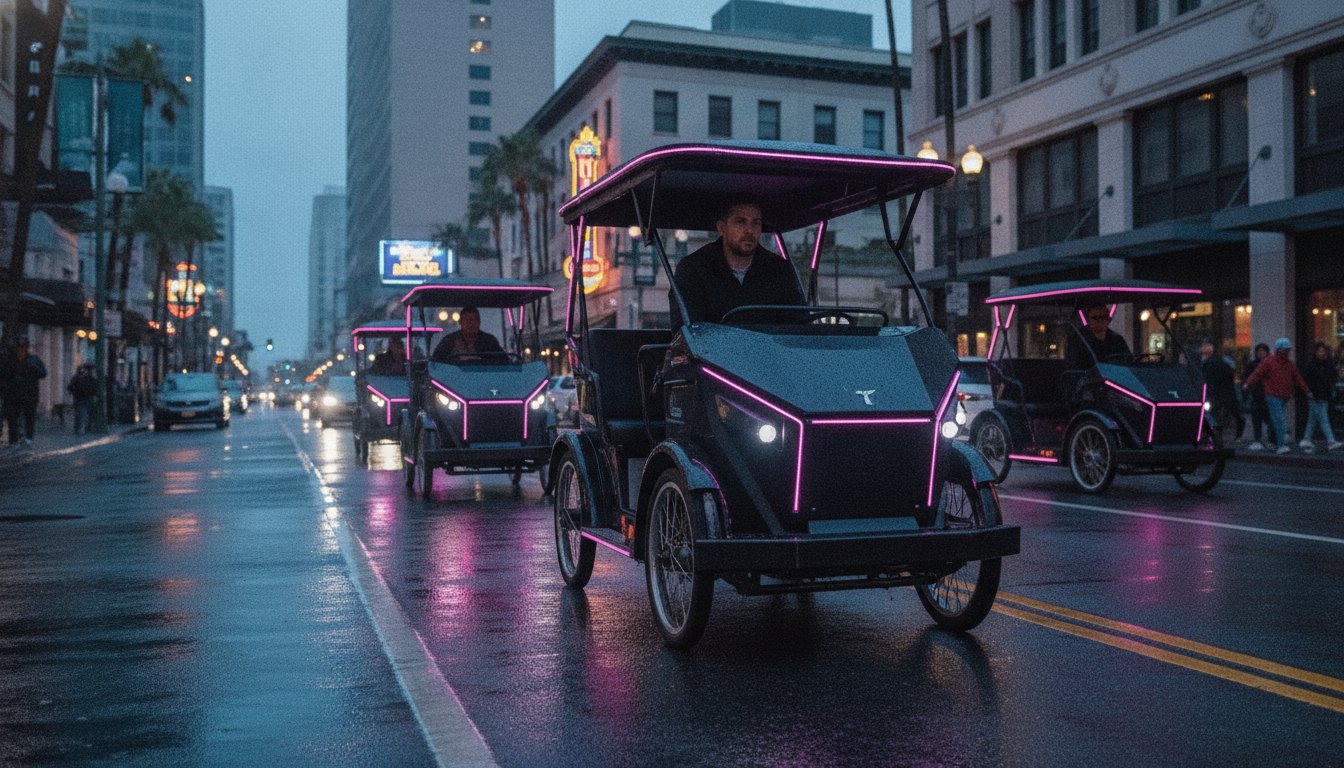
The most expensive vehicle in your fleet might actually be the one with the lowest sticker price. While many operators default to traditional shuttles, the 2026 commercial landscape proves that the electric pedicab vs golf cart debate is no longer a contest of speed. It is a contest of access. You shouldn't have to fight for space on 35 mph roads when the most profitable passenger miles are found in pedestrian zones and restricted urban corridors where Low-Speed Vehicles (LSVs) simply cannot go.
We understand the frustration of watching your margins dissolve into high maintenance costs and regulatory red tape. You need a fleet that stays on the street, not in the shop. This guide breaks down why industrial-grade electric pedicabs are outperforming golf carts in urban access, regulatory flexibility, and bottom-line commercial ROI. We will examine the engineering shift toward high-torque performance and show you how to bypass the limitations of traditional shuttles to maximize your revenue per passenger mile.
Key Takeaways
- Learn why the "Bicycle" legal classification provides a massive regulatory advantage, allowing access to pedestrian districts where motor vehicles and golf carts are prohibited.
- Discover how to maximize your revenue per passenger mile by utilizing the high-rapport "Tour Guide" model unique to pedicab operations.
- Compare the electric pedicab vs golf cart based on 2026 industrial standards to see which vehicle offers the lowest long-term maintenance costs for high-utilization fleets.
- Explore the engineering behind the CyberX and VorteX models, designed by veteran operators to withstand the rigors of daily commercial deployment.
- Identify the specific battery management advantages that allow industrial pedicabs to outperform traditional LSVs in range and operational uptime.
Comparing Electric Pedicabs vs Golf Carts for Commercial Transit
Urban transit is undergoing a radical transformation. As city centers and resorts prioritize pedestrian-friendly zones, the traditional shuttle model is failing to keep pace. Forward-thinking operators are realizing that the electric pedicab vs golf cart debate isn't just about personal preference; it's about commercial viability. While the golf cart was once the standard for resort transit, its bulk and classification as a motor vehicle are becoming significant liabilities in dense urban environments.
The modern Cycle rickshaw has evolved from a simple manual trike into a high-performance industrial tool. Today's commercial fleets demand more than just movement; they require a vehicle that can access restricted zones where cars and golf carts are legally barred. This shift toward micro-mobility allows operators to capture high-value passenger miles in entertainment districts and historic centers that remain off-limits to traditional low-speed vehicles. The core trade-off is simple: you can choose the bulk and stability of a cart, or the agility and unrestricted access of a professional trike.
Size and Maneuverability: Navigating the Urban Grid
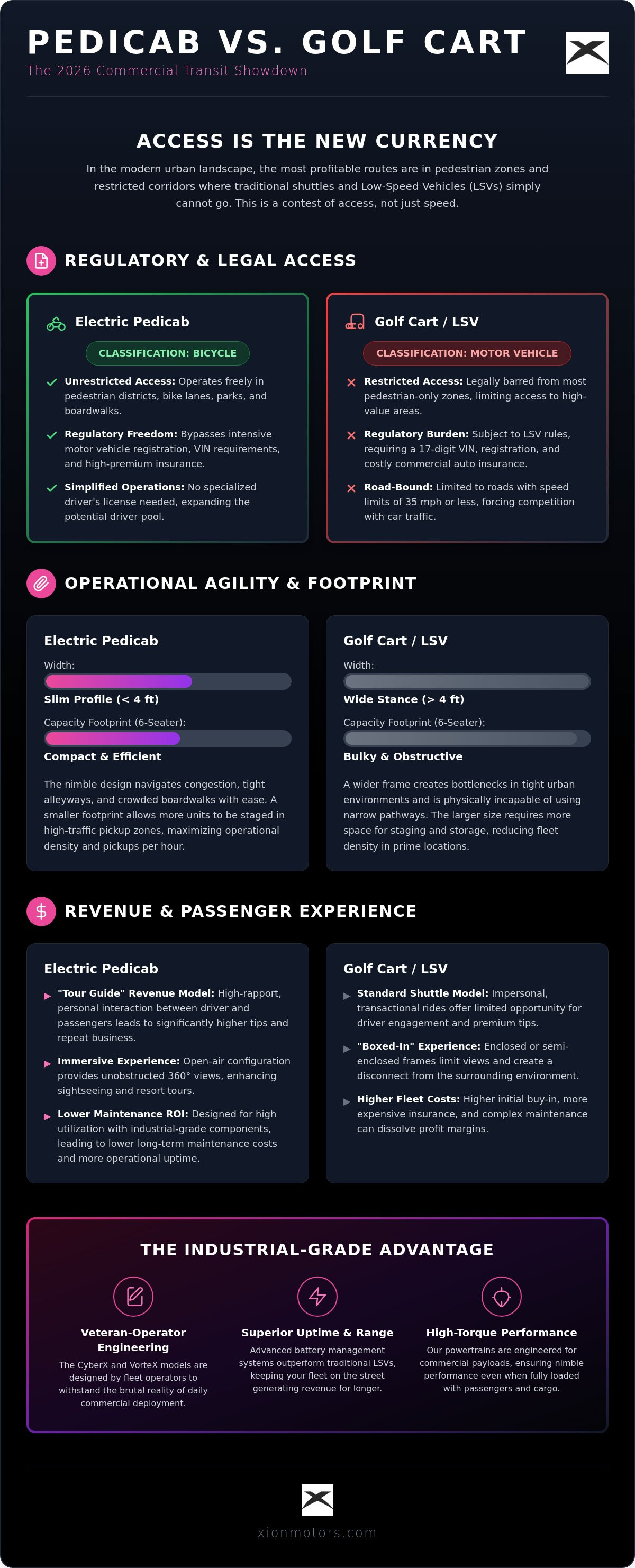
Precision matters when your revenue depends on turn-around time. A standard golf cart often exceeds 4 feet in width, making it a bottleneck in tight alleyways or crowded boardwalks. When comparing the electric pedicab vs golf cart for narrow historic districts, the difference in operational efficiency is stark. An industrial electric pedicab maintains a slim profile that slices through congestion, allowing your drivers to take routes that are physically impossible for wider vehicles.
Weight is another critical factor. Heavy golf carts accelerate pavement wear and tear, which can lead to friction with municipal authorities or resort management. Our chassis engineering focuses on a high power-to-weight ratio to ensure that even with a full payload, the vehicle remains nimble. A tighter turning radius means your drivers can navigate complex routes with surgical precision, which significantly reduces driver fatigue and increases the number of pickups per hour.
Passenger Capacity and Configuration
Don't mistake agility for a lack of capacity. A common misconception is that you need a bulky golf cart to move a group. The CyberX and VorteX models prove otherwise. A 6-seat electric pedicab occupies a significantly smaller footprint than a 6-seat golf cart, which is essential for staging in high-traffic zones without obstructing pedestrian flow. This compact footprint offers several operational advantages:
- Reduced staging space: Fit more units in busy pickup corridors.
- Easier storage: Maximize your fleet density in smaller depots.
- Lower infrastructure impact: Minimize stress on sidewalks and specialized pathways.
The open-air configuration of a pedicab offers a level of engagement that a boxed-in shuttle cannot match. Passengers get an unobstructed view of the city or resort, which translates directly into higher satisfaction and better tips for your drivers. For resort hospitality, we've integrated versatile cargo options. Whether it's luggage for a check-in or equipment for a beach excursion, these industrial-grade frames are built to handle the load without sacrificing performance.
The Regulatory Edge: Navigating Urban Access and Legal Classifications
The regulatory landscape for urban mobility is a complex maze of local ordinances and federal safety standards. When evaluating the electric pedicab vs golf cart for commercial use, the legal classification of your fleet determines exactly where you can generate revenue. Golf carts, even when outfitted with headlights and seatbelts, are frequently shackled by Low-Speed Vehicle (LSV) regulations that limit them to roads with speed limits of 35 mph or less and require a 17-digit VIN for street legality.
Pedicabs operate under a far more flexible set of rules. In the United States, an electric pedicab is typically classified as a bicycle as long as it meets specific motor wattage and speed thresholds. This classification grants your fleet the freedom to bypass the intensive motor vehicle registration hurdles that slow down golf cart deployment. You don't need the same high-premium motor vehicle insurance or specialized driver's licenses required for a fleet of LSVs. The barrier to entry is lower, and the speed to market is faster.
Access is the ultimate currency in passenger transport. Because they are classified as bicycles, industrial pedicabs can utilize bike lanes, narrow boardwalks, and pedestrian-only thoroughfares that are strictly off-limits to motor vehicles. This allows your drivers to pick up and drop off passengers at the exact doorstep of their destination, while golf cart operators are forced to search for legal street parking or designated LSV paths. If you want to dominate the curb, you can view our industrial fleet options designed for maximum urban penetration.
Street Legality and Municipal Compliance
Municipalities are increasingly banning motor vehicles from historic centers to preserve aging infrastructure and improve safety. This is where the electric pedicab vs golf cart comparison ends and the pedicab's dominance begins. While a golf cart operator is stuck circling the block looking for a legal access road, a pedicab driver can pull directly through restricted plazas. This unrestricted access is an operational "cheat code" for urban profitability. Under federal law, electric pedicabs are treated as bicycles, ensuring they remain exempt from the restrictive equipment mandates that apply to even the most modern golf carts.
Parking and Storage Efficiency
Real estate for fleet storage is a significant overhead expense. Industrial pedicabs are engineered with a slim profile that requires roughly 40% less storage space than a comparable commercial golf cart. This efficiency allows you to house a larger fleet in a smaller depot, directly improving your ROI. These vehicles integrate seamlessly into last mile passenger transport networks by utilizing existing bike infrastructure for temporary staging. You can park three pedicabs in the space required for a single traditional shuttle, ensuring your fleet stays positioned where passenger demand is highest.
Analyzing Operational ROI: Efficiency, Maintenance, and Longevity
Profitability in the transit sector isn't measured by what you spend at the dealership. It's measured by what you keep at the end of the fiscal year. When you break down the electric pedicab vs golf cart comparison through the lens of Cost per Passenger Mile, the industrial trike emerges as the superior financial instrument. A standard four-seater golf cart carries substantial dead weight in the form of heavy chassis and lead-acid battery banks, which forces the motor to work harder and drains energy faster. In contrast, an industrial electric pedicab utilizes a high power-to-weight ratio to move more people with significantly less energy consumption.
Operating costs are also dictated by the regulatory environment. Because golf carts often fall under state vehicle classification laws as Low-Speed Vehicles (LSVs), they carry higher insurance premiums and registration fees that eat into your daily margins. We've operated a fleet of over 130 pedicabs for more than 20 years, and the data is clear: reducing the regulatory friction and energy overhead leads to a faster return on investment. While a commercial golf cart is a depreciating asset with high overhead, a professional pedicab is a revenue-generating powerhouse that can earn between $30,000 and $35,000 annually per unit.
High-Torque Drive Systems and Power Consumption
Efficiency starts at the motor. Our industrial-grade 750W direct-drive transaxles are engineered for high-torque performance, allowing drivers to navigate inclines and heavy payloads without overheating the battery. This precision engineering means you get more range per kWh. Unlike golf carts that often require specialized charging stations or heavy-duty 220V outlets, our fleet packages are designed to charge via standard 110V outlets. This simplifies your infrastructure and allows for seamless 24/7 multi-shift operations where batteries can be swapped or topped off during driver breaks.
Maintenance Protocols and Parts Availability
Downtime is the enemy of a successful fleet. Most golf carts rely on proprietary automotive-style parts that can take weeks to arrive, leaving your vehicle sitting in the shop instead of on the street. Pedicabs utilize a mix of high-end bicycle components and industrial-grade custom parts that are significantly easier to source and replace. By implementing a proactive electric pedicab maintenance guide, your team can handle most repairs in-house in under an hour. The durability found in heavy duty electric passenger trike models ensures that the chassis survives the rigors of daily commercial use, maintaining a higher resale value when it's time to cycle your fleet.
Passenger Experience and Revenue Streams: The Engagement Advantage
Passenger engagement is the hidden engine of fleet profitability. While many operators view transit as a simple move from point A to point B, the most successful businesses realize that every ride is an opportunity for secondary revenue. When debating the electric pedicab vs golf cart for a high-traffic entertainment district, you must consider the social dynamics of the ride. A golf cart is a utilitarian box that isolates passengers, whereas a professional pedicab is an immersive stage that connects the rider to the environment and the operator.
This "Engagement Advantage" transforms a standard shuttle service into a premium tourism experience. In a golf cart, the driver is often physically separated or facing away from the group, creating a sterile atmosphere. An industrial-grade trike places the driver in a position to act as a seasoned guide, building rapport through effortless conversation. This human element is the primary driver of repeat business and increased passenger satisfaction, ensuring your fleet becomes a local landmark rather than just another transport option.
Maximizing Tipping and Secondary Revenue
The proximity of the driver to the passenger directly correlates with the value of the experience. In our 20 years of fleet operation, we've observed that the rapport built during a five-minute pedicab ride often leads to significantly higher tips compared to the passive experience of an enclosed shuttle. The engagement ROI of a pedicab is inherently higher than enclosed shuttles because every mile traveled is a personal interaction rather than a sterile commute.
Beyond tips, your vehicles are high-visibility rolling billboards. Pedicabs move at a pace that allows pedestrians to absorb branding, making them prime real estate for local business sponsorships. Unlike golf carts, which are often restricted to the road, pedicabs can carry your sponsors' messages directly into the heart of pedestrian plazas and boardwalks where static signage is frequently prohibited. Wrapping your fleet in custom branding allows you to monetize every square inch of the vehicle before a single passenger even climbs aboard.
Custom Branding and Fleet Aesthetics
A cohesive fleet look is essential for establishing authority in a resort or downtown district. You want your vehicles to be instantly recognizable as professional-grade equipment. The impact of CyberX styling on brand perception cannot be overstated; its aggressive, industrial aesthetic signals to passengers that they are riding in the gold standard of urban transport. This level of engineering excellence allows your fleet to stand out in crowded entertainment zones where generic golf carts simply blend into the background.
Utilizing custom trikes allows you to tailor your aesthetic to the specific needs of your market, whether you are running a high-end resort shuttle or a rugged urban tour. If you are ready to upgrade your brand's presence on the street, explore our pedicab fleet packages and start building a high-revenue operation today.
Industrial-Grade Deployment: Why Xion Motors Sets the Fleet Standard
Xion Motors isn't just a manufacturer; we are veterans of the street. With over 20 years of hands-on fleet operation experience, we have engineered out the failure points that plague lesser vehicles. When you evaluate an electric pedicab vs golf cart for high-utilization commercial work, the difference is found in the welds and the wiring. Most manufacturers build for the hobbyist, but we build for the operator who needs a vehicle to survive 12-hour shifts in the harshest urban environments.
Our philosophy is rooted in entrepreneurial pragmatism. We understand that every hour of downtime is a direct hit to your profitability. That's why we bypassed the traditional dealer network to offer direct support and national shipping to operators across the United States. Whether you are deploying a single unit or scaling with electric pedicab fleet packages, you are getting equipment designed by practitioners who have managed fleets of over 130 units. We provide the tools, the parts, and the operational blueprint to ensure your success.
Structural Integrity and Safety Standards
The VorteX chassis represents the pinnacle of industrial-grade engineering. While a standard golf cart often struggles with the structural stress of a 6-seat payload, the VorteX is built with a reinforced frame specifically designed for heavy-duty passenger transport. We don't compromise on safety. Every vehicle features high-performance disc brakes, integrated lighting systems, and robust passenger restraints to meet the demands of modern municipal regulations. This 20-year legacy of engineering decisions ensures that your investment remains structural sound long after consumer-grade alternatives have been retired.
Starting and Scaling Your Fleet
Integrating pedicabs into an existing transit business is a strategic move that expands your operational reach. You can access the "unreachable" miles of a city center without the overhead of a full-sized motor vehicle fleet. For those just entering the market, we offer a comprehensive starting a pedicab company guide that covers everything from insurance to rate structures. The electric pedicab vs golf cart debate is settled by the numbers: lower entry costs, higher access, and a faster path to ROI.
Don't settle for equipment that wasn't built for the job. You need a partner who understands the grit of the industry and the precision of the engineering. Contact Xion Motors for custom fleet pricing and industrial-grade trike specifications to take command of your local market.
Dominating the Urban Curb in 2026
The choice in the electric pedicab vs golf cart debate comes down to where you want to operate. If your goal is to penetrate pedestrian-only thoroughfares, historic centers, and restricted boardwalks, the bicycle classification of a professional pedicab is your most powerful commercial asset. You shouldn't settle for a vehicle that is legally barred from the most profitable passenger miles in your city.
We build for operators because we are operators. With 20+ years of fleet experience, we've engineered our vehicles with industrial-grade high-torque motors that handle grueling multi-shift schedules without hesitation. Don't let regulatory red tape or excessive maintenance costs stall your business growth. We provide the engineering excellence and support you need to lead the market, including reliable shipping to all 50 states.
It's time to deploy a fleet that works as hard as you do. Explore Industrial-Grade Electric Pedicab Fleet Packages and secure your operational advantage today.
Frequently Asked Questions
Is an electric pedicab considered a motor vehicle or a bicycle?
Under federal law and most state classifications, an electric pedicab is legally considered a bicycle rather than a motor vehicle. This distinction allows operators to avoid the complex registration, VIN requirements, and high insurance premiums associated with Low-Speed Vehicles (LSVs). By maintaining this bicycle classification, your fleet gains access to urban zones where motor vehicles are strictly prohibited, giving you a massive advantage in the electric pedicab vs golf cart comparison.
Can electric pedicabs drive in bike lanes if they have passengers?
Yes, in the vast majority of jurisdictions, electric pedicabs are permitted to utilize bike lanes even when fully loaded with passengers. This operational flexibility is a primary advantage when comparing an electric pedicab vs golf cart, as golf carts are typically restricted to the main roadway. Utilizing existing bike infrastructure allows your drivers to bypass heavy traffic congestion and deliver passengers directly to their destination, significantly increasing your daily pickups per hour.
How does the maintenance cost of a pedicab compare to a gas golf cart?
Maintenance costs for an industrial electric trike are a fraction of those for a gas-powered golf cart. You completely eliminate the need for oil changes, spark plug replacements, and complex transmission tuning. Our engineering focuses on high-durability bicycle and industrial components that can be serviced in-house with basic tools. This reduces your operational downtime and ensures that your fleet stays on the street generating revenue rather than sitting in a repair shop.
What is the maximum passenger capacity for a commercial electric trike?
We offer high-performance configurations for both 3-seat and 6-seat payloads to meet diverse fleet needs. The VorteX model is specifically engineered to handle these larger groups while maintaining a compact footprint that doesn't obstruct pedestrian traffic. This allows you to maximize your revenue per passenger mile without the bulk of a traditional shuttle. Our chassis designs are rigorously tested to ensure structural integrity even under maximum commercial loads.
Do I need a special license to operate an electric pedicab fleet?
Most municipalities don't require a specialized commercial driver's license (CDL) to operate an electric pedicab. Since these vehicles are classified as bicycles, the barrier to entry for new drivers is significantly lower than for motor-driven shuttles or LSVs. However, you should always check your local city ordinances. Some jurisdictions require a basic pedicab operator permit or a standard driver's license to ensure safety and compliance within busy entertainment districts.
How long do the batteries last on an industrial-grade electric pedicab?
Our industrial-grade lithium battery systems are designed for high-cycle longevity and 24/7 multi-shift operations. Depending on the specific terrain and payload, a single charge can support a full shift of active commercial operation. We utilize advanced battery management systems to protect the cells and extend their overall service life. This ensures your fleet remains reliable for years of heavy use, providing a stable foundation for your business growth.
Can electric pedicabs handle steep hills with a full passenger load?
Yes, our vehicles are equipped with a 750W direct-drive transaxle (adjustable up to 3,000W peak) specifically engineered to conquer steep inclines with a full passenger load. Unlike lightweight hub motors that can overheat on hills, our transaxle drives the rear axle through a differential to maximize efficiency and power. This ensures that your drivers can navigate challenging terrain without sacrificing performance or passenger safety. It's a level of engineering excellence that hobbyist-grade trikes simply cannot match in the field.
What is the typical ROI timeframe for a commercial pedicab fleet?
Many operators achieve a full return on investment within their first six to twelve months of active operation. Given that a single industrial-grade unit can generate between $30,000 and $35,000 in annual revenue, the payback period is exceptionally short compared to traditional transit vehicles. Your ROI is further accelerated by the low overhead of electricity and minimal maintenance requirements. This fast-paced profitability allows you to scale your fleet quickly and dominate your local market.
Thinking about starting or scaling a pedicab operation?
See what a pedicab costs ($13,500–$15,000 direct from the manufacturer), explore fleet pricing on 3+ units, or start with $0-down equipment financing. Xion operators earn $30,000–$35,000 per cab per year across 59+ US markets.