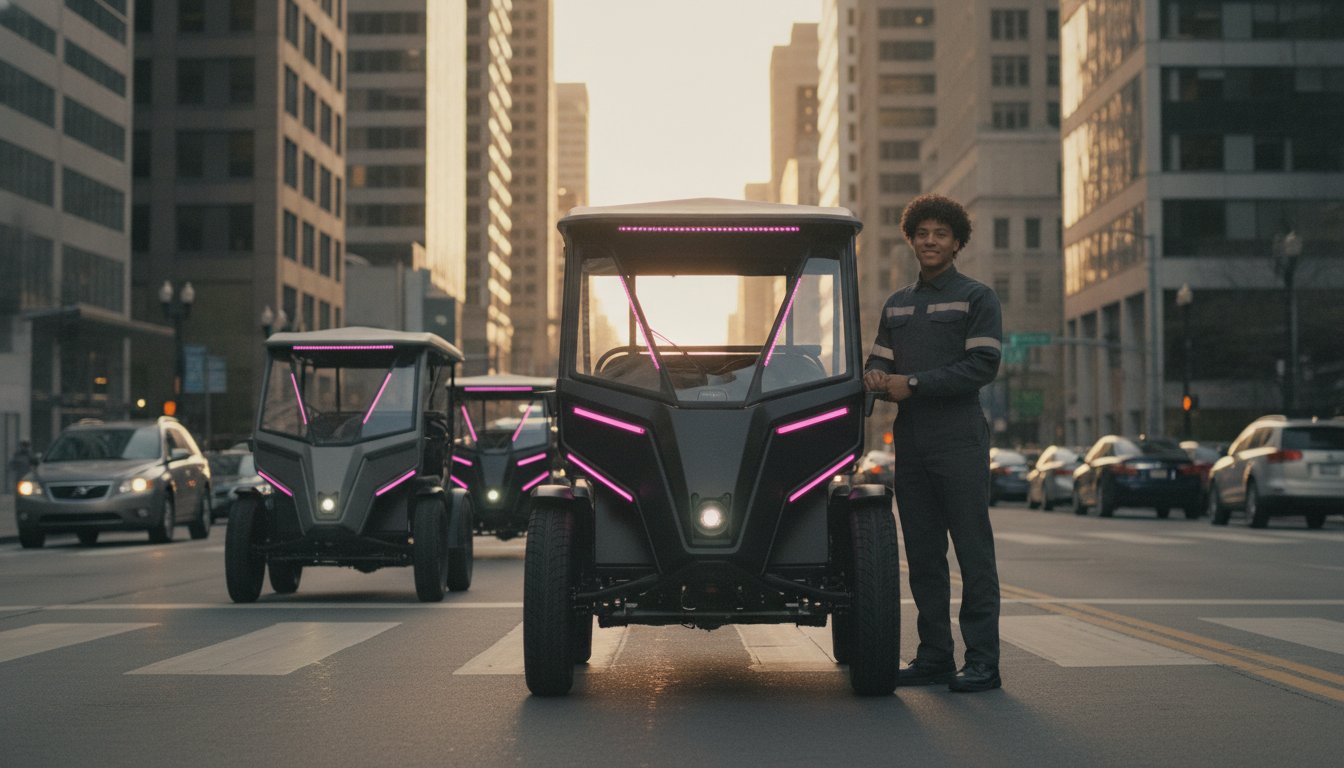
Street legality isn't a sticker you buy from a government office; it's a rigorous engineering standard that must be forged into the vehicle chassis from the very first weld. Many fleet owners realize too late that a low-cost import doesn't just lack power, it lacks the technical DNA to survive a 2026 regulatory audit. If you've felt the frustration of deciphering a shifting patchwork of municipal codes or feared your equipment might be banned before it pays for itself, you aren't alone. Deploying street legal electric pedicabs requires more than just a battery and a motor. It demands an industrial-grade understanding of how federal e-bike classifications and state-specific safety mandates intersect on the pavement.
We've spent decades in the trenches of the micro-mobility industry, and we know that professional-grade hardware is the only way to secure your ROI. This guide provides the definitive blueprint for mastering the 2026 regulatory landscape. You'll gain a clear understanding of the federal three-class system and the critical importance of UL 2849 battery certifications. We'll examine the technical specifications, from 72V electrical systems to high-torque drive trains, that separate hobbyist toys from legitimate commercial assets. By the end of this article, you'll have the confidence to invest in a fleet that's built to last and engineered to comply.
Key Takeaways
- Decipher the federal three-class e-bike system to ensure your fleet meets the specific power-to-weight ratios required for legal urban deployment.
- Identify the mandatory mechanical standards, including hydraulic disc braking and automotive-grade chassis welding, necessary for heavy-duty commercial use.
- Navigate the technical balance between the 750W federal nominal power limit and the peak torque requirements of street legal electric pedicabs operating on steep inclines.
- Secure your investment by establishing rigorous safety manuals and commercial-grade insurance policies that satisfy municipal oversight and liability requirements.
- Leverage industrial-grade builds like the CyberX and VorteX to guarantee long-term fleet continuity and compliance in the evolving 2026 market.
Understanding Street Legal Electric Pedicabs: Federal and State Classifications
A street-legal electric pedicab is a precision-engineered multi-passenger vehicle that occupies a unique legal space between a bicycle and a motor vehicle. Unlike a standard cycle rickshaw, modern electric versions must adhere to specific power-to-weight ratios to maintain their status as non-motorized transport. For a fleet to be viable, it must meet federal safety standards that allow for interstate shipping and national deployment without triggering the heavy registration requirements of a standard automobile. This classification is the cornerstone of a profitable operation. It allows you to bypass the costly insurance and licensing hurdles associated with traditional taxis while still moving significant passenger volume.
Achieving "Low-Speed Electric Vehicle" (LSEV) status is often the ultimate goal for industrial operators. While e-bike laws provide a low barrier to entry, LSEV standards offer a higher level of legal protection for vehicles that operate on public roads with speed limits up to 35 mph. This distinction is vital for those managing large-scale fleets across multiple states. Federal compliance ensures that your equipment remains an asset rather than a liability, regardless of where you deploy. It provides a level of equipment longevity that consumer-grade builds simply cannot match.
The 3-Class System and Commercial Applicability
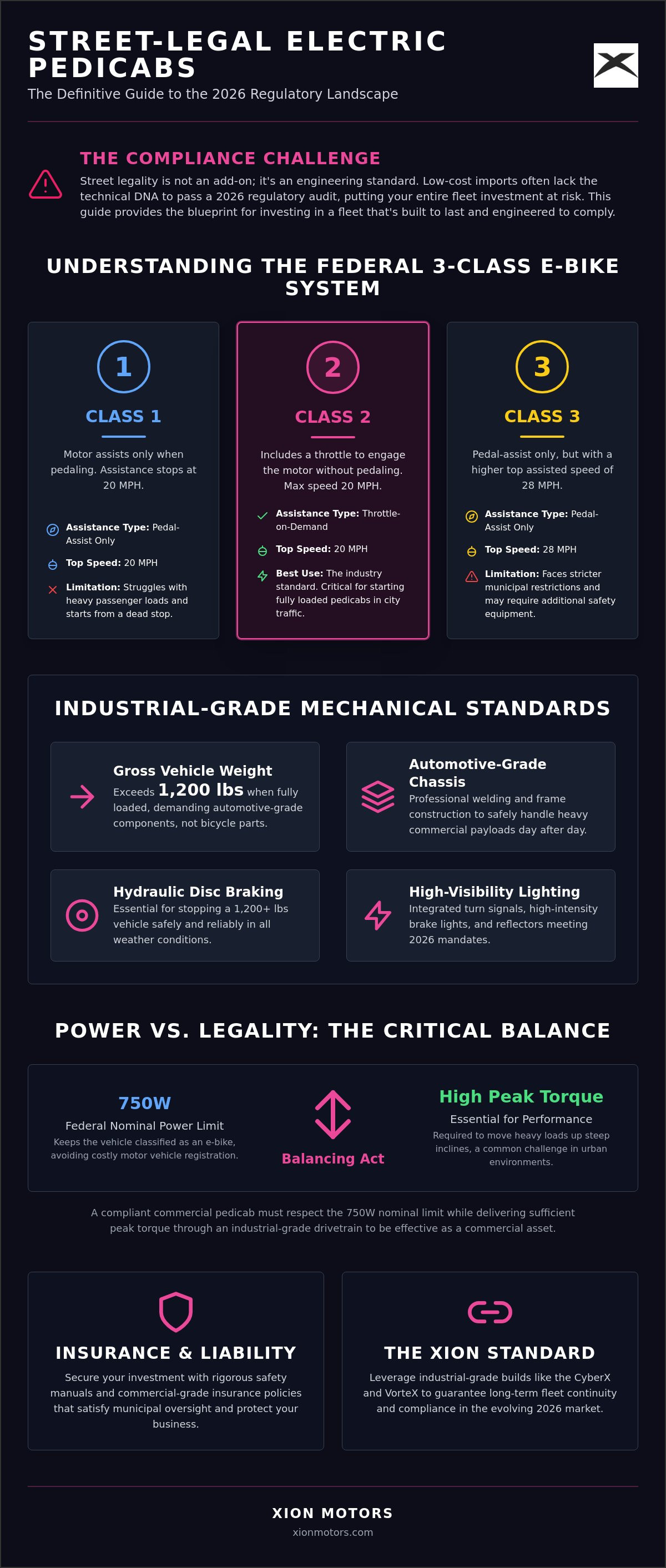
Federal law generally recognizes three distinct classes of e-bikes. For commercial operators, these classes determine where you can ride and how much weight you can safely move. Class 1 units are pedal-assist only. The motor only kicks in when the driver pedals, topping out at 20 mph. They're suitable for flat, light-duty tours but often struggle with heavy passenger loads. Class 2 is the industry standard for street legal electric pedicabs. These vehicles include a throttle, allowing the driver to engage the motor without pedaling. This feature is critical for starting a fully loaded 6-seat trike from a dead stop in city traffic. Class 3 units provide pedal-assist up to 28 mph. While fast, they often face stricter municipal restrictions and may require additional safety equipment like side-view mirrors or specific lighting arrays.
Commercial vs. Personal Use Designations
Consumer-grade e-bike laws weren't written with a 6-seat commercial trike in mind. A hobbyist bike might handle a single rider, but it'll fail under the 1,500-pound payload of a professional operation. Municipalities often fill this gap with local permits. These permits dictate which streets you can access and where you can pick up passengers. Navigating the grey area between bicycles and motor vehicles requires equipment that looks and performs like a professional transit solution. When you use industrial builds like the CyberX or VorteX, you project a level of professional-grade quality that city planners and insurance adjusters respect. This isn't just about moving people; it's about managing a compliant urban transit business.
Mechanical Standards for Industrial-Grade Compliance
Engineering a vehicle for the street requires a shift in mindset from bicycle mechanics to automotive-grade durability. A street legal electric pedicab carrying six passengers plus a driver can easily exceed a gross vehicle weight of 1,200 pounds. At these scales, the frame, braking system, and lighting aren't just features; they're critical safety components that determine your legal standing. Adhering to the Federal definition of low-speed electric bicycles allows these trikes to operate without traditional motor vehicle registration, but only if the mechanical build remains within strict safety parameters. If your equipment fails a roadside inspection due to substandard lighting or weak brakes, your entire fleet investment is at risk.
Professional operators demand high-visibility safety arrays as a standard requirement. This includes integrated turn signals, high-intensity brake lights, and red rear reflectors that meet 2026 California safety mandates. Beyond simple visibility, the Master Practitioner approach to fleet management focuses on component ratings. We utilize heavy-duty wheels and tires specifically rated for high-load commercial cycles. This ensures maximum uptime and prevents the frequent blowouts common in consumer-grade builds. If you're looking to scale, investing in industrial-grade fleet packages is the only way to guarantee both compliance and profitability.
Braking Systems and Descent Control
Stopping a fully loaded trike on a 10 percent grade requires immense thermal management. Mechanical rim brakes or low-end mechanical discs are a liability in a professional environment; they fade quickly and require constant adjustment. We mandate hydraulic disc braking systems on all street legal electric pedicabs to provide consistent, one-finger stopping power. These systems are designed for the physics of heavy payloads, utilizing larger rotors and multi-piston calipers to dissipate heat. Maintenance protocols should include monthly fluid checks and pad inspections to sustain performance over 3,000 plus annual miles of hard urban use.
Chassis Engineering and Weight Distribution
The structural integrity of the chassis is where many imports fail. The CyberX is built with automotive-grade welding and high-tensile steel to handle the constant stress of city potholes and heavy passenger loads. We prioritize low center-of-gravity designs to prevent tipping during tight urban maneuvers. While alloy frames offer weight savings, high-grade steel provides the fatigue resistance necessary for a vehicle expected to remain in service for a decade. Proper weight distribution ensures that the drive wheel maintains traction while the passenger load remains stable, creating a ride quality that passengers trust and drivers can manage with confidence.
Power vs. Legality: Navigating Motor and Speed Limits
Raw power is a liability if it pushes your vehicle outside the legal definition of a bicycle. For street legal electric pedicabs, the engineering challenge lies in maximizing torque while staying under federal wattage caps. While a 750W motor might sound modest, the distinction between nominal and peak power allows industrial-grade trikes to conquer steep inclines without violating 2026 regulations. Speed governors are equally critical. Maintaining a hard cap at 20 mph ensures your fleet stays within the Class 2 designation, which is the industry standard for safe urban operation. Exceeding this limit often triggers a reclassification into the "motor vehicle" category, bringing a wave of registration fees and licensing requirements that can cripple a business model.
Battery safety is no longer optional in the 2026 landscape. High-capacity commercial operations demand UL 2271 certification for all battery packs. This standard ensures the energy storage system can withstand the vibration, thermal stress, and heavy discharge cycles typical of professional use. Using uncertified batteries doesn't just risk a fire; it risks your commercial insurance coverage. Most providers now require proof of UL compliance before they'll underwrite a policy for electric trikes. Precision in your electrical system is the only way to protect your drivers and your bottom line.
High-Torque Motors and Wattage Caps
Under 15 U.S.C. § 2085, a low-speed electric bicycle is legally defined as a two- or three-wheeled vehicle with fully operable pedals and an electric motor of less than 750 watts that provides assistance up to 20 mph. However, the way that power is delivered matters. When deploying heavy duty electric passenger trikes, we focus on a 750W direct-drive transaxle that drives the rear axle through a differential. This configuration is preferred for its balanced traction and reliability in stop-and-go environments, and it can be tuned up to 3,000W of peak output. By optimizing the motor's peak torque output, you can move a 1,200-pound gross vehicle weight up a bridge incline while the nominal power draw remains within the legal 750W limit. This engineering balance is what separates a professional transit tool from a modified consumer bike.
Pedal-Assist vs. Throttle-Driven Dynamics
Operational reality dictates that a throttle is essential for commercial success. Starting a 6-seat VorteX from a dead stop at a traffic light using only pedal-assist is physically exhausting for the driver and inefficient for traffic flow. Throttles provide the immediate engagement needed for safety and driver longevity. In more restrictive cities, we utilize sophisticated pedal-assist (PAS) sensors to maintain compliance with local bicycle-only ordinances. These sensors detect human input and supplement it with motor power, ensuring the vehicle operates as a true hybrid. Balancing motor output with consistent human effort is the secret to extending your daily range while staying firmly on the right side of the law.
Operational Compliance: Insurance and Urban Deployment
Operational success depends on more than just high-torque motors; it requires a bulletproof legal and financial framework. Securing insurance for street legal electric pedicabs is often cited as the primary hurdle for new operators. Most underwriters flatly refuse to cover motorized trikes under standard bicycle policies. To satisfy a commercial carrier, your fleet must feature permanent Vehicle Identification Numbers (VIN) and meet the safety certifications discussed in previous sections. Having a VIN is not just for tracking; it's the industry standard for asset verification and regulatory audit compliance. Without these markers, your fleet is effectively uninsurable in a professional urban environment.
Success in high-density entertainment districts relies on precision logistics. These "Last Mile" zones are the most profitable areas for passenger transport, but they also face the most scrutiny from local authorities. Deploying a fleet in these areas requires a clear operational blueprint. If you're starting a pedicab company, you must implement a rigorous safety manual that governs driver behavior and passenger interaction. This documentation is your first line of defense against liability and a mandatory requirement for most municipal permits. To get your operation off the ground with the right equipment, explore our industrial-grade fleet packages today.
Securing Commercial Liability Insurance
Underwriters require data before they issue a policy. A minimum of $1 million in general liability coverage is the baseline for most city contracts. To secure these rates, you must prove your drivers have undergone professional training and that your vehicles are UL-certified. Non-motorized insurance policies are a trap; they won't cover accidents involving electric-assist systems. You need a policy specifically endorsed for electric trikes. This ensures that your business is protected from the unique risks of motorized passenger transport on public roads.
Fleet Management and Maintenance Protocols
Industrial-grade performance is only sustained through disciplined upkeep. Implementing a comprehensive maintenance guide ensures your fleet remains street-legal and reliable over years of service. Daily pre-trip inspections are non-negotiable. Drivers must verify brake pressure, lighting function, and tire integrity before every shift. Tracking battery health and motor performance through a centralized log provides the paper trail necessary for regulatory audits and maintains the resale value of your assets. High uptime is the direct result of a Master Practitioner approach to maintenance.
The Xion Motors Standard: Engineered for Street Legality
Xion Motors builds for the street because we've lived on the street. With over 20 years of fleet operation experience, we've distilled two decades of real-world data into every weld and wiring harness. Our street legal electric pedicabs aren't hobbyist projects; they're industrial-grade transit solutions designed to withstand the rigors of 2026 urban deployment. We understand that fleet continuity depends on more than just initial compliance. It requires a partner who provides USA-based manufacturing and a reliable supply of replacement parts. Every vehicle we produce is a testament to our legacy of market leadership and engineering precision.
Our commitment to your growth extends beyond the initial sale. We provide national shipping and maintain a deep inventory of vehicle parts to ensure your fleet never sits idle. In an industry where regulations can shift overnight, Xion Motors provides the engineering depth and historical expertise to keep your business moving forward. We don't just sell trikes; we provide the perfected tools necessary for professional-grade micro-transit enterprises.
CyberX: Precision-Built for 3-Seat Operations
The CyberX serves as the benchmark for 3-seat industrial performance. It aligns perfectly with national street-legal e-bike standards, featuring a 750W direct-drive motor that respects federal wattage caps while delivering the torque needed for commercial service. These machines are engineered for 12-hour commercial shifts, utilizing high-capacity 72V battery systems that maintain thermal stability under heavy use. When evaluating an electric pedicab vs golf cart, the CyberX wins on urban density. Its narrow profile allows for navigation through tight pedestrian zones and bike lanes where bulky golf carts are often legally prohibited.
VorteX: The 6-Seat Force for High-Volume Transit
The VorteX represents the definitive solution for high-capacity urban transport. Engineering a 6-seat chassis requires a master practitioner's touch to ensure maximum passenger safety and street stability. We utilize a low center-of-gravity frame and specialized high-torque drive systems optimized for 6-passenger climbs. This makes the VorteX the ultimate tool for entertainment districts and resort transit where volume is the key to profitability. It provides the same street legal electric pedicabs compliance as its smaller counterparts but doubles the revenue potential per trip. The VorteX is built for operators who refuse to compromise on power or passenger capacity.
Secure Your Urban Transit Legacy with Industrial-Grade Compliance
Success in the 2026 micro-transit market isn't found in cutting corners; it's forged through engineering excellence and regulatory discipline. You now have the blueprint to navigate the complex intersection of federal wattage caps, UL safety certifications, and municipal permitting. Deploying a fleet of street legal electric pedicabs requires a fusion of regulatory intelligence and rugged hardware that can survive 12-hour commercial shifts. By prioritizing industrial-grade components and automotive-grade chassis welding, you move from being a hobbyist to a dominant market force with a protected ROI.
Xion Motors brings over 20 years of industry experience to your operation. Our USA-based manufacturing facility ensures that every CyberX and VorteX trike meets the highest standards of durability and performance. We don't just build vehicles; we provide the backbone for profitable, long-term fleet operations. With fleet pricing available for both our 3-seat and 6-seat models, the path to a compliant and scalable business is clear. Take the first step toward dominating your local market with a partner who has spent decades in the trenches. Explore Xion Motors Commercial Electric Pedicabs and secure the future of your fleet today.
Frequently Asked Questions
Are electric pedicabs legal on all city streets?
Electric pedicabs are typically legal on public roads with speed limits of 35 mph or less. While federal law treats these vehicles as bicycles, municipal codes determine specific street access and restricted zones. For example, some high-traffic entertainment districts restrict through-traffic to permitted vehicles only. Always verify local "For Hire" ordinances to ensure your street legal electric pedicabs are operating within authorized urban zones.
Do I need a drivers license to operate an electric pedicab?
Licensing requirements vary significantly by jurisdiction and state classification. Under federal bicycle guidelines, a driver's license is often not required; however, states like New Jersey have reclassified all e-bikes as motorized bicycles, requiring valid registration and a license. In cities like New Orleans, operators must pass a federal background check and drug test to secure a specialized operator's permit.
What is the maximum speed for a street-legal electric pedicab?
The industry standard for maximum assisted speed is 20 mph. This limit ensures the vehicle remains within Class 2 federal e-bike designations, avoiding the heavy regulatory burdens associated with the motor vehicle category. Maintaining this speed cap is a critical engineering requirement. It protects your legal standing while providing sufficient velocity for efficient urban transit and passenger safety.
How much weight can a commercial 6-seat electric pedicab carry?
A professional-grade 6-seat trike like the VorteX is engineered to manage a gross vehicle weight exceeding 1,200 pounds. This includes the weight of the driver, the vehicle, and up to six adult passengers. To handle these heavy loads safely, we utilize high-torque 72V electrical systems and automotive-grade chassis welding. Consumer-grade builds will fail under these industrial stress levels and passenger payloads.
Can I use an electric pedicab in bike lanes?
Access to bike lanes depends on the local classification of motorized trikes and your specific e-bike class. Most jurisdictions allow Class 2 vehicles in bike lanes, but some cities prohibit them on sidewalks or specific pedestrian promenades to ensure public safety. In San Diego, motorized pedicabs are restricted from sidewalks and specified pedestrian areas. Always consult your city's micro-mobility map before establishing your routes.
What insurance is required for a commercial pedicab fleet?
Commercial operators must carry a minimum of $1 million in general liability or business auto coverage with a specific pedicab endorsement. This is the industry standard required by most municipal permit offices for street legal electric pedicabs. The average cost for this coverage typically ranges between $450 and $1,000 per year per vehicle. Professional underwriters will require proof of safety certifications before issuing a policy.
Is a VIN required for an electric pedicab?
A Vehicle Identification Number (VIN) is a mandatory requirement for professional fleet management and insurance underwriting. While hobbyist bikes lack these identifiers, industrial builds are issued permanent VINs to allow for asset tracking and regulatory compliance. This number is essential for registering your vehicle in states that require "For Hire" license plates or specific motorized bicycle registration numbers.
How do I maintain street-legal compliance for my fleet over time?
Compliance is maintained through disciplined maintenance and adherence to rigorous safety standards. You must ensure your electrical systems meet the latest battery safety certifications, such as UL 2849, which is a mandatory requirement in California as of 2026. Implementing a daily pre-trip inspection log ensures that every vehicle in your fleet remains roadworthy and meets all current local safety mandates.
Thinking about starting or scaling a pedicab operation?
See what a pedicab costs ($13,500–$15,000 direct from the manufacturer), explore fleet pricing on 3+ units, or start with $0-down equipment financing. Xion operators earn $30,000–$35,000 per cab per year across 59+ US markets.